









Introduction
Job Automation Fear Statistics: In 2025, AI is growing at the speed of a bullet train. If you can’t ride on time, the speed will outrun you. Just like most workplace employees who are concerned about their job security. In 2024, 52% of U.S. workers reported that they are worried about the long-term effects of AI in the workplace, and only 36% of them said that they are excited about or hopeful for upcoming advancements.
Additionally, 32% think AI will result in fewer job openings for them in the future, compared to only 6% who believe job openings will increase as a result of AI. Surprisingly, these fears are most pronounced among lower and middle-income workers, who are also more likely to see AI as a threat to their job opportunities.
16% workers are already using AI in their work, and younger, more educated people are doing so more than their colleagues. This data shows an increasing fear around the sense of AI in the workplace, and the threat it poses to the established working structure.
Editor’s Choice
- 32% think there will ultimately be fewer jobs available for them as a result of AI.
- 67 percent of AI is putting factory workers’ jobs at risk.
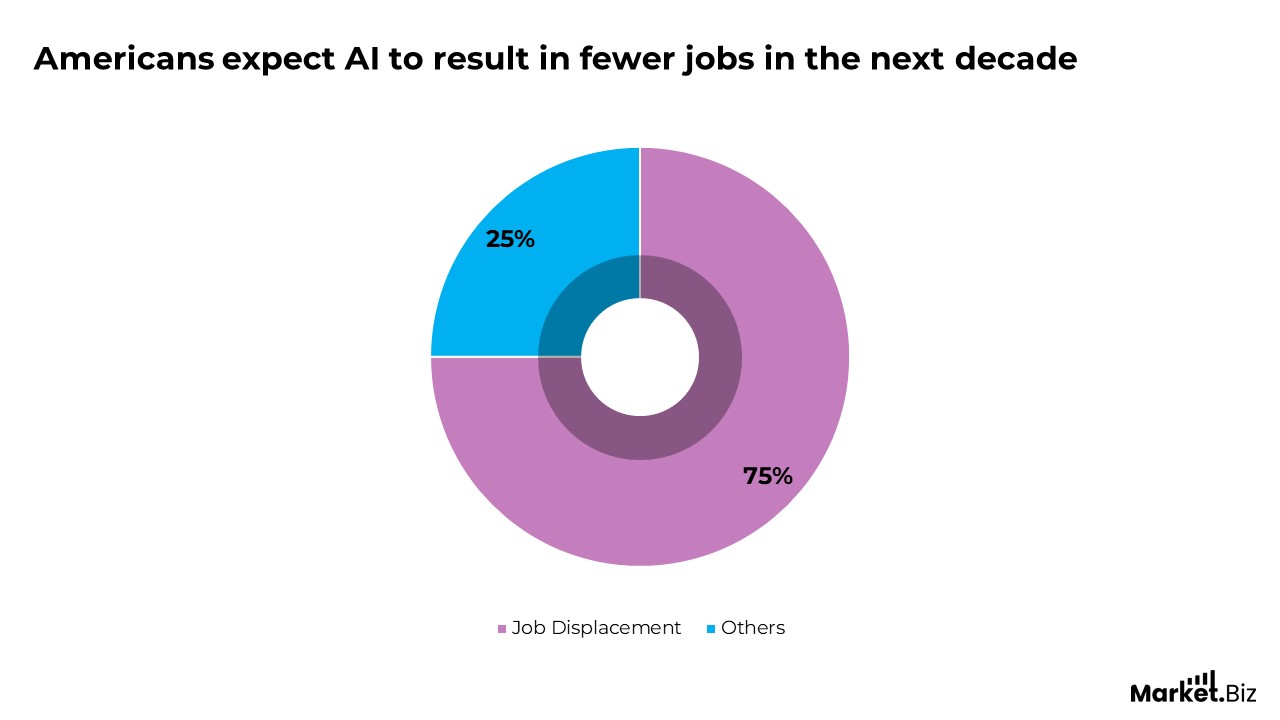
- 75% of Americans expect AI to result in fewer jobs in the next decade.
- 59 percent believe AI will threaten the jobs of journalists.
- 85% of employees will have some of their job tasks modified by a generative AI tool.
- Some 40% of workers think their jobs won’t exist in 10 years because of automation.
- In healthcare, 23% jobs are automatable as doctors and nurses need human interaction.
- 30% to 80% remote workers who work in sectors like customer service, data entry, and tech support are at a very high risk.
What is Job Automation?
Job automation is the technological replacement of a human’s work with a robot or machine using AI or machine learning. It includes a range of activities from simple office work to complex problem-solving.
Bardeen AI states that automation improves productivity substantially by working 24/7, reducing problems, and elevating service standards across most sectors. “Applying technology to accomplish a result with little to no human intervention is automation,” said IBM in its document.
General Job Automation Fear Statistics
- 52% of US employees are concerned about the future of the role of AI in the workplace.
- 32% think there will ultimately be fewer jobs available for them as a result of AI.
- Just 6 percent of workers believe A.I. will result in more job opportunities for them.
- 22 percent of U.S. workers worry that technology will make their job obsolete, an increase from 15 percent in 2021.
- 75 percent of Americans expect that over the next 10 years, machines will perform more of the work currently done by humans.
- 73% of American adults believe AI is going to take away jobs for cashiers within the next 20 years.
- 67 percent of AI is putting factory workers’ jobs at risk.
- 59 percent believe that AI will impact journalists’ jobs.
- 48 percent believe software engineers’ jobs are at risk of being automated by AI.
More Stats
- 19 percent of employed adults who are familiar with ChatGPT think that chatbots are likely to have a “significant” impact on their job.
- 30% of workers may have part of their daily tasks facilitated by generative AI.
- 51% of Americans are worry about their jobs due to AI’s effect, a concern that grew from 40% in recent years.
- 72% of Fortune 500 companies predict AI will replace the jobs in their company within the next 3 years.
- 63 percent of workers say they do not use AI much, if at all, in their jobs.
- 16 percent of workers say some or all of their jobs are currently performed using AI.
- 83% of Americans believe driverless cars would result in losing jobs for ride-share and delivery drivers.
- 58% of people believe technology carries more of a risk to U.S. jobs than immigration and offshoring.
- 23 percent of employees are very worried about losing their job to new technology, about twice as many as are worried about losing their job to immigrants.
AI-Introduced Job Displacement
- 75% of Americans expect AI to result in fewer jobs in the next decade.
- 64% of the public believes AI will take jobs away over the next 20 years.
- 32% of workers in the United States who believe that AI will reduce job opportunities for them personally in the long run.
- Just 6% of employees believe AI will open up more job opportunities for them.
- 73 percent of U.S. adults believe that AI is likely to result in fewer jobs for cashiers over the next 20 years.
- 67 percent say AI puts factory workers’ jobs in danger.
- 59 percent believe AI will threaten the jobs of journalists.
- 48% are worried about AI automation of software engineers’ duties.
- In 2022, 19 percent of American jobs were in the most exposed group of jobs, where AI could practically replace or increase key tasks.
- Employed workers with a bachelor’s degree or more (27 percent) are more than twice as likely as likely as those with just a high school diploma (12 percent) to hold jobs that are most at risk for exposure to AI.
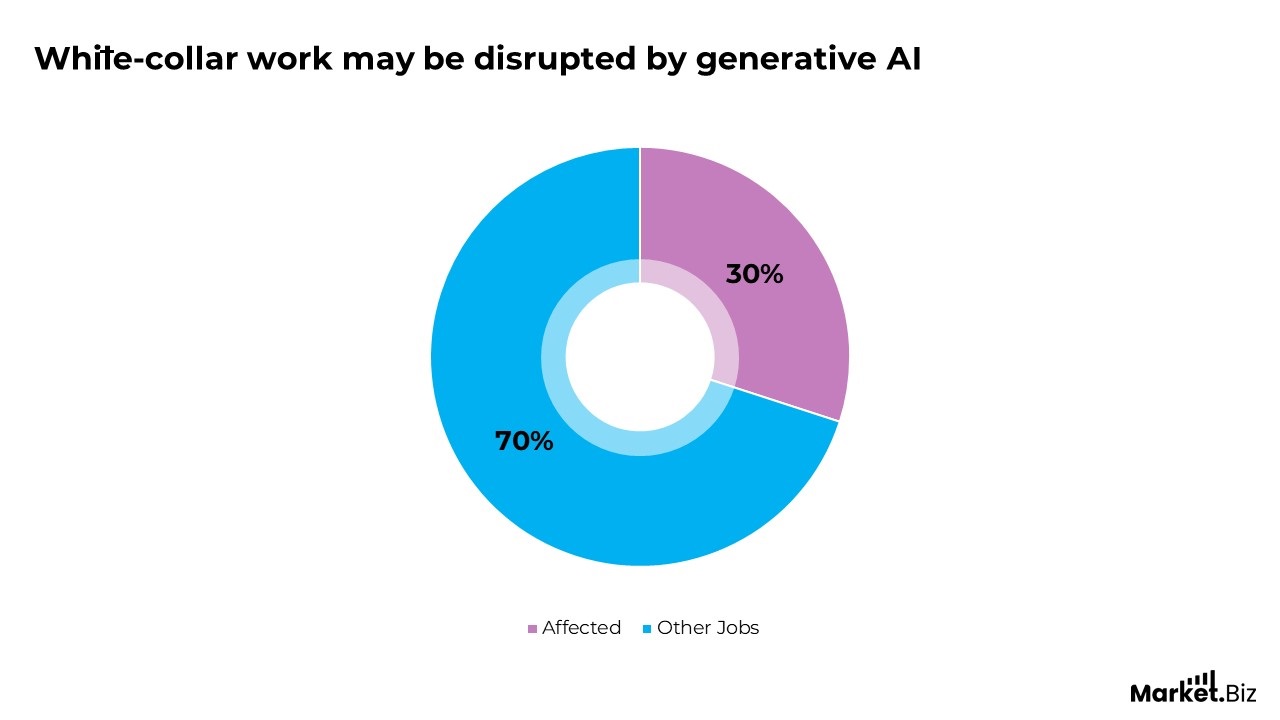
- Up to 30% of the workforce might have 50% or more of its work activities affected by generative AI.
- 63 percent of US workers say that AI is not part of what they do on the job.
- 16 percent of workers say at least some of their work is already done with AI.
Generative AI on White-Collar Jobs
- 30% of while-collar work may be disrupted by generative AI to the point where at least half of a job’s required activities are no longer the same as they are today.
- 85% of employees will have some of their job tasks modified by a generative AI tool.
- About a third of white-collar jobs could be done by generative AI, compared with less than 1% of blue-collar jobs.
- 19% Americans have jobs that are most threatened by AI and machines doing key tasks.
- More than half (52 percent) of the business leaders who made redundancies expecting Ai to replace the roles now regret the decision, as AI could not live up to the expectations.
- Cybersecurity Company CrowdStrike laid off 500 people, saying it is integrating AI to work more efficiently.
- IBM has cut several hundred human resources jobs in Europe over the past 3 years and brought is offices in the Czech Republic and other central and eastern European countries which specialize in robots and AI.
- JPMorgan, Goldman Sachs and other Wall Street companies are using AI to boost productivity, reduce costs and increase efficiency.
- LinkedIn saw a 20% growth in the number of job postings for “date storyteller” with demand shifting to roles that can interpret and communicate data insights, oftentimes supported by AI tools.
- The U.S. Bureau of Labor Statistics recorded the lowest rate of job openings in professional services in seven years, a 20% year-over-year decline, reflecting a white-collar hiring slowdown.
Automation Risk for Low-Wage Workers
- Jobs with hourly wages less than $20 are at the highest risk (83%) of automation, versus 31% for jobs with wages of $20-40, and just 4% of jobs above $40.
- There are 27% of jobs, on average across OECD countries, in occupations that are highly automatable and it is low-skilled workers who are most at risk.
- Those with less education and those performing routine tasks, like cashiers or file clerks, are most at risk of having their jobs automated.
- On average, 51% of work activities are automated in countries like US, Japan, China etc., meaning about 78.5 million jobs could be affected.
- According to the report, business in food services, waste management services, real estate, retail trade and transportation and warehousing will be in danger to automation.
- Among the more than 3 million out of work are a couple of thousand not rehired as well as they could have been because their training and education do not fit the needs of concerns installing automatic processes in lieu of old-fashioned machinery.
- Low-educated workers were more concentrated in high-risk occupations in 2012 and are even more concentrated in these occupations today.
- Automation is expected to have broad consequences. Estimated for the percentage of jobs that could one day be automated range from 9 to 47 percent.
Automation’s Impact on Job Security
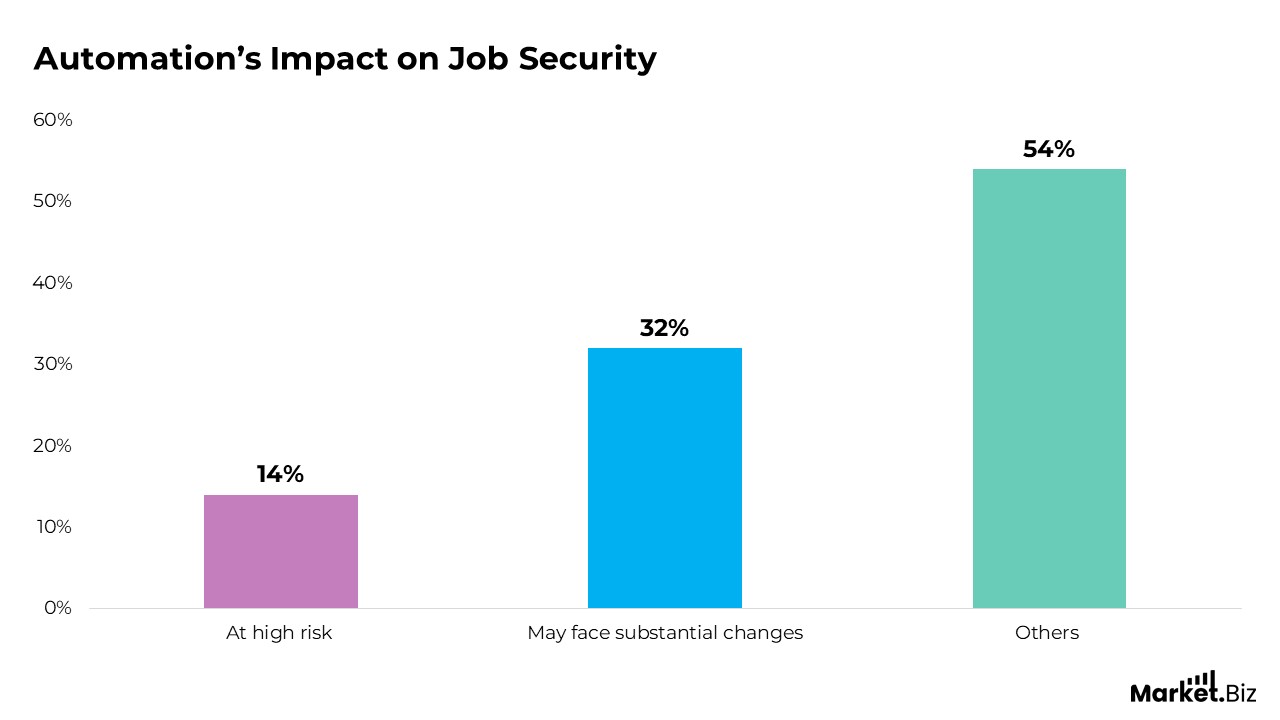
- 14% of all work globally, is at high risk of being automated and another 32% may face substantial changes in how they are conducted
- Workers in low-skill, routine occupations are at risk, because automation substitutes for repetitive tasks more easily.
- Three- quarters of U.S. adults are concerned about a future in which robots and computers can do many human jobs.
- One in three workers around the world worry that they may lose their work to automation in the next 10 years.
- Manufacturing, where more than 50 percent of tasks are automated, is particularly precarious for job security.
- Some, 40% of workers think their jobs won’t exist in 10 years because of automation.
- Women and older workers are more likely to feel insecure about their jobs in the face of increasing automation.
- 70% of the threat to displacement by automation impacts workers with either no education or a low education requirement.
- Despite concerns, automation also generates jobs, particularly in tech, maintenance and training for AI.
- Retail, transportation and administrative position are among the sectors with deteriorating job security as automation takes hold.
- In highly automatable industries, more than 80 percent of workers say they are concerned that they will lose their jobs and be unable to find new ones within their line of work.
Automation in Job Market Inequality
- Report says about 40% of jobs are open to AI. Which means many roles and positions could be automated by AI.
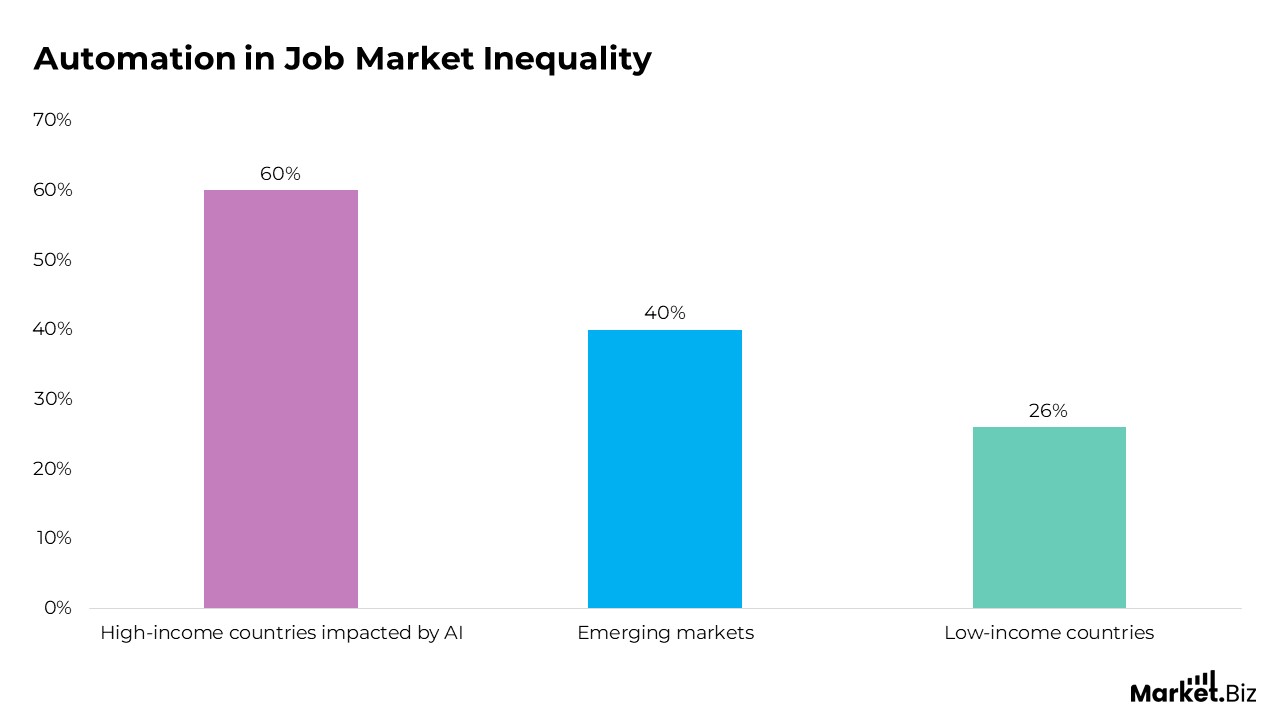
- 60% jobs in high-income countries may be impacted by AI, where 40% in emerging markets and 26% in low-income countries.
- AI is dominating in high-skilled roles even in high economies. According to IMF, AI can solve complex tasks.
- Employees see faster productivity by using AI tools and employees who cannot adapt fall behind.
- In 2025, education is more important than anything else. According to, World Economic Forum, fastest growing jobs are tech-related jobs for example, data analysts, software developer etc. Which means AI and tech industries will hit the less educated the most.
Demographics of Automation Fear
- Younger employees who aged 18-34, show higher level of anxiety and fear about job automation.
- According to a PEW survey in 2025, 52% of US workers said they are concerned about AI’s impact on job market in the upcoming years.
- The use of AI can be seen mostly among young adults. Around 73% of AI users are young and workers who use AI at work are under 50 years.
- Research says around 23% of AI chatbot users are 18-29 years old, where 17% of users are older.
- In U.S., 32% of employees expect that AI will replace their own job. These employees are generally fall in lower and middle income groups.
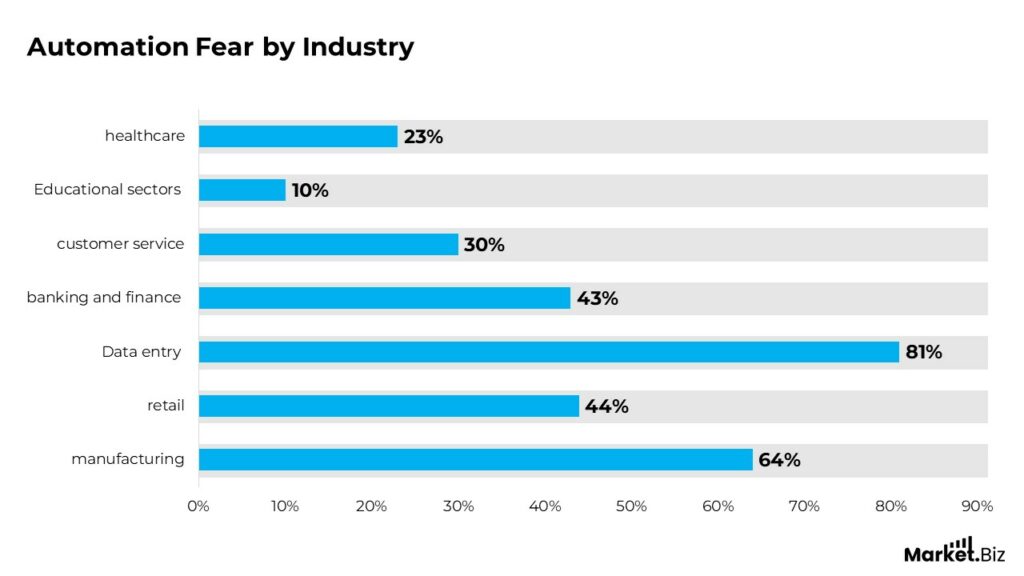
Automation Fear by Industry
- 64% of manufacturing work and workers are predicted to be automated within the next few years.
- In the retail sector, around 44% jobs are at risk, mostly cashier and stock designations.
- Data entry clerks will face the ultimate risk, with 81% of their jobs being automatable.
- 43% of banking and finance jobs, tellers and analysts, are at risk.
- With the growth of chatbots and AI tools, 30% of customer service agents are replaceable.
- Educational sectors are safe, where fewer than 10% jobs are automatable.
- In healthcare, 23% jobs are automatable as doctors and nurses need human interaction.
- Further, creative sectors like design, writing, and media reporting are less risky fields where the need for human creativity is still needed.
- Social work and caregiving, like NGOs, NGO’s are less likely to be automatable.
Job Automation Fear in Remote Setup
- 45% of remote employees are concerned that AI or automation will replace them.
- Likewise, 30% to 80% remote workers who work in sectors like customer service, data entry, and tech support are at a very high risk.
- Further, McKinsey’s report says, 36% of remote employees in low complexity roles think they would be replaced by AI by 2030.
- Moreover, learning AI tools become more than a necessity. 24% tech employees fear losing their jobs if they don’t learn new AI tools, GitHub Copilot, or ChatGPT.
- Against all odds, 62% of remote workers still believe that AI can help them work faster and also improve their job security.
Common AI tools used by Employees
- 79% of working employees use ChatGPT by OpenAI for writing, researching, coding, etc.
- More than 30million people use GrammarlyGO, an AI writing assistance.
- 46% of software developers use GitHub Copilot.
- 24% of creative workers use DALL-E and Midjourney, AI image generators for content creation.
- More than 100,000 businesses used Jasper.ai for blog and ad copywriting.
Conclusion
Job Automation Fear Statistics: Job automation fear is growing rapidly, and more and more working employees worry about losing their jobs to AI. Employees are concerned about how AI will shape their future.
Many think that only a few jobs will be available when AI reaches its peak. To win this human vs AI battle, businesses and governments need to focus on job training and skilling programs. Don’t fear it, use it, and adapt with it.
FAQs
Employees fear that AI and automation will take their jobs.
About 52% of employees are afraid of job automation.
Factory work, cashier roles, and basic data entry jobs.