








Introduction
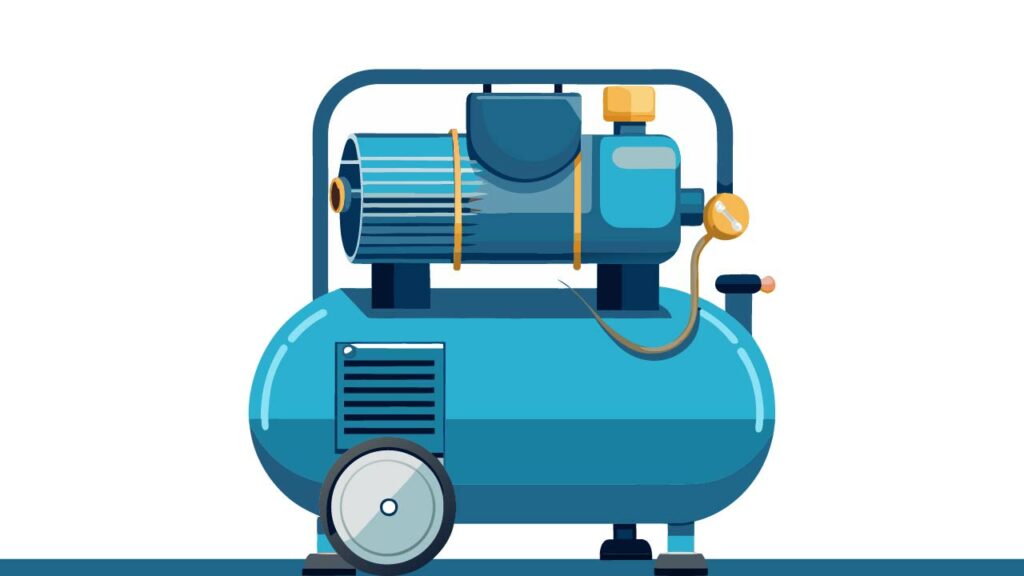
Air Compressor Statistics: An air compressor is a device that converts energy into pressurized air, which is subsequently stored in a tank for a variety of uses, such as powering tools, inflating tyres, and facilitating industrial processes. It operates by employing a mechanism that decreases the volume of air, thereby increasing its pressure.
Statistics regarding air compressors indicate a notable growth in the market, with forecasts suggesting it will reach approximately $37 billion by 2034. An air compressor is a device that changes power into stored potential energy in the form of compressed air. This compressed air fulfils multiple functions across different sectors, including inflating tyres, powering tools, and driving machinery.
Air compressors consist of essential components, such as a motor or engine, compressor pump, tank or receiver, safety valve, pressure regulator, and control valves. Different types of air compressors, including reciprocating, centrifugal, rotary screw, scroll, and axial compressors, are designed to meet specific requirements.
Editor’s Choice
- The industrial air compressors sector is expected to achieve USD 32.5 billion by 2030.
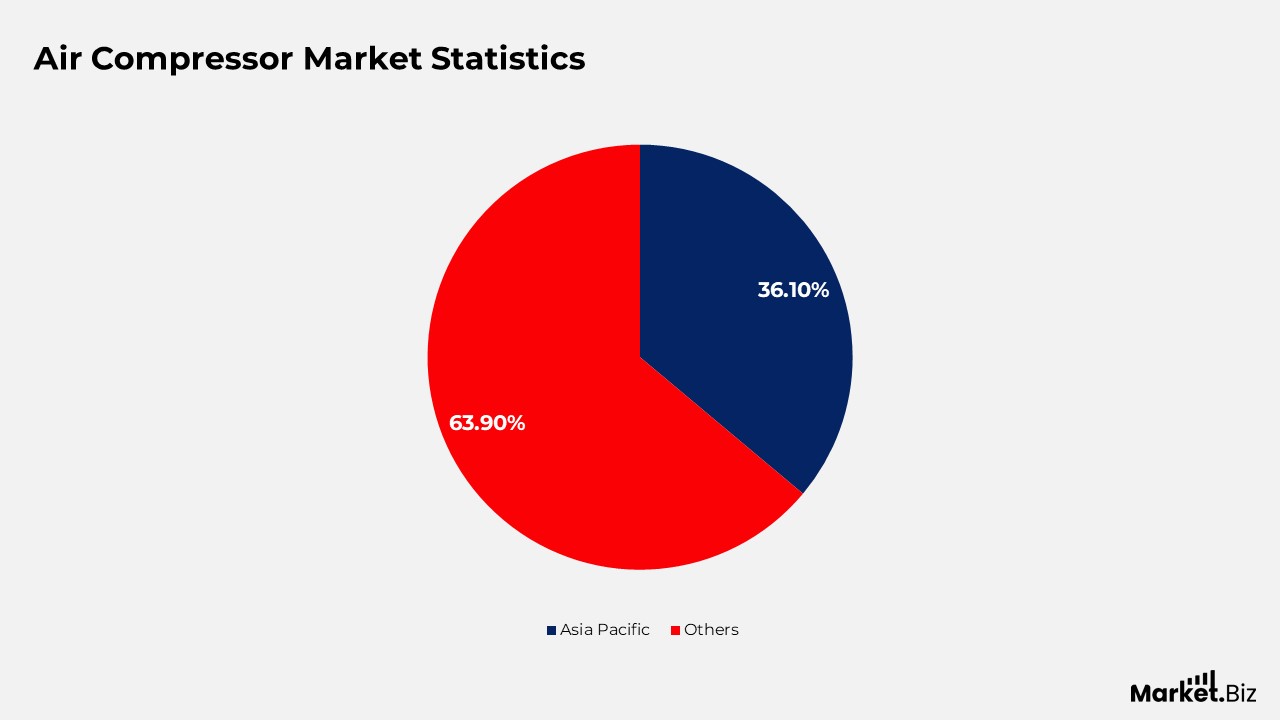
- In 2021, the Asia Pacific region represented 36.1% of the market share.
- Starting at USD 25 billion in 2022, the financial outlook for the market appears optimistic, with forecasts suggesting significant growth.
- Numerous compressors found in hardware stores and from compressor suppliers typically operate within a pressure range of 125 to 175 psi (8.5 – 12 bar).
- The upward trend persisted in 2022, as the market produced USD 56.81 billion in revenue.
- The duty cycle of air compressors pertains to the frequency of their usage within a designated period.
General Air Compressor Statistics
- The global air compressor market was assessed at USD 33,012.6 million in 2021 and is anticipated to experience a compound annual growth rate (CAGR) of 3.1% from 2023 to 2032.
- The industrial air compressors sector is expected to achieve USD 32.5 billion by 2030.
- Compressed air is utilised in a wide array of applications, with pressure levels ranging from as low as 14 PSI to as high as 6004 PSI (1 to 414 bar).
- It accommodates flow rates starting from a mere 3.5 CFM (equivalent to 0.1m3) and extending beyond that.
- Numerous compressors found in hardware stores and compressor dealerships typically operate within the pressure range of 125 to 175 psi (8.5 – 12 bar).
- Compressed air systems are considerable consumers of energy, accounting for approximately 10% of total industrial electricity usage.
- This amounts to around 8.8 terawatt-hours (TWh) annually, leading to CO2 emissions of 3,100 kilotons (kt) each year.
- The air conditioning market is projected to sustain its growth trajectory.
- Expected revenues are USD 62.8 billion in 2023, USD 67.32 billion in 2024, and USD 71.82 billion in 2025.
- In 2022, the demand for room air conditioners reached 99.9 million units.
Air Compressor Market Statistics
- The global air compressor market was assessed at USD 33,012.6 million in 2021 and is anticipated to experience a compound annual growth rate (CAGR) of 3.1% from 2023 to 2032.
- Manufacturing emerged as the leading sector in 2021.
- In 2021, the Asia Pacific region represented 36.1% of the market share.
Industrial Air Compressor Market Statistics
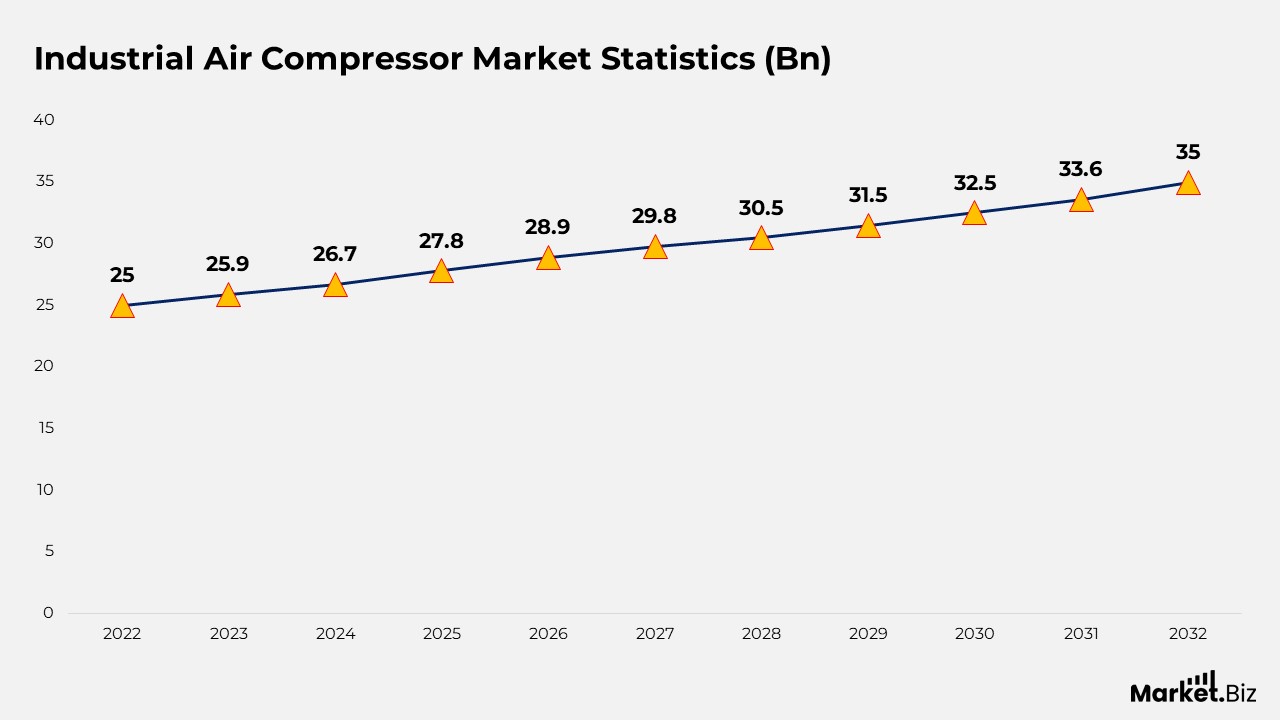
- Over the next ten years, the market for industrial air compressors is projected to witness a steady and consistent increase in revenue, with a compound annual growth rate (CAGR) of 3.5%.
- Starting at USD 25 billion in 2022, the financial outlook for the market appears optimistic, with forecasts suggesting significant growth.
- In 2023, revenues are anticipated to reach USD 25.9 billion, followed by USD 26.7 billion in 2024 and USD 27.8 billion in 2025.
- This upward trend is expected to persist throughout the forecast period, with revenues rising to USD 28.9 billion in 2026, USD 29.8 billion in 2027, and USD 30.5 billion in 2028.
- By 2029, the market is expected to exceed USD 31.5 billion, further solidifying its position.
- As we move into the 2030s, the industrial air compressors market is projected to attain USD 32.5 billion in 2030, and by 2032, it is anticipated to reach an impressive milestone of USD 35 billion.
Air Compressor Horsepower Statistics
- Horsepower measures the efficiency of a motor in an air compressor, taking into account a specific CFM and PSI.
- A common guideline in air compressors suggests that each horsepower is approximately equivalent to an output of 4 to 5 cubic feet per minute (cfm) of compressed air, operating at a pressure of 100 pounds per square inch (psi).
- For example, a one-horsepower compressor generally delivers around 4 to 5 cfm when functioning at 100 psi.
- In contrast, a ten-horsepower model can produce about 40 to 50 cfm under the same pressure.
- However, when higher pressure is required, such as 125 psi, this general rule may not hold true.
- Additionally, there is a noteworthy relationship: approximately 1 gallon of water is generated for each horsepower produced by a compressor.
- For instance, a 45-horsepower compressor running at a rate of about 7 cubic meters per minute can generate roughly 23 gallons of water each day.
- This is under conditions of around 20 degrees Celsius with 50% relative humidity.
- It is crucial to understand, however, that not all of this water converts into liquid; typically, in a system without an air dryer.
- About 1/4 condenses into liquid in the after cooler, and 2/4 within the piping system (given sufficient time to cool).
- Simultaneously, the remaining 1/4 remains in the compressed air as water vapour.
Cost-Effectiveness of Air Compressor Statistics
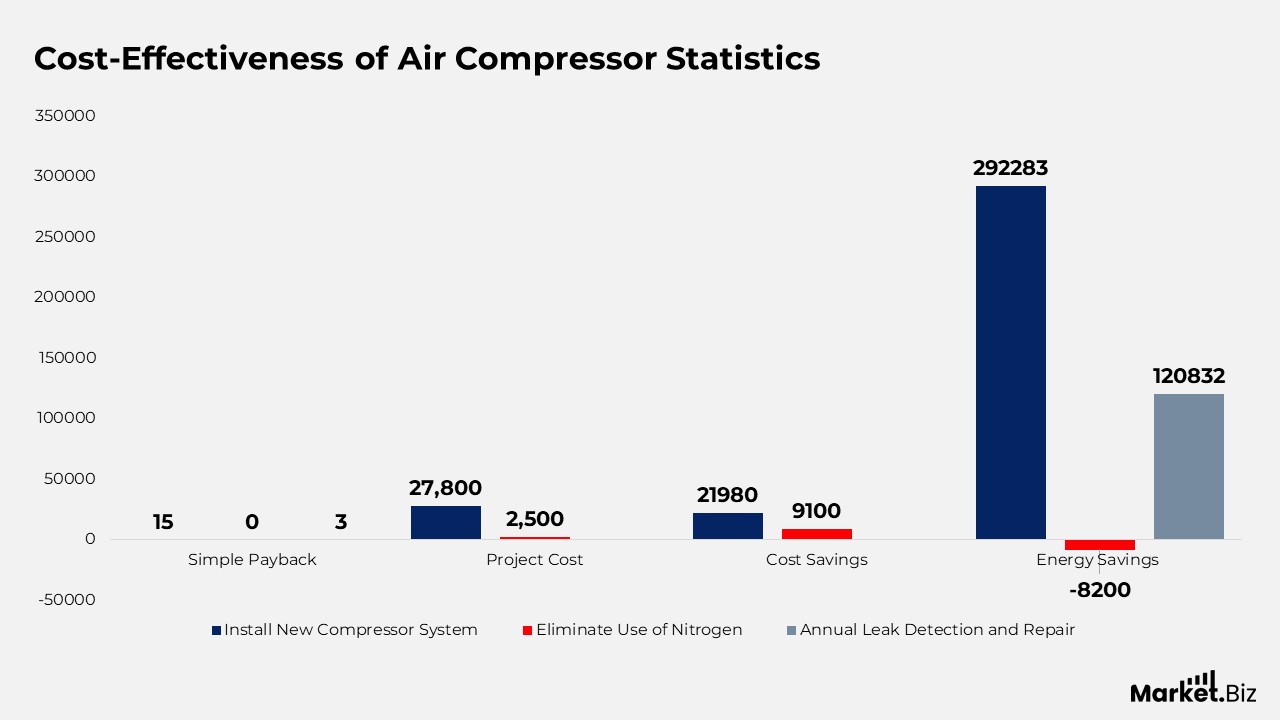
- The installation of a new compressor system and piping yielded considerable advantages, including energy savings of 292,283 kWh annually, which corresponds to cost savings of $21,980 each year.
- The total expenditure for the project was $27,800, resulting in a straightforward payback period of 15 months.
- Furthermore, by removing nitrogen as a backup, an annual cost reduction of $8,200 was realised, with no related project expenses, thus providing an immediate return on investment.
- Finally, the execution of an annual leak detection and repair program resulted in energy savings of 120,832 kWh per year, which equates to cost savings of $9,100.
- The financial outlay for this recommendation was $2,500, leading to a swift payback period of merely three months.
Air Compressor Pressure Statistics
- Pressure is usually quantified in units like bar or PSI (pounds per square inch).
- Numerous compressors found in hardware stores and from compressor suppliers typically operate within a pressure range of 125 to 175 psi (8.5 – 12 bar).
- Nonetheless, the key distinguishing element is their capacity. The pressure needed is dictated by the particular tools or equipment you intend to utilize. For instance, “This nailer requires 100 psi,” or “The machine functions at 125 psi.”
- Conversely, the necessary capacity of your air compressor is affected by the cumulative air consumption of all your tools and machinery, which may also fluctuate based on how many are being used at the same time.
- Compressed air tools are generally designed to work most effectively at approximately 90 – 100 psi (6 – 7 bar).
- As a result, many users discover that a compressor with a maximum pressure of 7 bar is adequate for their requirements.
- However, tasks that necessitate pressures of 15 or 30 bar demand higher pressures, which consequently require specialised compressors to fulfil those specific needs.
Market Revenue of Air Conditioners
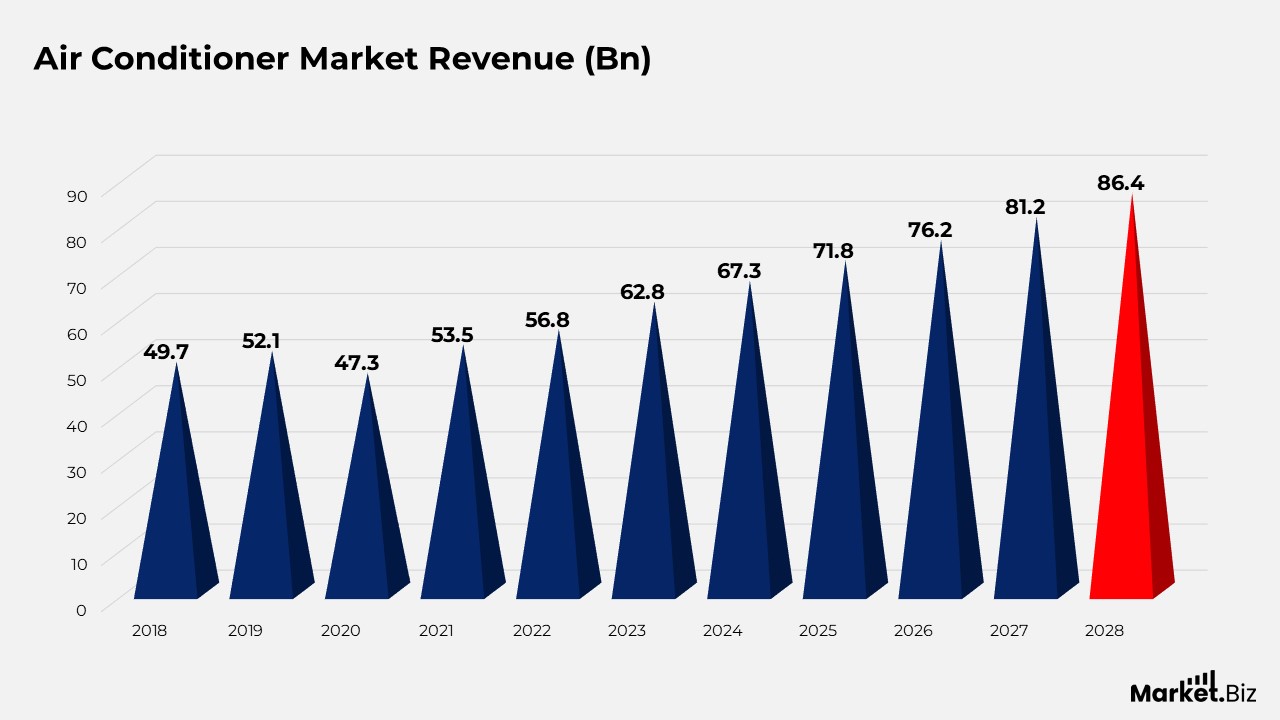
- In 2018, the market achieved a revenue of USD 49.68 billion; by 2019, this figure had risen to USD 52.11 billion.
- Although there was a minor decline in 2020, with revenue recorded at USD 47.3 billion, the market swiftly recovered in 2021, attaining USD 53.45 billion.
- The upward trend persisted in 2022, as the market produced USD 56.81 billion in revenue.
- The air conditioner market is projected to sustain its growth trajectory, with anticipated revenues of USD 62.8 billion in 2023, USD 67.32 billion in 2024, and USD 71.82 billion in 2025.
- The market’s growth is expected to continue, with revenues forecasted to reach USD 76.23 billion in 2026, USD 81.2 billion in 2027, and USD 86.36 billion in 2028.
Air Conditioner by Demand Statistics
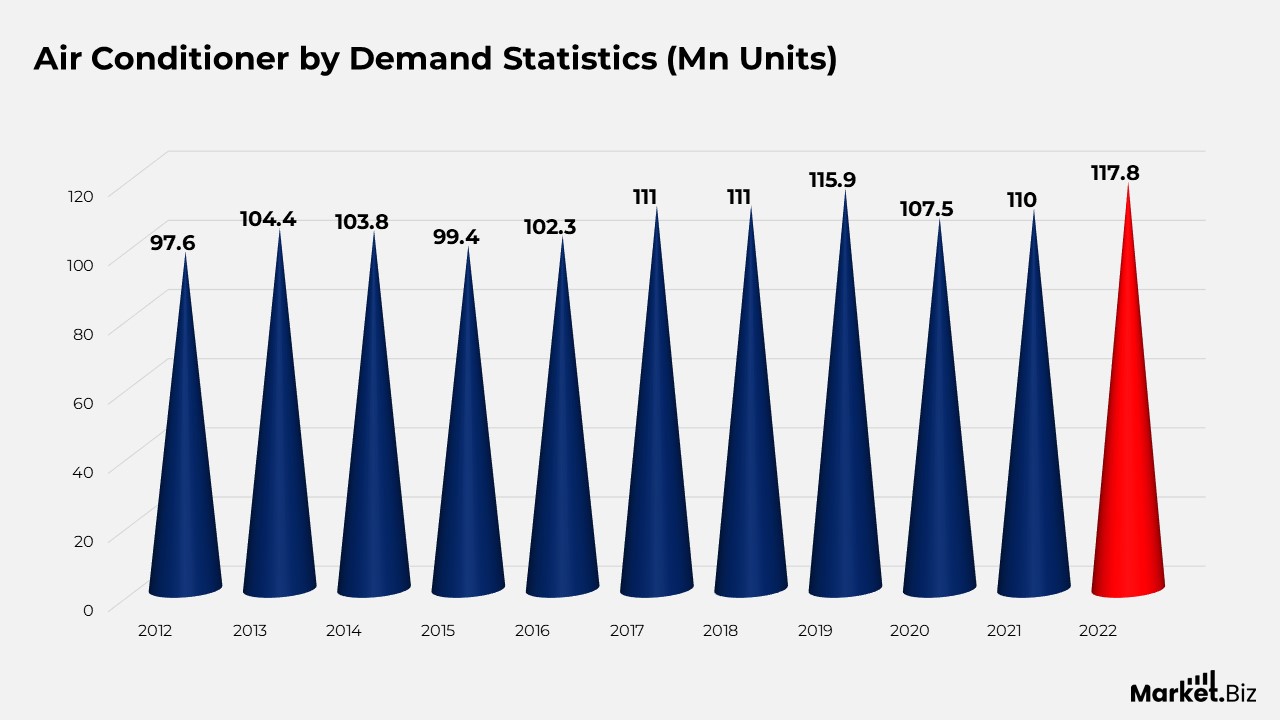
- In 2012, the demand for room air conditioners was noted at 85.11 million units, while the demand for packaged air conditioners stood at 12.49 million units.
- Over the subsequent years, a consistent increase in these numbers was observed. By 2017, the demand for room air conditioners had escalated to 96.41 million units, and the demand for packaged air conditioners had risen to 14.57 million.
- Despite minor fluctuations in the following years, 2019 marked a significant turning point, with the demand for room air conditioners peaking at 101.95 million units.
- However, both categories of air conditioners saw a decrease in demand in 2020, with room air conditioners at 93.95 million units and packaged air conditioners at 13.5 million.
- The trend subsequently started to rebound, and by the year 2022, the demand for room air conditioners had climbed to 99.9 million units, whereas the demand for packaged air conditioners had increased significantly to 17.87 million units.
Statistics of Air Compressor Duty Cycle
- The duty cycle of air compressors pertains to the frequency of their usage within a designated period.
- For example, an air compressor with a 100% duty cycle can operate continuously without the need for cooling breaks.
- Conversely, standard compressors generally feature duty cycles that vary from 50% to 100%.
- This means that after functioning for a specified percentage of the time, usually between 50% and 100%, it is advisable to switch them off to permit the motor to cool down before resuming operation.
- This precautionary measure helps to avert overheating and guarantees the compressor’s durability and dependable performance.
- Duty cycles are commonly represented as percentages, illustrating the ratio of time a compressor is actively engaged versus the time it remains inactive.
- For instance, if a compressor has a duty cycle of 60/40, it functions for 60% of the time and is idle or turned off for 40% of the time.
Air Compressor Recent Development
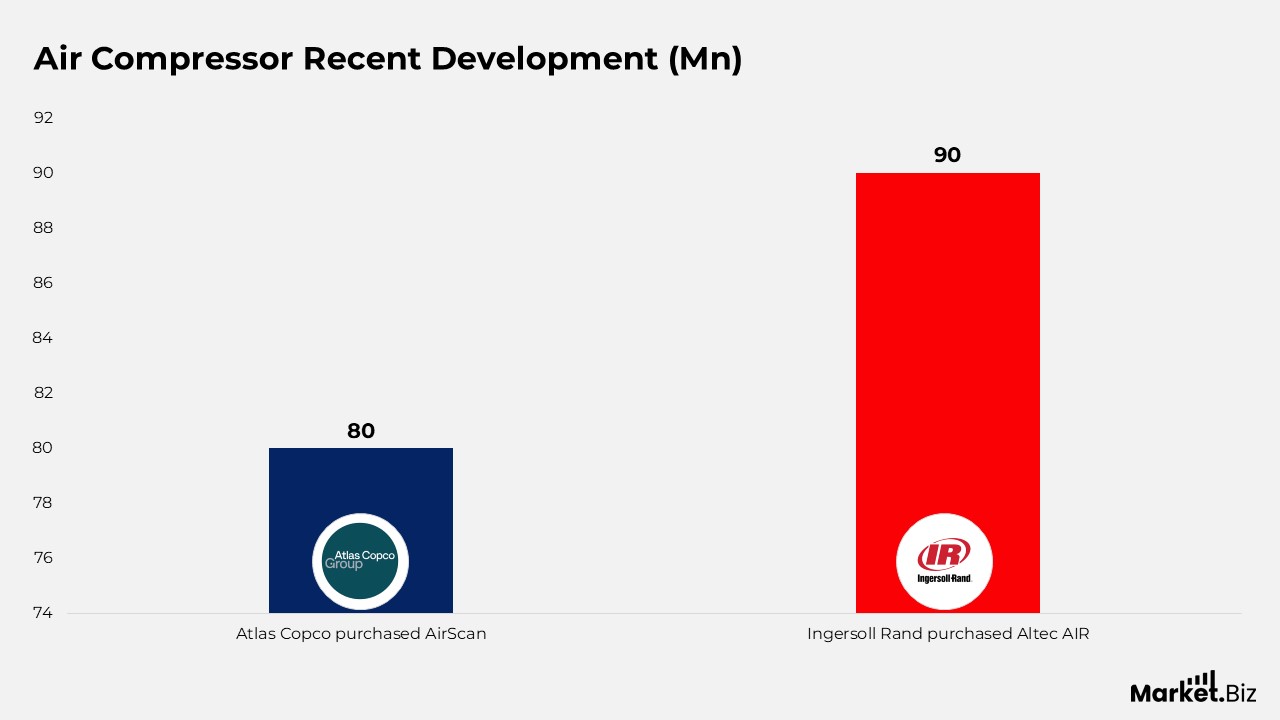
- In the middle of 2023, Atlas Copco purchased AirScan, a firm that specialises in monitoring and optimising air compressors, for a sum of $80 million.
- In the latter part of 2023, Ingersoll Rand finalised its acquisition of Altec AIR, a company that offers air compressors and air treatment solutions, for a total of $90 million.
- At the beginning of 2024, Kaeser Compressors introduced the CSG-2 series, a new range of rotary screw air compressors designed with enhanced energy efficiency.
- Elgi Equipment, a worldwide manufacturer of air compressors, obtained $75 million in early 2024 to improve its product development capabilities.
Air Compressor Future Prediction
- The market for oil-free air compressors is growing at a strong rate, with some forecasts projecting its size to reach over $11 billion in 2026.
- The global air compressor market is forecast to grow, with estimates for 2026 varying between approximately $40 billion and $45 billion.
- The global air compressor market is forecast to grow from approximately $18.34 billion in 2024 to $31.84 billion by 2035, with a compound annual growth rate (CAGR) of around 5.14%.
Conclusion
Air Compressor Statistics: The air compressor market is witnessing substantial growth, propelled by industrial development and a heightened demand for energy efficiency and sustainability.
Notable trends encompass a marked inclination towards positive displacement and electric-powered compressors, an increasing requirement for oil-free models in the food and beverage sector, and the considerable supremacy of the Asia-Pacific region, which is anticipated to persist.
The market outlook is optimistic, with a positive growth forecast driven by energy efficiency, oil-free technologies, and broader industrial applications, notwithstanding previous challenges such as the pandemic.
FAQs
SCFM, or Standard Cubic Feet per Minute, refers to the amount of air that the compressor delivers to the air tool. This measurement serves as an indicator of the compressor’s performance capabilities. Compressors with elevated CFM ratings supply a greater volume of air, making them more suitable for larger tasks.
The specific power is determined by calculating the ratio of the required energy consumption in kilowatt-hours (kWh) to the volume of air delivered in cubic meters (m3) over the same time frame. The specific performance metric of the compressor offers insights into its operational condition.
A compressor is a mechanical apparatus designed to elevate the pressure of a gas by minimising its volume. An air compressor is a particular category of gas compressor. Numerous compressors can be staged, meaning that the gas undergoes compression multiple times in sequential steps or stages to enhance discharge pressure.

