








Introduction
Workplace Ergonomics Statistics: Ergonomics has become an important part of workplaces as it transforms workplaces by reducing the risks of musculoskeletal disorders (MSDs) for employees and cuts the compensation costs for employers. Repetitive strain injuries (RSIs) are a subclass of MSDs that occur among employees as well.
The National Center for Health Statistics found in 2021 that 9% of adults in the United States experienced an RSI in the past three months, with 44.2% of that group having a limitation in their normal activities for at least 24 hours due to the RSI. Fascinating information that tells us, by effective use of ergonomics, the cases, rates, severity, and productivity impact of ergonomics can be reduced in the workplace.
Editor’s Choice
- Manual handling injuries account for 25% of all injuries in the workplace.
- 27% of the service industry has reported ergonomic injuries.
- 30% of MSD infected have to stay away from their workplace.
- The highest rate of MSD cases was experienced by firefighters.
- Employees complete their tasks 15% faster in ergonomic workplaces.
- The finance and insurance sector had one of the lowest rates of 0.3 cases per 100 full-time employees.
- Research indicates that the MSD symptoms increase with age.
- Continuous lifting and handling patients increases the risk of MSDs among healthcare employees.
- Various studies show that a 20-40% reduction in MSD injuries can be achieved through ergonomic safety programs.
What is Workplace Ergonomics?
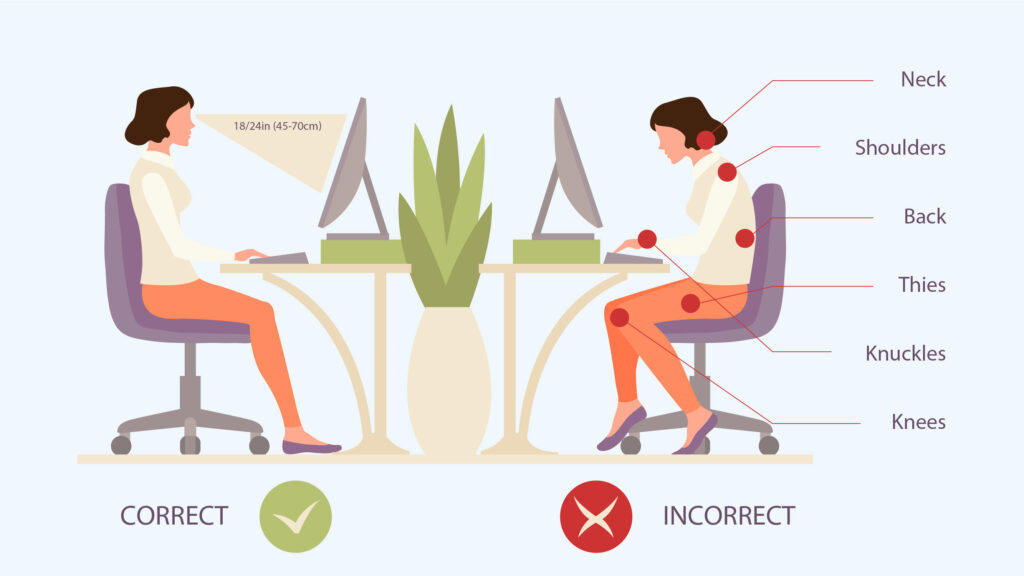
Workplace ergonomics refers to the science and art of how to design jobs, tools, and workplaces to match the needs of the employees; it is about reducing stress and tiredness, which also reduces the risk of injury.
The U.S. Occupational Safety and Health Administration defines ergonomics as “the science of fitting a job to a person” to minimise muscle fatigue, improve productivity, and reduce the number and severity of work-related musculoskeletal disorders. MSDs are among the most reported reasons for lost or restricted work time. Using ergonomic solutions can significantly reduce these types of injuries for both employees and employers.
General Workplace Ergonomics Statistics
- There were 272,780 MSD cases reported to the U.S. Bureau of Labor Statistics amongst private sector employees in 2018, which represents 30% of all work-related injuries that happen when you are away from work.
- Transportation workers are at a high risk for MSDs, and the transportation and warehousing sector had the highest MSD incident rate, at 77.1 MSD per 10,000 employees, according to a 2018 report.
- Older employees face more MSDs, and employees aged 45-54 have the highest total numbers of MSD cases, at 65,720 cases.
- About 27% of U.S. employees are exposed to repetitive motion tasks each day, which increases the possibility of MSDs.
- Manual handling injuries account for 25% of all injuries in the workplace.
- The leading cause of workplace injury is overexertion, which costs businesses an estimated $13.3 billion each year.
- Carpal tunnel syndrome is common, and it makes up to 24% of all MSDs in office workers.
- Many workplace employees reported discomfort, with an estimated 80% of office employees feeling discomfort from computer workstation injuries.
- Construction workers often report back pain, with 55% of them experiencing back pain due to heavy lifting.
Moreover
- Many workplaces have not been ergonomically calculated, with 70% of workers reporting that their workplace has never been ergonomically calculated.
- Nerve entrapment syndromes has been growing at a rapid pace, with 31% of employees are being affected over the last decade.
- Women’s are 1.7 times more vulnerable for MSDs, related to poor ergonomics than men.
- The agriculture industry has seen 45% increase in ergonomic injuries in the past five years.
- 27% of service industry has reported ergonomic injuries.
- Repetitive strain injuries impact 1 out of 8 employees which also increases health care costs.
- Around 70% of the transportation industry workers have lower back pain, and it could be added to poor ergonomics.
- Construction workers suffer from shoulder pain, with 1 out of 3 workers are suffering due to ergonomic factors.
- The hospitality industry has MSD challenges, and MSDs account for 33% of all injuries in the hospitality industry.
- Ergonomics programs have shown 59% reduction in MSDs and 75% less lost workdays.
- Excellent ergonomic programs have produced an additional 25% of productivity.
- Excellent ergonomic programs can reduce employee’s costs by 67%.
(Source: OFI, WP-Content)
Types of Workplace Ergonomics
- Physical Ergonomics
Involves in ergonomic aspects of the body at a workplace, the repetitive nature of tasks, and general set up of a work station to minimize the risk of injuries including back pain, carpal tunnel syndrome etc.
- Cognitive Ergonomics
Focuses on the user’s mental operations such as remembering, decision making, and attention in way that is not to heavy mental load to handle.
- Organizational Ergonomics
It involves in sweeping of all your organisation’s internal structure, the way of working and the flows and communication to a state of flow, making it efficient and satisfying.
- Environmental Ergonomics
Addresses the man-environment relationship in terms of light, sound, dust and air temperature, with a view to increasing comfort and adaptability.
- Visual Ergonomics
Focuses on maximizing visual task performance and minimizing eye strain using appropriate lighting and visual recovery healing approaches.
- Macro ergonomics
Involves in larger companies and system level concept to verify technology, processes, and human performance are aligned.
Cases of MSD Rate
- In 2018, a total of 272,780 MSD cases were registered in the U.S. private sectors.
- 30% of MSD infected have to stay away from their workplace.
- The rate of MSD cases was 27.2 cases per 10,000 full time employees.
- Employees who were infected with MSDs had to stay away from work for around 12 days or so.
- An estimated 50% of all MSD cases were seen in the retail trade, manufacturing, healthcare and social assistance industries.
- 56,360 MSD cases were filed by healthcare and social assistance industry alone.
- The rate of MSD cases in transportation and warehousing was 77.1 cases per 10,000 full time employees.
- 25,110 MSD cases were filed by labourers and cargo, stock, and material movers.
- Nursing assistance experience around 15,360 MSD cases, where 52% of them had to stay away from work.
- Heavy tractor and truck drivers were reported 14,810 MSD cases with minimum 21 days away from their work.
- Employees who are aged 45 to 64 reported over 30 cases per 10,000 full time employees.
- The highest rate of MSD cases were experienced by firefighters.
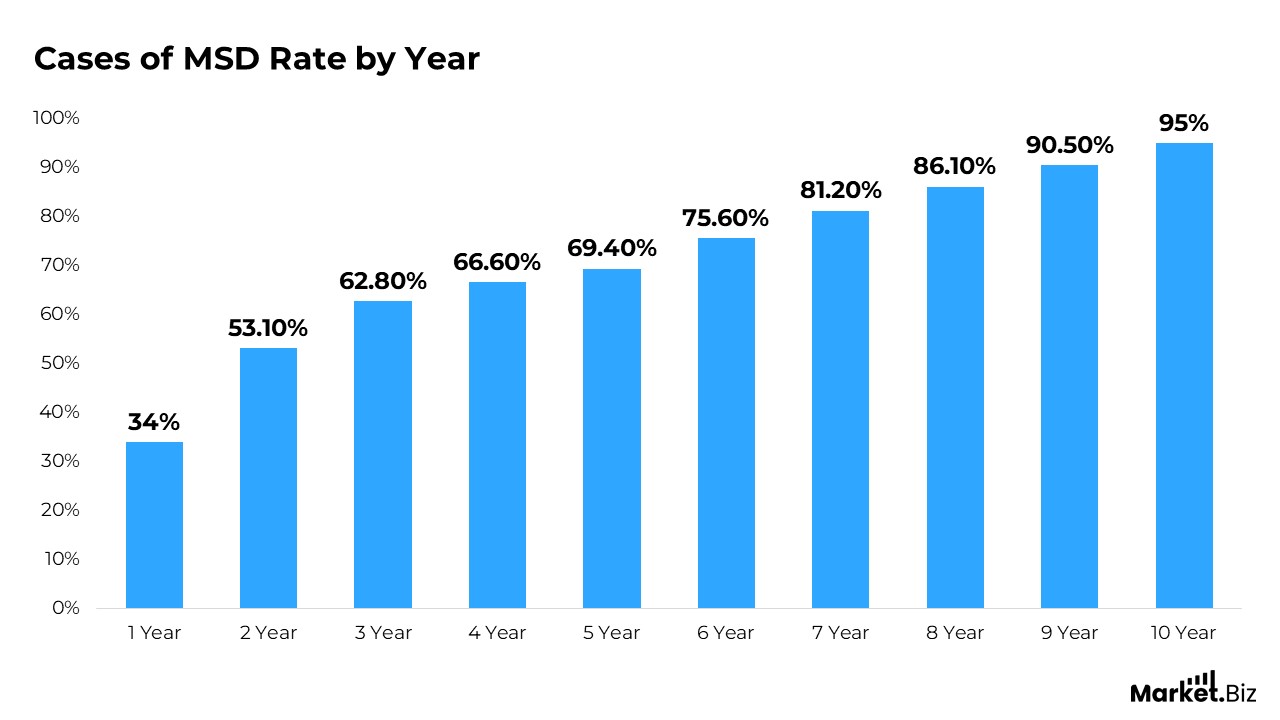
| Period | Cumulative MSD Development Rate (%) |
|---|---|
| 1st year | 34.0 |
| 2nd year | 53.1 |
| 3rd year | 62.8 |
| 4th year | 66.6 |
| 5th year | 69.4 |
| 6th year | 75.6 |
| 7th year | 81.2 |
| 8th year | 86.1 |
| 9th year | 90.5 |
| 10th year | 95.0 |
Impact on Workplace Productivity
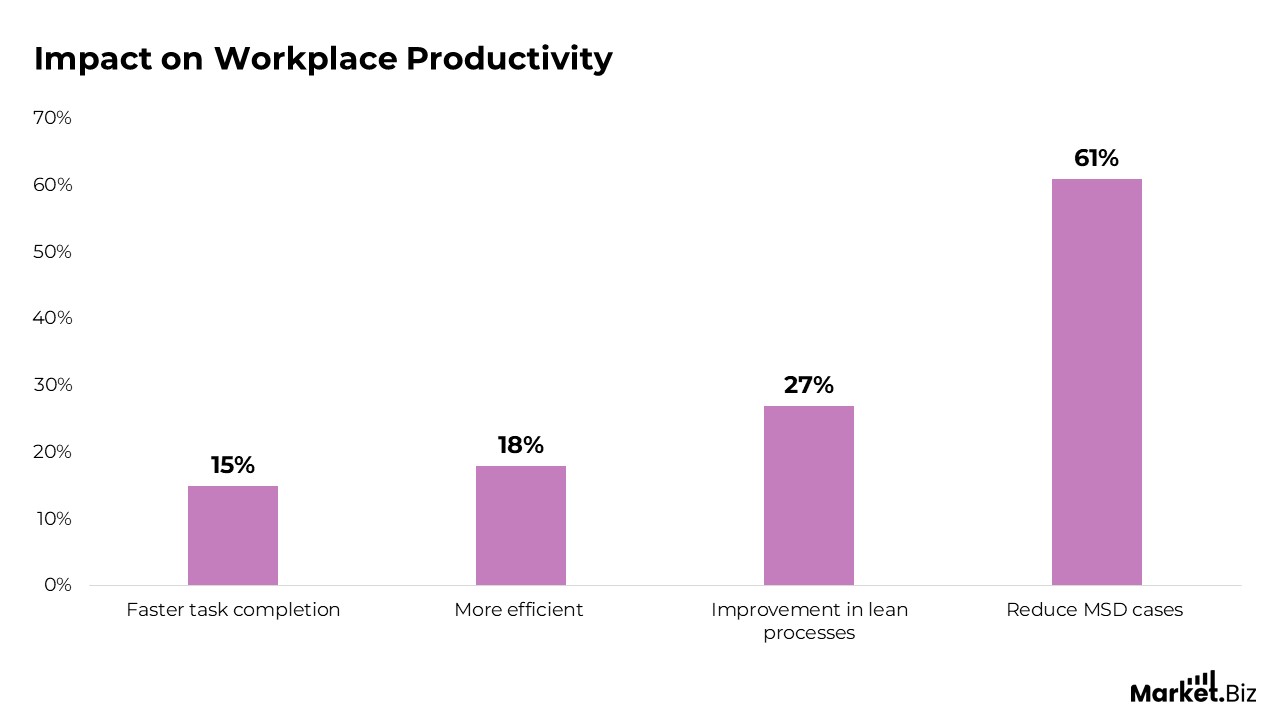
- Employees complete their tasks 15% faster in ergonomic workplaces.
- Ergonomic workplaces are more efficient in task execution and can enhance cycle time by 18%.
- Ergonomic workplaces reported 27% improvement in lean processes.
- Ergonomic workplaces can reduce MSD cases by 61% and improves employee well-being.
- Companies with ergonomic systems reported saving up to $2 million in employee’s compensation and medical claims.
- Ergonomics reduces the numbers of severity of work-related MSDs, which leads to less injuries.
- Proper ergonomic setups improve physical comfort, as a result employees work more efficiently and with less fatigue.
- Ergonomic equipment minimizes strain, improving focus, accuracy, and consistency in different activities.
- A comfortable work environment improves 66% of employee satisfaction and morale.
- Ergonomic designs offers better posture, reduce the risk of chronic pain and associated productivity losses.
- Comfortable and safe work environments encourage greater employee engagement and commitment by 36%.
- Companies who invest in ergonomics saw a 52% of significant return of investment through improved productivity and reduced injury costs.
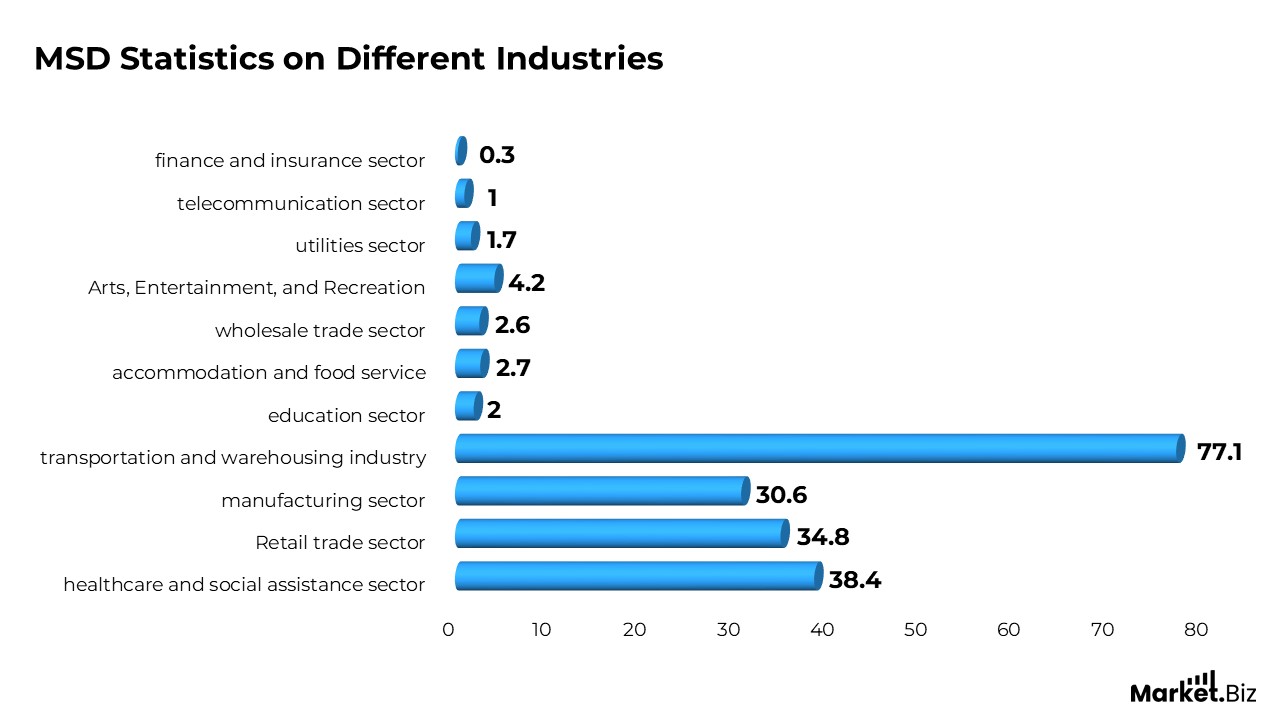
MSD Statistics on Different Industries
- As of 2024, healthcare and social assistance sector recorded 56,360 MSD cases, with the rate of 38.4 cases per 10,000 full-time employees.
- Retail trade sector recorded 41,070 MSD cases, with the rate of 34.8 cases per 10,000 full-time employees.
- The manufacturing sector recoded 38,640 MSD cases, with the rate of 30.6 cases per 10,000 full-time employees.
- The transportation and warehousing industry had an MSD rate of 77.1 cases per 10,000 full-time workers, which was the highest of them all.
- Construction sector was also affected by MSD, while no specific data is available on the internet, this industry is known for high rates of ergonomic injuries due to manual labor and repetitive tasks.
- The education sector recorded the rate of 2.0 cases per 100 full time employees for injuries and other health issues.
- In 2022, accommodation and food service industry had a rate of 2.7 cases per 100 full time employees for injuries and other health issues.
- The wholesale trade sector reported a rate of 2.6 cases per 100 full time workers.
- Arts, Entertainment, and Recreation industries experienced the rate of 4.2 cases per 100 full-time employees in 2022.
- The utilities sector had a rate of 1.7 cases per 100 full time employees for injuries and illnesses.
- In 2022, the telecommunication sector reported an increasing rate of 1.0 cases per 100 full-time employees.
- The finance and insurance sector had one of the lowest rate of 0.3 cases per 100 full-time employees.
Workplace Ergonomics Demographics
By Age
- Employees who aged 45-64 reported for 44% of all private sector has MSD cases, with a rate of over 30 cases per 10,000 full-time employees.
- According to research, the average age of employees with work-related MSDs was 40 years, including a small number of middle-aged employees.
- Research indicates that the MSD symptoms increase with age.
- Adults older than 65 years often spend up to 80% of their daytime in sitting activities, increasing the risk of ergonomic issues.
- Employees who aged 65 and over reported 10,010 MSD cases, with the rate of 21.2 per 10,000 full-time employees.
- Older employees often need longer recovery periods after ergonomic-related injuries.
- Reducing eyesight and hearing with age requires ergonomic adjustments in lighting and noise levels in the workplace.
- Reduced balance in older adults increases the risk of falls, highlighting the need for ergonomic flooring and support systems.
Gender
- According to reports, 92.5% of women’s were infected by MSDs, including cervical pain (88.8%) and lower back pain (83.8%).
- Research indicates that women report higher chances of MSD symptoms, mainly in the neck and shoulders.
- Many tools are designed for average male dimensions, which causes discomfort and injury in female workers.
- Women usually don’t report ergonomic issues due to workplace culture or fear of job loss.
- Pregnant workers need specific ergonomic setups to ensure safety and comfort.
- Women may suffer with higher stress levels due to ergonomic challenges, which impacted their mental health.
- Workplaces should adopt inclusive ergonomic designs that provide to all genders.
By Occupation
- Occupations in manufacturing, construction, and healthcare report higher rates of ergonomic injuries.
- Sitting for long hours and poor workplace setups lead to neck and back pain among office employees.
- Continuous lifting and handling patients increase the risk of MSDs among healthcare employees.
- Repetitive motion and heavy lifting contribute to high ergonomic injury rates in construction.
- Standing for long periods and repetitive tasks can cause foot and back problems in retail workers.
- Long hours of sitting and vehicle vibrations can lead to lower back pain among drivers.
- Manual labours and awkward postures increase ergonomic risks in farming.
- Carrying heavy trays and standing for extended periods can cause MSDs in hospitality workers.
- Repetitive writing or typing can cause ergonomic discomfort among educators.
- Continuous computer use and headset wear can cause neck and shoulder strain in call center agents.
Ergonomics Safety Programs
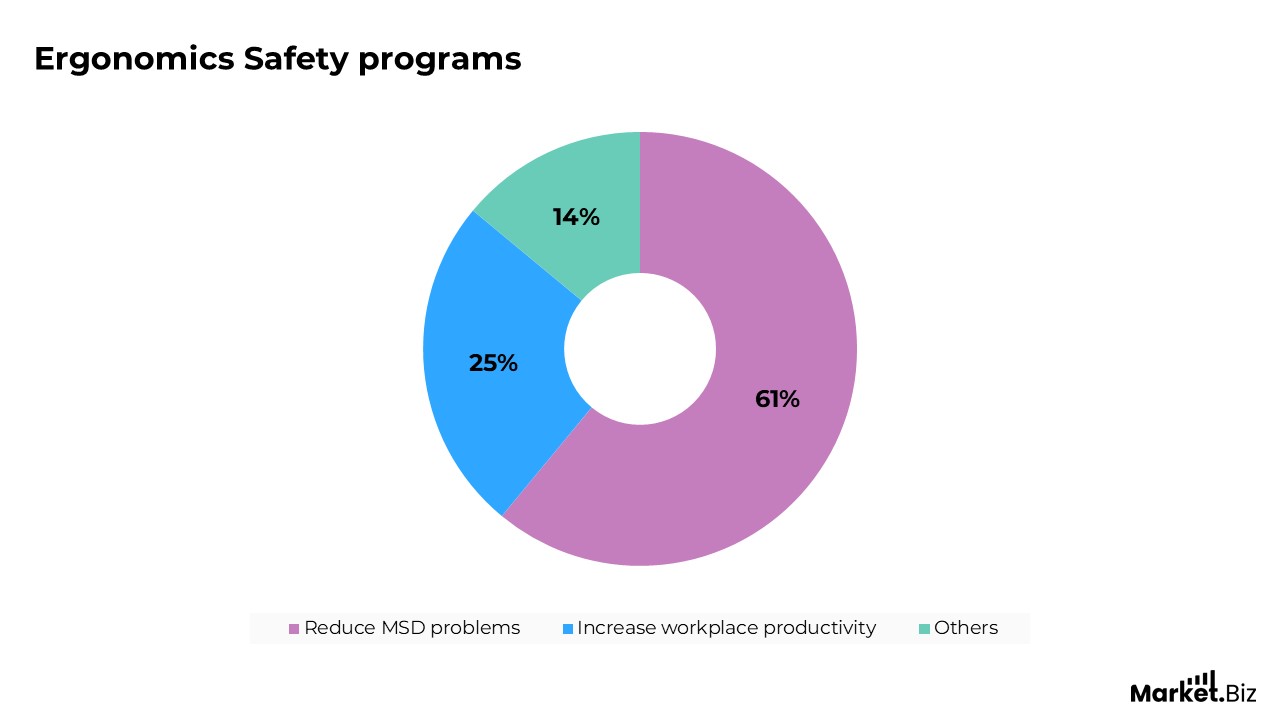
- Implementing effective ergonomic programs can reduce MSD problems by an average rate of 61%.
- Proper ergonomics can increase workplace productivity up to 25%, which benefits both employee and employer.
- For every dollar spent on employee health and safety, an employer can expect an average return of 57.3%.
- Ergonomic safety programs can reduce MSD incidents by up to 75% within 12 months, leading to fewer lost working days and reduced health care costs.
- Various studies show that a 20-40% reduction in MSD injuries through ergonomic safety programs.
- Well-designed ergonomic safety program can lead to fewer injuries, lower absence, and reduced healthcare costs.
- Safety programs helps lessen muscle fatigue, increase productivity and reduces the number of work related MSDs.
- According to a study, 59% average reduction of MSDs, a 65% average reduction in incidence rate, and a 75% reduction in lost workdays through ergonomic programs.
- By investing in safety programs, employers can save between $9 to $23 billion annually in employee compensation cost.
Recent Developments in Workplace Ergonomics
- Between 2023 and 2025, requests for ergonomic risk calculation increased by 75%.
- IoT-enabled desks and chairs now provide real-time feedback, reminding employees to adjust their posture or take breaks.
- AR tools are being used to teach proper lifting techniques and ergonomic practices through interactive simulations, which makes training more engaging.
- AI-driven platforms are developing personalized ergonomic interventions, adapting over time to individual needs and reducing injury risks.
- New wearable systems, including smart insoles and wristbands, have been designed to measure load vertical location during manual lifting.
Conclusion
Statistics for workplace ergonomics show that smart ergonomics leads to less injuries, improved worker productivity and less costs for businesses. Work-related injuries stemming from poor ergonomics constitute more than 30% of all occupational injuries, so companies need to have an ergonomic safety program.
These upgrades result is less lost work time and healthier workers. A strong emphasis on workplace ergonomics also contributes to a safer and more efficient workplace. Ergonomic solutions are gaining prominence with the rise of awareness within the present-day business. True ergonomic data is the foundation for a healthier and more productive workforce.
FAQs
The most common injuries are back pain, carpal tunnel syndrome, and neck strain, often caused by poor posture.
Ergonomic issues can lower productivity by causing pain, fatigue, and more sick days, with companies losing thousands of dollars each year.
Yes, studies show that ergonomic programs can reduce MSDs by up to 60%.