








Introduction
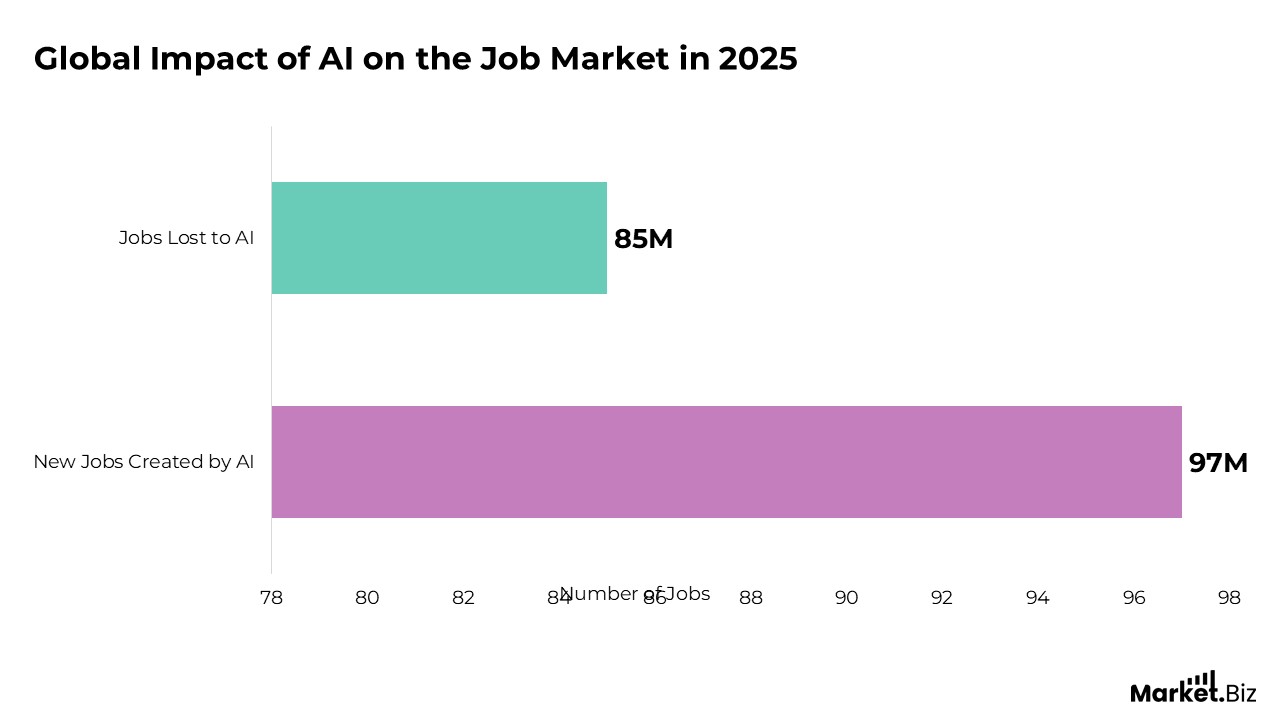
AI and Automation Job Impact Statistics: A host of emerging new applications and automation technologies are showing great promise in transforming the global workforce. Existing predictors have forecasted that with the use of AI and automation, there would be a loss of 85 million jobs, whereas, by the same year, it would create another 97 million jobs in diverse areas needing different skill sets.
Manufacturing, retail, and transportation have undergone large-scale disruption by case automation taking repetitive out-of-work jobs, whereas fewer remain open for tech, healthcare, and customer service jobs. For this reason, industries and policymakers must work hand-in-hand with workers to understand how technologies will reshape the job markets.
It is a transition with numerous opportunities and challenges that make reskilling and upskilling different from all those that preceded it.
Editor’s Choice
- AI will take away 85 million jobs in 2025, but 97 million new roles will be born through the emerging sectors.
- Manufacturing has been automated by 60%, which has increased the productivity and reduced manpower.
- According to estimates, around 45% of tasks are globally automatable; maximum tasks are in administration.
- Healthcare will see a 30% increase in AI jobs for diagnostics by 2030.
- The number of job offers in AI has been increasing at a rate of 74% every year since 2015, with a special focus on technology and health care.
- AI in customer service has reduced the direct work force by about 30-70% and increased efficiency.
- Due to development in AI, remote work has increased up to 250 percent during the pandemic, improving the productivity of people by 40%.
- A possible annual saving of $2 trillion is achieved from RPA automating back-office functions.
- Now, 85 percent of job applications are processed by AI recruitment tools, speeding up recruitment.
- There are now more cybersecurity jobs than ever, and 3.5 million of these are expected to be unfilled by the year 2026.
- In fact, AI-powered green technology will be responsible for creating about 18 million jobs in sustainability by 2030.
- Jobs in the retail sector reduced by 25% owing to AI-powered automation-for example, self-checkouts.
General AI and Automation Job Impact Statistics
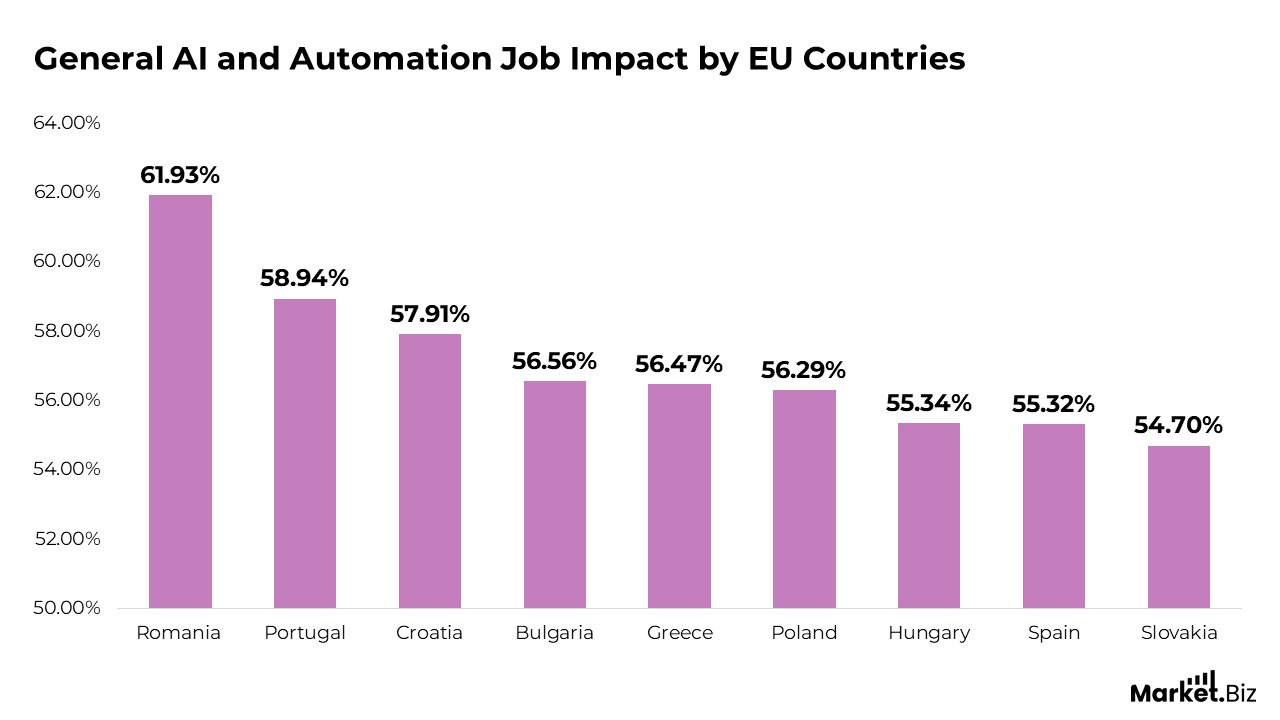
- AI and automation are expected to replace about 85 million jobs all around the world, chiefly in the areas of administration and routine-based occupations.
- However, the newer technologies are said to create 97 million new jobs in AI development, robotics, and data analysis.
- Existing technologies could automate up to 45% of tasks in jobs across industries.
- The last decade has recorded a 60 percent relative increase in automation for manufacturing, while it has reduced the demand for manual labour and improved productivity.
- AI Automation has reduced operating costs by 20% in companies that have activated such technologies.
- Approximately 74 million jobs across the U.S. would be very much at risk of automation by 2030, especially those in retail and transport sectors.
- The demand for AI jobs in the healthcare industry will increase by 30% owing to its effect by 2030, specifically in diagnostics and patient treatment.
- In developing countries, 15-30 percent of low-skill jobs will be automated for good by 2030 through AI and automation.
- A five-time increase in jobs related to AI and machine learning has been recorded in the last five years due to automation skill requirements.
- More than 25% of manufacturing today is automated robots are doing the repetitive work of tasks like assembly and welding.
- 70 percent of all transportation worker’s jobs will be under the threat of loss from autonomous vehicles.
- Retail jobs have been cut by 25 percent in locations that formerly had self-checkout systems.
(Source: Zippia, Wp-Content)
Impact of AI on the Job Market
Job Distraction and Automation Risks
- Almost 375 million people across the globe would have to switch jobs by the year 2030 because of AI and automation, as per reports.
- AI technology capable of performing 85 million jobs will, in 2025, displace these existing manual activities, especially data-processing and other routine tasks.
- Almost 40 to 50 percent of tasks performed by jobs throughout the world are possibly automatable according to today’s AI capabilities.
- It is projected the retail sector will have a 30% job loss, which will be induced further by AI-powered checkouts and inventory systems.
- By the year 2040, autonomous vehicles would reduce as much as 70 percent of driving jobs, including truck drivers and delivery drivers.
- The most at risk are those low-skilled jobs that may lose up to 80 percent of the jobs in food service and hospitality to automated machines.
- It is predicted that about 60 percent of jobs in banking and finance will be replaced by clerical jobs automation as transaction handling and even risk analysis come within the purview of artificial intelligence.
- AI tools taking over scheduling, document process handling, thus administrative support roles are predicted to shrink by almost 40%.
- Customer service jobs can be reduced as much as 50%, where AI chatbots and voice assistants take control of the interaction.
- Emerging markets are likely to face a greater brunt, with possibly close to 85% of the labour-intensive jobs becoming redundant due to AI adoption.
Job Creation, Transformation, and Opportunities
- Jobs going into the millions in the AI estimate will be generated into downstream jobs in a specific way-more in tech, healthcare, and education.
- Demand for AI specialists, data scientists, and machine learning engineers has grown by 74 percent every year.
- AI diagnostic and robotic services will create 2.3 million jobs in the healthcare industry by 2030.
- As jobs in cybersecurity continue growing, if threats by AI continue to prevail, in 2025 the urge in vacancies may rise to 3.5 million unfilled jobs worldwide.
- In convergence with green technologies, AI is supposed to create 18 million jobs worldwide by 2030 in sustainability-related disciplines.
- The application of AI in remote working has resulted in a 25 percent increase in jobs virtually, such as digital project managers and analysts.
- AI teaching in tandem with growing yearly-by-12-percent job opportunities requiring teaching of digital and cognitive skills.
- AI presents exciting new creative opportunities for hybrid roles-for example, AI-assisted designers and AI-assisted content creators-broadening the scope of jobs.
- Reskilling budgets set aside by governments aim to retrain over 100 million workers around the world for jobs in the AI era.
- The job environment is moving towards a collaborative future of human-AI interface, thus leading to the demand for definitions steeped in the ethics of AI use and exclusion.
(Source: Newhorizons, Portals)
AI’s Impact on Remote Work
- AI collaboration toolset enhances remote work productivity with up to about 40 percent increase in improving teams communication and task management.
- The remote work AI market is estimated to account at $21.3 billion by 2026 because of increasing demand for various virtual workspace solutions.
- AI chatbots reduce customer service response time by 30 percent while increasing the efficiency of the employee working remotely.
- According to evidence, AI project management tools automate remote projects and increase the rates of completion from 20-25%.
- Furthermore, close to 85% of the people engaged in remote working rely on AI to manage their time better, help prioritize tasks, and automate scheduling as well.
- In fact, AI virtual assistants would actually eliminate up to 60 percent of the administrative mundane tasks, which then beam remote workers upwards for bigger and better duties.
- AI data insights are expected to boost decision-making efficiencies by 35 percent among remote teams, shows special relevance in marketing and sales.
- Minimal adoption of the remote working modality increased in the pandemic up to about 250 percent with the help of AI to ease the transitions.
- AI can provide protection against 40 percent of breaches in security related to remote work.
- AI features such as transcription and translation have increased the use of video conferencing platforms by 100 percent.
- AI recruiting tools do 70 percent of hiring automated and very quick about recruitment through remote channels.
- In 2025, AI would automate around 40 percent of the tasks done from home, particularly in customer support and administrative roles.
- AI based remote work platforms grow at 18 percent per annum, thereby optimizing team management.
Work Tasks Replaced by AI
- The AI is Automation in 80% of data entry processes, which means that they have eliminated all types of repetitive manual input activities, home industry.
- AI Chatbots take care of up to 70% of the requirements in customer service; humble agents will be reduced since most of the requirements can be taken care of by these automated chatbots.
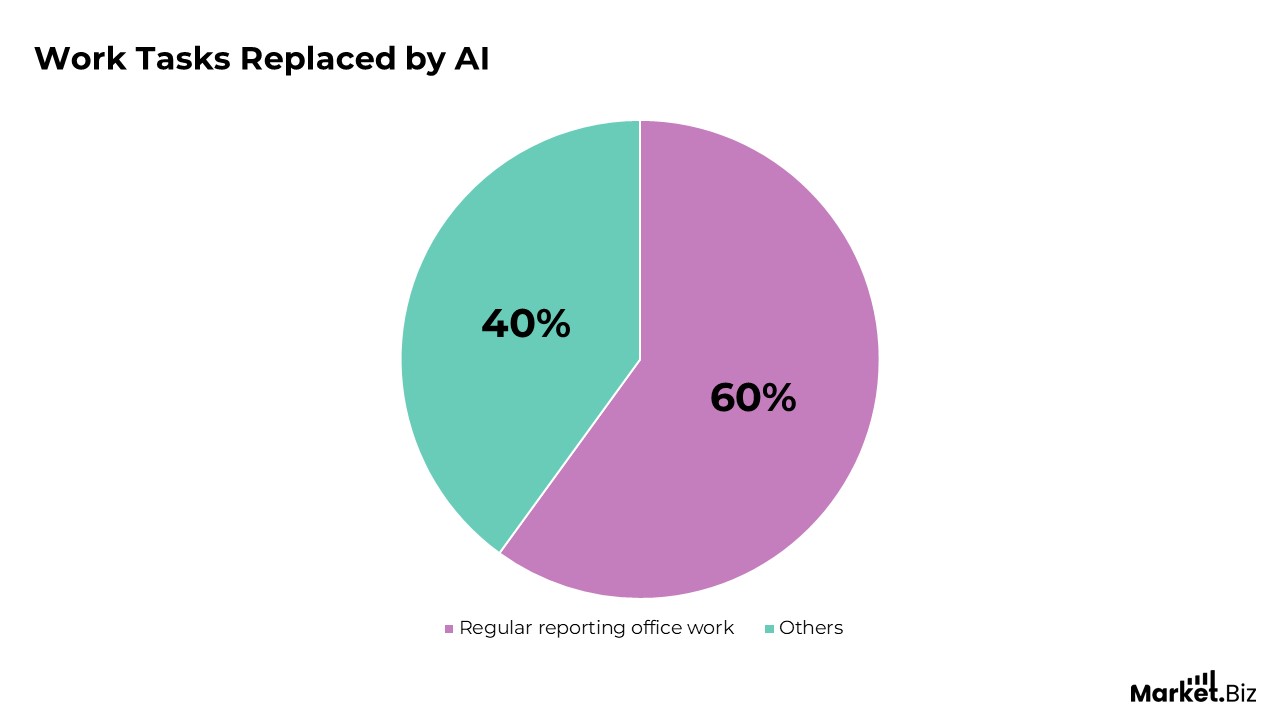
- AI Tools can create and send reports replacing nearly 60% of the regular reporting work done in offices.
- Robotic Process Automation (RPA) is the machine that performs invoice processing at about 90% by financial departments.
- AI Scheduling Assistants will save up to 75% of calendar and meeting management tasks of the professionals.
- AI transcription software can replace 95% of writing notes manually in meetings and interviews.
- Machine Learning Models automate 65% of Fraud Detection Processes in Banking and Insurance.
- AI Recruitment Platforms can screen up to 85% of job applicants; thus, employers can spend less time sifting through applications.
- AI content tools generate 50% of standard marketing copies and limit humanity’s burden of writing.
- AI algorithms sort and classify 70% data for increased speed in processing during logistics and research.
- Filtering spam and de-prioritizing 90% of emails in the inbox.
- In manufacturing environments, automated systems will carry out 60% of quality inspection control.
- AI chat interfaces perform 45% of IT helpdesk tasks, such as resetting passwords or troubleshooting.
Replaceable Jobs
- 99% of telemarketers are automated because AI voice systems handle outbound calls very efficiently.
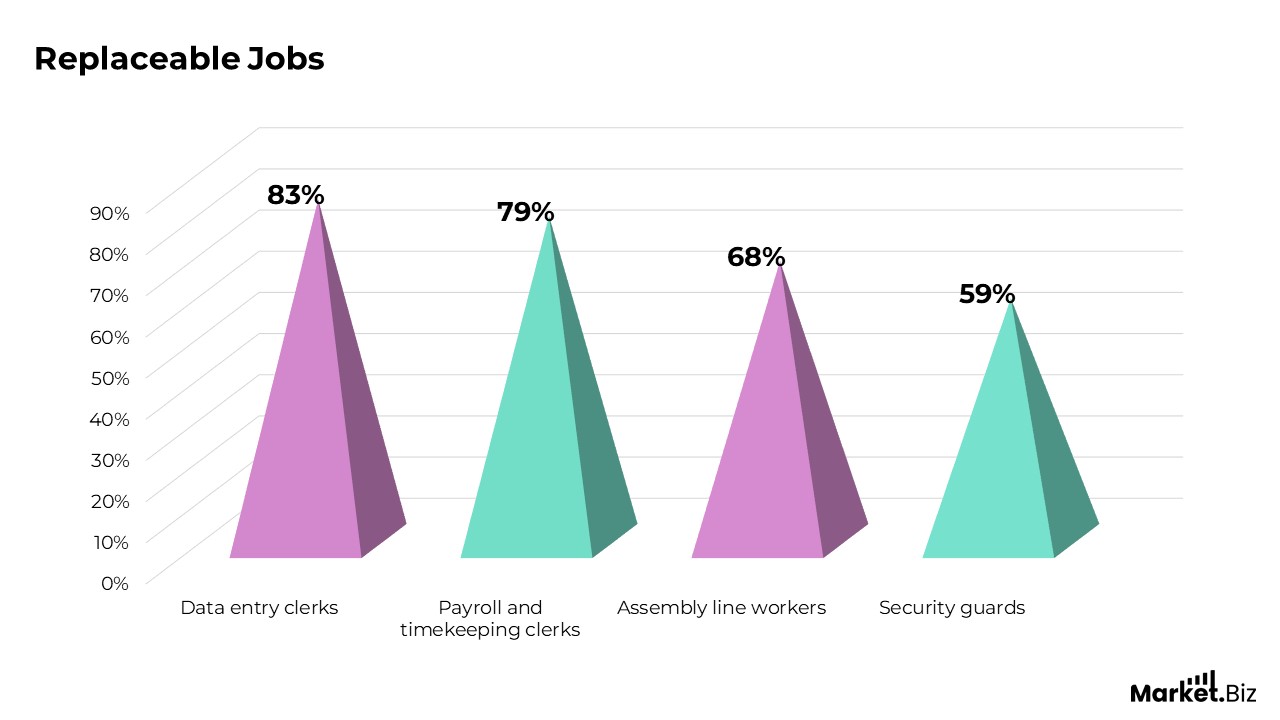
- Data entry clerks are highly automatable, with 83% of their work automatable with existing software.
- Cashiers have an automation probability of 79% due to provisions such as self-checkout and an automated payment processing system by AI.
- Payroll and timekeeping clerks have a 79% chance of being automated by a particular HR automated platform.
- Bulk of the 90% of receptionists can easily be classified under risk due to the fact that AI chatbots and scheduling tools have overtaken the front desk roles.
- Retail salespeople can be considered at high risk of 92%, especially concerning e-commerce and automated stores.
- 81% of fast-food workers are at risk, as with the growing trend of AI kiosks and robotic cooking systems.
- Transportation drivers, including truckers, do face an unemployment chance of about 79% due to the introduction of autonomous vehicles.
- Mobile banking and AI-powered ATMs are making bank tellers 76% replaceable.
- Assembly line workers are facing a 68% automation rate in manufacturing, especially in electronics and auto sectors.
- It is projected about 85%, that is fully automatable by AI chatbots and virtual assistants, can be customer support agents.
- Proof-readers should not be surprised if they are replaced up to 74% since most of the editing is now done by AI grammar tools.
- Security guards will have 59% of tasks automated by AI surveillance and facial recognition systems.
- Just delivery workers that face an increasing threat, an expected 40% of roles replaced by autonomous drones and robots by 2030.
Jobs and Tasks AI Can’t Replace
- Human empathy and judgment are central for therapists and psychologists, which makes them over 90% resistant to AI replacement.
- Originality and emotion cannot be fully automated; hence, even the most creative professionals, such as writers, can expect an 80% rate of job security.
- As a result, teachers and educators are not going to be replaced by machines at least 85%.
- Most of the work including hospitals being done nurses surgeons make their work 10-15% of tasks done to actually automatable.
- In that area of work, social workers require that human connection or thinking critically in areas such as development comes into play. That puts them in the least automatable 20% of jobs.
- This is a skilled trade, for example, an electrician, plumber, which consists of an environment that is complex, variable, less than 30% of the tasks being suitable for automation.
- Full automation in strategic decision-making with ethical consideration will be next to impossible for leadership roles.
- Even their basic roles are heavily human-dependent where research scientists require creative hypothesis-testing and abstract thinking in their activities.
- They perform coordination and planning of events, and events are dynamic and unpredictable with social features, which makes them less fit for AI applications of effectiveness.
- One of those jobs that fail to achieve more than 25 percent automation would be human resource professionals because they mostly do conflict resolution and cultural management.
- This has a unique role of human moral appropriation when a person delivers either religious or spiritual services, which is mostly indefinable by AI.
- They are entrepreneurs and business innovators: they take the risk and build a vision far beyond what AI can ever realize.
Industries Affected by AI
- Out of all global manufacturers, about 25% are using robotics and predictive maintenance tools in their industrial applications.
- In the health market for artificial intelligence applications, its value is expected to reach $187 billion by 2030 and will make transformations in diagnostics, imaging, and patient care.
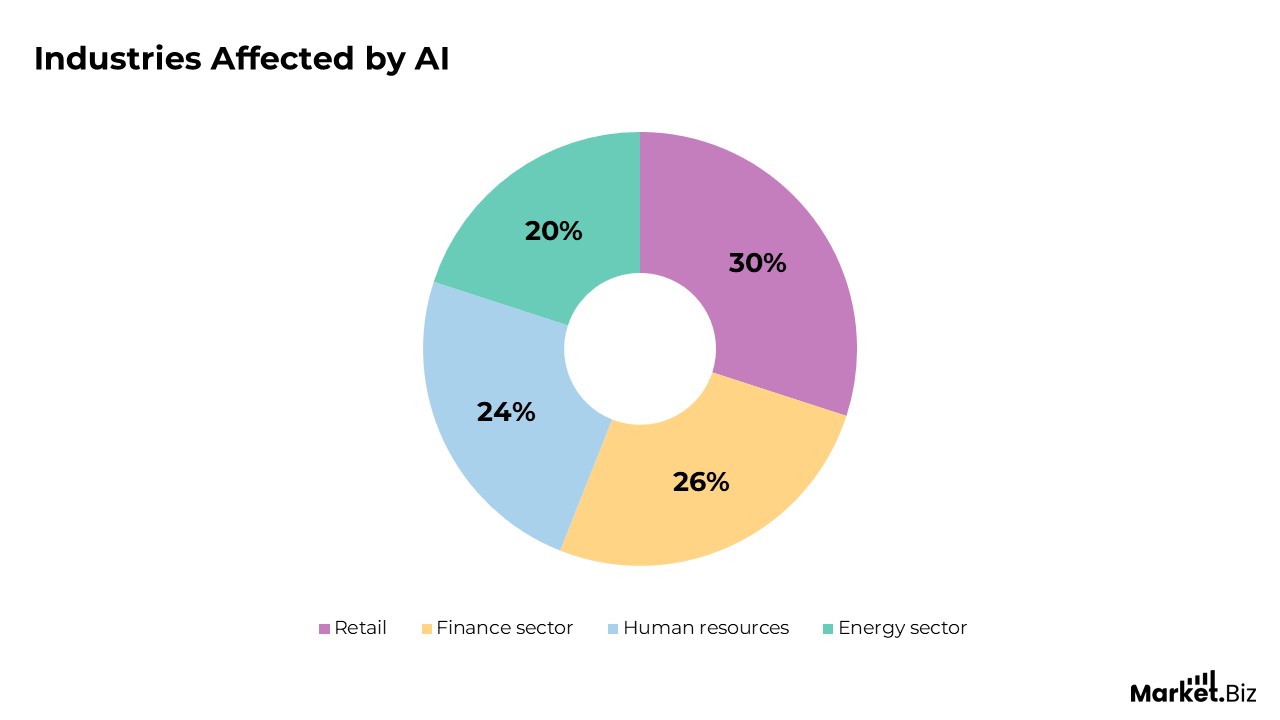
- 26 percent of data processing and fraud detection in the finance sector operate using machine-learning algorithms.
- Retail applies artificial intelligence to pricing, demand prediction and personalization, which can collectively bring about a 30 percent reduction in inventory cost.
- Of total process activities in transportation and logistics, 35% have been automated so far, most notably involving route optimization and driverless vehicles, which are headed by industry AI.
- The agriculture sector currently uses precision farming to increase yields between 15 and 20 percent while reducing resources consumed and waste previously generated.
- AI is being used in personalized learning and assessment tools at the moment in more than 47% of educational institutions.
- Among other applications of AI in legal services, contract reviews, legal research, and e-discovery work about 23% of their load in an automated manner.
- AI is also used in smart grids and predictive maintenance, and in the energy sector, it reduces the downtime outages by 20% or more.
- Human resources will run 70% AI in its first screening stage of all applicants to save time in recruitment but still provide a better matching for the job.
Recent Developments of AI in the Job Market
- The explosion of AI job types will progress; annual AI job openings have continued to show a phenomenal rate of 74% increase since 2015. This growth is felt mainly deeply in the technology, healthcare, and the finance-related contexts.
- Manufacturing AI is going to bring 25% more productivity by 2027, but it will need more roles for qualified robotics and process engineering.
- About 85 percent of job applications are screened by AI hiring tools; thereby reducing discrimination and enhancing selection processes in sectors such as retail and technology.
- Domestic transition reskilling programs will be undertaking similar exercises internationally, with the more than one billion United States dollar investment in AI and digital literacy by 2026.
- Robotic Process Automation at least drew a revolution in back-office banking. It could save banks almost $2 trillion each year; yet, there are emerging new roles for technology experts in the development of RPA.
- The AI-powered gig economy is fast expanding, with all new job roles at 15% in 2024 getting their whiff from AI-freelance platforms bringing in more flexible work options to the working society.
- AI-infused roles in healthcare are bound to grow; it is bringing about a job growth of 15 percent in radiologists, medical researchers, and bio-researchers through the application of AI in diagnostics and treatment planning.
Conclusion
As current job markets undergo rapid transformations, jobs that have grown obsolete are replaced by new jobs of which tech, healthcare, and cybersecurity are examples. Other fields such as manufacturing and retail have already begun doing away with huge overhead costs as a result of the increased efficiency these changes have brought in.
Meanwhile, reskilling will make a difference because of the very automation substituted by AI programs for many jobs, leaving very few people with employment. At the moment, there is a huge demand for AI specialists and cybersecurity experts whereby new skills are needed, but there will always be a gap in talent availability.
All in all, meanwhile, the businesses and the employees must adapt continuously to tap the benefits brought in by AI while, on the other hand, countering the threat of job losses.
FAQs
AI will create new jobs by generating demand for roles in technology, data analysis, and automation management while also increasing productivity in existing sectors. As businesses implement AI, the demand for skilled workers to design, develop, and maintain these new technologies will surround a turbulent wave of transformation.
Routine work is highly automated in the industries of manufacturing, retail, and logistics and thus reduces labour needs but changes skill requirements for those in the workforce. Customer service, transport, or warehouse jobs are especially threatened, while the health and technical industries show a scaling demand for AI skills.
Unemployment due to AI is more disorganized, displacing a certain number of jobs on the one hand, and creating others with jobs created by establishing a field of management and maintenance of AI-generated technologies. Often, automation complements the human work efforts, and employees, adaptive as they are, have to learn new, often in-demand skills.
Automation will widen the gap of wage inequality by substituting low-paid, routine jobs and at the same time, inflating the number of high-skill positions thereby polarizing pay. Advanced technical skills thus earn higher wages while those not so advanced, who are in such areas as low-skill manual, face diminished opportunities.