









Introduction
Recruitment Automation Statistics: Automation in recruiting is revolutionizing the way we hire globally, and there is a great space for AI solutions that can lead this revolution. 87% of companies use AI in their hiring processes. The use cases are for searching for candidates, filtering them out and nurturing them along the way. This broad application is based on the productivity gains that AI provides, with some companies achieving a 70% reduction in time to hire with AI recruitment tools, for example.
Monetarily, the adoption of AI has led to a 30% decrease in cost-per-hire, showing us that it pays for itself! But there are challenges as well that come with this transition that must be addressed. While AI is, without a doubt, a big part of recruitment, balancing technology with morality is still as important.
Editor’s Choice
- 99% of hiring managers used AI at some point in their hiring process in 2025.
- 90% of hiring managers had seen increased diversity in their staff since introducing skills-based hiring.
- 78% of recruiters say that AI accelerates candidate sourcing to a great extent.
- 63% of employers are using AI to drive remote hiring.
- In HR, 50% of generative AI users have cut costs.
- 82% of hiring managers use virtual interviews as of 2024.
- More than 65% of all applications are done from mobile devices, demonstrating the relevance of application processes accessible from mobile.
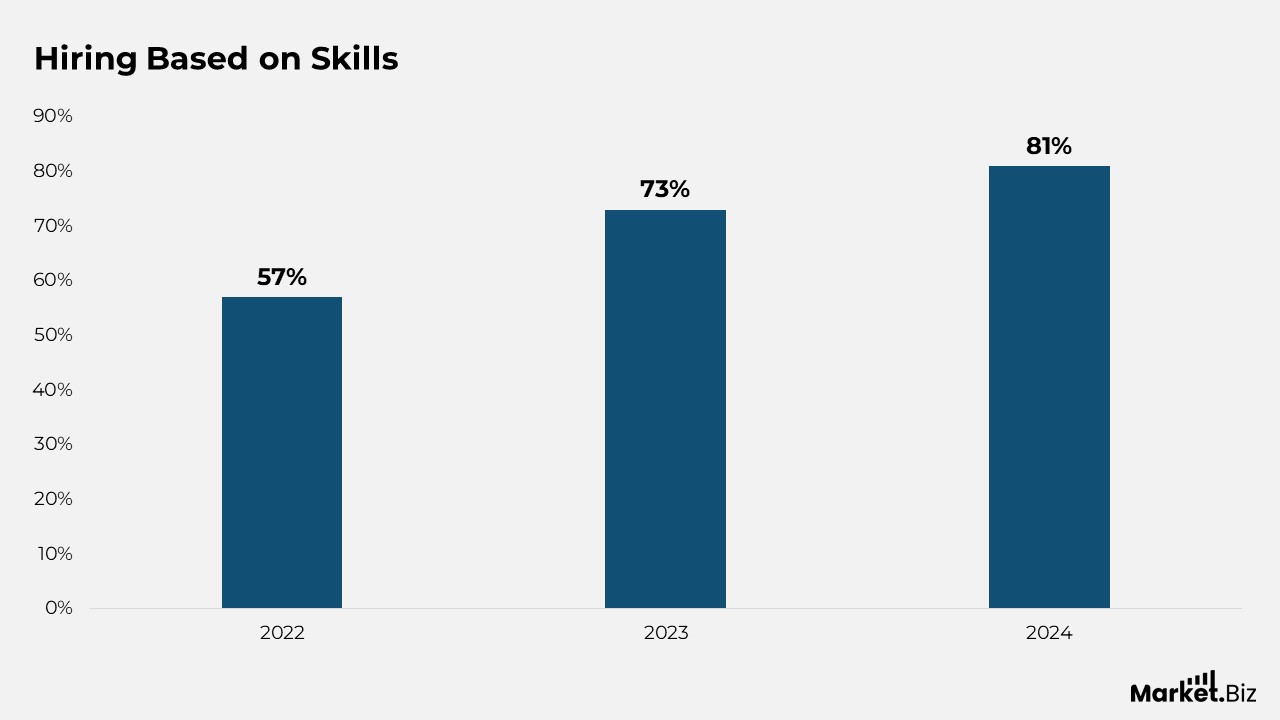
- 81 percent of US employers are using skills-based hiring in 2024, as compared with 73 percent in 2023 and 57 percent in 2022.
- Skills-based hiring is 98% more effective than using resumes to find talent.
- 95% of companies think skills-based hiring will prevail as the most important hiring trend.
- Companies can cut hiring costs by 30% by pinpointing where to recruit best.
- AI will predict staff requirements, which means organizations will be able to plan ahead and fill positions more effectively
What is Recruitment Automation?
Recruitment automation is the technology involved in making the hiring process more efficient and faster with the use of technology and tools to manage and design various elements of hiring. This involves leveraging tools to automate the many processes associated with sourcing of candidates through resume screening or interviewing to scheduling and messaging communications with candidates.
Organisations adopt recruitment automation tools to achieve at least some of the following goals. However, in addition to that, it can actually make the hiring process way more efficient, speed up time-to-hire, and improve the overall candidate experience. IBM research reports that recruiting automation means software to perform these repetitive jobs, freeing up recruiters to concentrate on those items of a higher order.
General Recruitment Automation Statistics
- 99% of hiring managers used AI at some point in their hiring process in 2025.
- 98% of organizations experienced a significant increase in hiring efficiency after using AI tools.
- Even as AI is becoming more prevalent, 93% of hiring managers still claimed that human touch is needed in the hiring process.
- Companies spent 54% more on AI than they did in 2022, for a total of $142.3 billion.
- Very nearly all (99%) of Fortune 500 companies now use some kind of AI recruiting.
- 65% of recruiters incorporate AI in hiring.
- In 2024, half of othe rganizations applied predictive analytics to forecast hiring needs.
- Organizations with data-driven methods saw a 20% decline in hiring expenses.
- Data-driven hiring practices led to a 15% increase in quality-of-hire metrics for business objectives.
- 67% of businesses use AI to sift through really huge numbers of applicants to help the process not become so overwhelming.
- 94% of employers say that skills-based hiring is a better way to predict on-the-job success than evaluating traditional resumes.
- The hiring quality of all organizations increases by 90% when they have assessment solutions based on skills.
- 90% of hiring managers had seen increased diversity in their staff since introducing skills-based hiring.
- Software platforms are decreasing weeks of onboarding time by as much as 80%, helping new employees adapt more quickly.
- There has been a 1,000% year-over-year increase in interview scheduling automation, revealing a clear appetite for more efficient tools to coordinate interviews.
- 50% of applications are up thanks to mobile recruiting solutions, so mobile matters.
- 92% of employers use social media for recruiting and use it as a tool to approach the wider potential talent pool.
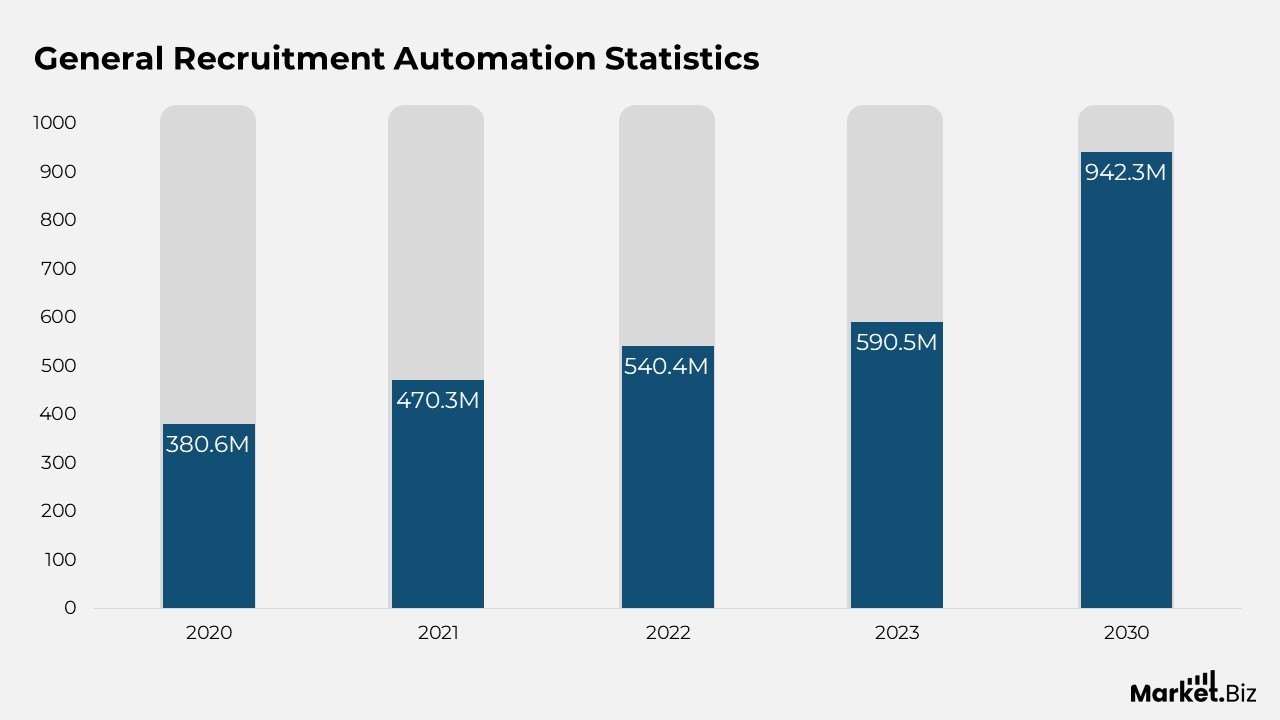
(Source: Businessolution, WP-Content)
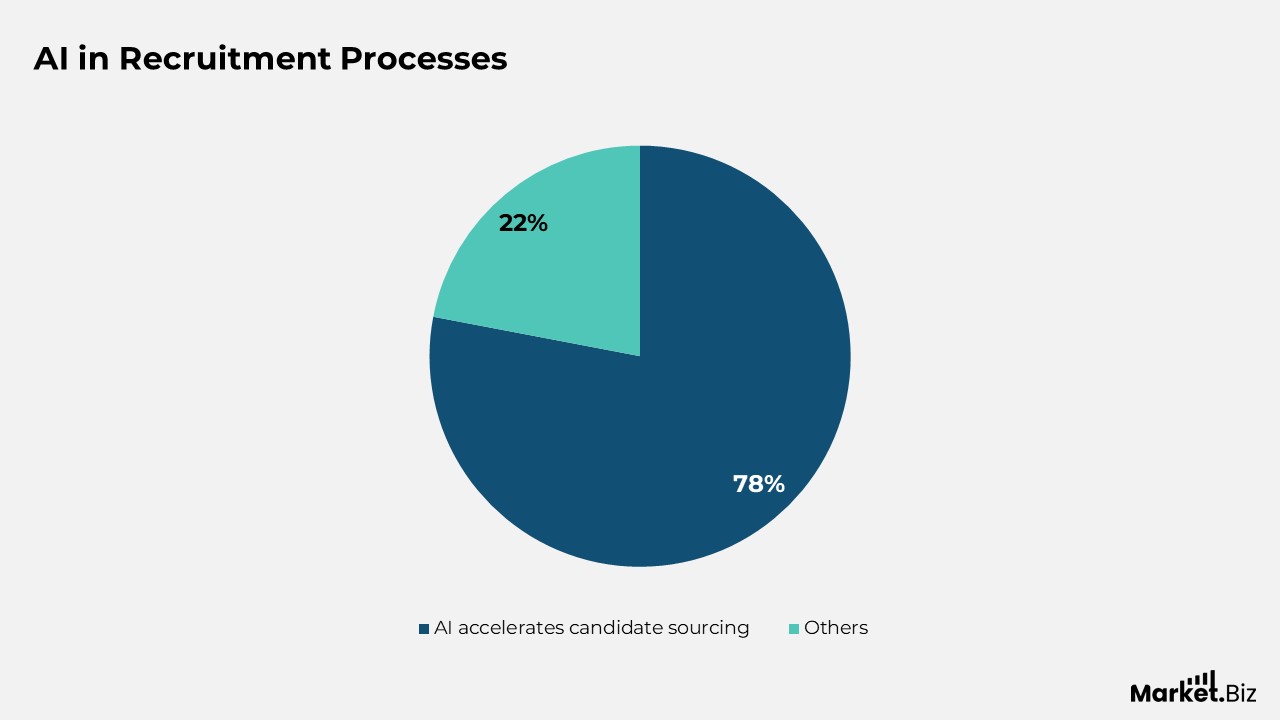
AI in Recruitment Processes
- 78% of recruiters say that AI accelerates candidate sourcing to a great extent.
- 70% of businesses are employing AI to sourcing to a great extent.
- Scheduling tools that use AI cut interview setup times by 75%.
- 68% of recruiters believe AI Chatbots help candidates stay more engaged during the hiring process.
- 55percent of organizations state AI makes hiring more fair by minimizing unconscious bias.
- Just having AI saves at least 25% for companies when it comes to hiring.
- 60% of companies believe AI helps those better fit roles to candidates.
- 48 percent of HR teams believe that AI broadens diversity by allowing them to reach more diverse candidates.
- Recruiters use AI insights to get faster hiring decisions 66%, utilize AI insights to make faster hiring decisions.
- 74% of job applicants would appreciate a streamlined hiring process with AI.
- AI is utilized by 52% of businesses to analyse staff data and forecast future hiring needs.
- AI chatbots manage 30% of candidate questions, reducing recruiter hours of work.
- 63% of employers are using AI to drive remote hiring.
- 59% of HR use AI tools to hire potential candidates.
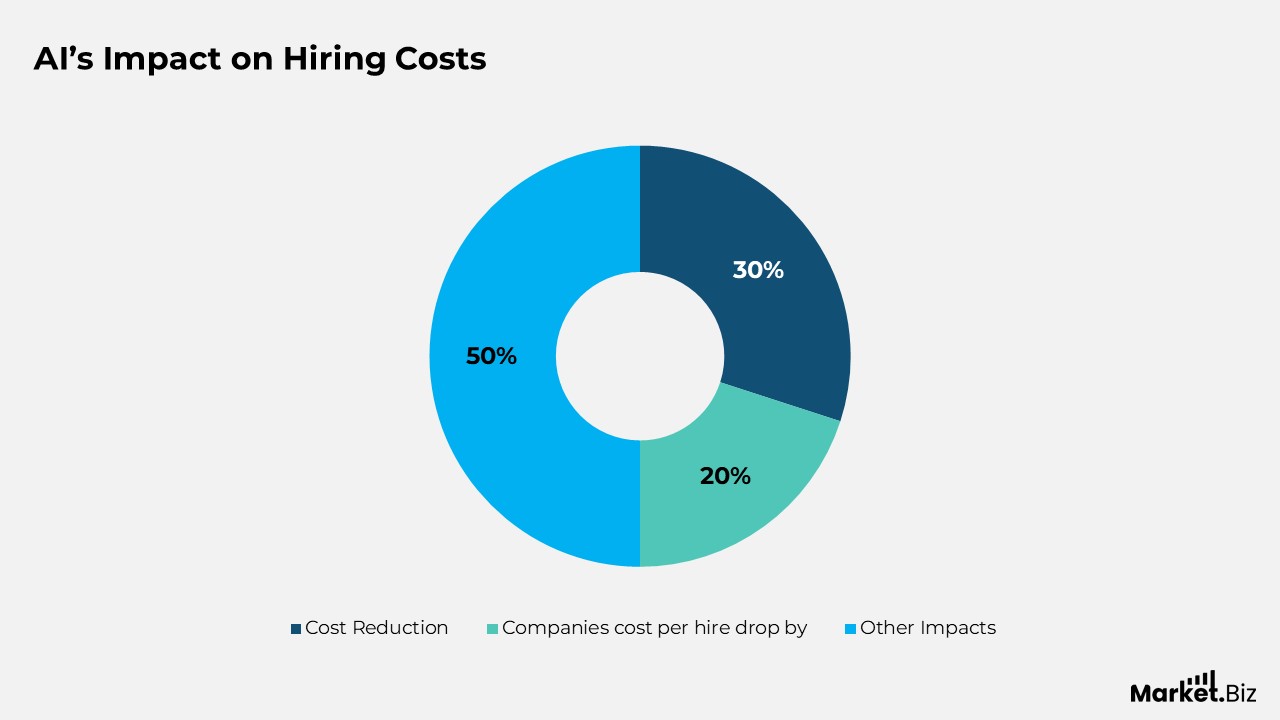
AI’s Impact on Hiring Costs
- If you can use AI to help you hire, you will reduce the cost of hiring by up to 30% per hire.
- People have saves 87.64% in terms of monetary cost by employing conversational AI in hiring as opposed to traditional method.
- 77.9% of businesses say they have saved costs by using AI.
- The cost per screening candidate has fallen by 75% by the use of an AI recruitment tool.
- Enterprise are achieving annual savings of $3.1 million from AI-powered recruiting by reducing cost-per-hire by 32%.
- North American firms benefit most financially by incorporating artificial intelligence based recruitment tools achieving a 37% saving, followed by 36% in Europe.
- Recruitment, AI, and cost savings specifically with AI-enabled recruitment processes, you are looking at nearly 50% time-to-hire reduction due to AI technology.
- 81% of C-suite executives in this category believe that AI will increase the level of efficiency within their industry by at least 25%, decreasing the need for new hires and allowing business to run more smoothly overall.
- In HR, 50% of generative AI users have cut costs.
- AI-powered recruitment solutions can save money, with many companies seeing cost per hire drop by up to 20%.
- In fact, 87% of organisations use AI for recruitment, with many reporting that it adds efficiency to the process and reduces the speed of hire.
- AI helps candidates and job match better, become better hires, and keep costs of turnover down.
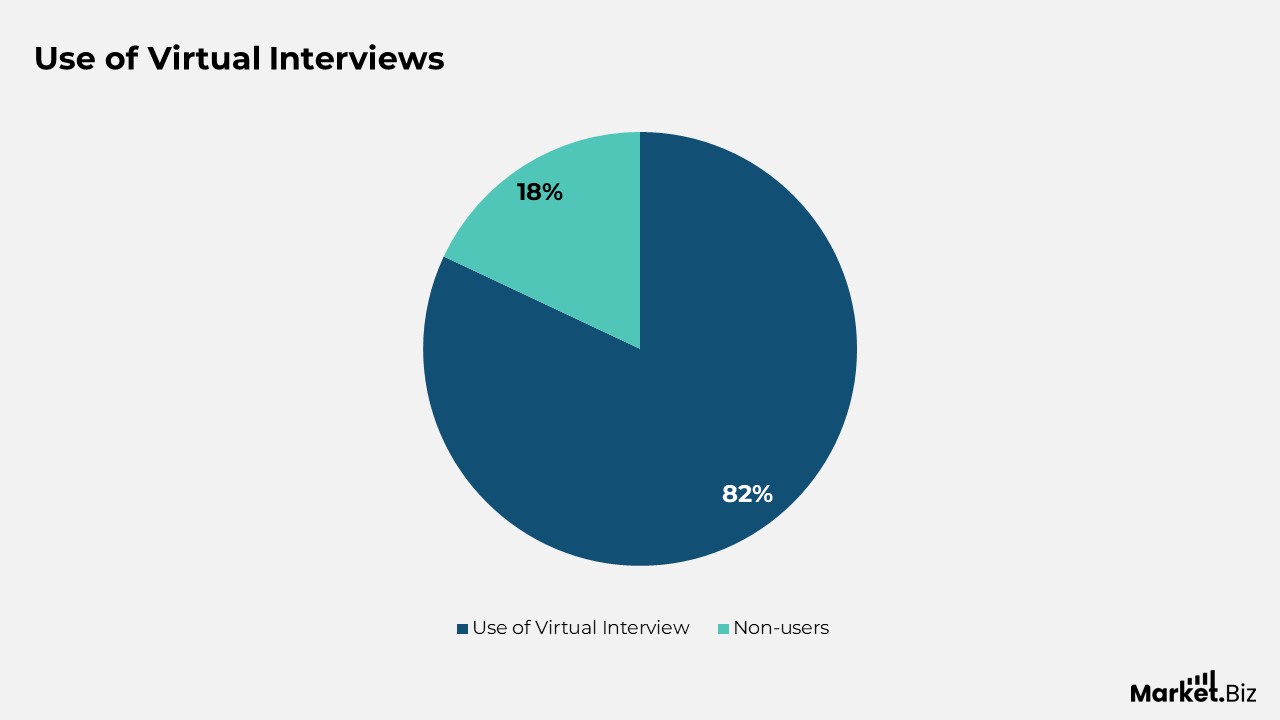
Use of Virtual Interviews
- 82% of hiring managers use virtual interviews as of 2024.
- Corporations today use video telephony and videoconferencing for hiring. Four in ten (47%) of corporations use some form of technology to interview candidates from a distance.
- Virtual interviews save you money from not needing to fork out for travel or venue costs, you can save as much as 70%.
- 84% of candidates scheduled their online interview within 24 hours of invitation, demonstrating candidates are quick to respond.
- Job seekers video interview perceptions 91% of job seekers believe that video interviews improve their perception of prospective employers.
- Virtual interviews allow companies to tap into a wider pool of talent, with 48 percent claiming more geographic diversity among candidates.
- 74% of recruiters claim that online interviews have made them more effective in the screening & selection process.
- Virtual interviews reduce the amount of travel and lead to a reduction in carbon emissions from hiring.
- Interviewing virtually can compress the hiring schedule, leading to faster decision-making and on-boarding.
- Online interviews are more convenient to schedule and fit around a candidate’s time zone.
- Candidates can interview more on the internet, with one performing an average of 14.2 through the service.
- AI being integrated in virtual interviews can more effectively assess skill and culture fit among the candidates.
- 61% of recruiters will continue to use virtual interviews post pandemic.
Mobile Recruiting Trends
- More than 65% of all applications are done from mobile devices, demonstrating the relevance of application processes accessible to mobile.
- 89% of job seekers want to get job-related texts compared to emails, showing the clear change in communication to mobile when it comes to hiring process.
- Recruiters achieve a 50% higher response rate email responses compared to text messages.
- 45% of respondents look at their phones at least once a day for new jobs.
- 68 percent of 18 to 25 year old job seekers do job searching on their smartphones, further driving an urgency to design mobile-friendly platforms.
- Mobile optimized job applications have 11% higher response rates when candidates can apply with ease.
- Only 20% of organizations have mobile-optimized job sites, yet 72% of active candidates have downloaded an app to be notified of job opportunities.
- 79% of those looking for a job use social media and 86% of people looking for a job are active on LinkedIn.
- By a preponderance of 77 percent candidates who are active job-seekers search for jobs via mobile devices, at least on a weekly scale; indicating a significant trend towards mobile job hunting.
- 10% of the workforce would drop an employer if they were not able to apply using their mobile, highlighting the importance of mobile apply solutions.
- Despite 66% of recruiting organizations wanting this capability, only 3% allow external applicants to complete an assessment on mobile.
- Mobile recruitment apps allow candidates to apply for jobs with the touch of a button, making applications a simpler and quicker process.
AI Tools for Recruitment
- Greenhouse: Recruitment tool is AI powered, it uses cognitive intelligence and creates HR friendly job descriptions and communications.
- Pinpoint: An automated applicant sourcing company that optimizes hiring by making the process of screening candidates easier by filtering out people who don’t quite meet your expectations.
- Canditech: Provides AI powered skill tests with video interviews, in order to give a comprehensive overview of candidates’ skills.
- ClearCompany: An AI fuelled talent platform that automates everything from sourcing to on boarding.
- HireVue: The AI driven video interviewing platform that has transformed the way companies assess talent at scale.
- HireEZ: Specializes in high volume sourcing with AI that identifies and reaches out to candidates across all platforms.
- Juicebox (PeopleGPT): An AI recruiting search engine that looks at 800m+ profiles to source the perfect candidate.
- Torre.ai: Uses AI to automate more than 90% of the recruitment journey, from candidate sourcing to screening to ranking.
- TalentRecruit: Offers AI-powered end-to-end life cycles that streamline the working of the recruiter, optimizes hiring process.
Hiring Based on Skills
- 81 percent of US employers are using skills-based hiring in 2024, as compared with 73 percent in 2023 and 57 percent in 2022.
- Skill-based hiring is 5 times more predictive of job performance than hiring based on education, and more than hiring based on education, and more than twice as predicatively valid as hiring based on work experience.
- 90% of companies who implemented skill-based hiring saw a decrease in mis-hires and an improvement in team performance.
- Workers hired on the basis of skills remain on the job 34% longer than their degree holding counterparts.
- Organizations that adopted skills-based hiring solutions decreased their time-to-hire by approximately 25 percent, and some as much as 40 percent.
- Companies typically save 30% in recruiting costs by using pre-screened candidate databases and automated assessments.
- Women are 24% more likely to be hired in underrepresented roles by using skill-based hiring vs the traditional hiring process, research finds.
- Skills-based hiring is 98% more effective than using resumes to find talent.
- 95% of companies think skills-based hiring will prevail as the most important hiring trend.
Use of ChatBots in Recruitment
- In 2024, 41% of the organisations have already included AI driven chatbots in the recruiting strategies for better efficiency and attracting the right candidate.
- Job sites with chatbots see a 95% lift in lead generation of candidates, showing greater candidate interaction and interest.
- Chatbots on career sites and HR portals increase job applications completed by 40%, which increases the application rate due to the streamlined process for users.
- About 66 percent of job seekers chatbot engagements, including after business hours, and the overall chatbot experience shifts to 24/7 availability.
- Organizations are recording a whopping 75% decrease in the cost per candidate screening, thereby realizing great savings.
- A report reveals that 80% of people enjoyed good interaction with chatbots; they are quite effective when it comes to communication.
- Chatbot market worldwide is growing at a steady rate and with its increasing applications in multiple industries, the global chatbot market is estimated to progress from $15.57 billion in 2018 to $19.34 billion by 2034.
- 92% of HR teams require new employees to access chatbots are also involved in on boarding flows.
- 62% of workers use chatbots for HR inquiries, demonstrating their value within HR beyond hiring.
Use of Data Analytics in Recruitment
- By matching the right skills to the right role, analytics tools can help your recruiters find the best candidates who match key job requirements.
- Talent acquisition metrics gives HR teams the ability to measure how well their new hires are doing, connecting the dots of how the hiring process is working for employee performance.
- Insights also inform about strategic workforce planning including predicted hiring needs, based on data, company growth and market trends.
- Time-to-hire is 20% faster for organizations using data analytics to source candidates compared to others.
- Companies can cut hiring costs by 30% by pinpointing where to recruit best.
- Data-driven recruitment also reduces unconscious bias when the interview takes place based on reasons that are not subjective but on the numbers.
- The recruitment analytics industry is expected to reach $1.09 billion by the 2032, Audet said, showcasing how important the tool is in hiring.
- Analysis tools and processes help companies become smarter in hiring; they use historical data to look for trends of the best places to source and talent characteristics.
- By leveraging predictive analytics, employers can predict who will be successful in a role, which leads to greater long-term employee retention.
Benefits of Recruitment Automation
- 67% of employers say automation drastically cuts down on the time it takes to complete hiring processes, which would enable them to concentrate on strategic initiatives.
- Automation tools have driven a 316% growth in adoption YoY, facilitating multiple stages of the hiring process.
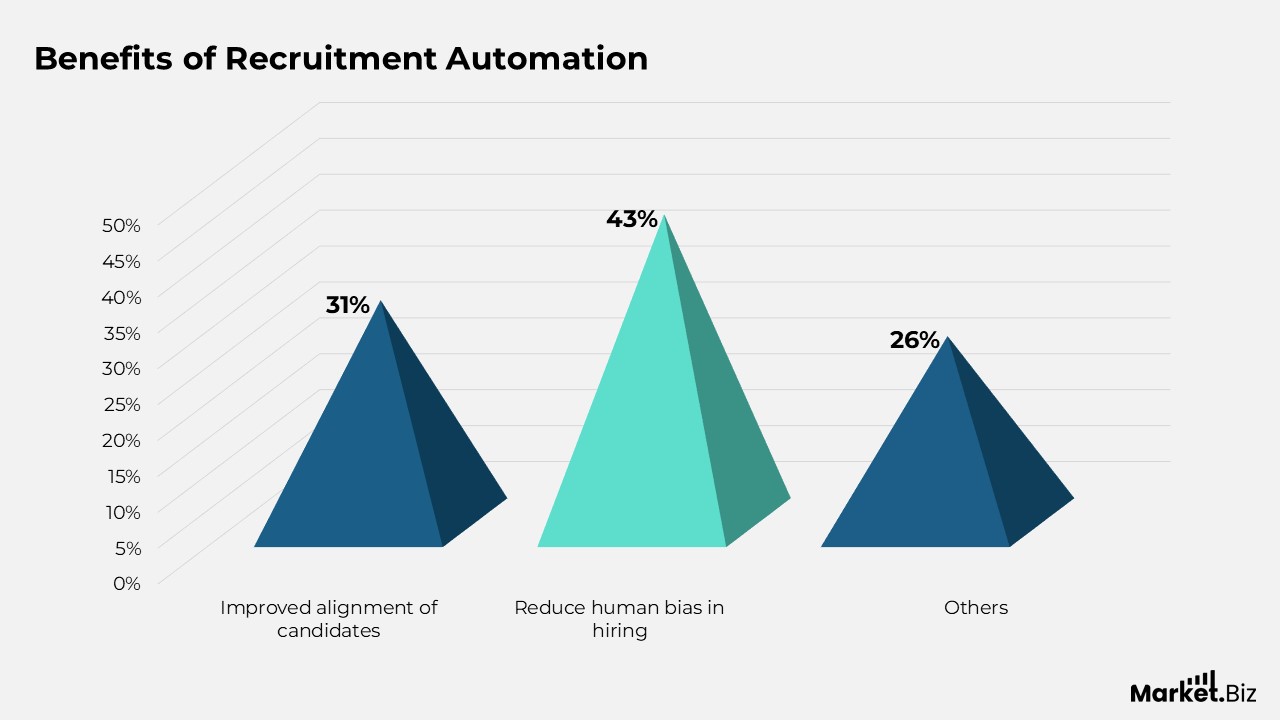
- 31% of companies report that automation has led to improved alignment of candidates and the skills needed for their positions.
- They point to how 43% of companies are also using automation to reduce human bias in hiring, making recruitment more equitable.
- Machine learning software accelerates the evaluation process, so recruiters can evaluate more candidates in less time.
Challenges of Recruitment Automation
- Some 35% of businesses say the upfront cost of recruitment automation technology is a major hindrance.
- 40% of HR professionals are struggling to connect new automation tools to current systems which is leading to a delay in adoption.
- For 50%, automation can bring decline to human interaction and impact candidate experience for the worse.
- And 28% of respondents have experienced the occasional glitch in their automation encounter, which affects the flow of recruitment and the tracking of candidates.
- Automated vetting could discard 15% of good applicants simply because of the way questions were phrased.
- Fears over the security of candidate data are harboured by a third (35%) of organizations that are using automated recruitment tools.
- 42% of organizations struggle to recruit experienced professionals to run and make the most of automated recruitment platforms.
Future trend of Recruitment Automation
- AI will predict staff requirements, which means organizations will be able to plan ahead and fill positions more effectively.
- Human-level AI in the form pf agentic AI would enable decision-making without human input, resulting in at least an eightfold increase in hiring success, that is the number of positive applicant-employer matches.
- In turn, automation will individualize the candidate experience, supplying timely updates and a more seamless application process.
- It’s projected that by 2030, 75% of the hiring process will be automated, making hiring responsibilities all that much easier.
- AI-related tools are increasing the quality of hires in cases, at the same time, companies with AI-enabled messaging are 9% more likely to keep hire quality higher than those that do not.
- Next step, recruitment automation will be dedicated fairer hiring approaches among a wider range of candidate groups.
Conclusion
Automation is revolutionizing the way companies hire by saving time, reducing costs and increasing the quality of candidates. The numbers don’t lie, tools such as AI, chatbots, and data analytics are accelerating and improving hiring. Automation will only increase as more companies adopt digital hiring tools.
But it’s important to strike a balance by bringing in a human element so that candidates still have a positive experience. And companies can use automation in smart ways to construct stronger, more diverse teams. The future of recruitment is bright, digital, and data-driven.
FAQs
Recruitment automation employs software tools based on technologies such as artificial intelligence and chatbots to assist in hiring responsibilities like reviewing resumes, arranging interviews, and finding matches for candidates. It can save time and avoid drudgery.
Recent figures suggest more than three-quarters of companies utilise some type of automation in their recruitment process, and the stat is only going to increase rapidly in the next number of years.