









Introduction
Work From Home Statistics: In 2025, remote work continues to reshape the professional working industry. Recent studies show that 30% of the global workforce is expected to work from home, which shapes a significant rise from 2020’s 24%.
This shift in workplace dynamics highlights the growing importance of flexible work arrangements, with 60% of employees stating they prefer remote options. As businesses adapt to these changes, the need for healthy remote work strategies has never been more critical.
Whether you’re an employer seeking to improve productivity or an employee finding this new standard, understanding the growing remote work statistics is important for future success. This statistical report will help you understand and explore the latest trends in remote work for 2025 to make informed decisions today.
Key Takeaways
- In 2025, 30% of the global workforce will work remotely, up from 24% in 2020. Employers should adapt flexible work models to remain competitive in this growing environment.
- A Stanford study shows remote work boosts productivity by 13%. As employees prefer remote work, businesses can leverage this to enhance performance and employee satisfaction.
- 60% of workers prefer flexible remote work options. If you’re an employer, offering remote opportunities can increase retention and attract top talent in 2025.
- 68% of companies now offer flexible work arrangements, up from 51% in 2023. Embrace hybrid or remote work strategies to meet employee demands and improve business outcomes.
- Companies save an average of $11,315 annually for each remote worker. Implementing remote work can cut overhead costs, increase profitability, and boost employee productivity.
- Remote workers report 20% higher job satisfaction. If you’re looking to improve employee morale, promoting remote work could lead to more engaged and satisfied workers.
- 48% of employees with flexible work arrangements report excellent work-life balance. Companies offering remote work can see improved employee well-being and reduced turnover.
- Office attendance is projected to be 30% lower in 2024 compared to 2019. Businesses must adapt by fostering hybrid or fully remote work environments.
- 54% of professionals would change jobs for more flexible work options. Businesses should offer remote or hybrid work to attract and retain top talent in a competitive job market.
- 56% of companies using AI have seen increased productivity. Investing in AI tools for remote teams can help improve efficiency, collaboration, and decision-making.
General Work From Home Statistics
- Working from home boosted productivity by 13%, according to a Stanford study that polled 16,000 employees over nine months. Employees in the same study reported 50% lower turnover and higher job satisfaction.
- A Connect Solutions research found that 77% of people who work from home at least occasionally each month are more productive, with 24% finishing more work in the same amount of time and 30% finishing more work in less time.
- The desire to work from home 5 or more days a week is shared by 31% of Americans, 22% of Latinos, 15% of Europeans, 21% of Australians, and 16% of Asians.
- Companies in the US and UK are more likely to allow employees to work from home 100% of the time than companies in Australia, South Africa, Brazil, and South Korea.
- 25% of remote workers plan to move to a new location to work as a lifestyle change.
Moreover
- 32% of digital nomads who work outside their home country say that difficulty networking is their biggest challenge, and 23% say that obtaining a visa is their biggest hurdle.
- Most remote workers in the US earn $80,000 to $130,000 per year. In the UK, most earn more than £30,000 per year. In Canada, most earn more than $78,000 CAD, and in South Korea, most earn between $10,000,000 and $40,000,000 CAD.
- 98% of employees would like to work from home for the rest of their careers.
- According to a 2023 survey by Owl Labs, 23% of employees have changed jobs. This is more common among those who work full-time in an office (about 26%). Only 17% of hybrid and remote employees have decided to change employers.
- Flexible work models are now the norm: While only 32% of companies require employees to come into the office full-time, 68% offer remote work options, up from 51% in 2023.
Companies’ Response to Work From Home Statistics
- Only 8% of businesses had flexible workplace policies even before to the 2020 shutdown.
- In 2021, almost two-thirds (62%) had implemented some form of flexible working. Mid-sized companies (501-5,000 employees) were particularly proactive, with 70% introducing work from home arrangements.
- Over time, employer opinions of remote work have continued to change. 73% of those who worked from home during the pandemic eventually went back to the office at least one day a week, according to a 2023 OwlLabs study.
- As of 2024, 74% of companies had promised some flexibility regarding working hours, while 82% planned to return to pre-pandemic working hours after the lockdown.
- The report on the current state of remote work found that in 2022, only 31% of employers offer fully remote work options, while 41% of small and medium-sized businesses (10-50 employees) have asked their employees to return to the office.
- In a McKinsey survey, 58% of respondents said they have the opportunity to work from home at least one day a week.
- Accenture research has found that by 2022, 36% of workers across all industries worldwide will return to a fully on-site work model.
- Another Atlassian survey also found that while 82% of all knowledge workers have some kind of “office obligation,” 25%of workers who could choose to work remotely still feel pressured to go to the office.
- A 2022 U.S. Bureau of Labor Statistics survey found that only 27.5% of private companies (2.5 million companies) have employees who work from home full or part of the time.
- The same U.S. Bureau of Labor Statistics survey found that the highest proportion of teleworkers was in professional and business services, educational services, and wholesale trade, at 67.4%, 49%, 46%, and 39%, respectively.
Pros, Cons, and Challenges of Work From Home Statistics
Pros of remote work
For employees
- A survey by the National Bureau of Economic Research found that teleworkers save an average of 72 minutes of time spent commuting to and from work each day.
- 40% of the saved time can be spent on a primary or secondary job, 34% on leisure, and 11% on caregiving activities.
- A report by Global Workplace Analytics estimates that employees can save $600 to $6,000 per year by working from home half the time. The savings come primarily from reduced transportation, parking, and food costs.
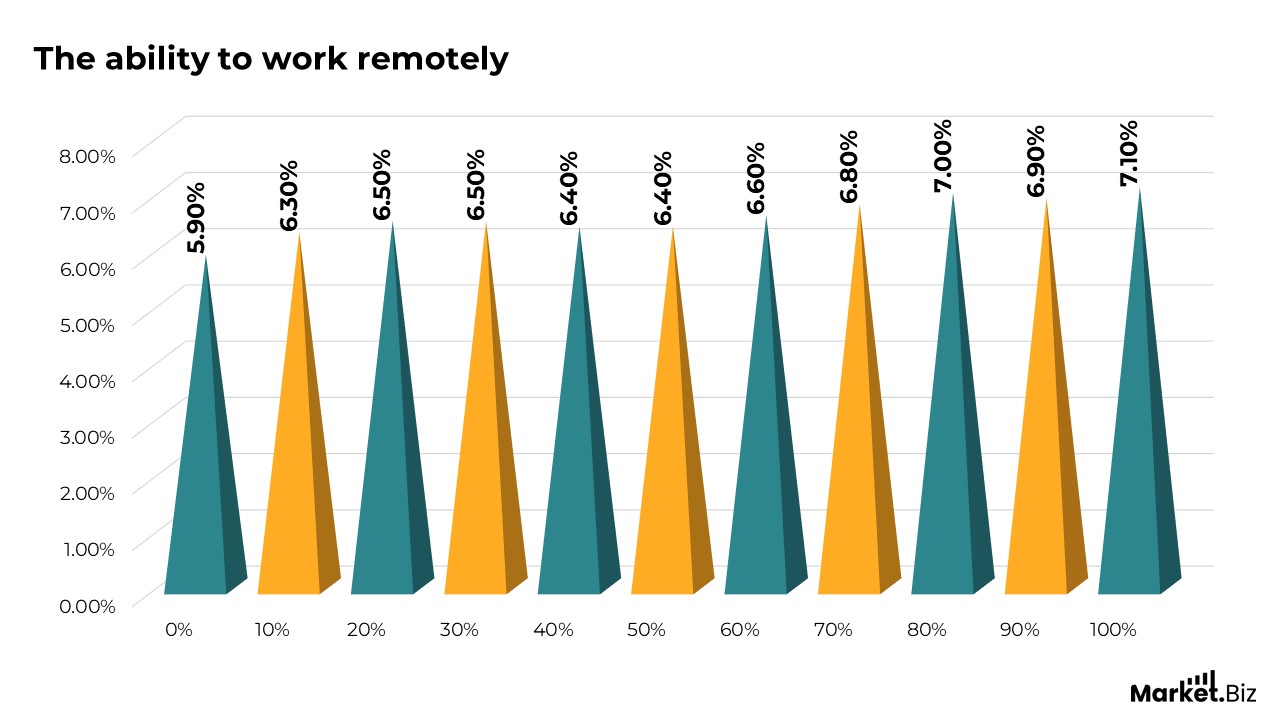
- According to Tracking Happiness, which surveyed 12,455 respondents, working entirely from home increases employee satisfaction by 20%. The survey found that the average job satisfaction of people who work on-site 100% of their time was 5.90 on a scale of 1 to 10, compared to 7.04 for remote workers.
(Source: TrackingHappiness, WP-Content)
- FlexJobs’ survey found that 48% of employees with flexible work arrangements (e.g. part-time, freelance, remote) said they had excellent or very good work-life balance, compared to 36% of employees without flexible work arrangements.
For employers
- According to Gallup research, employees are more engaged when they have the flexibility to work from home or the office. Higher engagement also leads to a 41% reduction in absenteeism and a 40% reduction in quality defects.
- The ideal increase in engagement happens when employees work 60% to 80% of their time outside the office. Working 3-4 days out of a 5-day work week.
- Companies save an average of $11,315 annually and are 21% more profitable for employees who work part-time from home.
- According to research from Owl Labs, remote workers spend less than half of that amount, $423, on communications, phone, and internet, compared to $863 for part-time on-site workers. Utilities, food, and other costs. That’s a $440 monthly or $5,280 annual difference.
- 54% of professionals say they would change jobs for one that offers more flexibility. As a result, turnover decreased by about 12% when remote work was offered as an option.
Cons of Work From Home Statistics
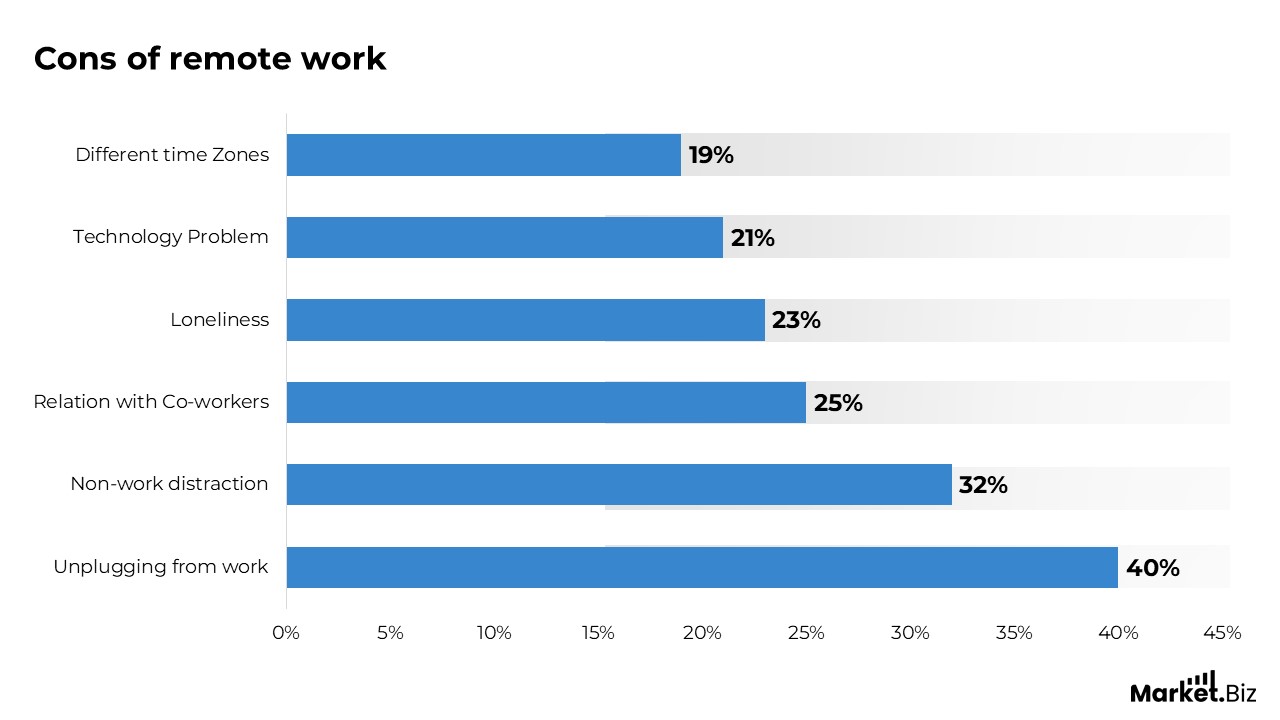
- Additionally, 10% of employees say they don’t feel comfortable working from home, 32% say their home offices are too distracting, and 13% lament the lack of proper equipment.
- According to an MIT study, employees who worked from home reported feeling noticeably more lonely than those who worked in an office. When working from home, 23% of the employees surveyed reported feeling more alone than when working in an office, compared to 19% who reported feeling the same way.
- Having clear boundaries can be difficult when working remotely, which can lead to burnout. 81% of remote workers report checking their email after work, including on weekends (63%) and holidays (34%).
- In 2023, remote workers reported that getting promoted (28%), collaborating (30%), and being acknowledged by leadership (37%), were the most difficult aspects of working remotely.
- It’s difficult to feel connected to co-workers, according to 55% of remote workers. Nonetheless, 25% of workers claimed that working remotely had no effect on their relationships with their co-workers.
(Source: Notta)
Challenges of Work From Home Statistics
- Remote work has many benefits, but it also comes with some challenges. Some remote workers have issues with isolation from spending too much time at home.
- There could be several reasons for this, but in a 2022 survey, 77% of remote workers who feel less productive said it was because of more distractions at home. This is understandable considering that 45% of remote workers use a multi-purpose room, such as a bedroom or study, as a kitchen for work.
- In a remote environment, it is also difficult to separate work and personal life. In one survey, 48% often work beyond their usual working hours, and 44% reported that their working hours have increased compared to the previous year.
- Another big challenge in implementing remote work appears to be perceptions in the workplace. According to one survey, 49% of employees believe their managers view in-office employees as more hardworking and trustworthy than their remote colleagues.
- 10% of employees fear being seen as less productive or engaged while working remotely.
COVID-19 Impact on Work From Home Statistics
Before COVID-19
- A 2019 survey by the Bureau of Labor Statistics found that 24% of workers do some or all of their work from home during the weekdays, while 82% of workers do some or all of their work at the workplace.
- The same Bureau of Labor Statistics survey also found that workers in finance, business, and management occupations (37%) and professional and related occupations (33%) are more likely to do some or all of their work from home during the weekdays, compared to workers in other occupations.
- A 2012 study showed that office workers assigned boring tasks perform better and faster in a regular office environment. If the work is not enjoyable, distractions in their personal lives are more likely to interfere with productivity.
- The same study also showed that the performance of the entire “office” decreases when everyone works from home. Each individual does just as much work as every other individual. This means that no one wants to work anymore and wants to let others ride the wave of success.
- Another recent study found that the longer people work from home, the less productive they are. People who work full-time (8 hours a day) from home are 70% less productive than those who don’t work from home.
After COVID-19
- According to the Stanford University data found that only 65% of Americans have internet speeds fast enough to make video calls. 42% of Americans work from home, and 26% work at their employer’s physical location.
- Great Place to Work compared employee productivity during the first six months of lockdown, March through August 2020, with the same six months in 2019. A two-year study of 800,000 employees found that productivity has remained stable or increased during remote work.
- The Prodoscore reported a 47% increase in productivity since March 2020 (compared to March and April 2019) and discovered when people are most productive.
- The report found that workers are most productive on Tuesdays, Wednesdays, and Thursdays, and between 10:30am and 3pm. The average workday is still between 8:30am and 5:30pm, and more workers are using email and customer relationship management software to stay in touch with colleagues.
- According to a March 2020 survey by Airtasker found that employees who work from home spend less time avoiding work (a 15% difference), work 1.4 more days per month, and take longer breaks.
Role of AI in Work From Home Statistics
- The increased use of AI is forcing companies to take a closer look at how they can protect remote workers’ computers. Nearly 23% of executives say they’ve noticed an increase in cybersecurity incidents since employees began working from home.
- While AI and remote work are not yet fully mature and widely adopted, early reports show that brands leveraging them at scale are seeing an average 25% increase in productivity.
- Just 2 years after GenAI caught the attention of most C-level executives, companies around the world are beginning to adopt it at scale. More than half (56%) say Gen AI has helped employees use their time more efficiently, and nearly a third report increased revenue (32%) and improved profitability (34%).
- Chatbots are another example of AI-powered technology that can help with remote work. Chatbots are software programs that use AI to simulate human conversations and can be used for a variety of tasks, including customer service and technical support.
- AI can analyse market trends, customer interactions, and performance indicators to offer remote workers practical suggestions. Strategic planning, work efficiency, and informed decision-making are all improved by this data-driven approach.
Future of Work From Home Statistics
- Upwork predicts that 32.6 million Americans will work from home next year. This statistic represents about 22% of the global workforce. Based on this prediction, we can assume that the development of remote work will continue and shows no signs of slowing down.
- Slack conducted a survey in six countries and found that 72% of 9,000 employees would prefer a hybrid work model. Only 12% of respondents said they would prefer an office environment, and 13% said they would always prefer to work from home if they had the opportunity.
- For those who work full-time in an office, simply driving to work can have a negative impact on the environment. Working from home for one day can reduce emissions by 2%, while working from home for two to four days can reduce greenhouse gas emissions by up to 29%. If you consider an entire week of remote work, the reduction in emissions is a staggering 54%.
- The survey asked whether remote work will be allowed permanently. 71% of business decision makers answered yes, more than 70% of companies plan to allow remote work in some form, and 8% were unsure, and only 8% answered no.
Moreover
- Hybrid workers cited many benefits of a mixed work schedule, including better work-life balance (76%), more efficient work (64%), less burnout (61%), and increased productivity (52%).
- More than 70% of US executives plan to prioritize virtual collaboration tools. “Virtual collaboration tools” is the most popular area for future investment among US executives, with 72% indicating they intend to prioritize this area.
- 70% of US executives plan to continue investing in “IT infrastructure to ensure virtual connectivity” and 64% want to invest in “training for managers to manage a more virtual workforce.”
- 97.6% of employees say they want to work from home at least a few days a week for the rest of their careers, and 36% of hybrid employees are enthusiastic about their jobs compared to just 30% of fully on-site employees.
- 20% of employees feel they would be more productive if they could choose when to work from home and when to work in the office, and 26% of survey respondents said a hybrid work environment would provide a better work-life balance.
- Office attendance is expected to be 30% lower in 2024 than in 2019, signalling a continuing trend toward hybrid work. A hybrid workforce is approximately 5% more productive than a fully remote or fully onsite workforce.
Conclusion
Remote work is expected to remain a leading force in shaping the workforce industry in 2025, with 30% of the global workforce working from home. The flexibility that remote work offers is highly favored, with 60% of employees preferring remote options. However, challenges remain, such as isolation and difficulty in collaboration, with 55% of remote workers feeling less connected to their co-workers.
Despite this, the benefits are clear—remote workers report higher productivity, job satisfaction, and work-life balance, while businesses also benefit from reduced costs and increased profitability. As we move toward a more flexible future, it’s crucial for both employees and employers to adapt to these changes. Embrace flexible work models and equip your organization for success in the remote work era!
FAQs
According to the most recent Pew Research data, roughly 14% of working adults in the United States—roughly 22 million people—now work exclusively from home. According to Owl Labs, 28% of workers worldwide now work remotely, and 16% of businesses are entirely remote.
Employees say that productivity levels are comparable to or even higher than pre-pandemic levels, despite employers’ doubts about remote workers’ ability to be productive. The main cause of the productivity boost that has been reported is that workers now have more freedom to work whenever it suits their schedules.
In general, remote workers say they enjoy working from home. Sixty-eight percent of Americans would prefer working remotely to coming into the office, and sixty-one percent would even accept a pay reduction in order to do so. It’s still up for debate whether workers want to be entirely or partially remote: 48% of respondents say their wellbeing is improved by a hybrid work model that combines in-office and remote work, and 44% say their wellbeing is improved by a fully remote model.