









Introduction
Big Data Statistics: Big Data Statistics involves the gathering, analysis, and interpretation of large volumes of data from diverse sources, including social media, sensors, online transactions, and digital devices. As businesses increasingly adopt data-driven strategies, the role of big data becomes more crucial.
By applying advanced statistical methods and leveraging powerful computing technologies, organizations can uncover valuable patterns, trends, and insights that fuel innovation and enhance competitive positioning. The growth of technologies such as machine learning, artificial intelligence, and cloud computing has enabled more efficient processing and analysis of massive datasets, leading to improvements in customer experience, operational efficiency, and strategic decision-making.
The global market for big data analytics is expected to grow rapidly, with sectors like healthcare, finance, retail, and manufacturing leading the way in adopting big data solutions.
Editor’s Choice
- Approximately 2.5 quintillion bytes of data are generated every day.
- The Big Data analytics market is forecasted to grow to USD 655 billion by 2029.
- As of 2023, the total volume of data created globally stands at 120 zettabytes, and it is expected to grow to 181 zettabytes by the end of 2025.
- More than 57% of the global data is generated by internet users, with 70% of the world’s data being user-generated.
- Every day, 2.5 quintillion bytes of new data are produced.
- By 2025, 181 zettabytes of data are expected to be generated worldwide.
- The global digital universe currently holds 64 zettabytes of data.
- Users create 70% of all data generated globally
- Over 97% of businesses have made investments in Big Data technologies.
- The Big Data analytics market is estimated to have reached USD 348.21 billion.
General Big Data Statistics
- An internet user generates roughly 1.7 megabytes (MB) of data every second.
- As of January 2024, the global internet user base stands at 5.35 billion, representing 66.2% of the world’s population.
- The total volume of global data is expected to reach 180 zettabytes by 2025.
- By 2025, an estimated 463 zettabytes (ZB) of data will be generated daily, valued at USD 229.4 billion.
- People are projected to create over 181 ZB of data by 2025, equating to 181, followed by 21 zeros.
- By 2025, 55.7 billion IoT devices are expected to be connected, contributing nearly 80 ZB of data on their own.
- It would take an internet user over 180 million years to download all the data available on the web.
- Nearly 80% of companies believe that between 50% and 90% of their data is unstructured, including text, video, audio, web logs, and social media content.
- The global Big Data and Analytics market is valued at over USD 348 billion.
- Approximately 402.74 million terabytes of data are produced every day.
- The entire digital universe currently contains over 147 zettabytes of data.
- Only about 2% of new data is retained after one year.
- Around 1 in 4 business executives report that their company’s Big Data efforts are profitable.
(Source: Capgemini, Statista, IDC, Semrush Inc., SiliconANGLE, Meetanshi Technologies LLP, G2.com, Inc.)
Global Big Data Storage Trends
- By 2025, it is estimated that 100 zettabytes of data will be stored in the cloud.
- Around 65.28% of individuals rely on personal cloud storage as their primary method for data storage.
- By 2025, unstructured data is expected to account for nearly 80% of all stored data.
(Source: Capgemini, Statista, Meetanshi Technologies LLP)
Big Data in the E-commerce Market Size
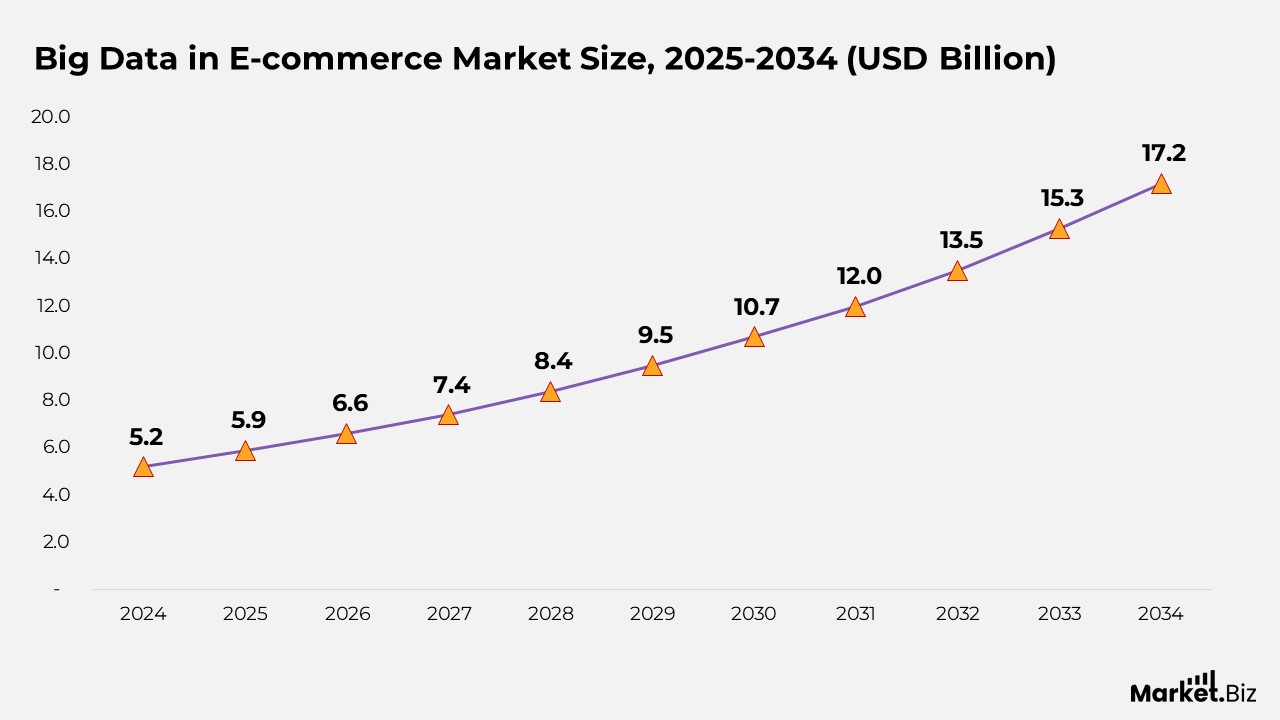
- According to Market.us, the big data in E-commerce market is expected to rise from $5.9 billion in 2025 to $17.2billion by 2034, representing a compound annual growth rate (CAGR) of 12.7% from 2025 to 2034.
- The growth of online shopping is fueling the expansion of the market, providing a wealth of data that can be leveraged for strategic business decisions. This increase is driven by the widespread shift toward e-commerce and the growing demand for data analysis to refine business operations and customer engagement.
- Progress in AI and machine learning technologies has greatly enhanced the speed and accuracy of processing large datasets. These technologies enable businesses to perform real-time analytics, leading to optimized marketing strategies, improved customer insights, and more agile decision-making.
- 40% of the market share in Big Data for e-commerce in 2024 was held by North America, generating USD 2.08 billion in revenue. This dominance is attributed to the region’s robust technological infrastructure, high adoption rate of digital services, and ongoing investments in cloud technologies and data-driven solutions.
- North America benefits from a superior technological infrastructure that encourages the widespread integration of Big Data analytics in e-commerce. The region’s favourable environment, including advanced internet connectivity, digital adoption, and regulatory support, facilitates the seamless integration of Big Data tools into businesses.
- In 2024, the U.S. Big Data market for e-commerce was valued at USD 1.9 billion, with a 10.4% CAGR forecasted. This upward trend reflects the increasing reliance on data to make informed business decisions, enhance customer experiences, and drive personalized marketing efforts.
Moreover
- The software segment commanded 68% of the Big Data market share in e-commerce in 2024, reflecting its critical role in data analytics and processing. E-commerce businesses depend on software for various tasks such as consumer behavior analysis, sales forecasting, and creating personalized customer experiences.
- The cloud-based segment dominated the big data in the e-commerce sector with a 65% share in 2024, thanks to the scalability, flexibility, and cost-effectiveness of cloud solutions. Cloud-based technologies are pivotal in managing the massive volumes of data generated by e-commerce platforms, enabling efficient processing and storage.
- Structured data captured 57% of the market share in Big Data for e-commerce in 2024. Its prominence stems from its well-organised nature, making it easier for e-commerce companies to process and derive insights for activities like inventory management, sales forecasting, and customer behavior analysis.
- In 2024, the Customer Experience Management (CEM) segment accounted for 30% of the Big Data market share in e-commerce. This segment’s growth highlights the growing importance of data-driven strategies to enhance customer experience, personalize offerings, and foster customer loyalty.
- The retail segment led the Big Data market in e-commerce with 40% of the share in 2024. Retailers increasingly leverage Big Data to optimize pricing, enhance product recommendations, and streamline inventory management, helping them maintain a competitive edge in a dynamic e-commerce landscape.
- According to BigCommerce, 87% of consumers are more likely to complete a purchase when e-commerce platforms offer personalized shopping experiences. Personalization plays a critical role in boosting customer conversion rates by tailoring offers and recommendations to individual preferences.
- A BARC study reveals that 52% of e-commerce companies gain deeper insights into customer behaviors, and 47% manage to reduce operational costs by leveraging Big Data. These efficiencies are achieved through improved targeting, enhanced customer satisfaction, and optimized resource allocation.
(Source: Market.us)
Big Data Consulting Market Size
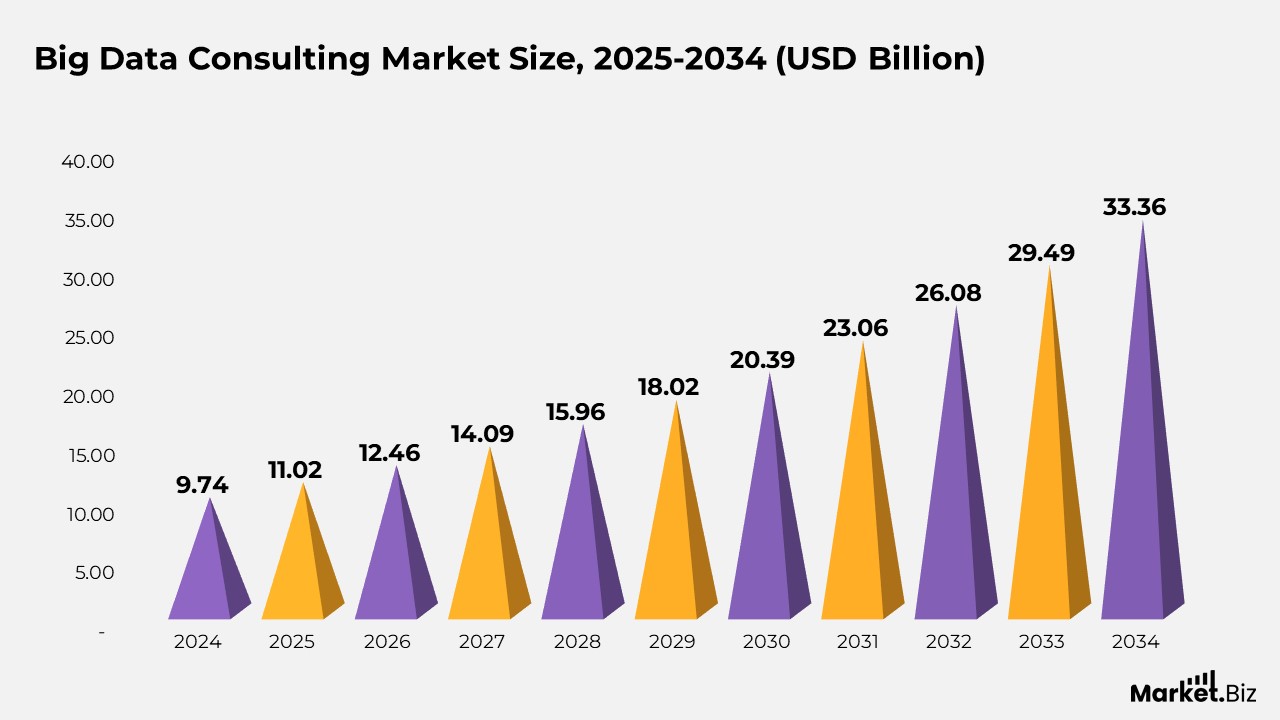
- According to Market.us, the big data consulting market is expected to rise from $11.02 billion in 2025 to $33.36 billion by 2034, representing a compound annual growth rate (CAGR) of 13.10% from 2025 to 2034.
- The market growth is driven by the rising demand for professional services to help businesses utilize large data volumes for decision-making, operational optimization, and gaining a competitive edge.
- The United States leads the Big Data Consulting market in North America, generating USD 3.43 billion in revenue and maintaining a strong 11.8% CAGR due to increased reliance on Big Data solutions in industries like BFSI, healthcare, and manufacturing.
- In 2024, North America accounted for more than 38% of the global Big Data Consulting market, with a revenue of approximately USD 3.70 billion, supported by advanced infrastructure and the widespread adoption of digital transformation strategies.
- The consulting services segment dominated the Big Data Consulting market in 2024, holding more than 40% of the market share, driven by businesses’ growing need for customized data strategies.
- In 2024, the on-premises segment captured more than 57% of the market share, as large enterprises in sectors like banking, finance, and healthcare prefer full control over their data infrastructure.
- The BFSI segment held more than 21% of the market share in 2024, driven by the sector’s increasing reliance on Big Data for enhanced decision-making, risk management, and customer experience.
(Source: Meetanshi Technologies LLP, Tech Target)
Big Data Use Cases
- Data warehouse forecasting and optimization were identified as the top use cases for Big Data, with more than 80% of respondents highlighting their significance.
- Customer and social analysis, predictive maintenance, fraud detection, clickstream analysis, and IoT ranked next, with over 70% of survey participants marking these as crucial.
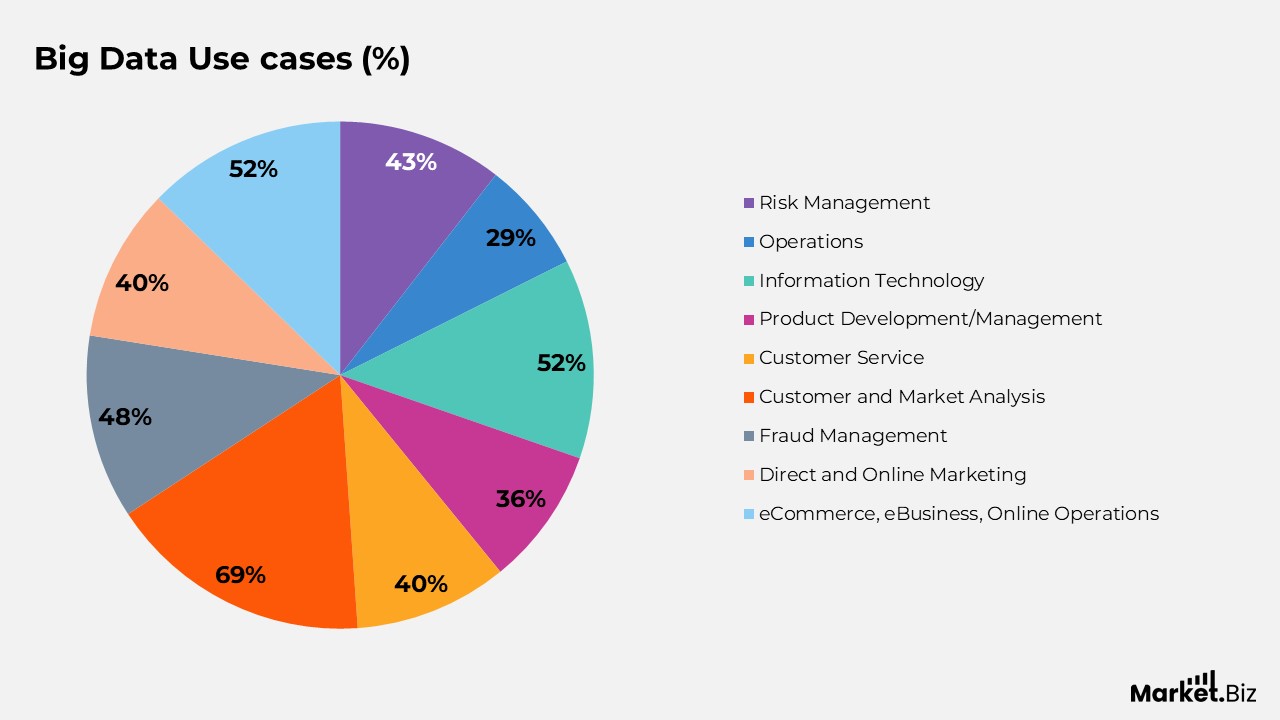
- Customer and market analysis (69%) is the primary business function driving Big Data initiatives, followed by Online Operations (52%) and IT (52%).
(Source: AIMultiple, Statista, DemandSage)
Challenges of Big Data
- Between 60% and 73% of all data within an enterprise remains unused for analytics on average.
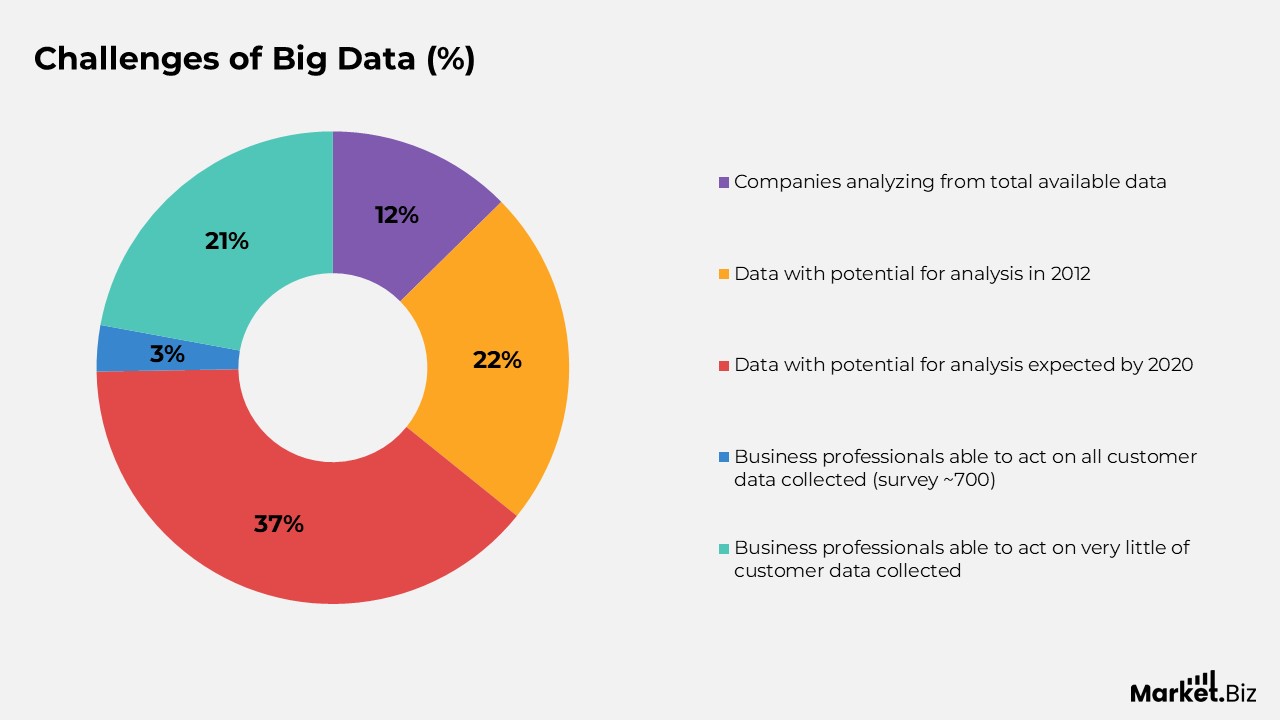
- Companies are only analyzing 12% of the available data.
- In 2012, only 22% of all data had the potential for analysis, with this figure expected to rise to 37% by 2020.
- In a survey of approximately 700 business professionals, only 3% reported being able to act on all of the customer data they collect, while 21% could act on very little of it.
- Around 70% of C-suite leaders identify security and risk management as the most critical challenges in big data analytics.
- Concerns such as metadata handling and governance issues are highlighted by 41% of executives, while 31% point to delays from slow data ingestion processes.
- For 61% of organizations, the rapidly expanding volume of data is seen as a barrier to fully leveraging its potential.
- Data specialists report an average monthly increase of 63% in the volume of data within their firms.
- Over 80% of IT decision-makers acknowledge that analytics initiatives are often delayed because required data is not readily available in the correct format.
- Poor data quality forces 8 out of 10 businesses to revisit and rework their analytics projects.
- Nearly 49% of executives believe existing data solutions lack the necessary flexibility to meet their needs.
- Only 25% of companies feel confident they are doing enough to promote the responsible and ethical use of data across their operations and industry.
(Source: AIMultiple, Statista, DemandSage)
Why is Big Data important?
- In 2013, it was claimed that 90% of the world’s data had been created in just the previous two years, and the rate of data production continues to double every two years.
- In 2017, over 2.5 quintillion bytes of data were generated globally every day, and the total volume of data created worldwide is projected to reach 149 zettabytes by 2045.
- The global datasphere is expected to grow from 45 zettabytes (ZB) in 2019 to 175 ZB by 2025.
- The amount of the global data sphere subject to analysis is anticipated to grow to 5 zettabytes by 2025.
- It was estimated that by 2020, 1.7MB of data would be created every second for every person on Earth.
- By 2020, there were expected to be over 2.9 million job postings for data science and analytics roles in the United States alone.
- Every minute worldwide:
- 500k tweets are shared on Twitter.
- 69k minutes of video are streamed on Netflix.
- 4 million videos are watched on YouTube.
- Over 100 million spam emails are sent.
- 46k new posts are made on Instagram, and 250k stories are shared.
- 527k photos are shared on Snapchat.
- Americans use 2.6 million GB of internet data.
- 3.6 million searches are made on Google.
- 15 million text messages are sent.
(Source: IBM, IDC, Domo, PwC)
Business Big Data Adoption Statistics
- 90% of businesses consider data and analytics essential for their organization’s digital transformation.
- 36% of organizations classify big data as a critical function, 29% as very important, 20% as important, and 12% as somewhat important.
- In 2018, 60% of survey respondents reported using big data globally.
- In 2017, IBM led the big data and analytics market with $2.66 billion in revenue.
- Companies spent approximately $187 billion on big data analytics in 2019.
- The top industries contributing to the largest share of big data and analytics revenues in 2018 include process manufacturing (9%), discrete manufacturing (12%), professional services (8%), banking (14%), and government (7%).
- These top 5 industries collectively accounted for nearly 50% of global big data and analytics revenue generation.
- On average, companies analyze only 12% of the data they collect.
(Source: IBM, IDC, Domo, PwC)
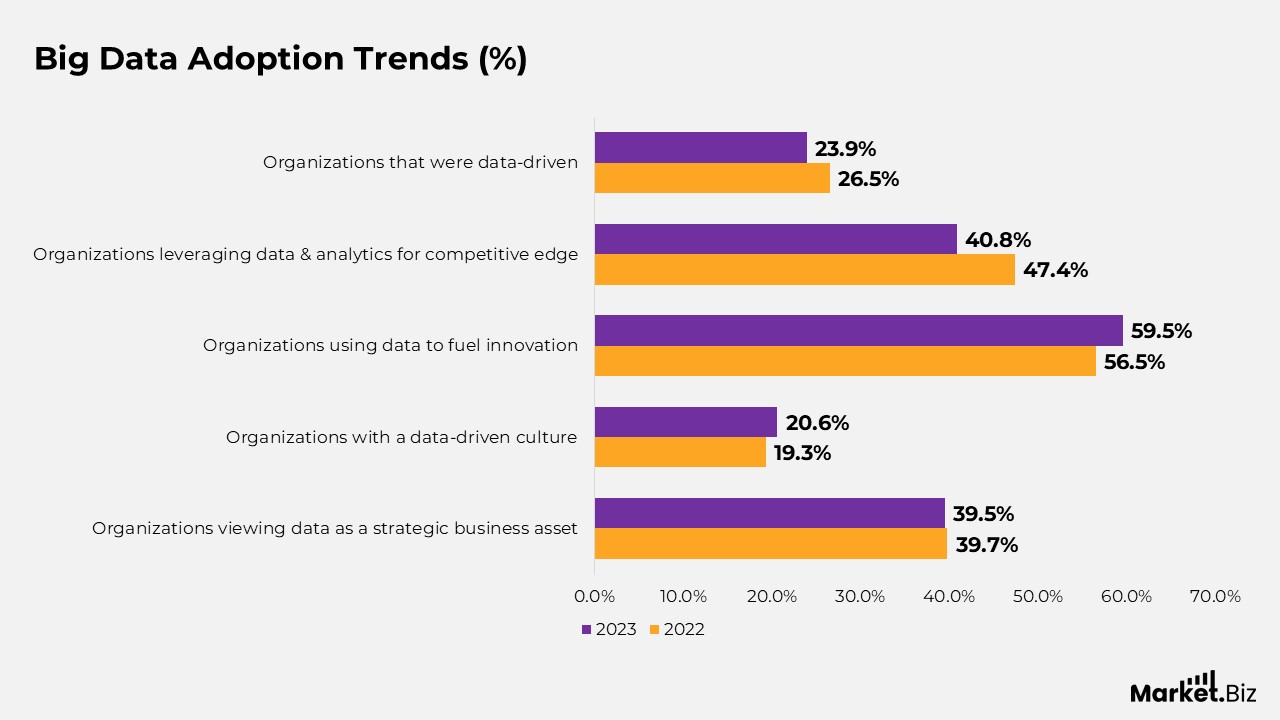
Big Data Adoption Trends
- In 2022, 39.7% of organizations viewed data as a strategic business asset, with this percentage slightly declining to 39.5% in 2023.
- 19.3% of organizations had cultivated a data-driven culture in 2022, which grew to 20.6% in 2023.
- 56.5% of organizations used data to fuel innovation in 2022, a figure that increased to 59.5% in 2023.
- In 2022, 47.4% of organizations leveraged data and analytics for competitive advantage, but this dropped to 40.8% in 2023.
- 26.5% of organizations were data-driven in 2022, while this figure fell to 23.9% in 2023.
(Source: Statista, DemandSage)
Benefits of Big Data Statistics
- Nearly two-thirds of digital leaders believe that big data and analytics will be among the top 2 technologies driving competitive advantage in 2024.
- 82% of organizations with advanced data and analytics maturity experienced positive year-over-year revenue growth over the past 3 years.
- On average, organizations manage around 400 data sources.
- Over 50% of executives report leveraging data to drive business innovation.
- 92% of data leaders claim their organizations have achieved measurable business value from investments in data and analytics.
- 78% of data executives anticipate an increase in their data-related investments in 2024.
- 40% of companies have witnessed tangible benefits and cost savings from their data and analytics initiatives.
- 22% of CEOs regard the effective use of data to create new products and services as a key driver of their growth over the next 5 years.
- One-fifth of digital leaders feel they are successfully utilizing data insights to generate additional revenue.
(Source: Statista, G2.com, Inc., DemandSage)
Conclusion
Big Data Statistics: Big Data is playing a crucial role in transforming industries and driving business strategies worldwide. As data generation continues to grow, companies are increasingly utilizing advanced technologies such as AI, machine learning, and cloud computing to extract valuable insights that enhance decision-making, streamline operations, and maintain a competitive advantage.
The expansion of the market is particularly fueled by sectors such as BFSI, healthcare, and manufacturing, which are rapidly embracing data-driven solutions. With North America at the forefront, the future of Big Data Statistics looks promising, with ongoing innovations and broader adoption across industries poised to boost growth and create new opportunities. The ability to effectively harness and analyze vast amounts of data will continue to be a critical factor for organizations aiming to thrive in an increasingly data-driven environment.
FAQ’s
Big Data Statistics involves the collection, analysis, and interpretation of large, complex datasets using statistical methods and tools. The goal is to identify patterns, trends, and insights that assist businesses in making informed decisions and optimizing their operations.
Big Data enables businesses to quickly and accurately analyze large volumes of data, allowing for data-driven decision-making. It aids in streamlining operations, enhancing customer experiences, refining marketing strategies, and securing a competitive edge in the marketplace.
Sectors such as Banking, Financial Services, and Insurance (BFSI), healthcare, manufacturing, retail, and technology are among the primary beneficiaries of Big Data. These industries leverage data analytics to improve decision-making, increase efficiency, and offer more personalized services to their customers.
Big Data Analytics relies on advanced technologies such as Artificial Intelligence (AI), machine learning, cloud computing, data mining, and predictive analytics. These tools help process large datasets, derive meaningful insights, and facilitate real-time decision-making.
Big Data enables businesses to make more informed decisions by providing deep insights into customer behavior, market trends, and operational efficiencies. It allows companies to refine their strategies, anticipate future trends, and proactively adjust their business models for improved performance.