









Introduction
Performance Management Statistics: Performance management plays a key role in helping organizations boost employee performance and reach business goals. Recent studies show that only 35% of U.S. employees are truly engaged at work, which highlights the need for better performance management practices. Companies with strong performance management systems see 14.9% lower turnover and 30% higher profitability.
In fact, over 85% of businesses worldwide are now using performance management technology, leading to a 12% boost in employee productivity. These numbers show just how important it is for organizations to focus on effective strategies that keep employees engaged and working toward success.
Editor’s Choice
- 35% of U.S. employees are engaged at work, highlighting the need for better performance management practices.
- Companies with strong performance management systems see 14.9% lower turnover and 30% higher profitability.
- 85% of businesses worldwide now use performance management technology, resulting in a 12% boost in productivity.
- 75% of organizations rate employee performance management as a high priority for business success.
- 70% of employees say feedback improves their performance and engagement.
- 86% of HR professionals believe performance management is key to employee development and retention.
- 72% of employees prefer regular feedback instead of annual performance reviews.
- Companies with performance management systems see an 82% increase in employee satisfaction.
- 78% of HR leaders believe that performance management drives organizational success.
- 61% of organizations have adopted AI-driven tools to assist in performance management, improving feedback collection and analysis.
General Performance Management Statistics
- Organizations rate employee performance management as a high priority for business success at 75%.
- High-performing organizations with a defined performance management process make up 87%.
- Employees who report not receiving regular feedback, impacting performance, is 54%.
- Companies that believe their performance management process is effective in driving business outcomes is only 8%.
- Employees who say feedback improves their performance and engagement account for 70%.
- Companies with strong performance management systems see 29% higher revenue per employee.
- Businesses that do not align their performance management system with overall business strategy are 60%.
- HR leaders who believe performance management drives organizational success is 78%.
- Employees who want more regular feedback instead of annual reviews is 75%.
- Companies that report using some form of performance appraisal are 98%, but only 14% say they are happy with the results.
- Organizations that implement continuous feedback experience a 15% increase in employee performance.
- Employees who receive regular feedback are 3 times more likely to be engaged in their work.
- High-performing companies using technology for performance management systems represent 90%.
- Employees who feel that performance reviews are outdated and not beneficial is 70%.
- Performance management software boosts productivity by 12% in companies that use it effectively.
- Businesses with performance management systems report an increase in employee satisfaction by 82%.
- HR professionals who say performance management is key to employee development and retention is 86%.
- Companies with continuous performance management processes experience 31% lower turnover rates.
- According to data from performance management, 26% of workers think well of their employers.
- 17% of workers believe their bosses are unfriendly.
- According to 43% of employers, their employers are doing well.
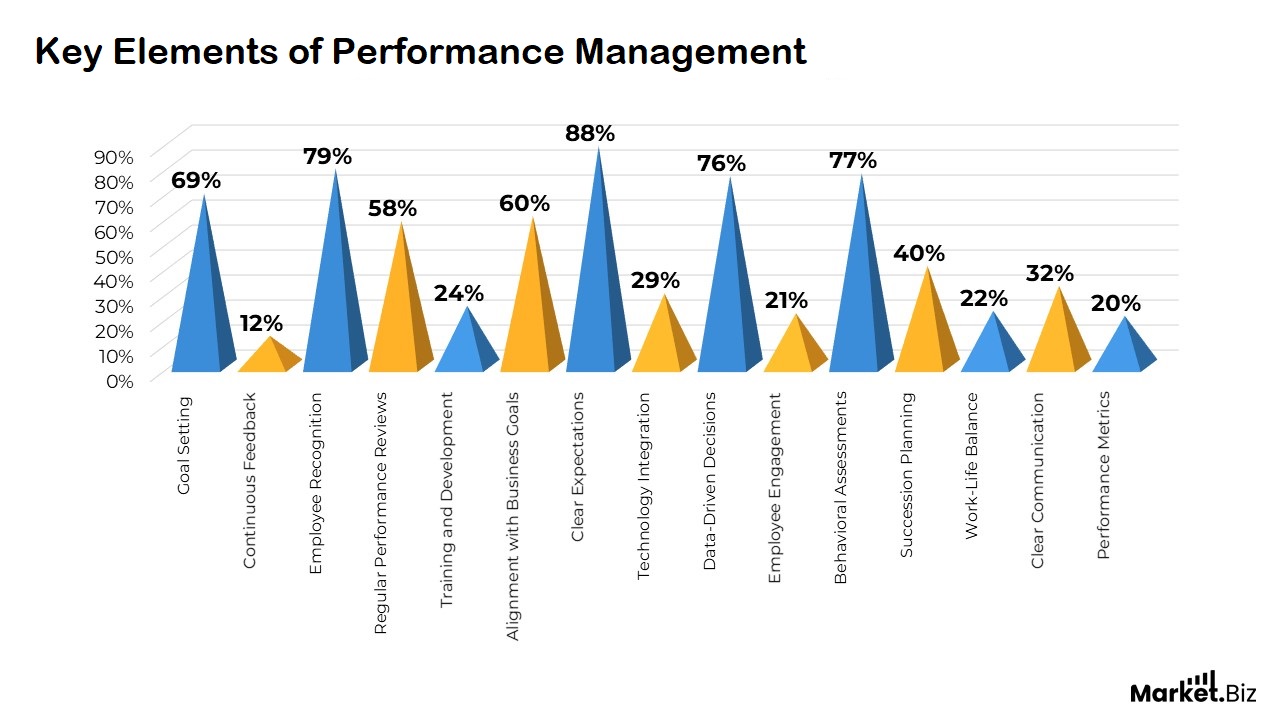
Key Elements of Performance Management
- Goal Setting
Clear, measurable goals enhance performance, with 69% of employees more likely to be engaged when they understand their work objectives.
- Continuous Feedback
Ongoing feedback increases employee engagement by 12%, helping workers improve consistently.
- Employee Recognition
79% of employees say they would work harder if they were better recognized, emphasizing the importance of recognition in performance management.
- Regular Performance Reviews
58% of companies still rely on annual performance reviews, although ongoing check-ins are being adopted by more organizations.
- Training and Development
Investing in employee growth, such as through training programs, results in a 24% improvement in employee performance.
- Alignment with Business Goals
60% of high-performing companies align individual performance with broader business objectives to drive company success.
- Clear Expectations
88% of employees perform better when they have clear expectations and understand what is required from them.
- Technology Integration
Companies using performance management software report 29% higher productivity and streamlined feedback processes.
- Data-Driven Decisions
76% of HR professionals use data to make informed decisions about employee performance and development.
- Employee Engagement
A focus on engagement leads to 21% higher profitability, as engaged employees are more productive and committed.
- Behavioral Assessments
77% of organizations use behavioral assessments to evaluate and guide performance, helping to shape future development strategies.
- Succession Planning
Performance management systems that include succession planning help to develop future leaders and reduce turnover by 40%.
- Work-Life Balance
Employees who feel supported in their work-life balance are 22% more likely to be satisfied with their performance and stay longer at the company.
- Clear Communication
Regular communication between managers and employees leads to a 32% higher likelihood of meeting performance goals.
- Performance Metrics
Companies that use specific performance metrics to track employee achievements report 20% higher retention rates and overall productivity.
Employer Relations in Performance Management
- 82% of employees say clear communication from their employer is key to enhancing performance and fostering strong relationships.
- Companies with high levels of trust report 15% greater employee productivity, as employees feel more supported in their roles.
- 72% of employees feel more valued when employers provide continuous feedback, which boosts engagement and performance.
- Transparent communication about performance expectations and business goals increases employee satisfaction by 30%.
- Organizations that actively manage conflicts in performance discussions see a 20% improvement in employee retention.
- Companies where employees are empowered to take ownership of their performance see 18% higher motivation and engagement levels.
- 79% of employees report that being recognized for good performance strengthens their relationship with their employer and boosts productivity.
- Employees who feel supported by their managers are 36% more likely to meet their performance goals and remain loyal to the company.
- Employers that promote work-life balance report a 25% reduction in employee burnout and improved overall performance.
- Offering career development programs contributes to 24% higher job satisfaction and enhances employer-employee relationships.
- 67% of employees believe fair and unbiased performance reviews foster better employer relationships and job satisfaction.
- A positive organizational culture where performance is regularly discussed leads to a 20% increase in employee commitment and performance outcomes.
Employees Cause of Concern
- 54% of employees report feeling burned out at work, with overwork being the leading cause of this stress.
- 63% of employees feel stagnant in their current roles, leading to disengagement and higher turnover rates.
- Employees with poor work-life balance are 30% more likely to experience job dissatisfaction and burnout.
- 50% of employees say their compensation does not reflect their level of work, which negatively impacts morale and retention.
- 42% of employees report confusion about their roles and expectations, causing stress and inefficiency in their work.
- 70% of employees say they would be more motivated if their efforts were regularly recognized by their employer.
- 58% of employees feel they don’t receive enough feedback to improve their performance, leading to frustration and decreased productivity.
- Employees in toxic work environments are 2.5 times more likely to quit, negatively affecting both morale and productivity.
- 45% of employees report feeling insecure about their job stability, which can reduce their overall job satisfaction and performance.
- 66% of employees seek jobs with more professional development opportunities, highlighting a concern for career advancement.
- 40% of employees feel that their workload is unmanageable, leading to stress and lower job satisfaction.
- Employees who feel unsupported by leadership are 3 times more likely to report high levels of stress and dissatisfaction at work.
Employee Feedback Statistics
- Employees say they feel more motivated to improve their work when they receive specific and actionable feedback at 92% of the time.
- Employees report feeling underappreciated when feedback is not provided, leading to lower morale and engagement at 47% of employees.
- 76% of employees say they would perform better if they received more constructive feedback from their managers.
- Employees believe their employers do not act on the feedback they provide, reducing trust in the feedback process at 48% of employees.
- 83% of employees agree that feedback improves their ability to grow and adapt within their role.
- Employees say they would be more likely to stay with a company that values and acts on employee feedback at 61%.
- Workers believe their workplace lacks a culture of open feedback, which negatively impacts overall productivity at 55%.
- 63% of employees prefer real-time feedback over annual performance reviews, favouring immediate, actionable insights.
- Employees say receiving regular feedback has a positive effect on their overall job satisfaction at 71%.
- Employees who receive feedback at least once a month are 27% more likely to meet their goals compared to those who receive it less frequently.
- 78% of employees agree that their performance would improve if their manager focused on their strengths during feedback discussions.
- Employees say they have never received feedback that was focused on personal growth or development opportunities at 45%.
- 37% of employees would prefer their feedback to come from peers, not just managers, indicating a desire for more well-rounded perspectives.
- Companies with regular feedback processes report higher employee engagement and job satisfaction at 65%.
- Employees prefer feedback delivered in a written format as it allows them to reflect on the comments and track their progress at 60%.
Remote Performance Management Statistics
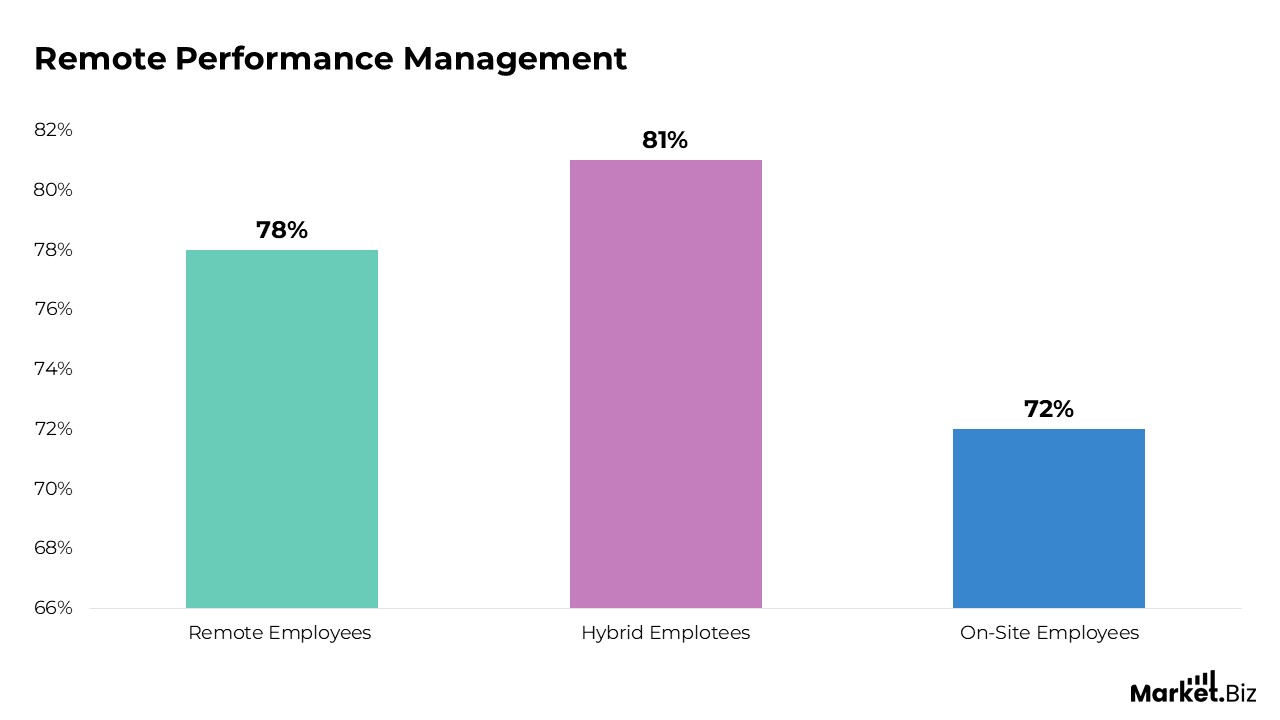
- Remote workers say that at 52%, they have a clearer sense of their goals and performance expectations when their company uses structured remote performance reviews.
- At 64%, managers’ report that they have had to adjust their performance management strategies to better suit the remote work environment.
- Collaborative tools like Slack or Microsoft Teams improve team performance and coordination for 58% of remote employees.
- Remote workers feel more engaged when performance metrics are tied to specific, measurable goals at 67%.
- Companies with virtual performance management platforms see an increase of 28% in efficiency when tracking and improving employee performance.
- Clear communication from their managers about performance expectations is critical to their success at 79% of remote employees.
- At 50%, remote workers feel disconnected from their team, impacting their ability to perform at a high level.
- Remote employees agree that they are more productive when given performance feedback on a weekly basis, rather than monthly or annually, at 72%.
- Virtual performance reviews, if not handled properly, could lead to miscommunication about their strengths and areas for improvement at 62% of employees.
- Managers find it more difficult to provide constructive criticism remotely compared to in person, affecting performance management at 45%.
Performance Reviews Statistics
- Employees report feeling more engaged when receiving regular feedback during performance reviews, with 90% agreeing.
- Companies now conduct performance reviews annually in 62% of cases, with 25% opting for quarterly evaluations.
- Employees who receive feedback at least once a week are 3x more likely to be engaged and motivated.
- Organizations with 360-degree feedback systems report improved communication between employees and management in 75% of cases.
- A numerical scale (1-5) for performance ratings is used by 63% of companies, though many are shifting towards qualitative feedback.
- Peer reviews contribute to 58% of employee performance evaluations, increasing collaboration and self-awareness among teams.
- Employees say they are dissatisfied with the effectiveness of their performance reviews, with 60% citing a lack of clarity and actionable feedback.
- Performance management software is used by 72% of HR departments to streamline the review process, enabling more accurate assessments.
- Millennials (57%) and Gen Z (45%) are more likely to prefer real-time feedback as opposed to traditional annual reviews.
- Managers admit to being influenced by personal bias during performance reviews, affecting fairness in 40% of cases.
(Source: 99firms)
Performance Management Statistics by Industry
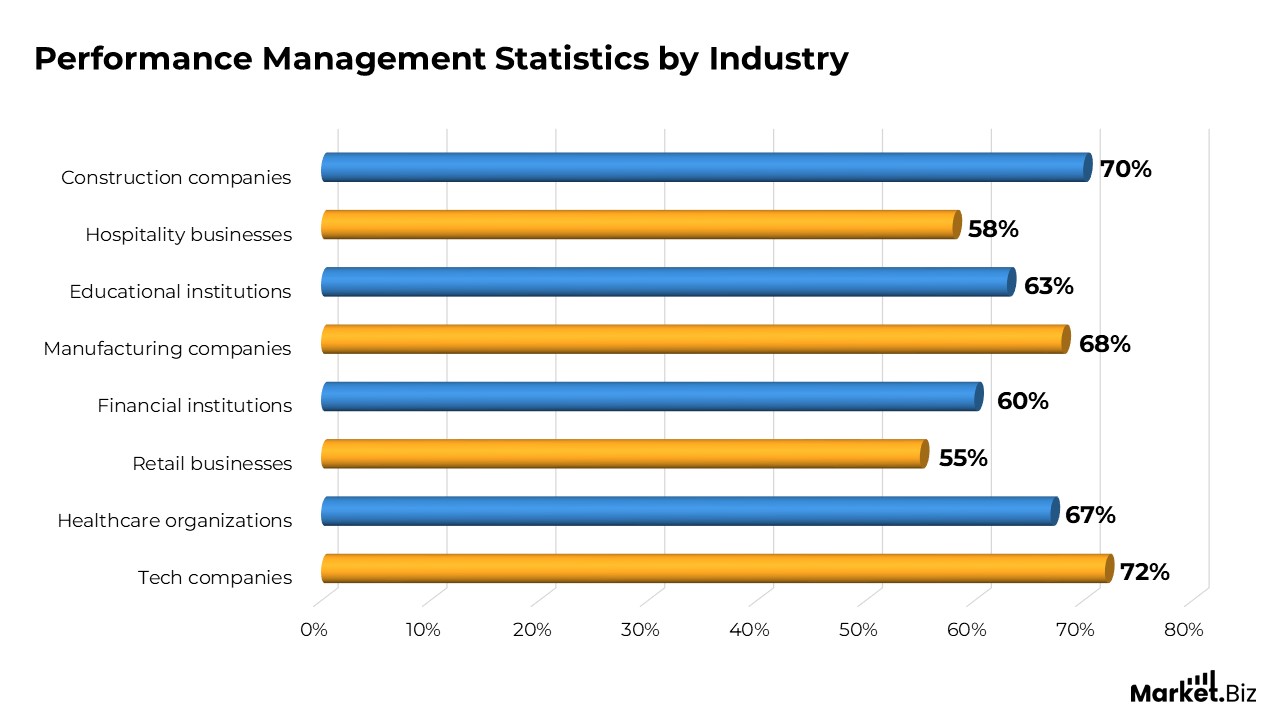
- Tech companies use continuous performance management tools in 72% of cases, focusing on real-time feedback and agile performance assessments.
- Healthcare organizations report that performance reviews lead to improved patient care in 67% of cases by increasing employee accountability and performance.
- Retail businesses have adopted regular performance check-ins in 55% of cases, allowing for more flexibility in assessing employee development in fast-paced environments.
- Financial institutions focus on measurable outcomes like sales performance and compliance in 60% of cases when evaluating employees in performance reviews.
- Manufacturing companies emphasize safety and productivity in performance evaluations in 68% of cases, integrating KPIs that align with operational goals.
- Educational institutions conduct performance reviews based on student outcomes and teacher development in 63% of cases, prioritizing feedback on teaching effectiveness.
- Hospitality businesses use performance management to ensure customer satisfaction scores and employee interaction metrics are prioritized in 58% of cases.
- Construction companies incorporate safety standards and project completion timelines into their performance reviews in 70% of cases, ensuring both individual and team performance align with business objectives.
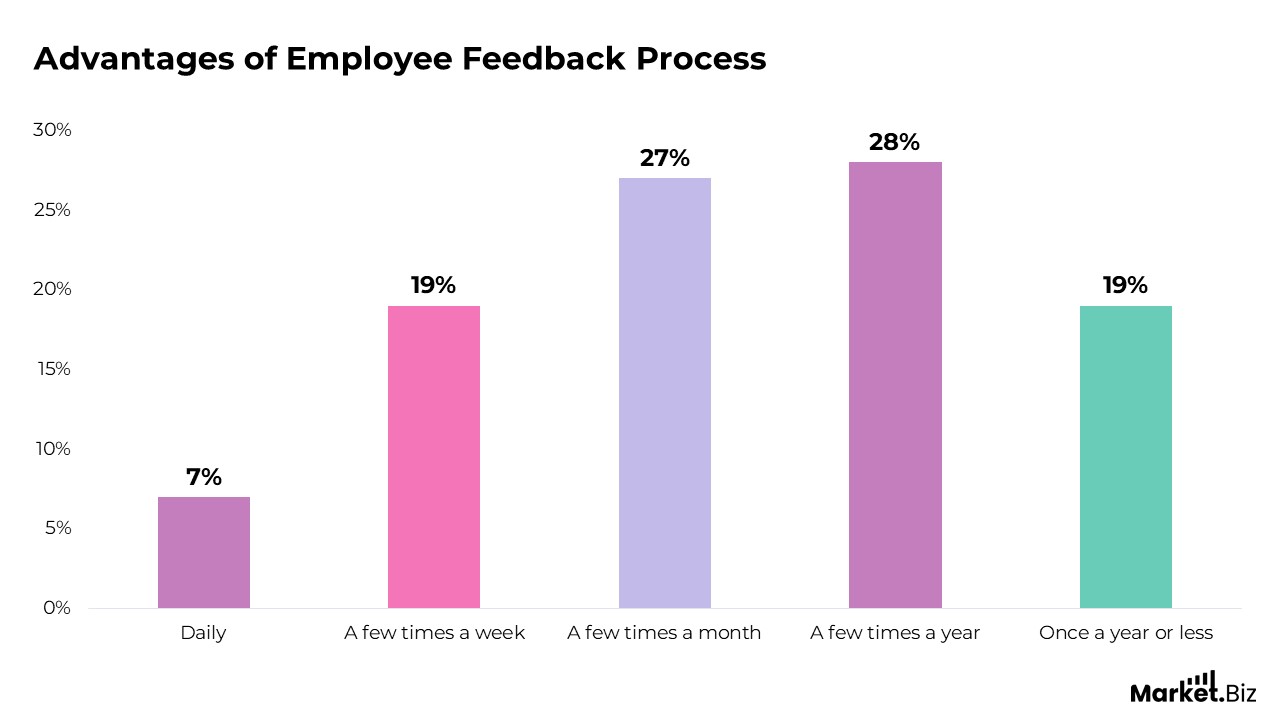
Advantages of Employee Feedback Process
- Regular feedback helps 72% of employees develop their skills and achieve career growth within their organization.
- Companies that actively encourage feedback see a 25% improvement in employee retention, as employees feel more valued and heard.
- 65% of employees who receive ongoing feedback report feeling more committed to their organization, improving overall company loyalty.
- 59% of managers believe feedback is essential to improving team performance, with many reporting a 20% increase in team collaboration.
- 70% of employees prefer to receive constructive feedback frequently rather than annually, as it helps them make real-time adjustments and enhances their productivity.
- Feedback-driven organizations have 12% higher employee satisfaction scores, due to improved transparency and trust between employees and management.
(Source: 99firms)
Challenges in Performance Management Data
- Companies struggle with collecting accurate performance data in 47% of cases, often due to inconsistent data inputs from various sources like managers and self-assessments.
- Performance management systems are difficult to integrate with existing HR platforms in 56% of organizations, causing data silos and inefficiencies.
- Managers admit to relying on subjective assessments in performance reviews in 41% of cases, leading to bias and inconsistency in the data collected.
- Employees feel that performance data lacks clarity in 62% of cases, making it harder for them to understand how to improve and meet expectations.
- Companies face difficulties in tracking long-term employee performance in 50% of cases, as traditional systems fail to capture ongoing progress effectively.
- Insufficient training for managers on data-driven performance management results in inaccurate evaluations in 55% of businesses.
- Businesses find it challenging to ensure performance data is aligned with organizational goals in 49% of cases, leading to misalignment between individual efforts and company priorities.
AI in Performance Management
- 61% of organizations have already adopted AI-driven tools to assist in performance management, streamlining feedback collection and analysis.
- AI can help reduce bias in performance reviews, with 54% of HR professionals stating AI algorithms provide more objective and consistent evaluations.
- 48% of companies use AI to predict employee performance trends, allowing managers to intervene proactively and address potential issues.
- 75% of HR leaders believe AI-powered performance management systems enhance employee development by offering more personalized growth recommendations.
- AI-driven tools can automate routine tasks like tracking goals and progress, helping 67% of managers spend more time on strategic decision-making.
- 63% of employees report that AI-based feedback systems provide faster, more frequent, and actionable insights compared to traditional methods.
- 58% of businesses say that using AI in performance management has led to a 20% improvement in overall productivity due to better alignment with company objectives.
- AI-based performance systems are expected to save businesses an average of 32% on administrative costs related to employee evaluations.
- 70% of companies using AI in performance management report higher employee satisfaction, as AI enables more tailored and transparent feedback.
Future Trends of Performance Management Statistics
- Companies plan to shift to continuous performance management systems in 64% of cases within the next 3 years, moving away from annual reviews to more frequent check-ins and real-time feedback.
- AI in performance management is expected to grow by 45% by 2027, with companies using machine learning algorithms to provide predictive analytics and data-driven performance insights.
- 72% of HR professionals believe that the future of performance management will prioritize employee well-being, integrating mental health and work-life balance metrics into evaluation systems.
- 80% of organizations will use cloud-based performance management platforms in 2025, allowing for seamless integration across departments and real-time data updates.
- Personalized performance management will become the norm in 67% of businesses, adopting AI tools to tailor feedback and development plans to individual employee needs in 2025.
- 55% of companies are exploring 360-degree feedback systems, which are expected to increase by 28% over the next 5 years as organizations prioritize holistic performance evaluations.
- Peer-to-peer feedback is expected to rise in 62% of companies over the next 2 years, with employees increasingly using social platforms to give and receive feedback.
- By 2026, 59% of organizations will integrate gamification into performance management systems, using game mechanics to drive engagement, motivation, and goal achievement.
Conclusion
Effective performance management is key to boosting employee engagement, retention, and overall business success. With 75% of organizations prioritizing it, companies with strong systems see a 30% increase in profitability and 14.9% lower turnover rates. Regular feedback is essential, with 70% of employees saying it improves their performance and engagement.
Technology, including AI, is also changing the game, with 61% of companies already using AI to streamline feedback. The move towards continuous performance management is clear, with 64% of companies planning to shift in the next 3 years. To stay competitive, businesses must embrace these trends and focus on providing real-time, personalized feedback to their teams.
FAQ’s
Measures of user behavior, such as time spent on task, the number of errors made, the recovery from errors, the success or failure of task completion, the use of help, documentation, or embedded assistance, and so on, form the basis of performance data. Every performance metric you establish must be supported by data.
For every 1,000 employees in 2020, 33.4 had performance problems that were documented. That figure increased to 43.6 in 2023, per HR Acuity. This increase is a result of post-pandemic corrections, economic pressures, and the increasing need for efficiency in the era of artificial intelligence.
A constant, continuous process of outlining and communicating job duties, priorities, performance standards, and development plans in order to maximize employee performance and match it with the strategic objectives of the company.
A specialized field, performance analysis uses systematic observations to improve performance and decision-making. It is mainly provided by objective statistical (data analysis) and visual feedback (video analysis).