









Introduction
Wasting Time at Workplace Statistics: Time is a precious resource in the workplace, yet many employees find themselves wasting it on non-work-related activities. A study by Salary.com found that 89% of employees admit to wasting time during their workday, with 31% spending up to 30 minutes each day on personal tasks.
Social media is another big distraction, with 39% of workers reporting they spend time browsing during office hours. 12% of employees spend over an hour daily on personal phone calls. These numbers show just how important it is for businesses to focus on improving time management and boosting productivity.
Editor’s Choice
- 89% of employees admit to wasting time during their workday, spending an average of 2 hours and 53 minutes on non-work-related activities.
- 40% of workers spend over an hour daily on social media, significantly reducing productive time.
- Employees spend 28% of their workweek managing emails, contributing to lost time on communication tasks instead of core responsibilities.
- On average, workers waste 31 hours per month in unnecessary meetings, draining productivity.
- 12% of employees make personal phone calls for over an hour a day, reducing their work output.
- 23% of workers attempt multitasking during work hours, which leads to inefficiency and wasted time.
- 22% of employees regularly procrastinate, with 15% citing it as a major cause of wasted work hours.
- Unclear goals lead employees to waste up to 3 hours per week, focusing on less important tasks.
- Time wasted on non-productive activities results in an estimated $1.8 trillion loss annually for U.S. businesses.
- 68% of employees report disengagement due to wasted time, which negatively affects job satisfaction and morale.
General Wasting Time at Workplace Statistics
- 89% of employees admit to wasting time during the workday, spending on average 2 hours and 53 minutes on non-work-related activities.
- 40% of workers admit to spending over an hour each day on social media during work hours.
- 12% of employees reportedly spend over an hour daily on personal phone calls, which contributes to overall productivity loss.
- Employees spend an average of 31 hours per month in unnecessary meetings, contributing to wasted time.
- Employees spend 28% of their workweek managing emails, a major time-consuming task.
- 58% of employees struggle with time management, causing them to waste significant portions of their day.
- 22% of workers admit to regularly procrastinating, with 15% citing it as a major reason for wasted work hours.
- 31% of employees confess to spending up to 30 minutes a day on personal tasks such as shopping or managing appointments.
- 68% of U.S. workers are disengaged, leading to a noticeable drop in productivity and wasted time.
- 21% of employees acknowledge spending at least 1 hour per day browsing non-work-related websites.
- Workers are interrupted every 11 minutes, resulting in an average of 2.1 hours lost per day.
- 23% of employees try multitasking during work hours, which leads to time loss and decreased work efficiency.
- Employees waste up to 3 hours per week due to unclear goals or conflicting priorities.
- 34% of employees say they take more breaks than necessary, with some spending up to an hour socializing during work hours.
- 25% of employees believe poor office environment (noise, discomfort) leads to wasted time and decreased productivity.
How Workers Waste Their Time at Work?
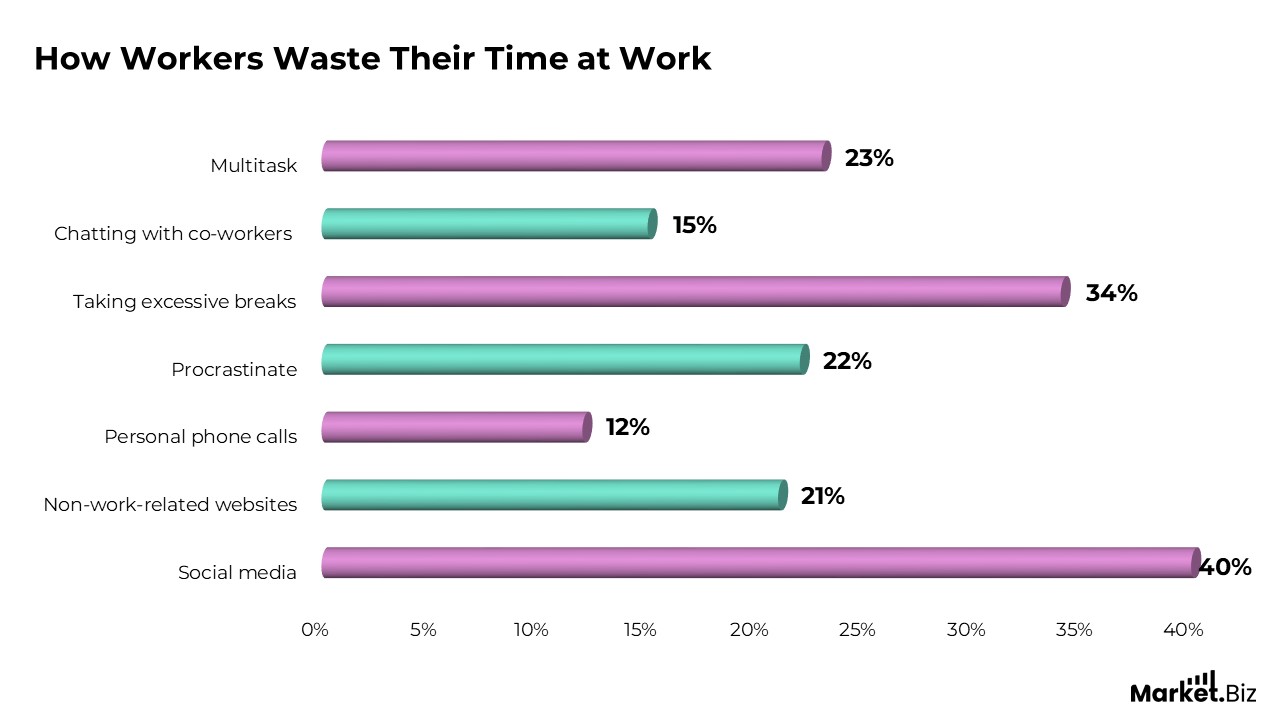
- 40% of workers spend more than an hour a day on social media, which distracts them from their core responsibilities.
- Employees often spend a significant portion of their workweek managing emails, leading to time lost on communication tasks rather than focused work.
- 21% of employees spend over an hour daily browsing non-work-related websites, which detracts from productivity.
- 12% of workers spend over 60 minutes a day making personal phone calls, reducing work output.
- Employees waste an average of 31 hours a month in meetings, many of which are deemed unnecessary or unproductive.
- 22% of employees regularly procrastinate, wasting hours each week that could be better utilized.
- 34% of workers admit to taking excessive breaks, leading to wasted time during the workday.
- 15% of employees cite chatting with co-workers as a frequent source of time wasted at work.
- Unclear priorities waste up to 3 hours of employees’ time every week, as they focus on less important tasks.
- 23% of workers multitask, but this often leads to lower efficiency and wasted time as tasks take longer to complete.
Wasting Time at Workplace Statistics by
Wasteful Work-Related Activities
- Studies show employees waste up to 31 hours per month in meetings that are seen as unnecessary, impacting overall productivity.
- On average, employees spend 28% of their workweek managing emails, leading to hours lost on tasks that don’t directly contribute to their core responsibilities.
- Employees spend an average of 2 hours per day switching between tasks, which significantly reduces focus and efficiency.
- 23% of employees admit to spending time re-delegating tasks that should have been initially completed, leading to inefficiency and wasted time.
- Unclear priorities can result in 3 hours of lost productivity per week as employees focus on low-priority tasks.
Scrolling Through Social Media
- Many employees spend time on social media for non-work-related reasons, although some argue it’s for job-related networking or research.
- 39% of workers admit to spending over an hour per day on social media platforms during work hours, significantly cutting into productive time.
- 47% of employees report being distracted by social media notifications, often leading them to lose track of their tasks.
- Employees who engage with social media during work experience a 20% drop in productivity due to reduced focus on primary tasks.
- 25% of employees acknowledge that they spend more than 30 minutes per day scrolling through social media sites during work hours.
Non-Working Activities
- 12% of workers admit to spending over an hour daily on personal phone calls, which takes away from work duties.
- 31% of employees admit to shopping online during work hours, often spending up to 30 minutes daily on personal purchases.
- Employees commonly spend up to 15% of their day running personal errands, such as scheduling appointments or handling family matters.
- 18% of workers spend time watching videos or streaming content during work hours, leading to a substantial waste of time.
- 34% of employees say they take breaks longer than necessary, with some exceeding 45 minutes during a typical workday.
Distracting Activities
- 25% of employees report spending time chatting with colleagues during work hours, which often interrupts their focus and tasks.
- 15% of employees cite gossiping with co-workers as a common source of distraction, leading to hours lost on non-productive conversations.
- 18% of workers say distractions such as background noise, office chatter, and interruptions result in a loss of focus and wasted time.
- 23% of workers try to multitask during work hours, which results in lower quality and efficiency, ultimately wasting time.
- 21% of employees report that personal device usage (e.g., smartphones) distracts them during work, leading to lost time on non-work-related tasks.
Generations through Gossip
- Younger workers (Generation Z and Millennials) spend an average of 30 minutes daily socializing with colleagues, which can lead to wasted time in the workplace.
- 12% of employees admit to spending time listening to or engaging in workplace gossip, which reduces overall work efficiency.
- Older workers (Baby Boomers) are reported to spend more time engaging in workplace gossip than their younger counterparts, contributing to inefficiency.
- 20% of employees report that casual office conversations, such as gossiping about co-workers, result in significant time wasted.
- Office gossip often causes distractions that can reduce focus, leading employees to waste up to 1 hour a day on non-productive conversations.
Wasting Time at Workplace Statistics by States
- Employees in California report spending an average of 2.5 hours per day on non-productive activities, leading to a significant loss in productivity across the state.
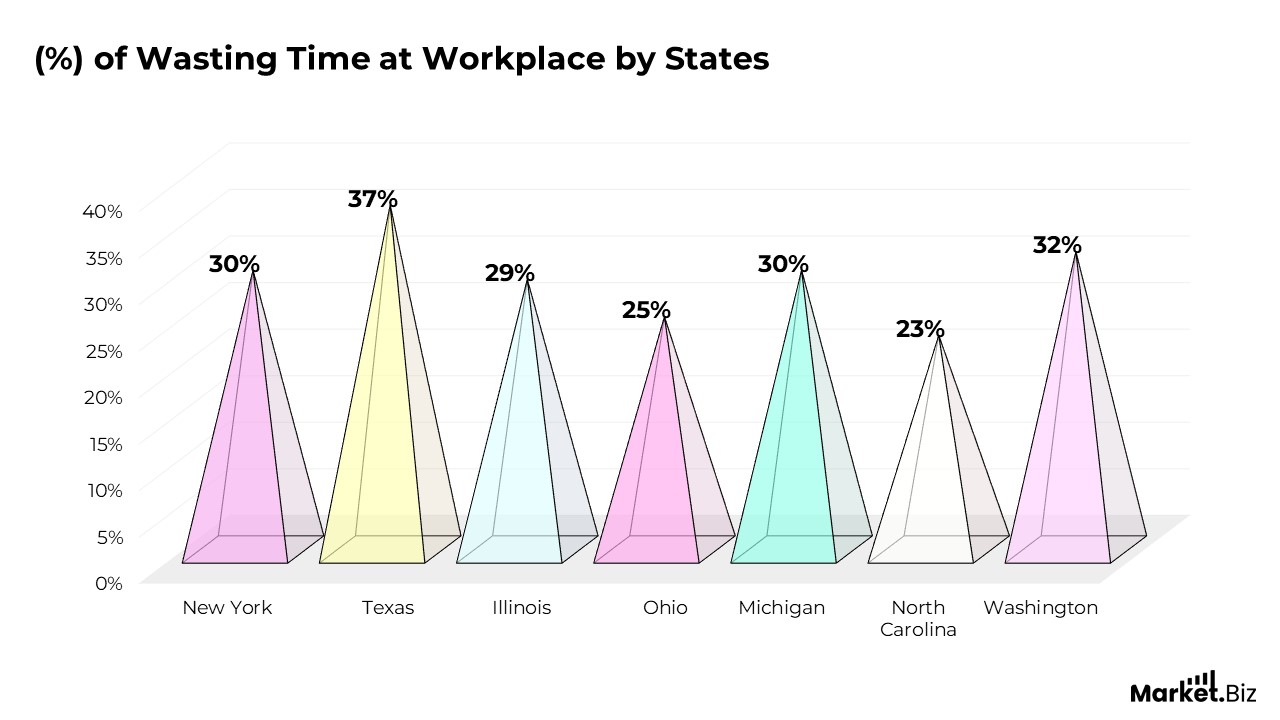
- Workers in New York waste an estimated 30% of their workday on distractions, with social media being one of the top time wasters.
- In Texas, 37% of employees admit to spending over an hour daily on personal phone calls during work hours, reducing overall efficiency.
- Florida workers spend an average of 1 hour per day browsing non-work-related websites, contributing to a loss of nearly 5 hours each week in lost productivity.
- Employees in Illinois often waste time in unproductive meetings, with 29% of workers spending up to 2 hours a week in meetings deemed unnecessary.
- Pennsylvania workers report spending over 45 minutes each day on personal tasks like scheduling appointments and shopping, cutting into productive work time.
- Ohio employees waste 25% of their workday on social media and internet distractions, costing the state’s economy millions in lost productivity.
Moreover
- In Michigan, nearly 30% of workers admit to procrastination, wasting at least 1 hour daily that could be spent on more important tasks.
- Georgia workers waste up to 35 minutes per day on office gossip, which significantly reduces focus and productivity in workplaces across the state.
- 23% of employees in North Carolina report multitasking during work hours, which decreases work quality and leads to inefficiency.
- Workers in Virginia spend over 40 minutes per day on personal device usage, including texting and social media, leading to substantial time wasted each week.
- In Washington, 32% of employees report that lack of clear direction from leadership leads to wasted time on unclear or unimportant tasks.
- Colorado workers spend an average of 1.5 hours a day on non-work-related activities like browsing social media, leading to a significant decrease in overall work output.
Wasting Time at Workplace Statistics by Industries
- In the tech industry, employees waste an average of 3 hours per week on social media and personal browsing, reducing overall productivity.
- Workers in finance spend 1.5 hours daily on non-work-related tasks, including phone calls and personal errands, affecting overall job performance.
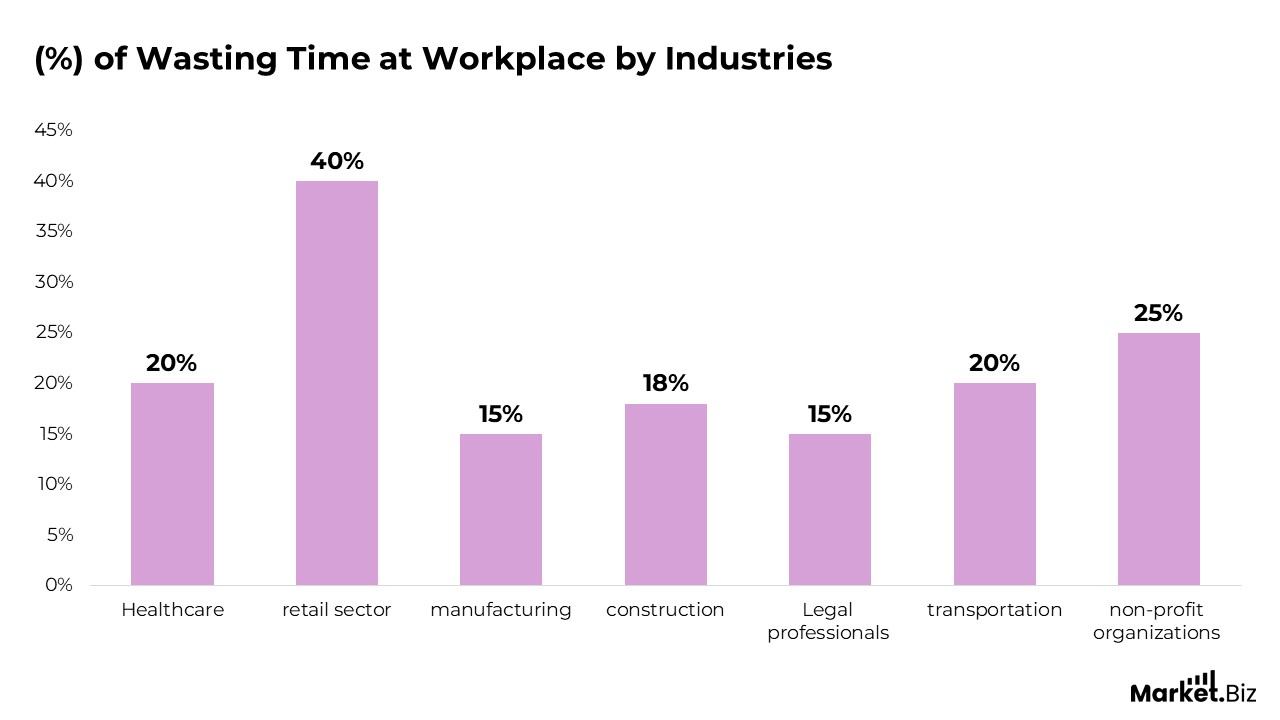
- Healthcare professionals waste 20% of their time on unnecessary administrative tasks, which could otherwise be spent on patient care.
- Employees in the retail sector report spending 40% of their day on unproductive activities, including socializing with co-workers and handling personal matters.
- Workers in manufacturing spend up to 15% of their day dealing with avoidable equipment malfunctions, reducing their ability to focus on actual production tasks.
- Teachers and administrators spend about 2 hours a week on non-educational activities like meetings and personal tasks, leading to lower work efficiency.
- In the hospitality industry, employees waste time on personal phone calls and socializing with colleagues, contributing to a loss of nearly 5 hours per week.
- Employees in construction experience significant time loss, with 18% of their workday spent on avoidable delays and interruptions caused by management miscommunication.
- Marketing professionals report spending an average of 30 minutes per day on non-work-related activities like browsing social media, impacting productivity.
- Legal professionals waste up to 15% of their workday on time-consuming administrative duties and email management, reducing their ability to focus on core tasks.
- Workers in transportation report spending 20% of their day dealing with equipment issues and unproductive downtime, delaying schedules and operations.
- In the real estate industry, agents waste over an hour each day on personal calls and non-work-related browsing, reducing time spent on client interactions.
- Employees in non-profit organizations spend about 25% of their time on activities unrelated to their core mission, such as meetings and personal tasks, leading to inefficiency.
Causes of Wasting Time at the Workplace Statistics
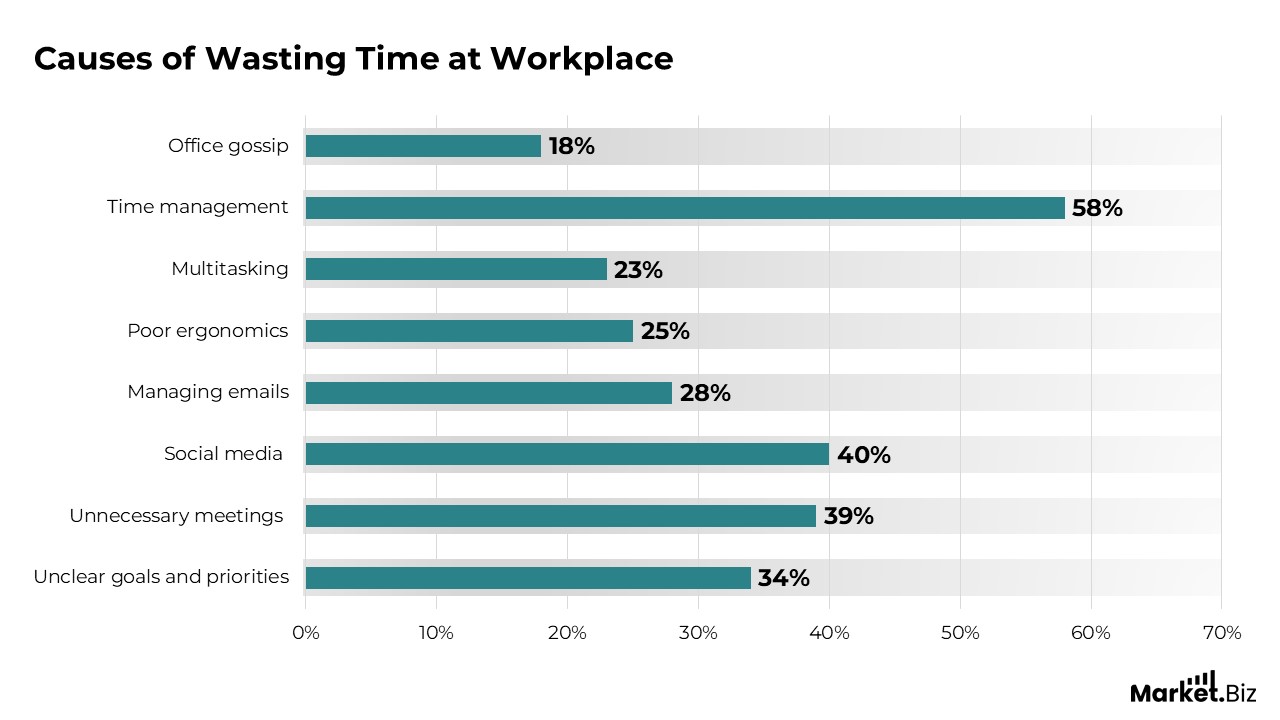
- 34% of employees report wasting time due to unclear goals and priorities, leading to confusion and inefficiency throughout the workday.
- 39% of workers feel that unnecessary meetings waste their time, with many spending up to 31 hours per month in unproductive meetings.
- 40% of employees admit to spending at least an hour per day on social media during work hours, contributing to significant time loss.
- Personal tasks, such as handling family matters or scheduling appointments, cause employees to waste up to 1 hour a day, reducing their focus.
- 28% of an employee’s workweek is spent managing emails, with many workers feeling overwhelmed by the constant influx of messages.
- A disruptive or uncomfortable work environment, including noise or poor ergonomics, leads 25% of workers to waste time and lose focus.
- 23% of workers believe multitasking is efficient, but it leads to slower task completion and reduces overall productivity, causing time waste.
- 58% of employees struggle with time management, often underestimating how much time it takes to complete tasks, leading to inefficiency.
- 18% of employees report wasting time engaging in office gossip, which takes away from productive work time and leads to distractions.
- Technical problems, such as slow computers or software malfunctions, cause employees to lose an average of 3 hours per week, adding to work delays.
Consequences of Wasting Time at Workplace Statistics
Impact on Productivity
- Wasting time at work leads to an average productivity loss of 2-3 hours per employee per day, reducing overall organizational efficiency.
- 37% of employees report that wasted time causes project delays, with missed deadlines becoming a common result in workplaces.
- Constant distractions and multitasking lead to 40% slower task completion, as switching between tasks reduces focus and efficiency.
- 23% of employees acknowledge that wasting time leads to a decline in work quality, which can impact client satisfaction and brand reputation.
- Time wasted on non-productive activities reduces collaboration among team members, leading to decreased innovation and weaker team dynamics.
Financial Implications
- Time wasted due to distractions results in an estimated loss of $1.8 trillion annually for U.S. businesses in missed productivity.
- Companies face rising operational costs, with 27% of employees spending valuable hours managing non-work-related tasks.
- Companies lose up to 18% of their potential profitability due to inefficiency caused by time wasted on social media, personal tasks, and unnecessary meetings.
- On average, businesses lose up to 7% of their total payroll due to time wasted on non-productive activities, leading to significant financial strain.
- Companies with low productivity due to wasted time face higher turnover rates, leading to increased recruitment and training expenses.
Employee Engagement and Well-being
- 68% of employees report a lack of engagement when they feel their time is wasted, resulting in lower job satisfaction and morale.
- Employees who waste time at work often experience higher levels of stress and burnout, with 25% of workers citing this as a major concern.
- 41% of employees report dissatisfaction with their job due to unproductive workdays, which can lead to disengagement and lower retention rates.
- Wasted time, especially from stress and frustration, can result in physical health issues, with 30% of workers reporting increased stress levels due to time inefficiency.
- Employees who regularly waste time are often overlooked for promotions, with 22% of workers feeling stagnant in their careers due to low productivity.
Factors to Resolve Wasting Time at Workspace Statistics in 2025
- 43% of employees who have clear goals report a 25% increase in productivity, reducing time wasted on unimportant tasks.
- Companies using time management tools see a 20% improvement in employee focus, reducing distractions and wasted hours.
- 38% of employees say better communication with managers can eliminate unnecessary meetings, saving up to 10 hours per week.
- The use of automation tools has been shown to save up to 14% of employee work hours, allowing staff to focus on higher-value tasks.
- 41% of workers report increased productivity with flexible work schedules, allowing employees to manage their time more effectively.
- 31% of organizations investing in time management training see a 15% reduction in time wasted on unproductive tasks.
- Companies that reduce unnecessary meetings by 40% have employees who save up to 1 hour per day on tasks that directly contribute to business outcomes.
- 28% of employees admit that time wasted on low-priority tasks could be reduced by implementing a more structured approach to task prioritization.
- Adopting modern technology in the workplace leads to a 12% decrease in downtime, as faster tools reduce time spent on administrative tasks.
- 20% of employees report a significant reduction in wasted time when working in a well-designed, quiet, and distraction-free environment.
Conclusion
This report shows how time-wasting activities are affecting productivity at work. With 89% of employees admitting they waste time on non-work tasks, businesses are losing valuable hours each day. Social media, unnecessary meetings, and personal phone calls are major distractions that add up to huge costs for companies.
To tackle this, companies need to focus on better time management, setting clear goals, and using tools to boost efficiency. By cutting down on distractions and improving workflows, businesses can enhance employee engagement, reduce costs, and create a more productive work environment.
FAQs
Spending time on unrelated activities or ineffective tasks that don’t increase productivity is referred to as wasting time at work. This includes, among other things, excessive internet use, ineffective meetings, ambiguous roles, inadequate administrative abilities, and a lack of required tools.
A time management system is not in place for 82% of people. 51% of the average worker’s workday is spent on insignificant or useless tasks. Employees are interrupted roughly sixty times a day on average. The typical worker only produces for two hours and fifty-three minutes every day.
Statistics on wasting time at work show that not everyone wastes the same amount of time. 31% of workers waste about 30 minutes a day, 89% of workers waste any amount of time at work, and the top 10% waste up to three hours on average.
Personal distractions like scrolling through social media, attending pointless meetings, or handling an excessive amount of emails are typically the biggest time-wasters at work. It’s very simple to become distracted by office gossip or to switch between tasks.
There are far more negative effects of wasting time at work than just financial ones; it can also result in dissatisfaction, disengagement, and even burnout.