








Introduction
Performance Review Statistics: Performance reviews are a cornerstone of employee development and organizational growth. Around 60% of employees report not receiving enough feedback, revealing a gap in many performance management systems. Companies that provide regular feedback experience up to 14% higher employee engagement.
Additionally, 89% of organizations are moving away from traditional annual reviews, opting instead for more frequent check-ins. This shift underscores the importance of continuous feedback in enhancing employee performance and aligning it with broader business goals.
Editor’s Choice
- 60% of employees report insufficient feedback, indicating a major performance management gap.
- 89% of companies are moving away from annual reviews, favouring frequent check-ins for continuous feedback.
- Regular feedback leads to a 14.9% increase in employee engagement.
- 43% of employees find performance reviews ineffective, negatively impacting job satisfaction and retention.
- 85% of managers acknowledge biases that affect performance review accuracy.
- 90% of companies now use 360-degree feedback to gain a comprehensive view of employee performance.
- 56% of companies use performance management software, streamlining and improving review processes.
- 72% of Millennials prefer frequent feedback over annual performance reviews.
- Women are 1.6 times more likely to receive feedback on personality traits, while men get performance-based feedback.
- 73% of companies leverage AI to enhance the accuracy and efficiency of performance evaluations.
- 70% of remote workers find performance reviews less effective than in-office reviews, often due to communication barriers.
- By 2026, 70% of companies are expected to adopt continuous performance reviews, focusing on real-time feedback.
General Performance Review Statistics
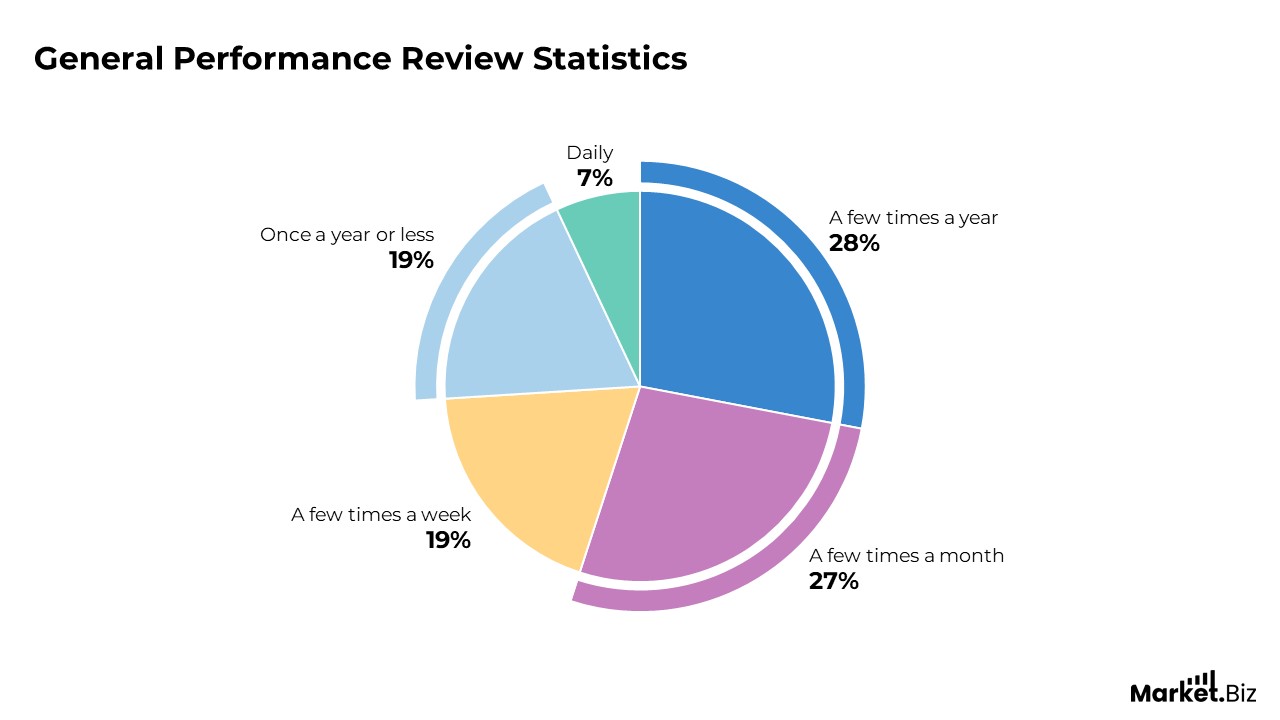
(Source: Enterpriseappstoday, WP-Content)
- 60% of employees feel they don’t receive enough feedback, indicating a critical gap in performance management.
- 89% of companies are shifting away from annual performance reviews in favour of more frequent check-ins.
- Organizations that provide regular feedback see up to a 14.9% increase in employee engagement.
- 43% of employees say performance reviews are ineffective, leading to lower satisfaction and retention.
- 80% of top-performing companies use frequent performance feedback to better align individual goals with business objectives.
- 85% of managers admit to having biases that affect the accuracy of performance reviews.
- Employees who receive feedback from their manager are 3.5 times more likely to be engaged at work.
- 90% of companies now use 360-degree feedback to provide a more comprehensive view of employee performance.
- 55% of organizations plan to discontinue traditional annual performance reviews in the next 1-2 years.
- 64% of employees believe performance reviews are critical to their career development.
- 67% of remote employees report they receive fewer performance reviews than in-office workers.
- 79% of employees say they would work harder if their efforts were more regularly recognized.
- Firms that have a strong feedback culture report 37% higher revenue growth year-over-year.
- 56% of companies are adopting performance management software to streamline and track performance reviews.
- 40% of employees report that peer feedback has a higher impact on their performance than manager feedback.
- 72% of Millennials prefer frequent performance feedback over annual reviews.
- Employees who set specific performance goals are 20% more likely to achieve them compared to those without defined targets.
- 90% of HR professionals use a numeric rating scale to assess employee performance.
- Employees who receive feedback regularly are 50% more likely to stay with their company for longer.
- 65% of managers say they need more training on how to give effective performance feedback.
Types of Performance Review Methods
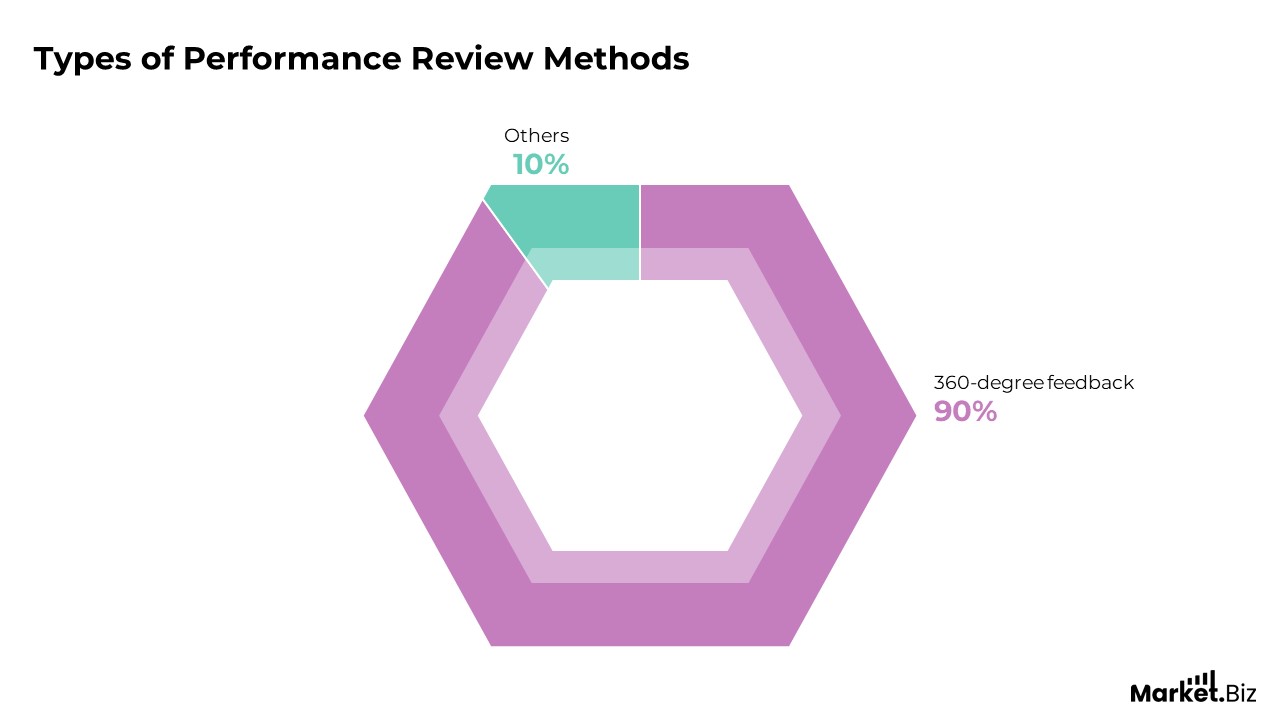
- 90% of organizations now use 360-degree feedback, gathering input from managers, peers, and subordinates for a comprehensive evaluation.
- 74% of employees believe that self-assessments can help them better understand their performance, making it a valuable method for self-reflection.
- 55% of companies still rely on manager-only reviews, where the supervisor evaluates an employee’s performance based on set criteria and objectives.
- 43% of companies incorporate peer reviews, providing employees with feedback from colleagues who work closely with them, often enhancing collaboration.
- 37% of organizations use forced ranking, where employees are ranked against each other, which can help identify top performers but may foster competition.
- 61% of organizations utilize BARS, linking job behaviours to specific performance levels, ensuring a more objective evaluation.
- 72% of companies use MBO, where employees and managers set specific, measurable goals together, ensuring alignment with business objectives.
- 63% of employees prefer continuous feedback over traditional annual reviews, emphasizing real-time development and immediate corrective actions.
- 48% of firms employ checklist methods, where employees are evaluated against a pre-determined set of criteria, offering quick assessments but lacking detail.
- 39% of organizations use the critical incident method, documenting notable employee actions throughout the review period to highlight strengths or areas for improvement.
- Used by 27% of companies, this method involves psychological testing to assess an employee’s potential and future performance capabilities, often in leadership roles.
- 22% of organizations still use the essay method, where managers write a narrative about the employee’s performance, providing qualitative insights, though it’s time-consuming.
Importance of Performance Reviews
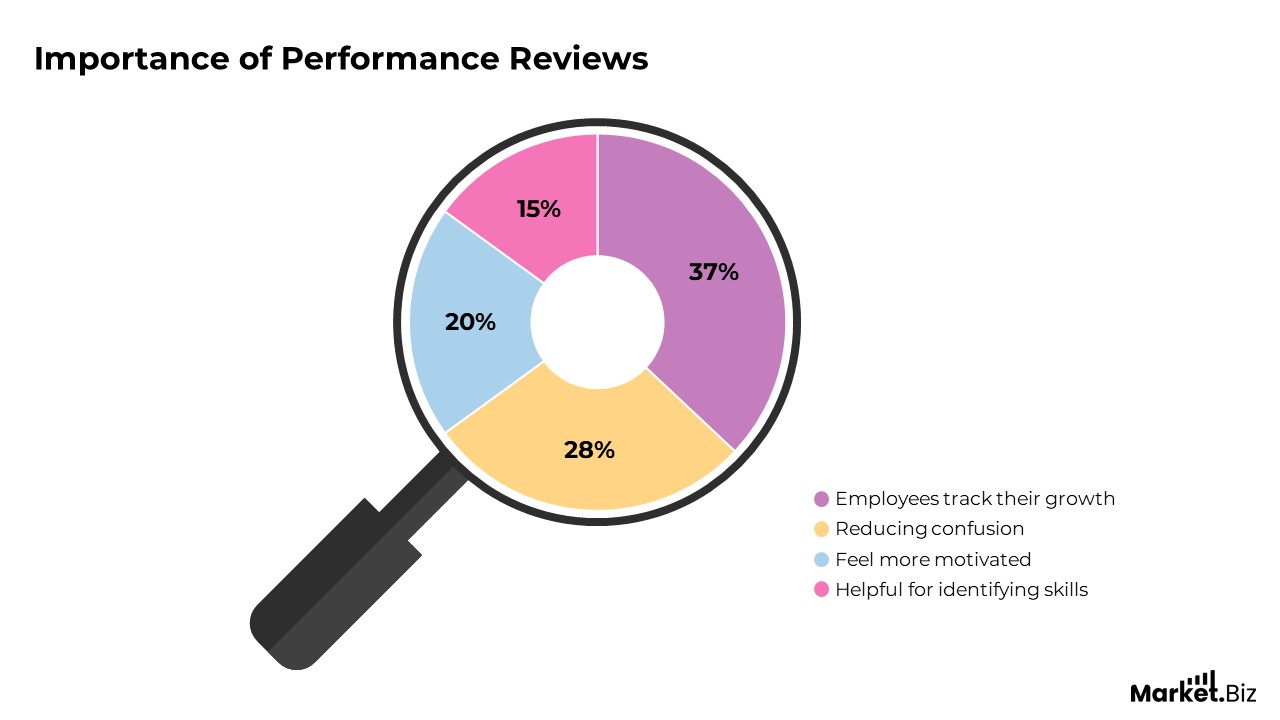
- Regular performance reviews help 37% of employees track their growth, making it easier to stay on target with professional goals.
- 28% of employees say performance reviews clarify job expectations, reducing confusion and improving overall job performance.
- Employees in companies with frequent reviews feel 20% more motivated, as feedback helps them see how their work contributes to the team.
- 15% of employees find performance reviews helpful for identifying skills they need to improve, paving the way for continuous growth.
- 66% of companies report that regular performance reviews improve communication between managers and employees, creating a more transparent work environment.
- 78% of managers use performance reviews to decide on promotions and salary increases, making them essential for career advancement.
- Performance reviews help resolve issues early, reducing workplace conflicts by 35% and preventing bigger problems down the road.
- Employees who receive regular feedback are 72% more likely to feel satisfied with their job, which boosts their productivity.
- 83% of top-performing companies make sure their employees’ efforts align with business goals through regular performance evaluations.
- 50% of employees who get consistent feedback are more likely to stay with their company, feeling valued and supported in their development.
Gender Differences in Performance Review
- Men are 1.5 times more likely than women to receive feedback about their strengths during performance reviews, contributing to a more positive experience.
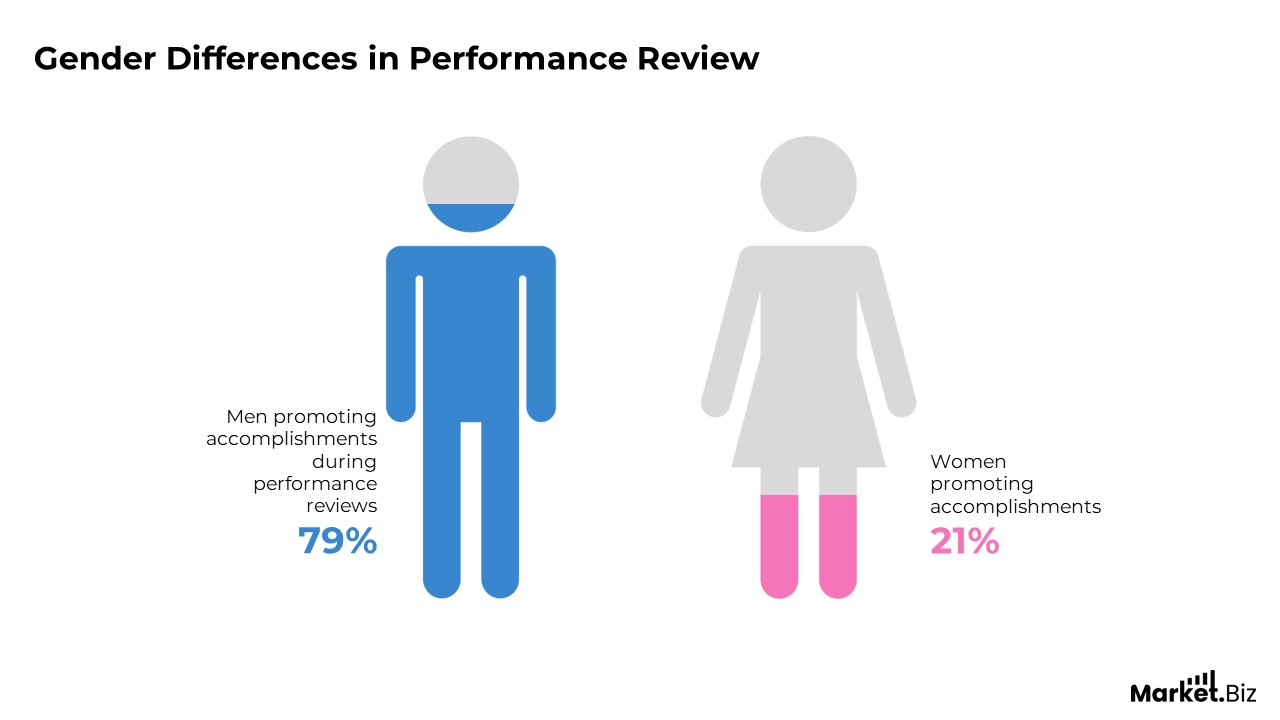
- 79% of men report feeling more comfortable promoting their accomplishments during performance reviews, while women often underreport their achievements due to fear of being perceived as boastful.
- Research shows that women are often rated more harshly than men on subjective criteria, with 20% of women receiving lower performance ratings than their male counterparts despite similar job performance.
- Women are 1.6 times more likely to receive feedback focused on personality traits (e.g., “too emotional”) compared to men, while men often get feedback linked to results and performance.
- 62% of managers admit to unconsciously rating women lower in performance reviews due to gender biases, affecting their overall career progression.
- Women are 27% less likely to be promoted following a performance review compared to men, even when their ratings are similar.
- Women are 18% less likely to receive developmental feedback aimed at career growth during performance reviews, which limits opportunities for skill advancement.
- Men are 5% more likely than women to receive an “exceeds expectations” rating, while women are more likely to be rated as “meets expectations.”
- Women are 10% more likely than men to be described as “too emotional” or “not assertive enough” during reviews, which can influence the perception of their leadership capabilities.
- Gender differences in performance reviews can contribute to a 15% wage gap, as women are often passed over for promotions due to biased feedback.
- Women are more likely to receive critical feedback regarding their communication style and demeanour, while men tend to receive more actionable feedback on job performance.
- Studies show that women are 30% more likely to receive performance reviews that question their competence, even when their performance metrics align with male colleagues.
Technology in Performance Reviews
- 56% of companies are adopting performance management software to streamline review processes, making feedback more structured and accessible.
- 62% of HR departments use automated systems for tracking employee performance, reducing time spent on manual evaluations by up to 40%.
- 63% of employees prefer continuous feedback through apps or platforms, which offer real-time insights into their performance and development.
- 49% of companies now use data analytics to assess employee performance, helping to identify trends, strengths, and areas for improvement more objectively.
- 47% of organizations incorporate self-assessment tools, allowing employees to reflect on their performance before discussing with managers, enhancing engagement and ownership.
- 87% of organizations that use 360-degree feedback software report better clarity and fairness in evaluations, as feedback is gathered from multiple sources.
- 65% of companies offer performance review platforms with mobile access, enabling managers and employees to complete reviews on the go, increasing convenience.
- 72% of employees benefit from real-time performance tracking tools, which help them adjust their performance based on immediate feedback.
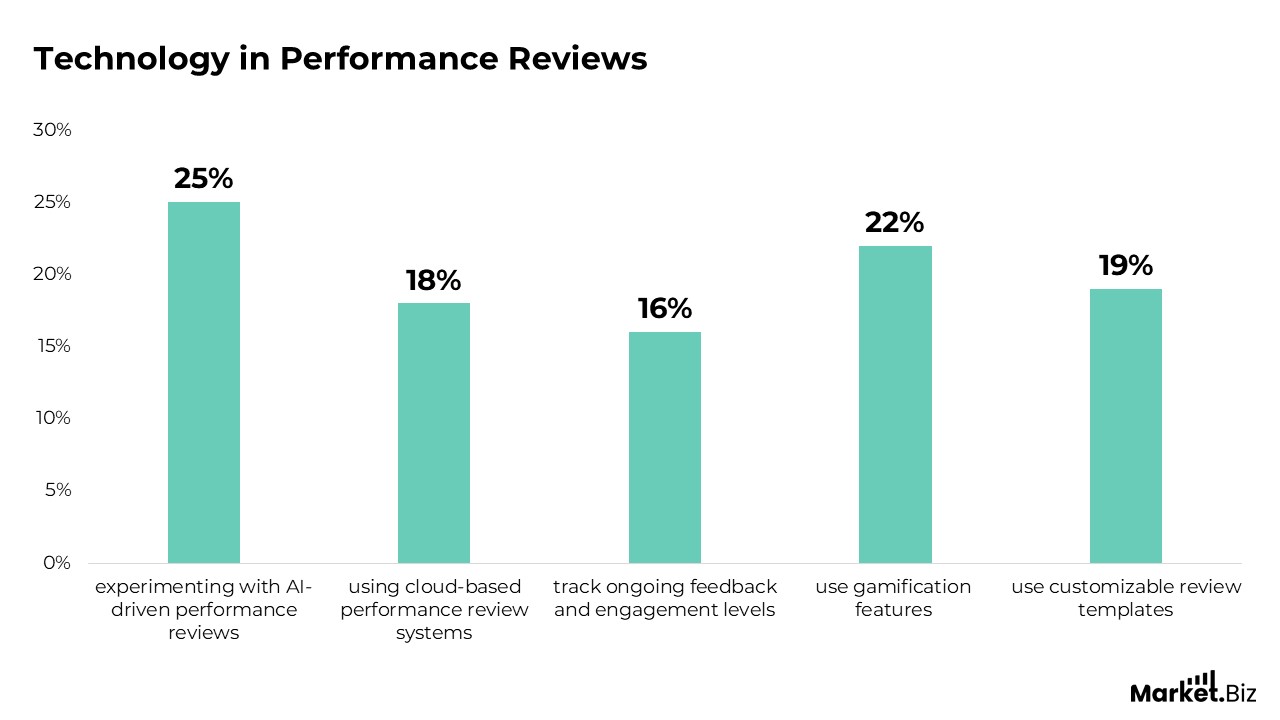
- 25% of organizations are experimenting with AI-driven performance reviews to reduce bias and provide more accurate, data-backed insights into employee performance.
- 18% of businesses are using cloud-based performance review systems, allowing for easy integration with other HR tools and ensuring data security.
- 16% of companies with dedicated employee engagement platforms report higher quality performance reviews, as these tools help track ongoing feedback and engagement levels.
- 22% of companies use gamification features within their performance review systems to increase employee motivation and participation in feedback processes.
- 19% of organizations use customizable review templates, enabling managers to tailor feedback forms to specific roles and job functions for more relevant evaluations.
Challenges in Performance Reviews
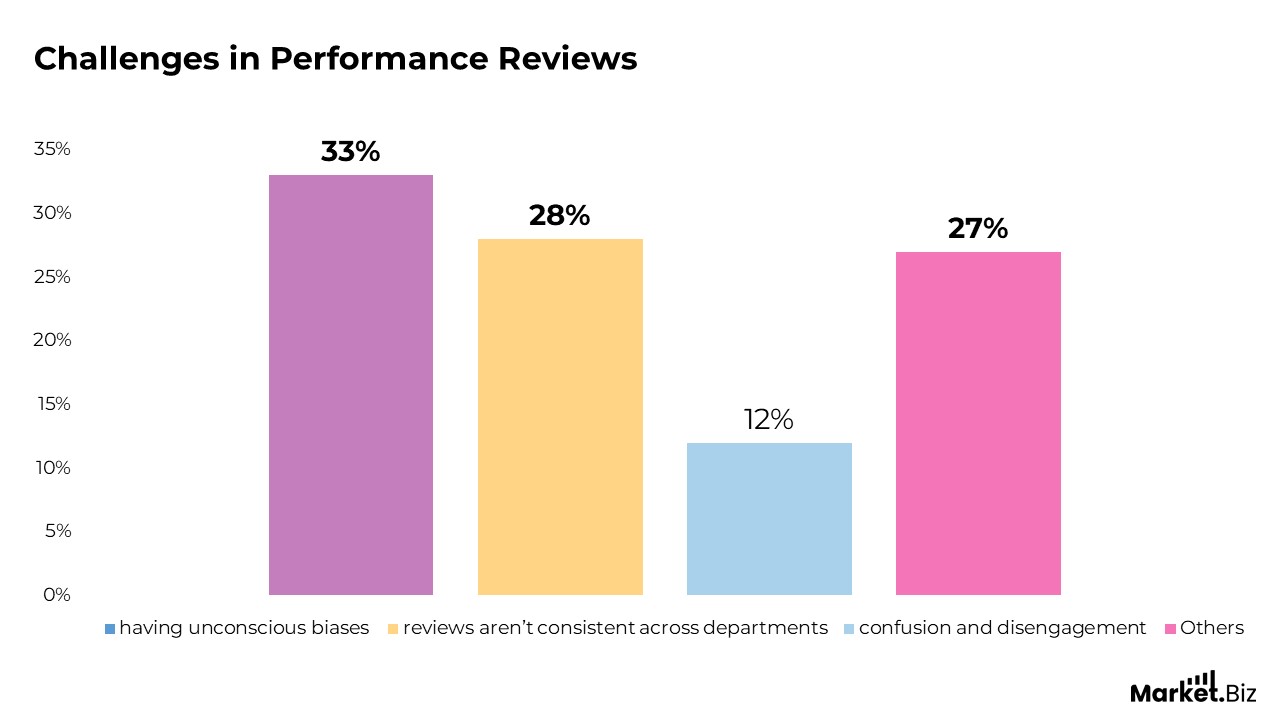
- Managers admit to having unconscious biases during performance reviews, with 33% acknowledging that this leads to unfair evaluations and erodes trust among employees.
- 28% of employees say performance reviews aren’t consistent across departments, making it difficult for companies to ensure fair treatment for everyone.
- During performance reviews, 12% of employees report feeling overwhelmed by the sheer volume of feedback, which can cause confusion and disengagement.
- 45% of employees feel that annual reviews are too infrequent to provide timely feedback, preventing them from making necessary improvements throughout the year.
- 61% of employees say they receive feedback that’s too vague or unclear, making it difficult for them to apply it for personal growth or improvement.
- Receiving constructive criticism is hard for 58% of employees, often leading to defensiveness and diminishing the effectiveness of performance reviews.
- Half of all employees, or 50%, believe that communication during performance reviews is unclear, leading to confusion about expectations and goals.
- 47% of managers feel they haven’t received enough training on how to give effective reviews, which results in inaccurate or low-quality feedback.
- 55% of HR professionals say that performance reviews take up too much time, with some reviews requiring as much as 20 hours per employee to complete.
- After receiving negative feedback, 41% of employees report feeling demotivated, which can have a lasting impact on their morale and job satisfaction.
Effectiveness of 360-Degree Feedback
Benefits of 360-Degree Feedback
- When using 360-degree feedback, 87% of organizations report better clarity and fairness in evaluations, as it collects insights from multiple sources like peers, managers, and subordinates.
- 78% of employees say that 360-degree feedback helps them gain better self-awareness, enabling them to identify their strengths and areas for improvement.
- 73% of companies claim that 360-degree feedback reduces manager bias by offering a more balanced view of an employee’s performance from various perspectives.
- After implementing 360-degree feedback, 67% of employees notice improved communication and collaboration within teams, as it encourages open dialogue.
- 72% of organizations see a significant increase in employee engagement when they use 360-degree feedback, as employees feel more involved in their performance development.
- 62% of companies find 360-degree feedback essential for identifying leadership potential, helping them prepare future managers more effectively.
- 68% of employees who receive 360-degree feedback demonstrate positive behavioural changes, as the process provides actionable and diverse insights.
- 56% of businesses report improved employee performance metrics after adopting 360-degree feedback, as it helps align personal goals with company objectives.
- 65% of organizations find that 360-degree feedback increases employee accountability, as feedback from multiple sources makes employees more committed to improvement.
Challenges of 360-Degree Feedback
- Gathering and analysing feedback in 360-degree reviews is time-consuming and resource-intensive for 58% of organizations, which slows down the process.
- 49% of employees feel overwhelmed by the sheer volume of feedback they receive during 360-degree reviews, making it difficult to focus on the most important areas.
- Employees worry that 53% of the time, 360-degree feedback focuses too much on negative aspects, making the process more demotivating than constructive.
- Companies report 42% of the time that feedback quality is inconsistent in 360-degree reviews, as not all reviewers provide actionable or detailed comments.
- 37% of employees express concerns about the confidentiality of 360-degree feedback, fearing that revealing their identity might lead to workplace tensions.
- Organizations note 51% of the time that the high costs involved in implementing 360-degree feedback systems are particularly challenging for smaller businesses with limited resources.
- 48% of employees resist 360-degree feedback, citing discomfort with receiving feedback from peers or subordinates, fearing potential personal conflict.
- Companies find that 44% of the time, 360-degree feedback emphasizes consensus over individuality, making it harder to pinpoint true performance gaps.
- Businesses report that 55% of the time, performance improvements from 360-degree feedback are short-lived due to a lack of consistent follow-up or action plans after reviews.
Role of AI in Performance Reviews
- 73% of companies use AI to analyse performance data, helping HR departments save time and increase accuracy in evaluations.
- 67% of employees report receiving more timely and actionable insights using AI-driven platforms for real-time feedback.
- AI helps reduce unconscious bias in performance reviews, with 65% of organizations using AI-based tools reporting more objective evaluations.
- 70% of HR professionals say AI enables them to provide more personalized feedback by analysing individual performance trends over time.
- AI’s predictive capabilities allow organizations to identify potential high performers, with 56% of companies using AI to forecast future talent needs and performance outcomes.
- 64% of HR managers use AI to track long-term performance trends, enabling more informed decision-making and future goal setting.
- 62% of organizations have adopted AI-based performance scoring systems, which streamline the review process and ensure consistency across evaluations.
- 60% of companies use AI to analyse employee sentiment from performance reviews, allowing HR to gain deeper insights into workplace culture.
Moreover
- AI is used by 55% of organizations to automate 360-degree feedback collection, making the process faster and more efficient.
- AI tools can identify skill gaps, with 68% of businesses using AI to recommend training programs based on individual performance data.
- AI systems enable continuous performance monitoring, with 52% of companies adopting AI to track employee progress in real time, rather than relying solely on annual reviews.
- 66% of organizations leverage AI to set data-driven, measurable goals for employees, improving goal alignment and performance tracking.
- 57% of organizations use AI-based coaching tools to provide employees with personalized guidance, improving performance outcomes.
- 59% of HR professionals report that AI tools have significantly reduced the administrative burden of collecting and processing performance feedback.
- 49% of companies find AI-based performance review systems to be more cost-effective, as they automate routine tasks and reduce the need for manual intervention.
- 62% of organizations integrate AI with existing HR management systems to create a seamless and comprehensive performance review process.
Performance Reviews on Remote Work
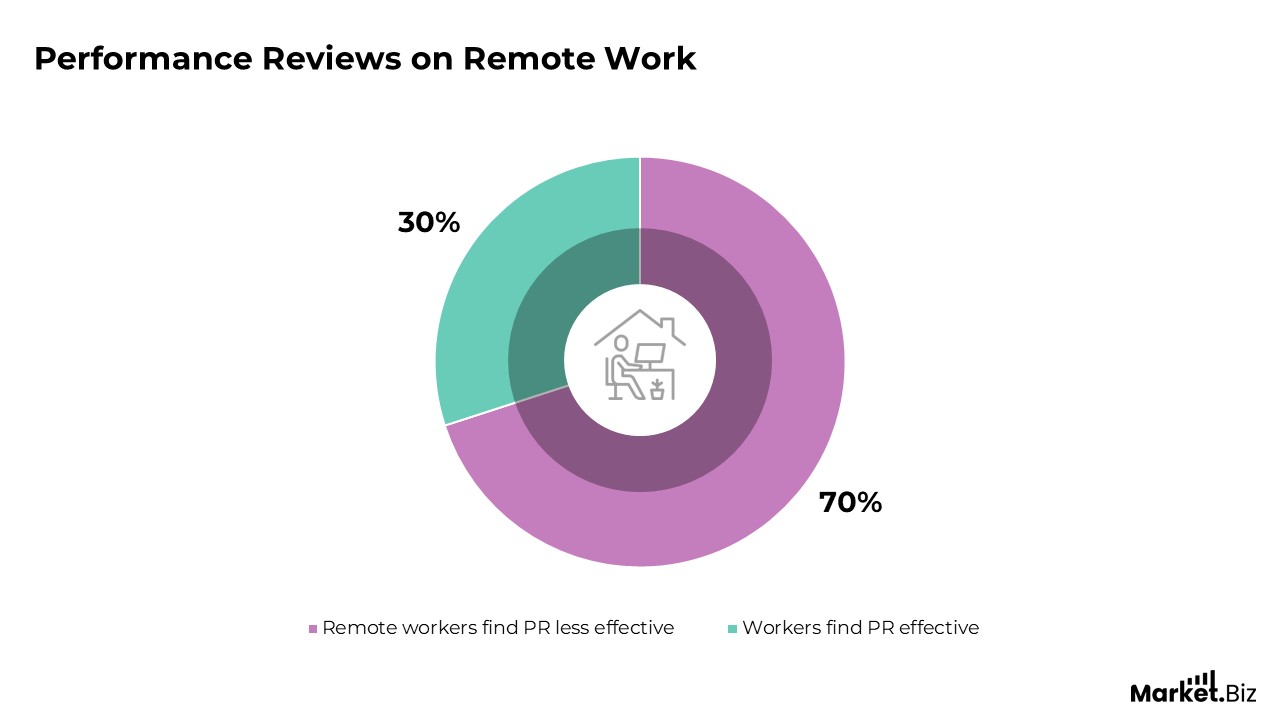
- Remote workers find performance reviews 70% less effective than in-office evaluations, mainly due to communication barriers.
- HR managers say remote performance reviews are 68% harder to conduct, mostly because of the lack of non-verbal cues.
- 55% of remote employees feel virtual reviews focus more on results, leaving qualitative feedback often overlooked.
- Managers use digital tools to track remote performance, with 60% relying on them as traditional methods are less effective.
- More frequent performance reviews have been adopted by 64% of companies to provide continuous feedback for remote workers.
- 80% of remote workers prefer reviews with clear, measurable metrics that show how their work impacts company goals.
- Remote workers believe 53% of the time that their managers lack proper training for conducting effective virtual reviews.
- 62% of employees feel remote performance reviews lack personal connection, which leads to disengagement and dissatisfaction.
- Companies use AI or automated tools for remote performance reviews in 57% of cases to improve effectiveness.
- 45% of remote workers feel they receive less constructive feedback compared to in-office employees, contributing to isolation.
- Remote workers prefer performance reviews via video calls, with 69% feeling they offer a more personal experience.
- 59% of HR professionals say remote performance reviews are less standardized, making fairness more difficult to ensure.
Future Trends in Performance Reviews
- By 2026, 70% of companies are expected to shift towards continuous performance reviews, focusing on real-time feedback rather than relying on annual evaluations to drive employee development.
- 60% of HR professionals foresee AI playing a significant role in performance reviews, automating data analysis, and reducing bias in the evaluation process.
- With remote and hybrid work models on the rise, 65% of companies are likely to adopt digital-first performance review systems, making it easier to assess distributed teams.
- 50% of organizations plan to integrate 360-degree feedback into their performance review processes by 2027, providing a more holistic perspective on employee performance.
- As the demand for flexibility grows, 80% of workers are expected to prefer performance reviews that are mobile-friendly, allowing for on-the-go feedback, especially among younger generations.
- 58% of companies are investing in upskilling managers to conduct more empathetic and personalized performance reviews, recognizing the need for emotional intelligence in remote settings.
- Data-driven performance reviews are projected to increase by 72% in the next five years, with businesses prioritizing measurable, objective metrics to assess employee success.
- 65% of businesses are likely to incorporate gamification elements in their performance reviews, aiming to boost engagement and motivation by aligning reviews with personal achievements.
Conclusion
The report shows a clear shift in how companies handle performance reviews, with many moving away from annual evaluations and embracing more frequent feedback. This change helps boost employee engagement and aligns individual goals with business objectives. However, challenges still exist, as many employees feel they don’t get enough or effective feedback.
The use of tools like 360-degree feedback, AI, and performance management software is on the rise, making reviews more objective and tailored to individual growth. Looking ahead, continuous feedback and real-time tracking are likely to play a key role in shaping how companies support their employees’ development.
FAQs
Companies are adopting frequent check-ins to provide timely feedback, improve engagement, and better align goals with business objectives.
Technology, such as AI and performance software, helps streamline reviews, reduce bias, and offer personalized insights for development.
Regular feedback boosts employee engagement, motivation, and satisfaction, leading to higher productivity and retention.
Challenges include biases, inconsistent feedback, and the time-consuming nature of traditional reviews, which can be confusing.
A strong feedback culture increases employee engagement, retention, and alignment with goals, boosting revenue and performance.