









Introduction
Video Marketing Statistics: It has become a dominant force in the digital marketing world, offering a compelling way to deliver messages that engage and resonate with audiences. With its ability to captivate viewers and leave a lasting impression, video content has become an essential tool for brands looking to grab consumer attention.
As more businesses adopt video as a core marketing strategy, understanding the key statistics behind its rise and influence is crucial. These insights highlight how video is enhancing viewer engagement and driving higher conversion rates, ultimately transforming how brands interact with their customers. By staying updated on the latest trends and data in video marketing, businesses can harness its power to improve brand visibility and achieve tangible outcomes.
Editor’s Choice
- 91% of businesses incorporate video content, underlining its essential role in engaging audiences and driving growth.
- 68% of marketers who have not yet adopted video plan to do so by 2025, signaling a significant shift toward this powerful medium.
- YouTube remains the leading platform for video marketing, with 90% of video marketers utilizing it for their campaigns.
- Live-action videos make up 48% of video marketing content, valued for their authenticity and ability to resonate with audiences.
- An impressive 90% of marketers affirm that video marketing delivers a strong return on investment (ROI), proving its effectiveness across various performance indicators.
- Most marketers allocate 21-30% of their video marketing budget, reflecting its growing importance in their overall marketing strategy.
- 87% of marketers report that video content has significantly boosted lead generation.
- 91% of consumers have watched an explainer video to understand a product or service better, highlighting their effectiveness in conveying key information.
- Short-form videos, typically between 30 and 60 seconds, are highly effective on social media, capturing viewers’ attention due to their concise nature.
- 87% of marketers attribute increased sales directly to the use of video content, showcasing its powerful impact on consumer purchasing decisions.
What is the Influence of Video Content Online?
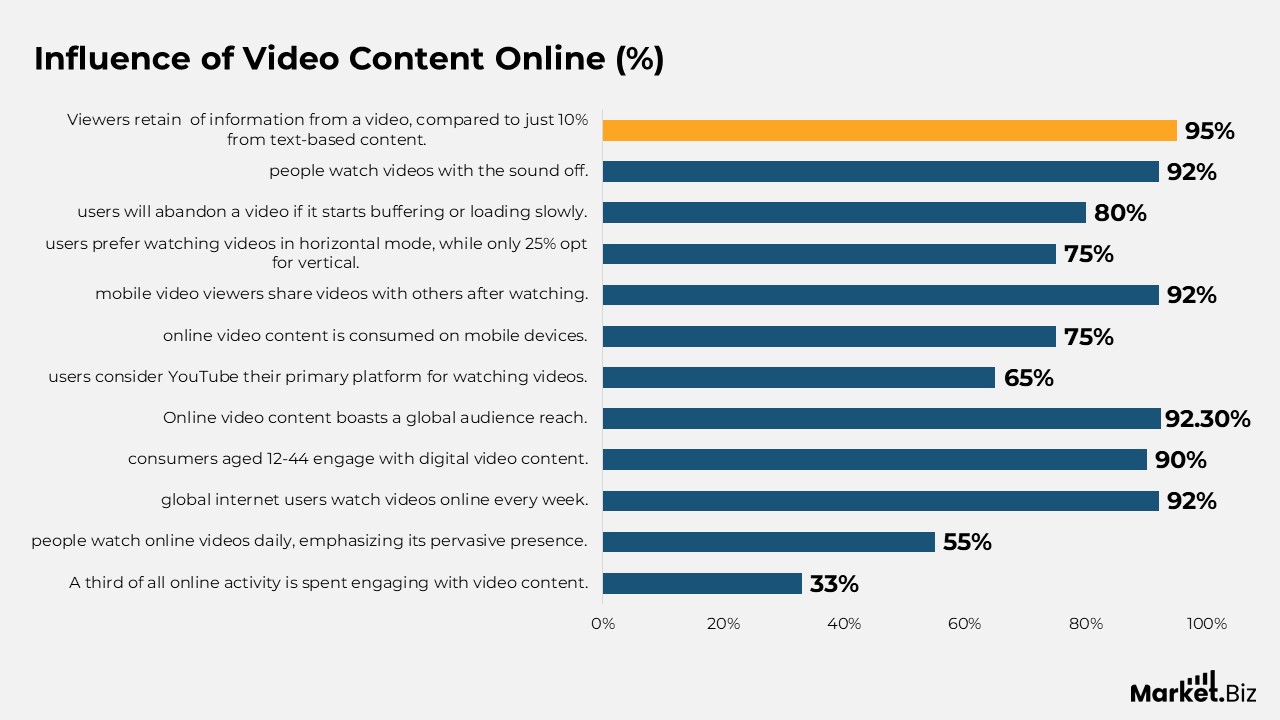
- A third of all online activity is spent engaging with video content.
- Every day, 100 million internet users watch videos online.
- 55% of people watch online videos daily, emphasizing its pervasive presence.
- YouTube sees more than 1 billion hours of video watched every single day.
- Over 92% of global internet users watch videos online every week.
- On average, people consume around 17 hours of video content each week.
- More than 90% of consumers aged 12-44 engage with digital video content.
- There are over 244 million online video viewers in the United States alone.
- Online video content boasts a global audience reach of 92.3%.
- 65% of users consider YouTube their primary platform for watching videos.
- More than 75% of online video content is consumed on mobile devices.
- 92% of mobile video viewers share videos with others after watching.
- 75% of users prefer watching videos in horizontal mode, while only 25% opt for vertical.
- 80% of users will abandon a video if it starts buffering or loading slowly.
- 92% of people watch videos with the sound off.
- Viewers retain 95% of information from a video, compared to just 10% from text-based content.
(Source: WebFX, Statista)
General Video Marketing Statistics
- 79% of non-video marketers (up by 10% from the previous year) plan to incorporate video into their marketing strategies.
- 66% of companies used videos to communicate with key stakeholders during the COVID lockdown, and this trend has remained steady since then.
- Videos on social media are shared 12 times more than text and images combined.
- Marketers using video marketing see 49% faster revenue growth compared to organizations that do not use video.
- 98% of marketers view video marketing as an essential part of their overall strategy.
- Video marketing helps marketers land 66% more qualified leads.
- Adding a video to a website’s landing page can boost conversions by 18%.
- 52% of marketers consider video a valuable tool for building trust between brands and customers.
- 87% of marketers are satisfied with the return on investment (ROI) from their video marketing efforts.
- 54% of video consumers want more video content from their favourite brands.
- After Google (87%), YouTube is the second most used platform for product research, with 63% of users, followed by TikTok at 25%.
- More than 78% of observers consume video content weekly, with 55% engaging with it daily.
- 75% of video marketers have used artificial intelligence (AI) to create video content.
- 59% of marketers are uncertain about whether their company will invest in AI-driven video marketing.
(Source: Lemonlight; Wyzowl, G2.com, Inc.)
Marketing Animation Video Production Market Size
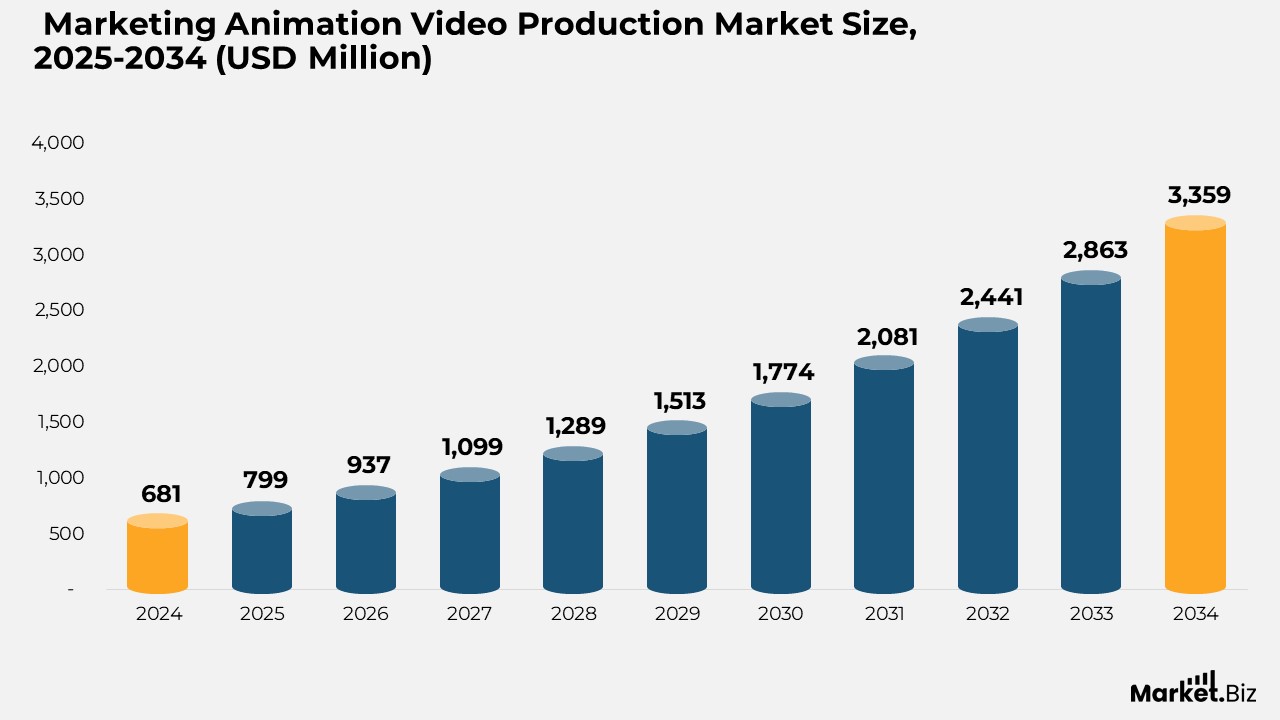
- According to Market.us, the marketing animation video production market is expected to rise from $799 million in 2025 to $3,359 billion by 2034, representing a compound annual growth rate (CAGR) of 17.3% from 2025 to 2034.
- The market’s growth is fueled by the increasing demand for visually engaging content on digital platforms, with video dominating social media.
- In 2024, the 2D Animation segment holds a dominant market share of over 40%, driven by its widespread use in digital marketing and advertising.
- The Retail & E-commerce segment dominates the marketing animation video production market in 2024, capturing more than 20% of the total market share due to the rise in online shopping.
- The US marketing animation video production market is projected to reach $271.1 million in 2024, growing at a CAGR of 15.7%.
- North America holds a dominant market share of 34.5% in the marketing animation video production market in 2024, with revenues of approximately USD 234.9 million.
- Video content is projected to account for 82% of all internet traffic by 2025, emphasizing its increasing role in digital marketing strategies.
- A 2023 Nielsen study found that 73% of global consumers are willing to pay more for sustainable products, suggesting a growing opportunity for animated content focusing on sustainability.
- According to a HubSpot study, 54% of consumers desire more video content from brands, with short-form animated videos being particularly effective for engaging audiences with limited attention spans.
(Source: Market.us)
Contextual Marketing Market Size
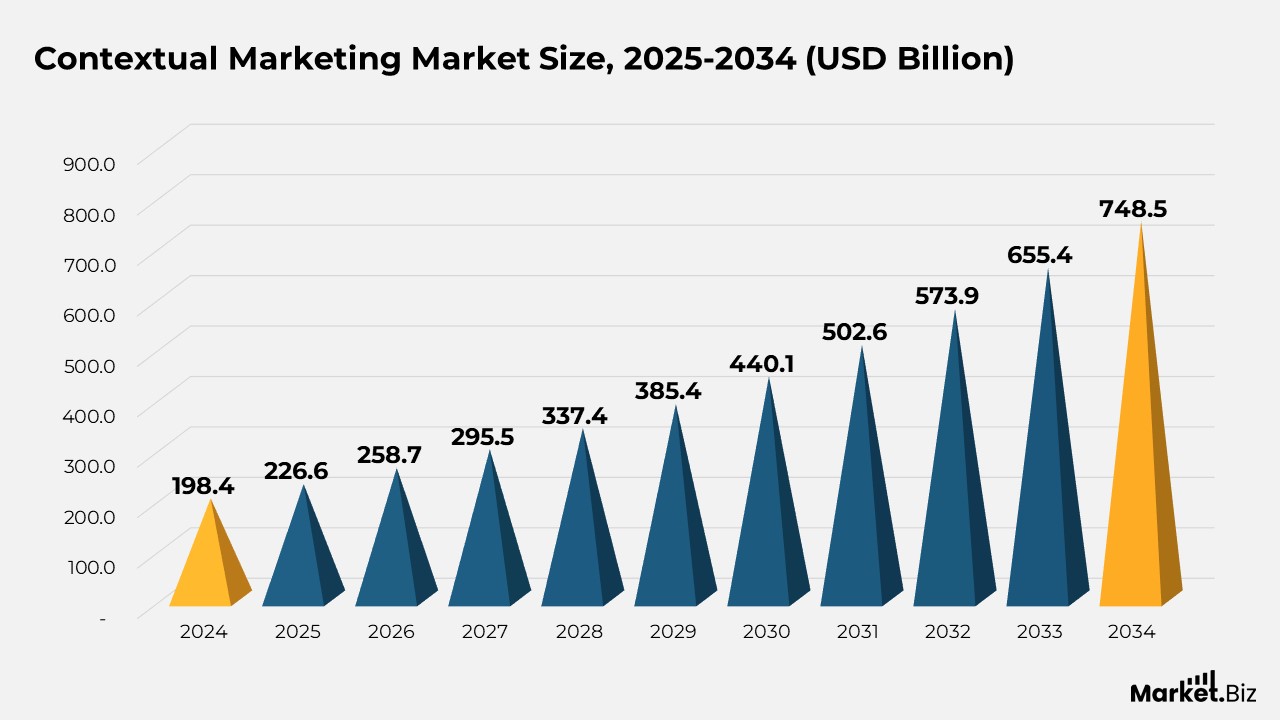
- According to Market.us, the contextual marketing market is expected to rise from $226.6 billion in 2025 to $748.5 billion by 2034, representing a compound annual growth rate (CAGR) of 14.2% from 2025 to 2034.
- Market growth is driven by the need for personalized and relevant advertising that respects consumer privacy through contextual marketing.
- In 2024, the Mobile Devices segment holds a dominant market share of over 46.5%, fueled by the widespread use of smartphones and tablets for delivering location-specific ads.
- The Retail & Consumer Goods segment captures more than 23.7% of the contextual marketing market in 2024, leveraging contextual tools effectively for targeted promotions.
- The US Contextual Marketing Market is appreciated at almost USD 68.21 billion in 2024 and is projected to grow to USD 233.60 billion by 2034, with a CAGR of 13.1% from 2025 to 2034.
- North America dominates the contextual marketing market with a 38.2% share in 2024, amounting to USD 75.7 billion in revenue, driven by advanced tech infrastructure and major AI-driven companies.
- According to Epsilon, 69% of advertisers believe the elimination of third-party cookies will have a greater impact on digital advertising than privacy regulations like GDPR and CCPA.
- As of 2024, 74% of marketers use contextual data to optimize ads, responding to the absence of third-party cookies and device IDs.
- 79% of consumers feel more comfortable with related ads associated with behavioral ones, and nearly 80% prefer ads that do not collect personal data.
- 42% of brands plan to increase investments in contextual advertising, reflecting growing confidence in its effectiveness.
- Contextual ads are 50% more likely to be clicked and yield a 30% higher return on investment compared to non-contextual ads.
(Source: Market.us)
Short-Form Video Content Statistics
- Short-form videos, including formats like TikTok, Instagram Reels, and YouTube Shorts, are the most widely utilized by marketers, with 29.18% incorporating them into their strategies.
- 21% of marketers believe short-form videos offer the highest return on investment (ROI).
- Short-form videos are the top content format that marketers plan to prioritize, with 17.13% intending to increase their investment in this area.
- More than a third of video marketers say the ideal video length is between 1 and three minutes, and 96% agree that videos should generally be under 10 minutes.
- 73% of consumers prefer watching short-form videos to learn about products or services.
- YouTube Shorts achieved the maximum engagement rate among all short-form video platforms, with an engagement rate of 5.91% in Q1 2024. TikTok followed closely with an appointment rate of 5.75%, while Facebook Reels recorded around 2%.
- The average length of TikTok videos increased to 42.7 seconds in 2024, up from 39 seconds in 2023. TikTok videos eternal over 54 seconds averaged 38,000 views, while shorter videos usually fewer views. Videos under 10 seconds had the lowest engagement, with around 19,000 views.
- YouTube Shorts had an average of 2 billion monthly viewers by July 2023.
- Most YouTube Shorts are 30-40 seconds long, with those lasting 50-60 seconds receiving the most
(Source: HubSpot State of Marketing Report; Statista; INFLOW Network, HubSpot, Inc.)
Video Analytics and Marketing Trends
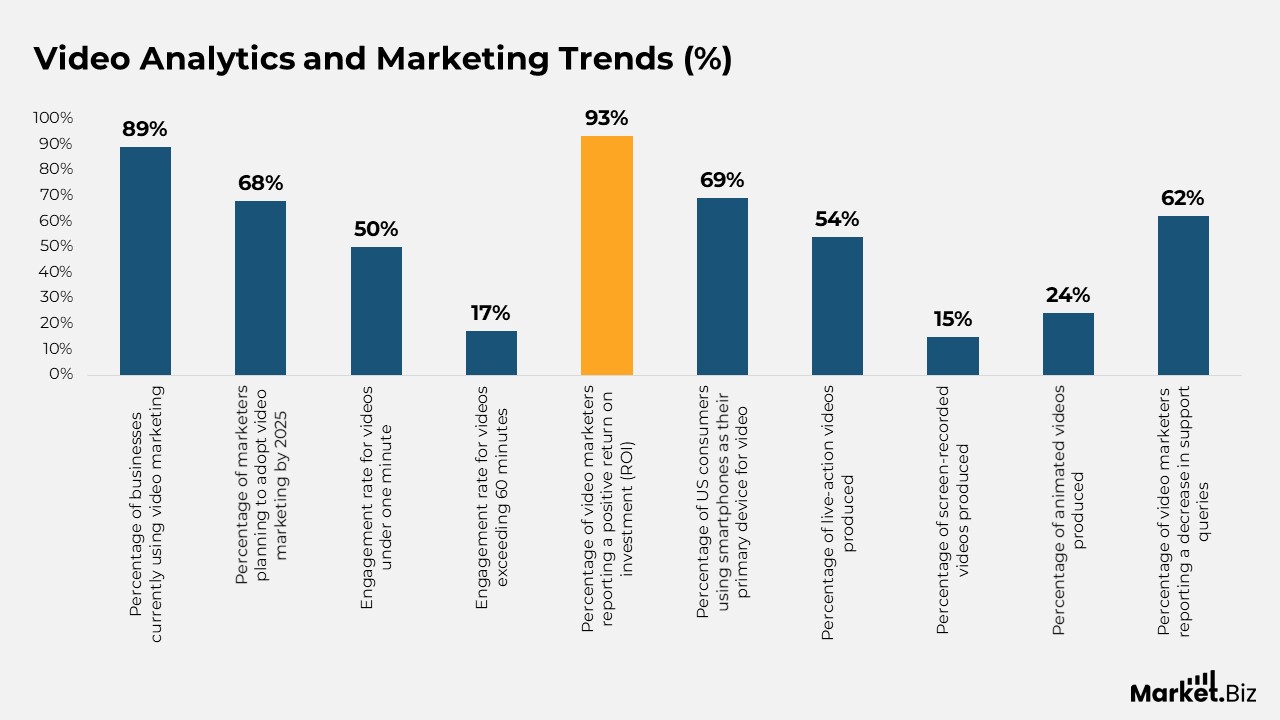
- 89% of businesses currently use video marketing, and 68% of marketers who haven’t yet adopted it plan to do so by 2025.
- Most videos uploaded to Wistia in 2023 were either under three minutes or between five and 30 minutes in length.
- As video length increases, engagement tends to decrease. Videos under one minute have an average engagement rate of 50%, while those exceeding 60 minutes see a significantly lower engagement rate of 17%.
- 93% of video marketers report achieving a positive return on investment (ROI) from their video marketing efforts.
- The majority of US consumers, 69%, consider smartphones their primary device for watching videos, making mobile devices the most popular choice for video consumption.
- The most commonly produced types of videos are live-action (54%), followed by screen-recorded videos (15%) and animated videos (24%).
- 62% of video marketers have reported a decrease in support queries, attributing this reduction to the use of video content in addressing customer inquiries.
(Source: Wyzowl; Wistia; Statista, HubSpot, Inc.)
Product Videos Statistics
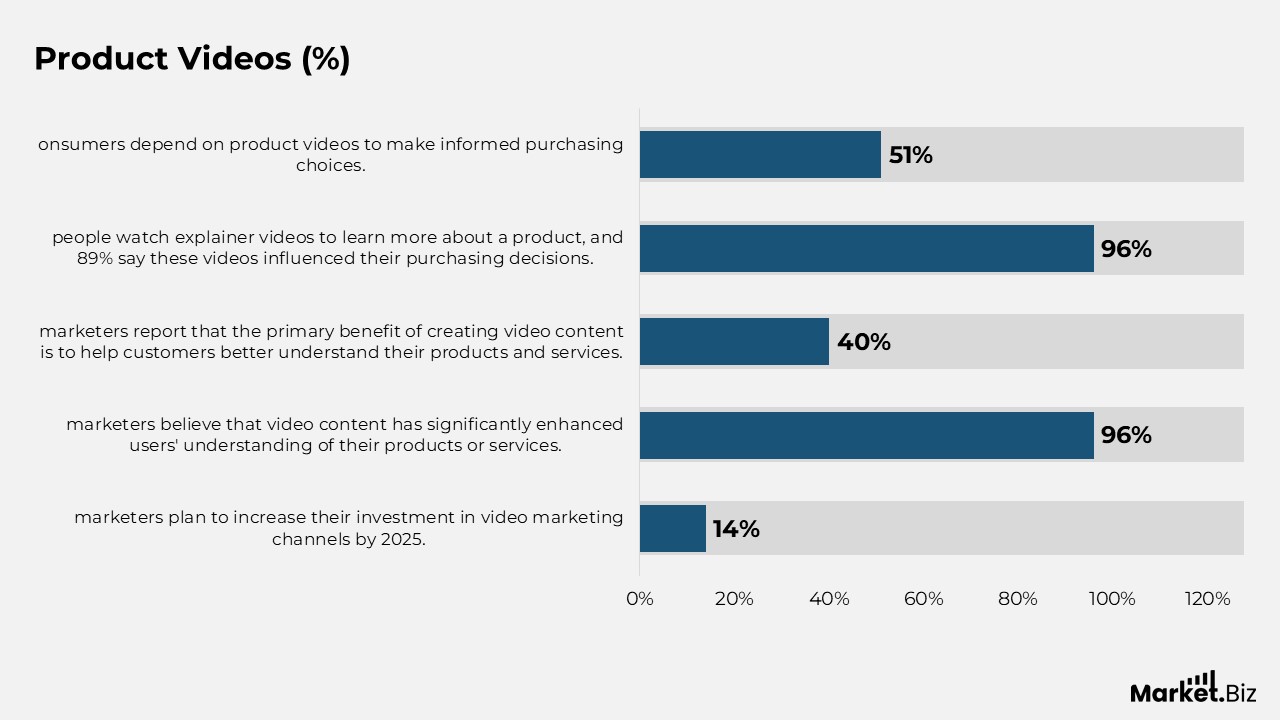
- 13.99% of marketers plan to increase their investment in video marketing channels by 2025.
- 96% of marketers believe that video content has significantly enhanced users’ understanding of their products or services.
- 40% of marketers report that the primary benefit of creating video content is to help customers better understand their products and services.
- 96% of people watch explainer videos to learn more about a product, and 89% say these videos influenced their purchasing decisions.
- 51% of consumers depend on product videos to make informed purchasing choices.
(Source: HubSpot State of Marketing; HubSpot State of Video Marketing Report, Plainly)
YouTube Video Statistics
- YouTube now permits consumers to upload Shorts up to three minutes long.
- In 2023, YouTube Shorts’ monetization rate more than doubled compared to in-stream video, indicating an increase in ad spending on Shorts.
- YouTube has the highest mobile audience reach among all leading smartphone apps in the US, with 76% of mobile users accessing the platform.
- YouTube boasts more than 2.5 billion active users worldwide.
- The user base on YouTube is nearly split, with 45.6% female users and 54.4% male users.
- Over half of US viewers believe that YouTube ads are more relevant than those on traditional TV or other streaming platforms.
- 22% of marketers have integrated YouTube Stories into their video marketing strategies.
- In the United Kingdom, children spend an average of 66 minutes daily on YouTube.
(Source: Alphabet, Earnings Call; Statista; DataReportal, Social Media Examiner)
What Impact Does Video Marketing Have on Business Performance?
- 86% of marketers report that video content has significantly increased website traffic.
- 82% of businesses say that videos help to keep visitors on their website for a longer duration.
- Pages with video content see users staying almost 3 times longer than those without video content.
- Blog posts that include video attract 3 times as many backlinks as those that don’t.
- 90% of marketers agree that video marketing has improved their return on investment (ROI).
- 87% of marketers say video marketing has led to an increase in lead generation.
- 87% of marketers report that video marketing has resulted in more sales for their businesses.
- Companies using video marketing grow their revenue 49% faster than those that don’t.
- Businesses leveraging video marketing experience 34% higher conversion rates compared to those that do not.
- On e-commerce sites, video marketing can increase conversions by up to 80%.
- Adding a video to a landing page can boost its conversion rate by up to 80%.
- The average conversion rate for websites with video content is 4.8%, compared to 2.9% for sites without video.
- Social media posts with video content generate 2 times more engagement than those with only images.
- Posts featuring videos generate 1200% more shares than text or image-based posts combined.
- Including video in marketing emails can increase click-through rates by as much as 300%.
- 88% of marketers say video marketing has helped customers better understand their products or services.
- 90% of businesses report that video marketing has boosted brand awareness.
- 62% of Google searches now display video results.
(Source: WebFX, Statista)
What Are the Key Best Practices for Effective Video Marketing?
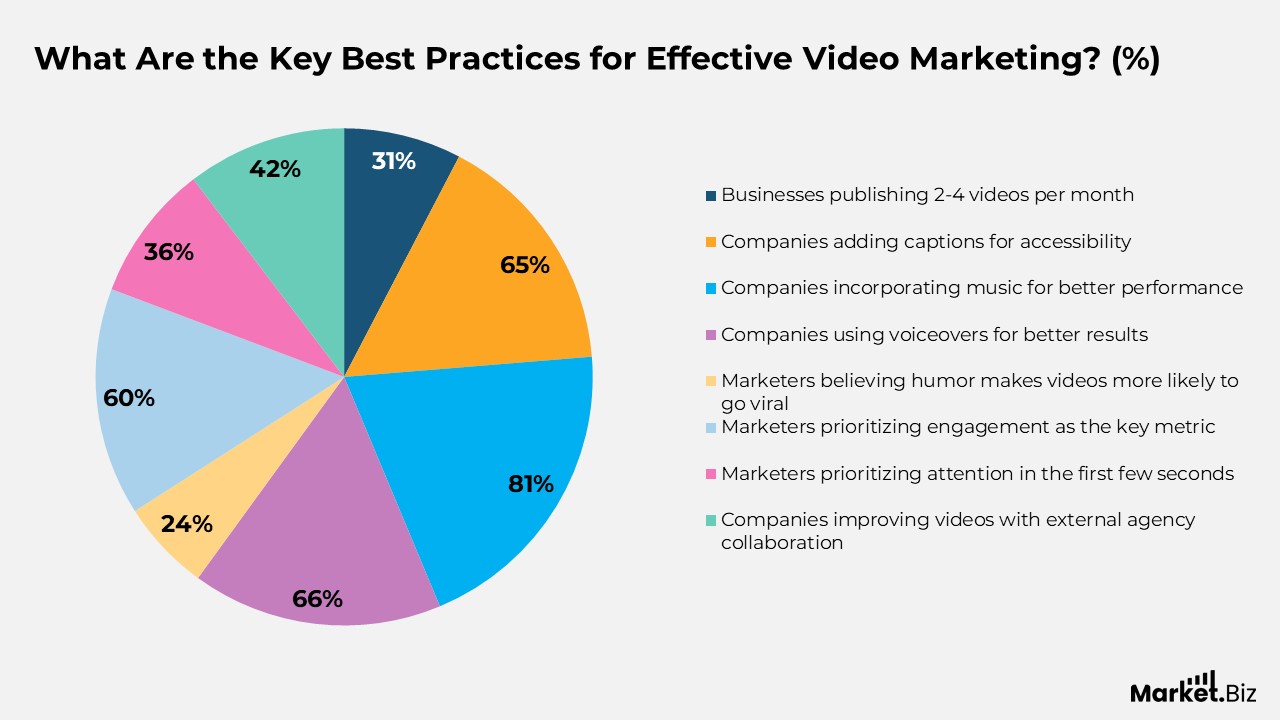
- 31% of businesses publish between 2 and 4 videos per month.
- 65% of companies add captions to their videos to improve accessibility.
- Marketing videos must capture viewers’ attention within 2.7 seconds or less, due to short attention spans.
- 81% of companies report that incorporating music into their videos enhances their performance.
- 66% of companies say using voiceovers in their videos leads to better results.
- 24% of marketers believe videos are more likely to go viral when humor is used.
- 60% of marketers consider engagement to be the most important metric to track in video marketing.
- 36% of marketers prioritize grabbing users’ attention in the first few seconds when creating video content.
- 42% of companies feel their videos have improved after collaborating with an external agency.
(Source: WebFX, Statista)
Social Media Video Marketing Statistics
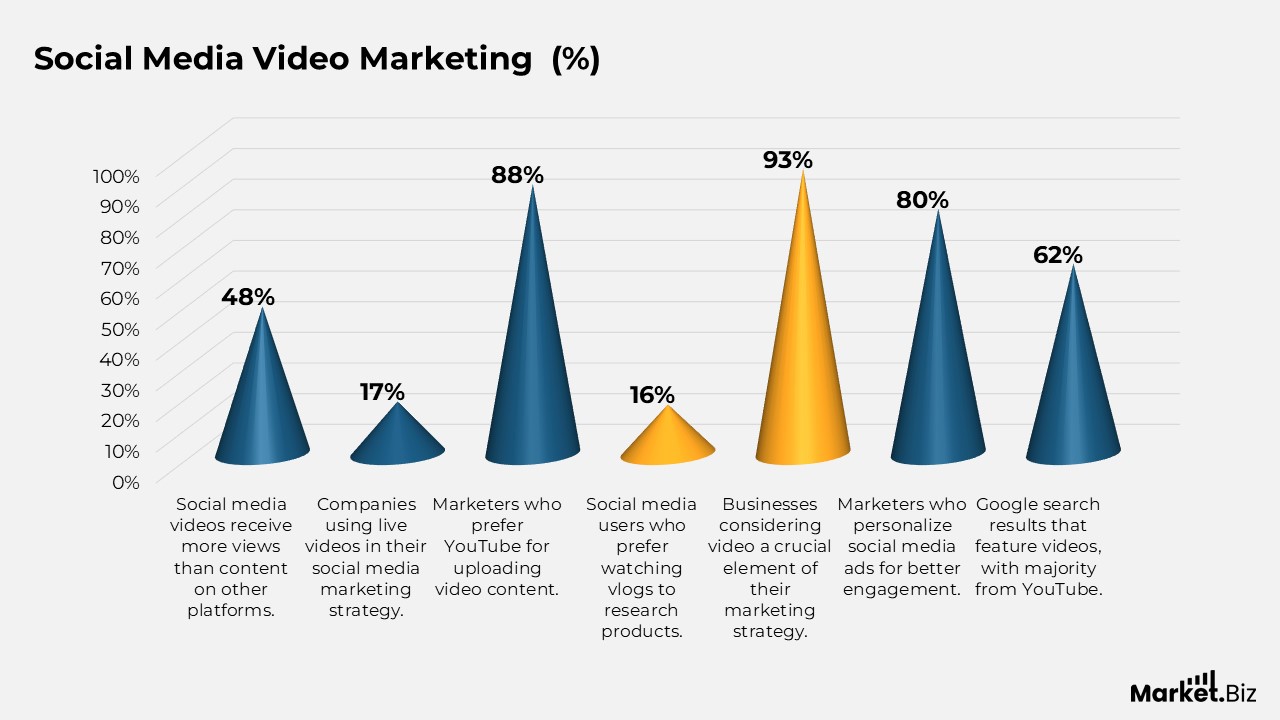
- Social media videos receive 48% more views than content on other platforms.
- 17% of companies use live videos as part of their social media marketing strategy.
- 88% of marketers prefer YouTube for uploading video content.
- More than 500 hours of new content are uploaded to YouTube every minute.
- 16% of social media users choose watching vlogs to researching products.
- 93% of businesses consider video a crucial element of their marketing strategy.
- 80% of marketers personalize their social media ads for better engagement.
- 62% of Google search results feature videos, with 80% of those coming from YouTube.
- YouTube viewers on mobile devices pay twice as much attention to content as television viewers.
- 90% of businesses use webinar software like Wistia Live, Zoom, or GoToWebinar for broadcasting live events, while only 10% stream directly on YouTube, LinkedIn, Instagram, or Facebook.
- 90% of Instagram users follow at least one business.
- Facebook sees more than 8 billion video views daily.
- 73% of marketers use Facebook video ads to help their products or services.
- The highest conversion rates for Facebook video ads are seen in videos that are 16 to 20 seconds long.
- 40% of Facebook users prioritize sharing videos and images, followed by 29% on Instagram, 29% on Snapchat, and 23% on Tumblr.
- 58% of Instagram operators feel extra connected to a brand after viewing their Instagram story.
- 38% of marketers generate video content for LinkedIn, and 75% of them report success with it.
(Source: Plainly, G2.com, Inc.)
Conclusion
Video marketing remains a powerful and indispensable tool for engaging audiences and driving business growth. As the demand for visual content continues to rise, companies are utilizing videos to enhance brand visibility, generate leads, and improve customer interaction.
With the digital landscape constantly evolving, video remains a dominant medium, with consumers actively seeking video content across various platforms. The data highlights its effectiveness in generating impressive returns on investment and influencing consumer purchasing behavior.
Marketers who prioritize video as a core element of their strategy are better equipped to thrive in today’s fast-paced digital environment.
FAQ’s
Video marketing is essential because it engages audiences in ways that text alone cannot. With dynamic visuals and compelling storytelling, video content offers deeper engagement, making it easier for businesses to communicate their message and establish a connection with consumers. It enhances brand visibility, boosts conversions, and has become a critical tool for driving growth in the digital age.
Around 91% of businesses have incorporated video into their marketing strategies, demonstrating that it is no longer an optional tactic. Video has become an integral part of modern marketing, helping businesses stay competitive and relevant in the digital landscape.
YouTube is the leading platform for video marketing, with 90% of video marketers using it. Its broad reach and accessibility make it an ideal platform for businesses to engage with a global audience. Additionally, YouTube’s search functionality and analytics tools make it an invaluable resource for video marketing campaigns.
Consumers are spending a significant amount of time watching video content, with video consumption being a major part of their online activity. This trend underscores the growing preference for video as a medium and highlights the opportunity for businesses to engage their audiences through video marketing.