









Introduction
Eyewear Statistics: The eyewear industry has experienced consistent growth, driven by health-related needs and fashion trends. As vision issues become more prevalent worldwide, the demand for prescription eyewear has risen, alongside a growing interest in non-prescription fashion eyewear. The increasing prevalence of digital eye strain, primarily due to the extensive use of electronic devices, has also increased demand for corrective lenses and blue-light-blocking eyewear.
Additionally, as consumers become more style-conscious, eyewear has evolved into a significant fashion accessory, driving the growth of stylish, luxurious, and customizable frames. This growth is further supported by innovations in eyewear technology, such as smart glasses, which are influencing market trends and consumer choices. As the industry advances, eyewear remains a vital component in both health and personal style.
Editor’s Choice
- Silicone hydrogel lenses have gained significant popularity, accounting for 67% of the total contact lens market, according to Contact Lens Spectrum (2022).
- In 2022, approximately 88.4 million people worldwide experienced moderate to severe distance vision impairment or blindness due to untreated refractive errors.
- 94 million individuals worldwide are affected by cataracts, making it a leading cause of vision impairment.
- According to the NCBI, around 200 million people had age-related macular degeneration (AMD) globally in 2020, with projections suggesting that 288 million will be affected by 2040.
- As of August 2023, around 7.7 million people globally are living with glaucoma, with estimates suggesting that this number will rise to 112 million by 2040, largely due to an aging population.
- In the US, 4.1 million people were diagnosed with retinopathy in 2023, and approximately 899,000 individuals are experiencing vision-threatening retinopathy.
(Source: National Institute of Health, National Center for Biotechnology Information, Glaucoma Australia, Center For Disease Control and Prevention, Contact Lens Spectrum)
Eyewear Market Size
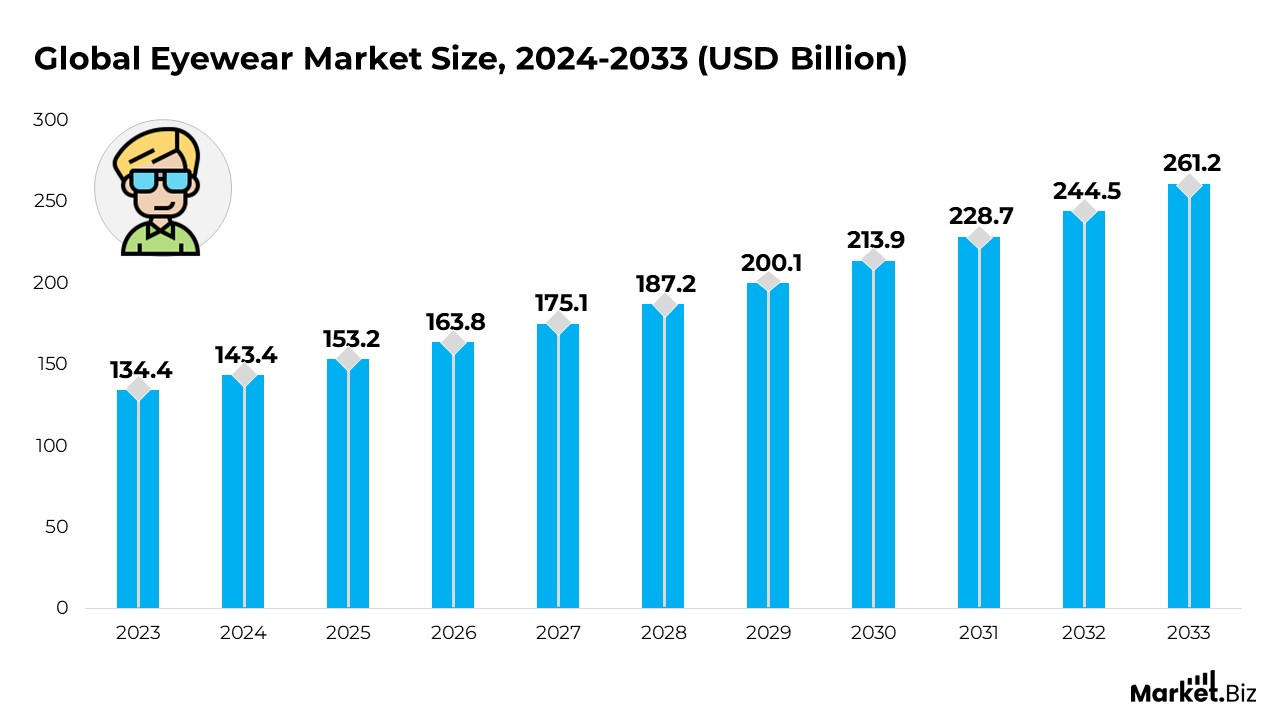
- According to Market.us, the global eyewear market is projected to grow from $153.2 billion in 2025 to $244.5 billion by 2032, representing a compound annual growth rate (CAGR) of 6.9% from 2023 to 2033.
- The eyewear market is growing due to rising global rates of myopia and presbyopia, driven by demographic changes, increased digital screen exposure, and advances in lens technology.
- In 2023, spectacles dominated the eyewear market, accounting for 52% of the market, while frames and lenses also experienced significant growth, driven by demand for both functional and fashionable options.
- In 2023, men accounted for a 37% share of the eyewear market, reflecting their growing preference for both functional and designer eyewear across various product types.
- In 2023, optical stores accounted for 62.4% of the eyewear market, offering essential services such as eye exams, expert consultations, and immediate adjustments, all of which are crucial for making informed eyewear purchases.
- North America led the global eyewear market in 2023, accounting for 44.2% of global market share and generating USD 59.27 billion in revenue, driven by strong consumer awareness and the presence of leading brands.
(Source: Market.us)
Types of Eyewear
- Contact Lenses
- Sunglasses
- Blue Light Glasses
- Computer Glasses
- Prescription Glasses
- Non-Prescription Glasses
- Smart Glasses
- Fashion Eyewear
(Source: Oscar Wylee Pty Ltd, Warby Parker)
Eyewear Types Statistics
Contact Lenses Statistics
- The contact lens market is projected to reach US$19.83 billion by 2025, driven by sustained global demand.
- With a Compound Annual Growth Rate (CAGR) of 3.81% from 2025 to 2029, the market is projected to grow steadily over this period.
- A significant portion of revenue is expected to come from the United States, with an estimated US$6 billion in revenue by 2025.
- On a per-person basis, the contact lenses market is expected to generate US$2.54 globally in 2025.
- By 2029, the contact lenses market volume is expected to reach 8.0 billion units.
- A 1.2% growth in volume is projected for 2026, reflecting a continued upward trend.
- According to the Centers for Disease Control and Prevention (CDC), 45 million Americans wear contact lenses, with one-third of them experiencing at least one healthcare visit for issues such as red or painful eyes in 2022.
- Studies from the US National Library of Medicine indicate that 40%-90% of contact lens users do not follow the proper care instructions provided by their optometrists.
- Despite these concerns, contact lenses remain largely safe, with only 1 in 500 users experiencing a serious eye infection.
- According to a 2022 Vision Council study, the primary consumer demographic for contact lenses is individuals aged 18-34.
(Source: Centers for Disease Control and Prevention, Contact Kugler Vision, Professional VisionCare, US National Library of Medicine, Statista, Vision Council)
Sunglasses Statistics
- The global sunglasses market is projected to reach US$26.32 billion in revenue by 2025, with an anticipated compound annual growth rate (CAGR) of 3.43% from 2025 to 2029.
- The United States is projected to lead the market in 2025, accounting for approximately US$5 billion in revenue.
- The sunglasses market is projected to generate US$3.37 billion in revenue per capita in 2025, based on global population figures.
- By 2029, the sunglasses market volume is anticipated to reach 873.8 million units.
- The market is expected to exhibit a 0.5% volume growth in 2026, reflecting steady demand.
- In 2025, the global average per capita consumption of sunglasses is estimated at 0.1 units.
- In Australia, polarised lens sunglasses are particularly popular, as they effectively reduce glare from reflective surfaces, such as water and sand.
- According to a 2023 survey by the Vision Council of America, more than 223.5 million Americans own or wear at least one pair of sunglasses.
- Among those surveyed, 56% wear sunglasses when relaxing or lounging, whereas 74% indicated they are more likely to wear them for leisure activities.
(Statista: Vision Council of America, Statista, Mougy)
Prescription Glass Statistics
- Prescription glasses hold the largest market share at 42%, with annual sales totaling approximately $15 billion.
- In India, there is a growing demand for affordable eyewear, particularly for fashionable frames and prescription lenses.
- According to a 2022 Vision Council study, 60% of prescription-glasses consumers are adults aged 40 and older.
- As reported by Consumer Reports in 2022, the average price for a pair of prescription glasses is around $250.
(Statista: Electron IQ, Vision Council)
Eye Disease Statistics
- In 2022, it was estimated that more than 2.2 billion people worldwide had some form of near or distance vision impairment. Of these, 1 billion cases could have been prevented or remain unaddressed.
- Globally, only 36% of individuals with distance vision impairment due to refractive errors have received necessary interventions, and only 17% of those with cataract-induced vision impairment have access to appropriate treatments.
- The leading causes of distance vision impairment or blindness globally are cataracts (94 million cases), age-related macular degeneration (8 million cases), refractive errors (88.4 million cases), glaucoma (7.7 million cases), and diabetic retinopathy (3.9 million cases). Among near-vision impairments, presbyopia is the most prevalent condition, affecting approximately 826 million people.
- Furthermore, the prevalence of distance vision damage in middle- and low-income regions is estimated to be four times that in high-income regions, highlighting disparities in access to eye care and treatment worldwide.
(Source: World Health Organization, National Institute of Health, National Center for Biotechnology Information, Glaucoma Australia, Center For Disease Control and Prevention)
What Percentage of People in Each Age Group Wear Glasses?
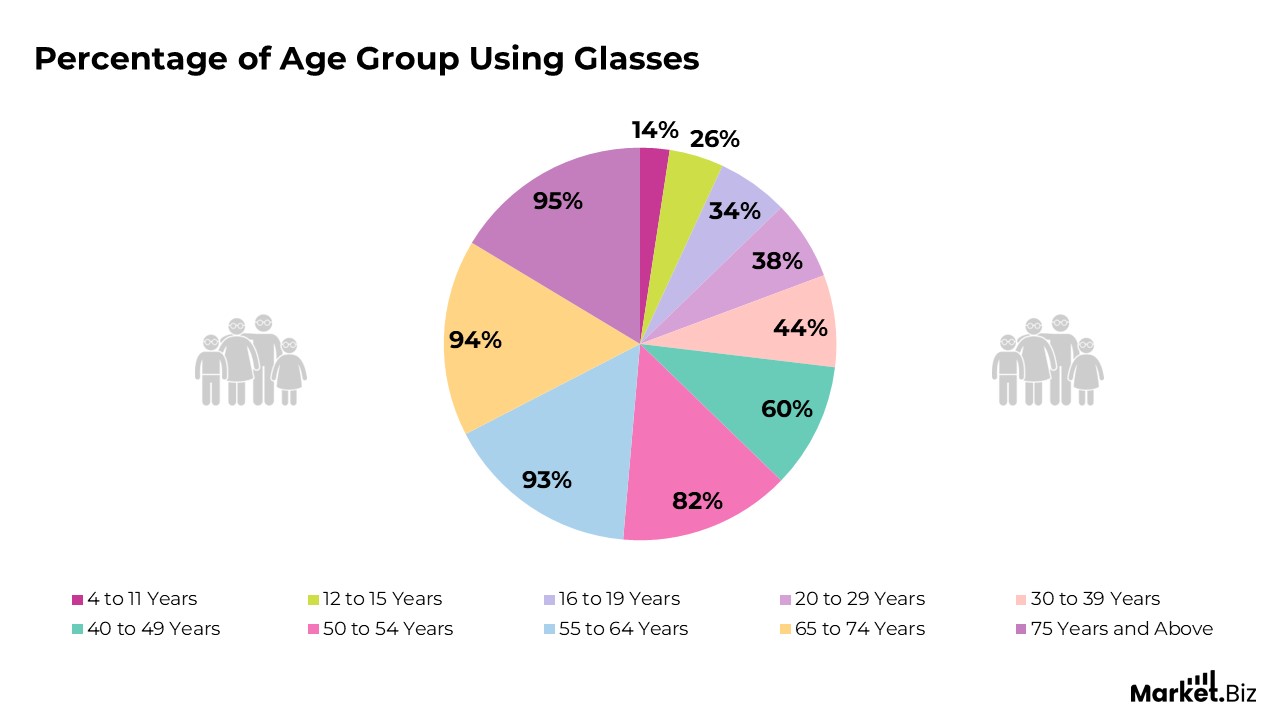
Percentage of People Using Optical Aids – by Age Group
| Age Group | Glass (%) 2022 | Contact Lenses (%) | Other Optical Aids (%) |
|---|---|---|---|
| 4-11 yrs | 14.2 | 0.4 | 0.6 |
| 12-15 yrs | 26.4 | 5.8 | 1.7 |
| 16-19 yrs | 34.2 | 15.8 | 1.1 |
| 20-29 yrs | 38.4 | 20.0 | 1.6 |
| 30-39 yrs | 44.1 | 19.7 | 1.7 |
| 40-49 yrs | 59.7 | 18.1 | 5.9 |
| 50-54 yrs | 82.1 | 16.1 | 13.0 |
| 55-64 yrs | 92.5 | 12.3 | 10.9 |
| 65-74 yrs | 94.3 | 5.8 | 10.9 |
- In 2022, 66% of women reported wearing glasses occasionally, compared to 57% of men.
- Fifteen per cent of women reported wearing contact lenses, whereas only 10% of men reported the same.
(Source: Facts that matter)
Eyewear Buying Patterns: Comparing In-Store and Online Preferences
- Prescription eyeglasses are most commonly purchased in person: 85% of consumers opt for in-store purchases, followed by 79% for non-prescription reading glasses and 77% for sunglasses.
- Contact lenses are also primarily bought in person, but have the highest online purchase rate at 37% among the segments surveyed.
- Online shoppers are more likely to buy multiple pairs of prescription eyeglasses, non-prescription reading glasses, and non-prescription sunglasses.
- A Consumer Reports survey found that 35% of consumers prefer to purchase eyeglasses in physical stores to try them on before making a purchase.
(Source: The Vision Council, Consumer Reports Eyewear Survey)
Eyewear Brands
Oakley
- As of 2023, Oakley commands an 8.5% market share in the performance eyewear sector, positioning it as one of the top players in the industry.
- The brand has experienced consistent revenue growth, with a Compound Annual Growth Rate (CAGR) of 8% over the past five years.
- A substantial 70% of Oakley’s sales are generated in North America, highlighting its dominant presence in the region.
- Oakley’s eyewear is especially favoured by athletes, with the segment accounting for approximately 25% of total sales.
- The company has secured more than 600 patents in eyewear technology, underscoring its leadership in the field.
(Source: Theme Circle, Statista, VentureBeat, US Patent and Trademark Office)
Ray-Ban
- Ray-Ban became part of the Luxottica Group in 1999, with a reported acquisition cost of $640 million, and has since expanded its presence to more than 130 countries worldwide.
- In 2022, Ray-Ban accounted for an estimated 12% of the global eyewear market, representing a significant share.
- Approximately 45% of Ray-Ban’s customers fall within the 25 -44 age range, reflecting the brand’s strong appeal to a younger, fashion-forward audience.
- The brand has established a robust online presence, with 22% of its 2022 revenue coming from e-commerce sales.
(Source: Pritchard Cowburn Opticians Ray-Ban Customer Demographics Study)
Gucci
- Around 40% of luxury eyewear shoppers prioritize Gucci as their top choice, underscoring the brand’s strong market appeal.
- Approximately 35% of Gucci eyewear purchases are made through online channels, indicating the brand’s substantial e-commerce presence.
- Limited edition Gucci eyewear collections typically sell out within 48 hours of their release, reflecting the high demand for exclusive offerings.
- The brand’s signature cat-eye frames account for nearly 25% of Gucci’s total eyewear sales, underscoring their immense popularity among consumers.
(Source: Gucci Annual Report, Statista)
Recent Developments
Technological Advancements
- The advancement of 3D printing technology enables the creation of custom-made eyewear frames, offering consumers personalized fit and design options.
- The incorporation of advanced lens technologies, such as blue-light filtering and photochromic lenses, helps mitigate digital eye strain while providing protection against harmful UV radiation.
Investments and Fundings:
- In May 2025, IXI secured USD 36.5 million in funding to develop eyewear that adapts to the wearer’s vision needs.
- In October 2023, Pair Eyewear raised USD 15 million in Series C funding to enhance the quality of its lenses and further expand its product offerings.
Conclusion
The eyewear market is experiencing robust growth, driven by increasing consumer demand for eyewear that seamlessly blends functionality with style. Technological advancements, including 3D printing for customized frames and innovations in lens technologies such as blue light filtering and photochromic lenses, are transforming the industry.
Leading brands such as Oakley, Ray-Ban, and Gucci are securing significant market share while adapting to e-commerce trends and offering exclusive collections to meet evolving consumer needs. As the focus shifts towards personalization, comfort, and cutting-edge optical features, the eyewear market is expected to continue its expansion, supported by increasing online sales and a younger, trend-conscious customer base.
FAQ’s
The demand for eyewear is primarily driven by younger, fashion-savvy consumers, with a significant share of individuals aged 25-44 opting for stylish eyewear. Additionally, older adults, particularly those aged 40 and older, constitute a crucial market segment for prescription eyewear due to their increasing need for vision correction.
The eyewear sector is being transformed by 3D printing technology, which enables the creation of custom frames, and by advances in lens technologies, such as blue-light filtering and photochromic lenses, which provide both comfort and enhanced protection for consumers.
Current trends in the eyewear industry include the rise of smart glasses integrated with augmented reality, the increasing demand for blue light-blocking lenses, the use of eco-friendly and sustainable materials, and a growing focus on personalization and customization. Moreover, direct-to-consumer (DTC) brands and online retail are reshaping the traditional eyewear purchasing model, a trend accelerated by the pandemic.
The leading eyewear products include prescription eyeglasses, sunglasses, and contact lenses. Prescription glasses dominate the market due to widespread need for vision correction, whereas sunglasses are popular not only for UV protection but also as a key fashion accessory. Contact lenses, both corrective and cosmetic, continue to hold a strong market position.