









Introduction
Digital Nomad Work Statistics: The remote work culture development worldwide has given its impetus to a new wave of digital nomads, with over 35 million digital nomads existing across the globe as of 2024. The professional workforce evolving with location-independent workers is reshaping the traditional work models.
In the U.S. alone, the digital nomad population jumped by 131% from 2019 to 2023 to an estimated 17.3 million. Flexibility always comes first for digital nomads—the tech-enabled jobs and freedom of lifestyle make IT, marketing, design, and consulting work their top choices. New statistics indicate that 53% of digital nomads work full-time remotely, while 47% are freelancers or entrepreneurs.
The secondary surface shows how companies rolled around the hybrid and remote workforce approach, presenting clues that would become important in workforce planning and global mobility insights.
Editor’s Choice
- The population of digital nomads worldwide will reach 40 million individuals by 2026 with 46 percent settling in the U.S.
- People who work as digital nomads consist of 66 percent who work full-time and 34 percent who operate their own business or freelance.
- People earning between $50,000 to $100,000 annually make up the majority of digital nomads but those in tech jobs bring in more than $150,000 a year.
- The large majority of digital nomads around the world choose to work in co-working spaces as well as cafes and shared offices to maintain their productivity.
- The digital nomad community consists mainly of individuals who are 36 years old while 47% of members fall between 30 to 39 years of age.
- Digital nomads show high-level talent since 90% of them have completed at least a bachelor’s degree.
- Digital nomads show highest interest in relocating to Bali along with Lisbon and Chiang Mai and Medellín and Barcelona.
- Digital nomads maintain high mobility levels as almost 68% of them visit at least three countries each year.
- The number of digital nomad applications at remote-first companies has increased by 25% since 2022.
- When selecting a destination for their work 87% of digital nomads require fast internet as a top priority.
- Digital nomads choose their lifestyle mainly because they pursue work-life balance, according to 44% of these individuals.
- The digital nomad trend will increase by 17% each year until 2027 and transform labour models throughout the world.
What is a Digital Nomad?
A digital nomad operates as a professional who uses technology to perform remote work from various locations, including while traveling and residing across different regions. The lifestyle of digital nomads combines professional responsibilities with travel activities through work in tech, marketing, and freelance writing as well as consulting roles.
Digital nomads depend on digital tools, together with cloud platforms and stable internet connections, to maintain their work productivity while operating across different countries. Digital nomads select co-working spaces alongside cafes and global hubs, which offer excellent remote work facilities for their operations. Remote work has reached a mainstream status, which explains how the digital nomad movement demonstrates changing perspectives toward career flexibility and worldwide job mobility.
General Digital Nomad Work Statistics
- The total number of digital nomads across the globe has surpassed a total of 40 million in 2024, and the population continues to grow following the COVID-19 pandemic.
- The United States stands at the top of the list with approximately 18.1 million digital nomads, which represents nearly 46% of all such workers worldwide.
- Most digital nomads equal 66% of the population who work full-time, while the remaining 34% work as freelancers or entrepreneurs.
- The digital nomad segment includes 53% of workers who specialize in tech alongside marketing, design and consulting.
- The majority of digital nomads achieve annual earnings between $50,000 and $250,000 USD, according to 70% of survey participants.
- Digital nomads use co-working spaces along with cafes and shared offices for productivity, according to 91% of respondents.
- The digital nomad population consists of 47% freelance workers who operate their businesses independently.
- Digital nomads have the highest median age between 30 and 39 years with millennials representing the majority of people in this lifestyle.
- The workforce of digital nomads consists of 90% individuals who have either college degrees or higher educational qualifications.
- Digital nomads regard Bali, Lisbon, Chiang Mai, Medellin, and Barcelona as their most popular destinations.
- Most digital nomads visit three or more countries every year, which demonstrates their extensive travel patterns.
- Remote-first organizations have observed a 25% increase in applications from digital nomads since 2022.
- Digital nomads prioritize high-speed internet access the most when they select their working locations, according to 87% of survey participants.
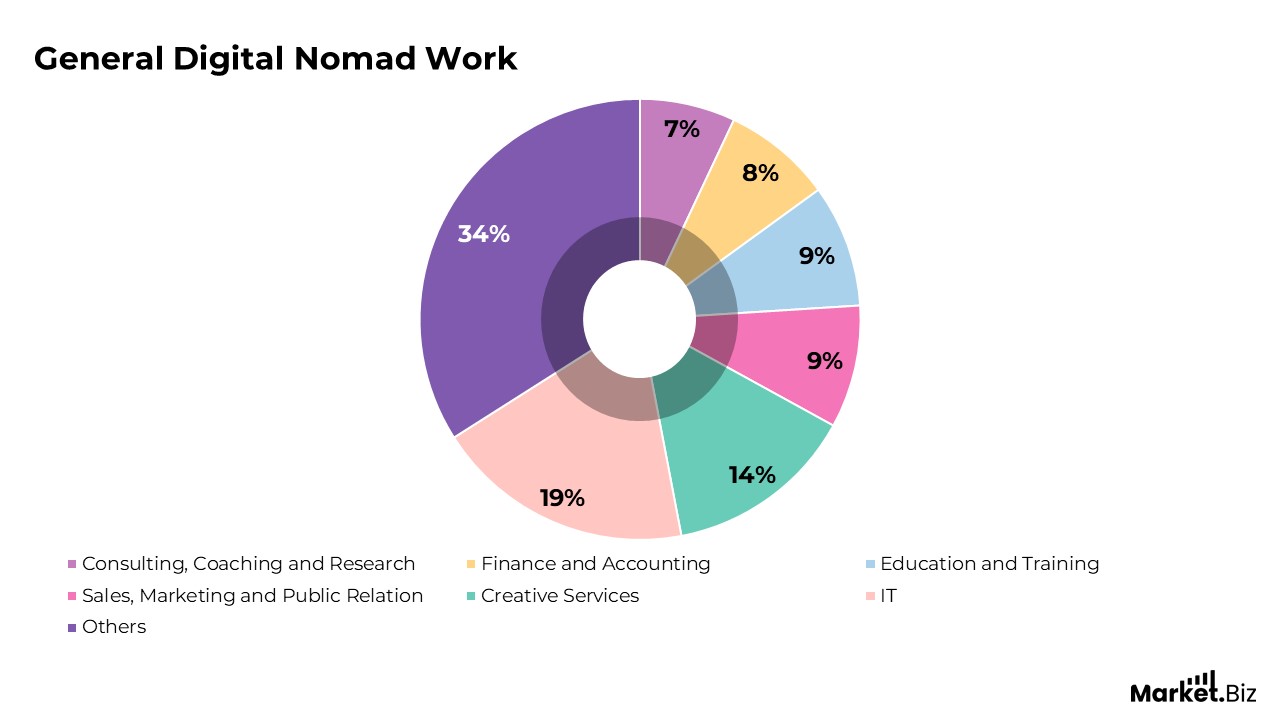
(Source: SavvyNomad)
Best Digital Nomad Jobs
- Web development is one of the highest-rated digital nomad jobs, with entry-mid level developers earning as much as $70,000 to $120,000 each year.
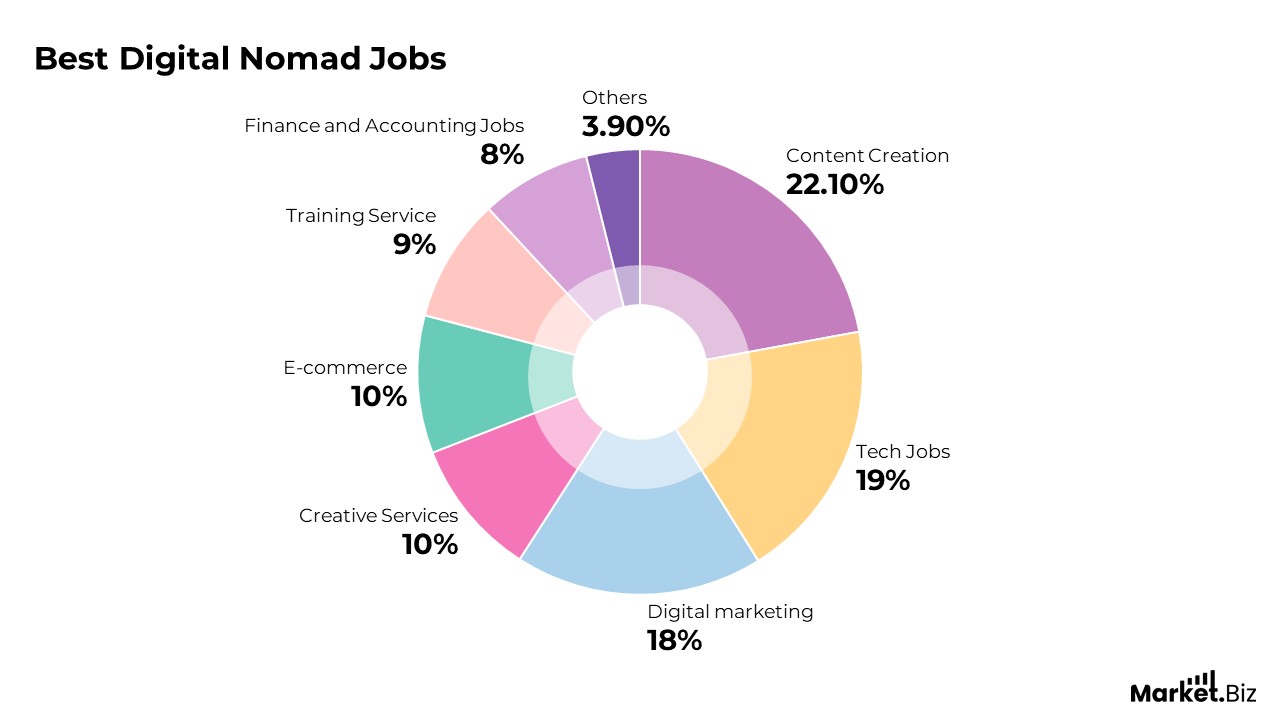
- Content creation and copywriting are also the most popular freelance jobs, and 22.1% of digital nomads work in this space.
- Digital marketing specialists, especially in SEO and social media, make up 18% of remote work as freelancers.
- Graphic designers find the remote environment useful and earn between $45,000 to $90,000 +, depending on experience and clients.
- Virtual assistants (VAs) are very popular now, especially in e-commerce and real estate, and their hourly rate ranges from $15 to $50 per hour.
- Online teaching and tutoring work, particularly in English, accounts for over 1.5 million digital nomads internationally.
- E-commerce and drop shipping entrepreneurs make up 10% of digital nomads and location-independent workers.
- Software engineers and app developers (engineers who spend time on the project submission) are probably the highest earners of digital nomads, with salaries an average well over $100,000/year.
- Affiliate marketing and blogging used as passive income (12% of seasoned digital nomads) means turning a “hobby or activity” into an income stream.
- Consulting and coaching, especially in business, tech or wellness, is also a flexible high-income remote opportunity for digital nomads.
Digital Nomad Demographics
Age & Gender Demographics
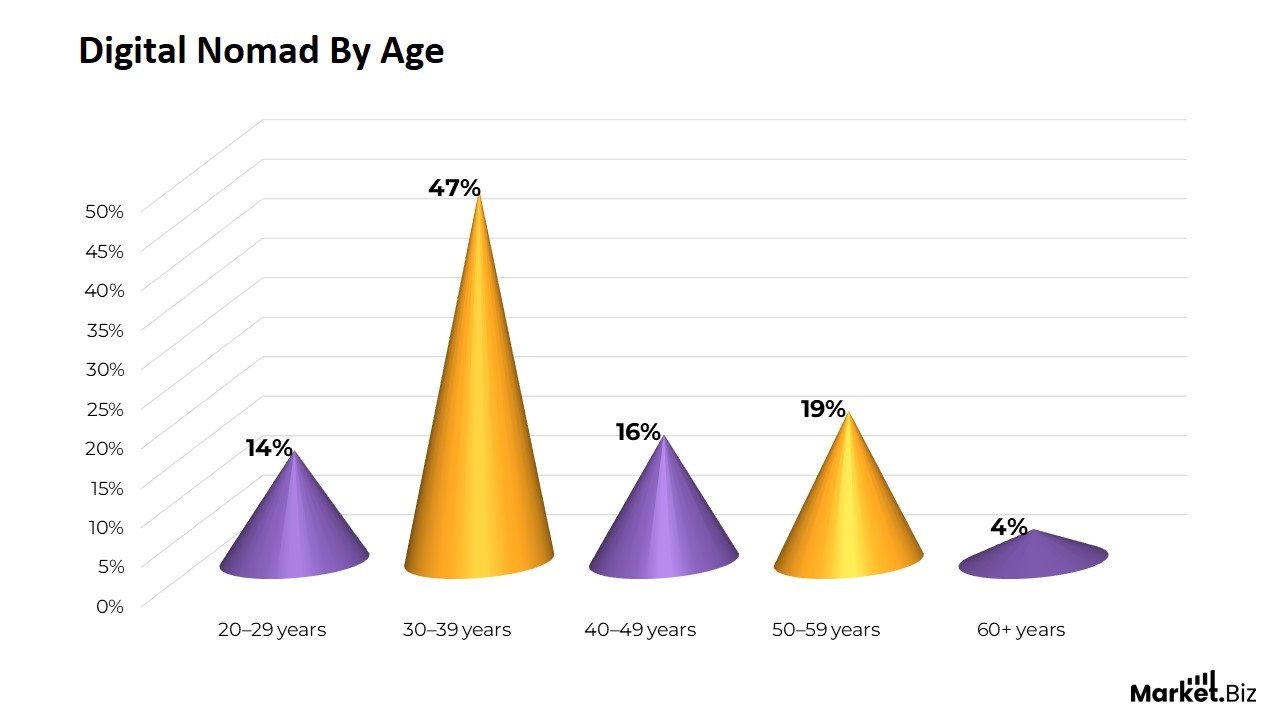
- Digital nomads between the ages of 30-39 are the most represented age group at 34%.
- Millennials make up more than 44% of the global digital nomad community.
- Due to a remote-first entrance into the workforce, Gen Z (ages 20-29) is now about 21% of the digital nomad demographic.
- Those aged 40-59 account for 28%, showing the increasing prevalence of digital nomads in mid-career.
- The average age of a digital nomad globally is now 32.6 years old in 2024.
- 51% of digital nomads identify as male and 49% identify as female, indicating roughly equal gender representation.
- Women nomads increased by 12% year-on-year, with many working in coaching and consulting, writing, and design (as well as other fields).
- A relatively steady 9% of people identifying as digital nomads fit into the demographic of ages 50+, and often work as semi-retired consultants.
- Young digital nomads (under the age of 30) are more likely to work in freelance and gig work.
- 20–29 years: 14%
- 30–39 years: 47%
- 40–49 years: 16%
- 50–59 years: 19%
- 60+ years: 4%
Education & Skills Demographics
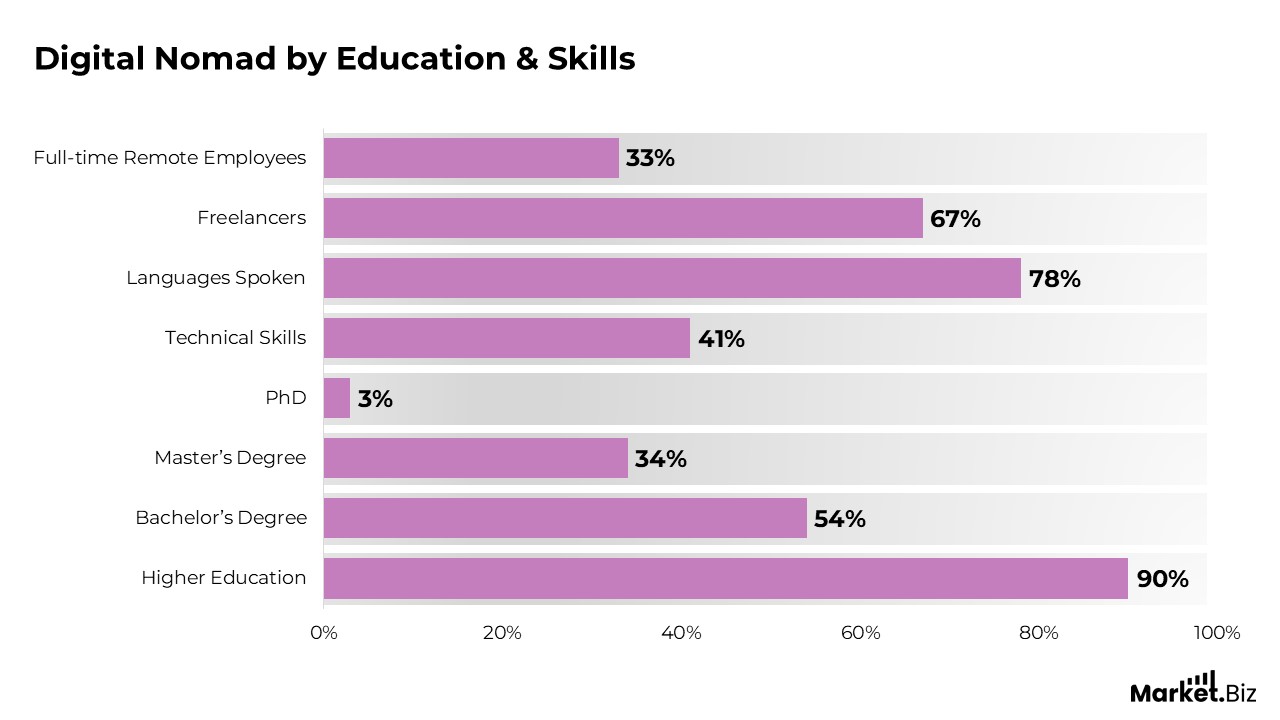
- 90% of digital nomads have a bachelor’s degree, showing how educated the rank and file is.
- 35% have advanced master’s or professional degrees, particularly in technology or related business fields.
- Most digital nomads also possess technical and creative skills; the most in-demand creative and technical skills are digital marketing, IT skills, and writing, respectively.
- 41% of digital nomads report STEM (science, technology, engineering, and math) education, particularly in software or data analysis.
- Language skills are also a strength; 78% of digital nomads report fluency in more than one language.
- Among mid-career stage digital nomads, certifications in UX/UI, coding, and project management are most frequently reported.
- 82% of digital nomads report that soft skills are a key enabler of success, with adaptability and self-motivation most frequently referenced.
- About 64% have taken a course on working remotely or an “online learning course”.
- Skill diversification is the key to success 38% report combining freelancing and consulting services into a single income stream as a digital nomad.
- Higher Education: 90%
- Bachelor’s Degree: 54%
- Master’s Degree: 34%
- PhD: 3%
- Technical Skills: 41%
- Languages Spoken: 78% are bilingual or multilingual
- Freelancers: 67%
- Full-time Remote Employees: 33%
Geographic & Cultural Demographics
- With 18.1 million digital nomads, the United States leads, with the United Kingdom, Germany and Canada following.
- Surprisingly, where the digital nomads travel most, is represented by South America and Southeast Asia for cost and connectivity.
- Top nomadic cities are Bali, with strong nomad infrastructure, along with Lisbon, Medellin and Tbilisi, to name a few.
- Approximately 46% of digital nomads have dual citizenship or have long-term tourist visas to facilitate travel.
- 68% of digital nomads travel an average of 3 countries per year where flexible visa policies are a big contributor to the choice.
- More than 40% of nomads favour countries that provide strong tax privileges or provide digital nomad visas.
- 72% of long-term digital nomads assert that cultural adaptability or openness to being in new environments is the most or second most important trait.
- Nomadic digital workers from emerging markets (e.g., India, Brazil, and Philippines) are increasing because access to remote work has improved with a greater income potential than if they worked in their home country.
- Urban centres are still the preferred choice, but 21% of digital nomads are exploring rural areas to get away from it all and live in nature at a slower pace.
Top Countries:
- United States: 46%
- United Kingdom: 7%
- Canada: 5%
- Russia: 5%
- Germany: 4%
Countries Visited By Digital Nomads
- Thailand draws more than 15% of the world’s digital nomads, especially in Chiang Mai and Bangkok, because of the price point and availability of co-working areas.
- Portugal, with Lisbon and Porto, ranks in the top 3 hottest digital nomad destinations in Europe as of 2024.
- Indonesia, especially Bali, has around 10% of digital nomads every year, they like Indonesia because of their nomad visa and it is generally a lively scene from the expat community.
- Mexico has become a North America hot spot, with Tulum and Mexico City are popular with 12% of nomads visiting.
- Spain’s Barcelona and Madrid attract 9% of the digital nomads every year because they can combine strong infrastructure and culture.
- Colombia, often with cities such as Medellín and Bogotá, is growing year on year at a pace of 18%. Cheap cost of living with a growing technology sector, recruitment, and outsider help.
- Georgia (Tbilisi) became the hotspot for having a 1-year digital nomad visa as well as no tax on your foreign income under the Remotely from Georgia program, which is quite attractive for several nomads.
- Vietnam (most notably Da Nang and Ho Chi Minh City) 6-8%, is being selected by very nomads due to being able to enjoy culture and have a cheap living cost.
- Germany (such as Berlin) attracts remote professionals on behalf of its tech ecosystem and communication from Europe into the rest of the globe.
- Croatia launched its digital nomad visa in 2021, steadily reporting 5% of nomads, typically in cities such as Split and Zagreb.
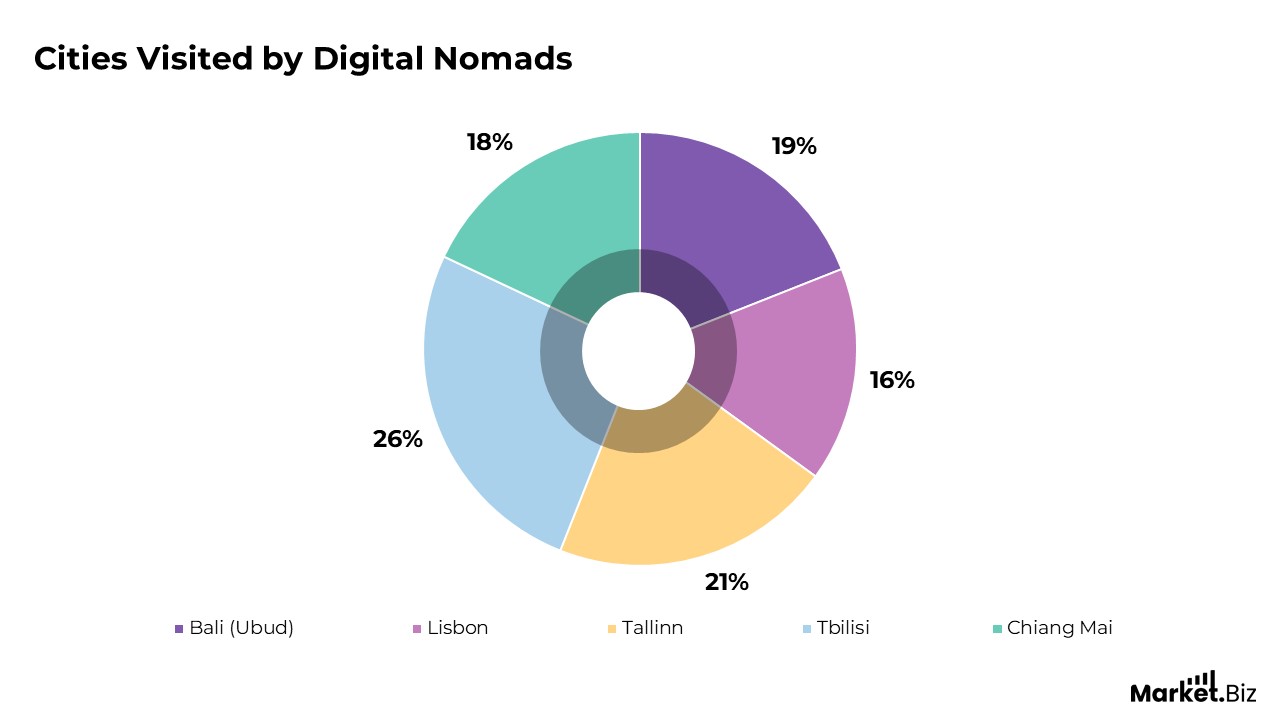
Cities Visited by Digital Nomads
- Bali (Ubud) is a destination for 19% of digital nomads. It has a low-cost lifestyle, co-working options, and a vibrant expat community.
- Lisbon is a current favourite for 16% of digital nomads thanks to its emerging tech hub, pleasant climate and proximity to various European cities.
- Tallinn has become popular in Europe, with 21% of digital nomads using its e-residency programme, as well as pro-digital economy policies.
- Tbilisi (Georgia) is an emerging favourite, with a 26% year-on-year increase in nomad arrivals. The new nomad visa and cost-effective way of life have increased the experiences from digital nomads to share with others.
- Chiang Mai is the original favourite, with 18% of digital nomads visiting to apply its solid remote worker culture and low cost of living.
Digital Nomad Challenges
- About 40% of digital nomads say they almost always feel lonely, which underscores some of the social challenges of remote work.
- 77% of digital nomads report that they have burnout, often from working and traveling at the same time.
- One of the big barriers to digital nomads is navigating visa and work permit regulations, where many countries have not established strict HR policies for remote workers.
- More than half of digital nomads claim unreliable internet access is a leading challenge for them since it negatively affects their productivity and communication efforts.
- Working across multiple time zones makes scheduling a struggle for many digital nomads (30% indicated it is a struggle!).
- Accessing consistent health care is challenging for many digital nomads, as many do not have employer-sponsored health coverage with the flexibility to travel.
- Just shy of half of digital nomads earn less than if they worked in a traditional job, and the variability in income is quite common.
- Minimum lease requirements and constantly rising prices in popular places made a huge impact on flexible and long-term housing plans.
- Most of the nomads are unaware of tax obligations across multiple jurisdictions and face the liabilities afterwards.
- Another challenge that nomads face is adjusting to a new culture and language that affects both personal and professional interactions.
- Travelling and working together is a tough thing to do. Around 68% nomads reported having difficulties maintaining a healthy work-life balance.
- Where normal employees get different work benefits like insurance, paid time off, PF, etc., digital nomads usually lack access to all these benefits.
- Personal safety is a very big challenge for digital nomads. 34% of digital nomads report concerns about their safety.
Digital Nomad Benefits
- Around 36% of digital nomads earn within the $100,000 to $250,000 annual income range, presenting an opportunity for that much money to be made.
- A huge majority of 93% of remote workers say they have greater job satisfaction, which indicates a positive impact of flexible work arrangements.
- Digital nomads typically find an inexpensive life with an average monthly spending of $1,724, enabling them financial flexibility.
- The digital nomad lifestyle encourages work life balance since 78% of remote employees have stated they have better balance than traditional office workers have.
- Remote work reduces time commuting which allows digital nomads to have more productivity and better mental health.
- Being in a variety of locations promotes a cultural exchange in the environment and personally in themselves, which makes for a rich digital nomad lifestyle.
- Digital nomads have the opportunity to travel a variety of countries, which is enhanced by 73% of nomads visiting 1 or 2 countries a year, and will help the nomads’ global perspective in life.
- The digital nomad lifestyle itself allows for spontaneous travel and exploration, which leads to a fulfilling life for them.
- According to the report, digital nomads have improved mental health, with 44% of them reporting improved mental well-being as a result of reduced stress and greater autonomy.
- The emergence of digital nomad visas across 60 countries offers employees legal pathways to live and work abroad.
- Tax incentives, reduced living costs for housing, food, and services are some of the ways digital nomads benefit from the financial situation of host countries.
- The global digital nomad community can provide networking and support opportunities that engender collaboration and professional development.
- Digital nomads can contribute to local economies by spending money on housing, food, and services that boost host economies.
Future of Digital Nomadism
- About 37% of digital nomads earn at least $100,000 a year, showing a shift from backpacker to financially independent.
- By 2035, the size of the digital nomad population is expected to grow by 1 billion, as remote work becomes easier for many organisations and more employees find themselves working in a flexible employment position.
- According to the estimated key population in the U.S., more than 40 million digital nomads will exist by 2026, demonstrating how the trend of location-independent employment remains high.
- More and more digital nomads are seeking to go to rural destinations with spaces like Avnea community in Crete and Madeira’s Digital Nomad Village, both promoting real cultural experiences with a sense of community.
- Improvements in technology, from ever-increasing portability with AI-driven tools and connectivity, are impacting the efficiencies and mobility of digital nomads in every corner of the globe.
- Co-working spaces are starting to adapt to the unique needs of digital nomads by offering additional flexibility in membership and providing wellness options.
Conclusion
The lifestyle of digital nomadism is rapidly taking center stage, having already achieved an impressive more than 40 million remote workers, and travellers who work at any point in time around the globe, largely due to the increased inclusion of technology (5G speed, AI tools that provide productivity, and mobility) and because governments (as countries) are now providing digital nomad visas, or legal clarity in their framework to accommodate this group of mobile workers.
The benefits of digital nomadism are vast; however, the problem persists, like visa issues, navigating a new culture, and work-life balance, all of which highlight a need for increased continued facilitation and infrastructure.
FAQs
As of 2025, there are almost 35 million digital nomads worldwide, contributing an estimated $787 billion a year to the global economy.
The average age of digital nomads is 36 years, where the majority of them (47%) are falling between 30 and 39 years old.
Around 83% of digital nomads are self-employed, 66% own businesses, and 34% work as freelancers or gig workers.
Mexico and Thailand are currently the most popular destinations for digital nomads, offering affordable living and vibrant cultures.
Almost 70% of digital nomads work 40 hours or less per week, equating to an average of 5.7 hours daily.