









Introduction
Job Market Skills Gap Statistics: The job market skills gap has become a critical concern for businesses and workers alike, with nearly 50% of employers globally reporting difficulty in finding candidates with the necessary skills. This gap is particularly evident in industries such as technology, healthcare, and manufacturing, where specialized skills are in high demand.
According to recent reports, over 70% of companies are investing in employee upskilling to bridge this gap, while nearly 40% of workers feel they lack the skills required for future job roles. As automation and AI continue to reshape industries, addressing the skills gap is essential for maintaining a competitive workforce and fostering economic growth.
Editor’s Choice
- Nearly 50% of employers globally report difficulty finding candidates with the right skills.
- The global skills gap costs businesses an estimated $1.3 trillion in lost productivity annually.
- 75% of employers struggle to fill tech and digital roles due to skill shortages.
- 87% of executives believe their organizations face a skills gap, especially in digital expertise.
- 70% of companies planned to invest in upskilling programs to bridge the skills gap in 2023.
- 50% of workers in the tech sector face difficulty in finding qualified IT candidates.
- 41% of businesses report difficulty hiring candidates with the right soft skills, such as communication.
- 55% of U.S. employers report the skills gap is delaying business expansion.
- 30% of workers feel their jobs are at risk due to automation and technological advancements.
- 50% of workers fear their skills are becoming obsolete due to rapid technological change.
- The tech industry faces a 70% skills gap, particularly in software development and cybersecurity.
- Healthcare has a 50% skills gap, especially in nursing and medical technician roles.
- COVID-19 increased the demand for tech skills, with a 50% rise in demand for data analysis and cybersecurity.
- The global skills gap could cost $8.5 trillion annually by 2030 due to lost economic growth.
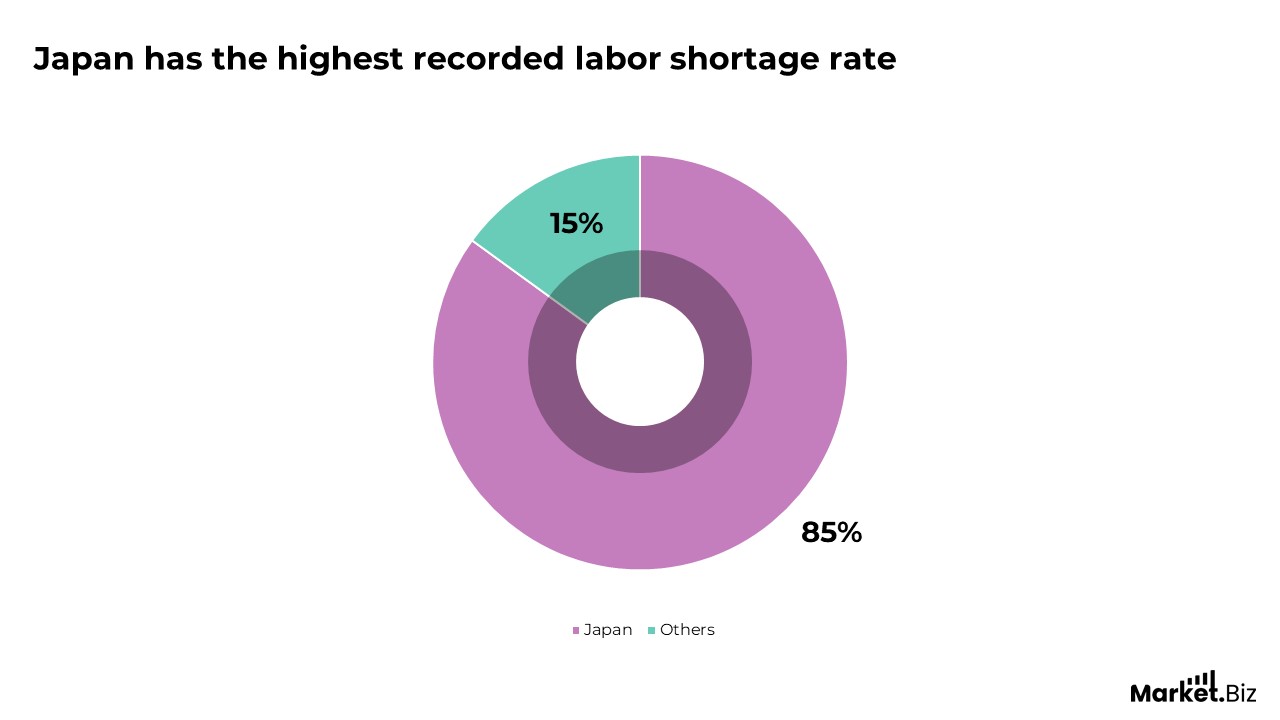
(Source: buttercms)
What is the Job Market Skills Gap?
The job market skills gap refers to the mismatch between the skills employers require and the skills job seekers possess. This gap has grown significantly in recent years, particularly in fields such as technology, healthcare, and skilled trades. With rapid advancements in automation, AI, and digital tools, many workers struggle to meet the evolving demands of the job market.
Employers are increasingly investing in training and development programs to close this gap, while many workers are seeking upskilling opportunities to stay competitive. Bridging the skills gap is crucial for both economic growth and workforce sustainability.
General Job Market Skills Gap Statistics
- Nearly 50% of employers worldwide report difficulty in finding candidates with the right skills to fill open positions.
- The global skills gap has cost businesses an estimated $1.3 trillion in lost productivity annually.
- Approximately 75% of employers struggle to fill positions in technology and digital fields due to a shortage of skilled workers.
- 87% of executives believe their organizations are facing a skills gap, with 65% actively seeking candidates with digital expertise.
- Around 40% of workers feel their skills are outdated, highlighting the need for continuous upskilling.
- In 2023, 70% of employers planned to invest in employee training programs to address the growing skills gap.
- The technology sector has the largest skills gap, with 50% of organizations unable to find qualified IT candidates.
- 41% of businesses report difficulty hiring candidates with the right soft skills, such as communication and problem-solving.
- The healthcare industry faces a skills shortage, particularly in nursing, with a projected shortage of 1.1 million nurses by 2030.
- Manufacturing industries face a skills gap, with 2.4 million jobs expected to go unfilled by 2028 due to a lack of skilled labour.
- 55% of U.S. employers say the skills gap has led them to reduce or delay business expansion plans.
- 30% of workers in the U.S. believe their job is at risk due to technological advancements and automation, adding pressure to reskill.
- The global demand for data science and AI skills has risen by 28% in the last two years, significantly outpacing supply.
- A recent study showed that 53% of workers would be willing to undergo training to acquire skills that improve their job security.
- About 70% of companies report that they are struggling to find workers with the technical and digital skills required for future job roles.
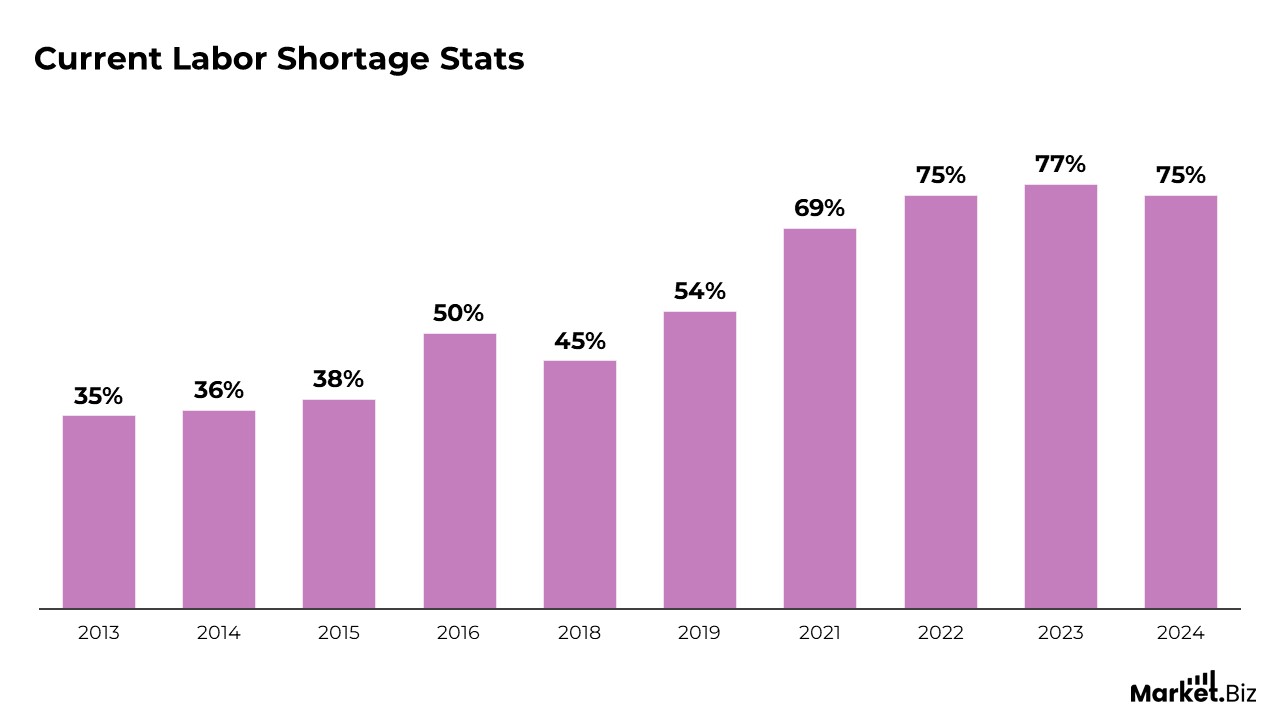
(Source: buttercms)
Causes of the Skills Gap
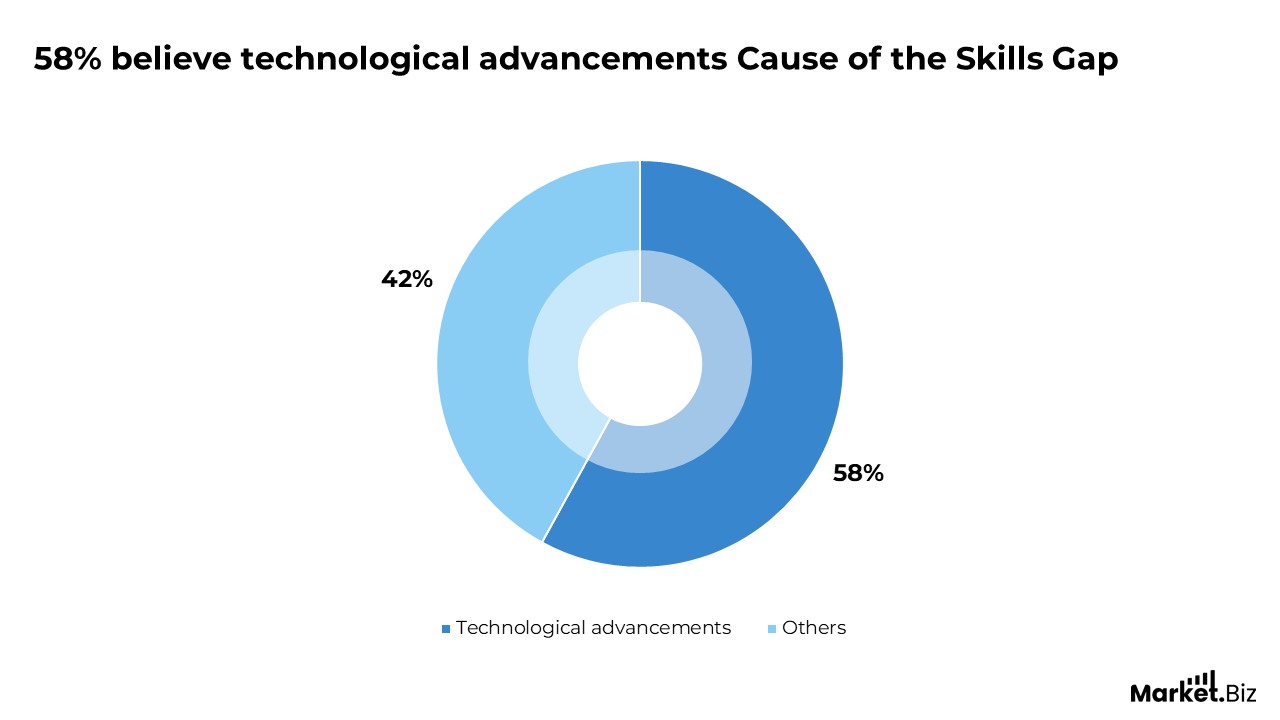
- Rapid technological advancements are outpacing workers’ ability to acquire new skills, with 58% of companies reporting difficulty finding employees with digital expertise.
- Automation and artificial intelligence are replacing routine tasks, with 40% of jobs in the U.S. at risk of automation by 2030, increasing the demand for specialized skills.
- 55% of employers say education systems are not keeping up with the evolving skill requirements, leaving graduates underprepared for modern job roles.
- Over 60% of employers cite a lack of practical experience in candidates as a primary cause of the skills gap, particularly in industries like technology.
- 64% of employees say they struggle with remote work technology, highlighting a skills gap in digital literacy as the shift to hybrid work accelerates.
- 39% of employers report difficulty finding candidates with industry-specific skills, especially in sectors like healthcare and manufacturing.
- The aging workforce is exacerbating the skills gap, with over 25% of workers in sectors like manufacturing expected to retire in the next decade.
- Only 26% of businesses globally invest in employee training, leaving workers without the necessary resources to stay competitive.
- 47% of workers are employed in jobs that do not match their skillsets, highlighting a significant skills mismatch in the job market.
- 60% of workers report a lack of access to upskilling programs, preventing them from closing the skills gap in rapidly evolving industries.
- 34% of regional skill shortages are due to geographic disparities in education and training opportunities, especially in rural areas.
- 75% of companies report that globalization has increased the need for workers to adapt to new technologies, yet 60% of workers feel ill-prepared for these changes.
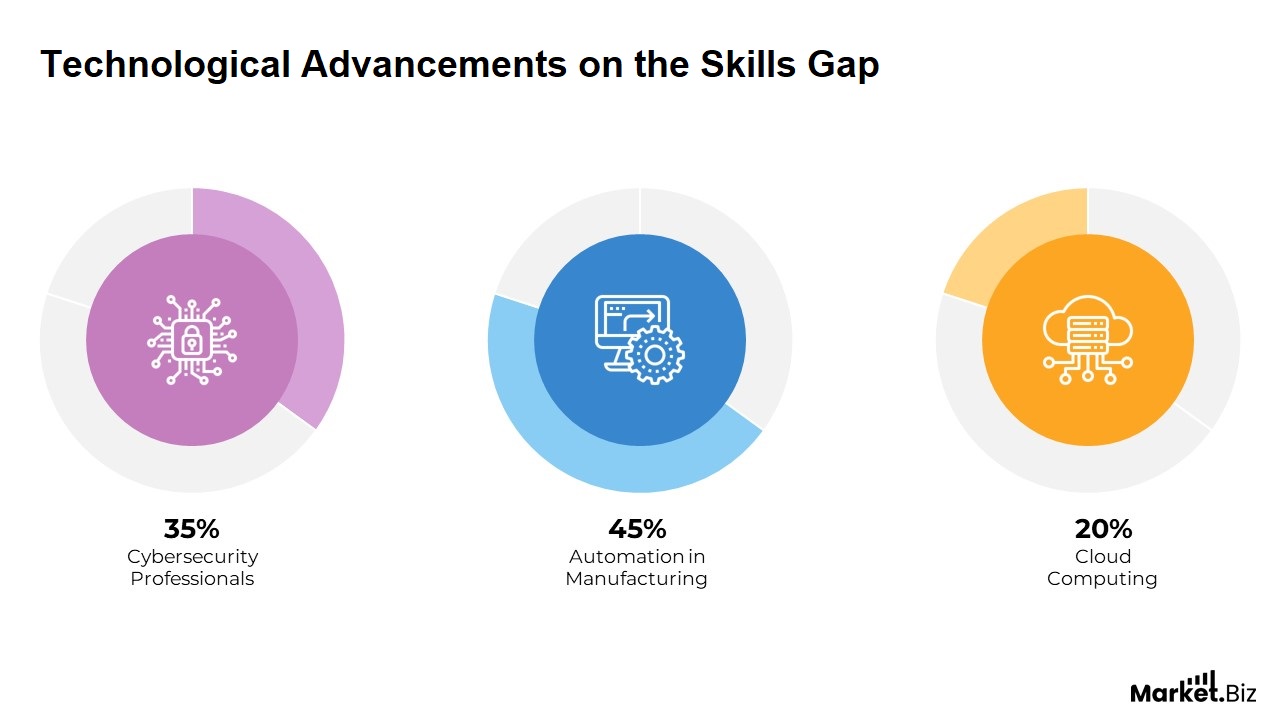
Technological Advancements on the Skills Gap
- 50% of workers feel their skills are becoming obsolete due to the rapid pace of technological change, especially in fields like AI and automation.
- The adoption of AI and automation technologies is expected to displace 85 million jobs in 2025, creating a significant skills gap in the workforce.
- 70% of organizations report a shortage of workers with the necessary digital skills, particularly in emerging technologies such as machine learning and data analytics.
- The demand for cybersecurity professionals has surged by 35%, driven by increasing cyber threats and technological reliance.
- 80% of employees in non-technical roles feel unprepared for the digital transformation occurring in their industries, widening the skills gap.
- Automation in manufacturing has increased the demand for skilled technicians, yet 45% of employers struggle to find qualified candidates.
- Cloud computing roles have grown by 20% annually over the past five years, but only 22% of the global workforce has the required cloud skills.
- 62% of organizations have implemented or plan to implement AI in their operations, increasing the need for skilled workers in data science and AI ethics.
- The rise of remote work technology has led to a surge in demand for employees with strong digital collaboration skills, yet 40% of workers report lacking these skills.
- Technological advancements in healthcare, such as telemedicine, have created a demand for workers skilled in both healthcare and technology, yet 33% of healthcare providers report a skills gap.
- 65% of organizations are investing in upskilling programs to help employees adapt to new technologies, yet only 30% of workers feel confident in these skills.
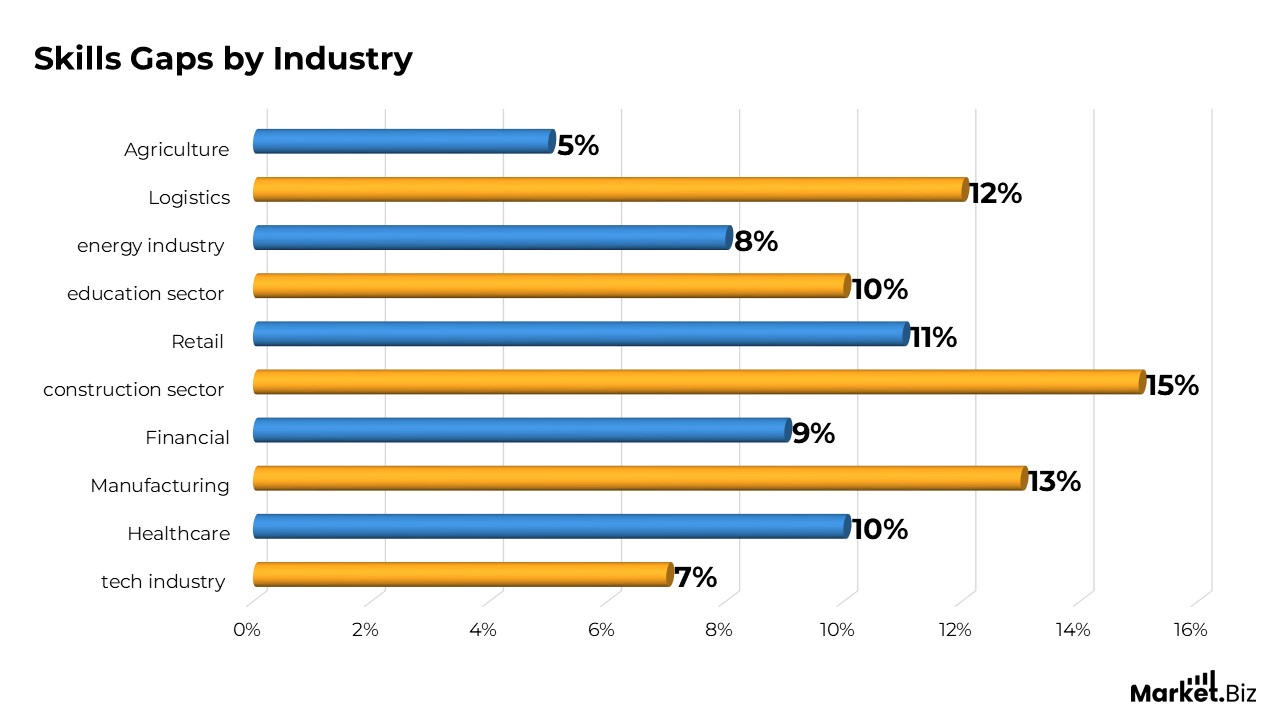
Skills Gaps by Industry
- The tech industry faces a 7% skills gap, particularly in software development and cybersecurity.
- Healthcare struggles with a 10% skills gap, especially in nursing and medical technician roles.
- Manufacturing sees a 13% skills gap, with a shortage in advanced manufacturing, robotics, and automation.
- Financial services report a 9% gap, mainly in data analytics, financial modelling, and risk management.
- The construction sector has a 15% skills gap, particularly in trades like electricians and carpenters.
- Retail faces an 11% gap in skills for e-commerce, digital marketing, and customer experience.
- The education sector has a 10% skills gap in STEM teaching positions, especially in computer science.
- The energy industry reports an 8% gap, particularly in renewable energy like solar and wind.
- Logistics has a 12% skills gap, especially in supply chain management and e-commerce fulfilment.
- Agriculture faces a 5% skills gap, particularly in agricultural technology and sustainable farming.
Impact of COVID-19
- COVID-19 accelerated digital transformation, creating a 50% increase in demand for tech skills such as data analysis and cybersecurity.
- Remote work surged, highlighting a 30% gap in digital communication and collaboration skills across industries.
- 40% of businesses reported challenges in filling positions for roles requiring advanced technical skills due to COVID-19’s disruption.
- The healthcare sector saw a 25% increase in demand for professionals trained in telehealth and digital healthcare solutions post-pandemic.
- COVID-19 amplified the skills gap in logistics, with 35% more demand for supply chain management expertise as e-commerce grew.
- As industries pivoted, 30% of companies struggled to find workers skilled in hybrid work models, including digital project management and virtual team leadership.
- Many businesses noted a 20% increase in skills shortages related to automation and AI as COVID-19 accelerated the adoption of these technologies.
- The pandemic caused a 40% surge in demand for skills in health and safety, especially in workplace management and COVID compliance roles.
- 25% of education and training institutions reported a widening gap in workforce skills, particularly in online teaching and learning tools.
- COVID-19 led to a 50% rise in demand for remote IT support specialists as businesses adjusted to hybrid and fully remote environments.
- The retail industry experienced a 30% skills gap in digital marketing and e-commerce expertise due to the shift in consumer behaviour during the pandemic.
- The manufacturing sector faced a 40% increase in the need for workers skilled in automation and robotics due to COVID-driven shifts in production processes.
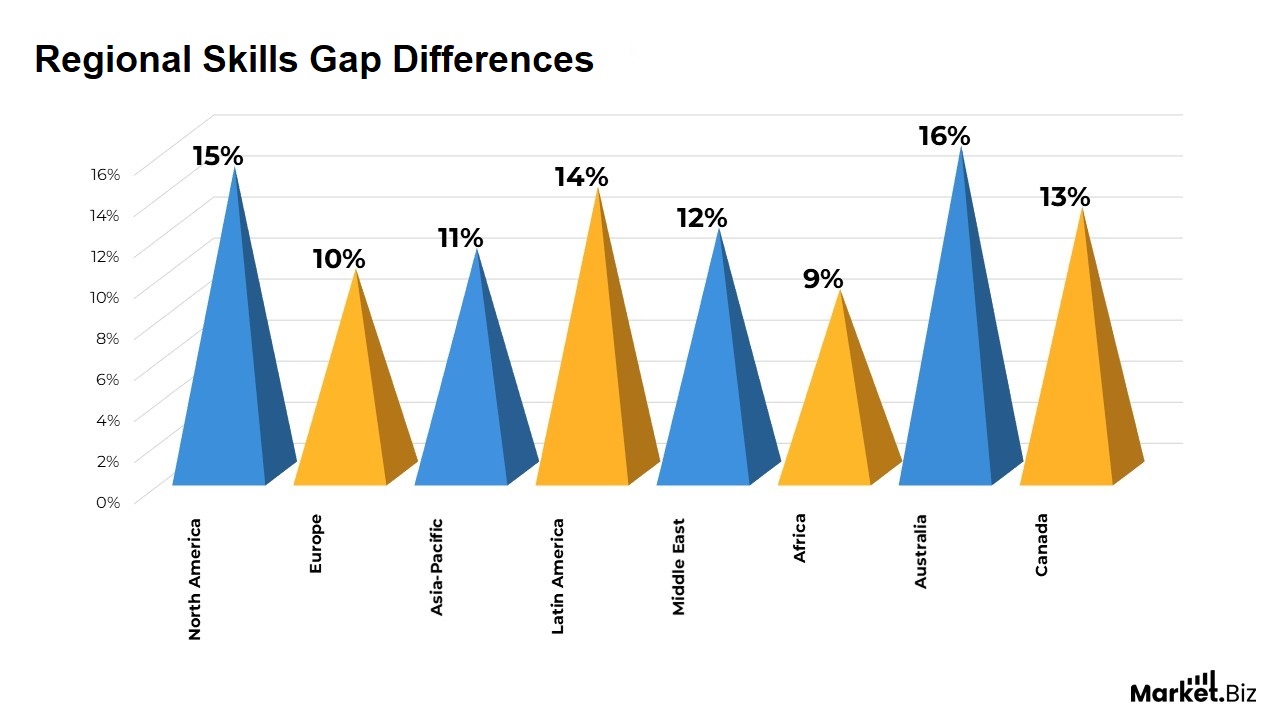
Regional Skills Gap Differences
- North America faces a 45% skills gap in tech roles, especially in AI and cybersecurity, driven by high demand for digital transformation.
- Europe has a 40% skills gap in manufacturing, with a particular shortage in skilled workers for automation and advanced robotics.
- The Asia-Pacific region sees a 50% skills gap in healthcare, particularly in nursing and medical technology roles, due to rapid aging populations.
- Latin America struggles with a 35% skills gap in STEM education, with few qualified professionals to meet the demand for technical jobs.
- The Middle East reports a 30% skills gap in renewable energy roles, as countries transition to greener energy sources.
- Sub-Saharan Africa faces a 60% skills gap in agriculture, as the need for modern farming techniques and agrotech innovation grows.
- In Australia, the skills gap is most evident in the construction and trades sectors, with a 25% shortage in qualified tradespeople.
- In Canada, the gap is most severe in digital skills, with 40% of businesses unable to fill tech-related positions due to a lack of skilled workers.
Soft Skills vs. Hard Skills
- Hard skills refer to teachable abilities or knowledge, such as coding or accounting, while soft skills involve interpersonal attributes like communication and leadership.
- 93% of employers say soft skills are just as important, if not more, than technical skills in hiring decisions.
- Hard skills are essential for specific job functions, but soft skills like problem-solving and teamwork are crucial for long-term career advancement.
- Soft skills, such as adaptability, are key in the rapidly changing workforce. 62% of employers value employees who can quickly adapt to new challenges.
- Employees with strong soft skills can earn up to 20% more than their peers with only technical expertise.
- Hard skills are easier to quantify and learn through formal education, while soft skills often require continuous practice and real-world experience.
- 85% of job success is attributed to soft skills like communication, while only 15% depends on technical knowledge.
- 71% of employers say teamwork and collaboration are the most important skills for effective team performance, indicating the need for strong soft skills.
- In a digital, remote-work environment, communication, time management, and emotional intelligence (all soft skills) are critical for success.
- Companies investing in both hard and soft skills training see 20% better employee retention rates and 10% higher productivity.
Gender and Diversity in the Gap
Gender Gap
- The gender pay gap globally remains at 20%, with women earning 80 cents for every dollar men make.
- Women hold only 24% of senior leadership positions, despite making up nearly half of the global workforce.
- 50% of women report facing gender bias in the workplace, affecting their career progression and opportunities.
- Gender diversity in leadership can lead to a 21% increase in profitability and 27% higher value creation.
- 70% of women believe that companies should do more to support gender equality through policies and actions.
- The global female labour force participation rate is 47%, compared to 74% for men, highlighting a significant gender gap in employment.
- Women face compounded challenges, with a 35% pay gap compared to their white male counterparts.
- Companies with a higher representation of women in their workforce report a 15% increase in profitability compared to their male-dominated peers.
- The gender gap in STEM (Science, Technology, Engineering, and Mathematics) fields remains large, with women comprising only 28% of the STEM workforce globally.
Diversity Gap
- Diverse companies are 35% more likely to outperform their competitors in terms of financial returns.
- Ethnic and racial marginalized groups represent 40% of the U.S. population but only hold 16% of leadership positions.
- Inclusive organizations are 2x as likely to innovate and more likely to experience high employee engagement.
- Companies with ethnic diversity on their executive teams are 33% more likely to experience above-average profitability.
- 67% of employees say diversity and inclusion policies influence their decision to work at a company.
- The workforce is becoming more diverse, with the proportion of white workers in the U.S. expected to drop below 50% by 2045.
- Black and Hispanic employees are underrepresented in tech, comprising only 16% of the workforce, despite making up 30% of the population.
- 56% of workers in diverse teams report having better work outcomes, such as increased creativity and problem-solving ability.
- Companies with strong diversity initiatives attract 3x more job applicants and see 2x higher employee retention rates.
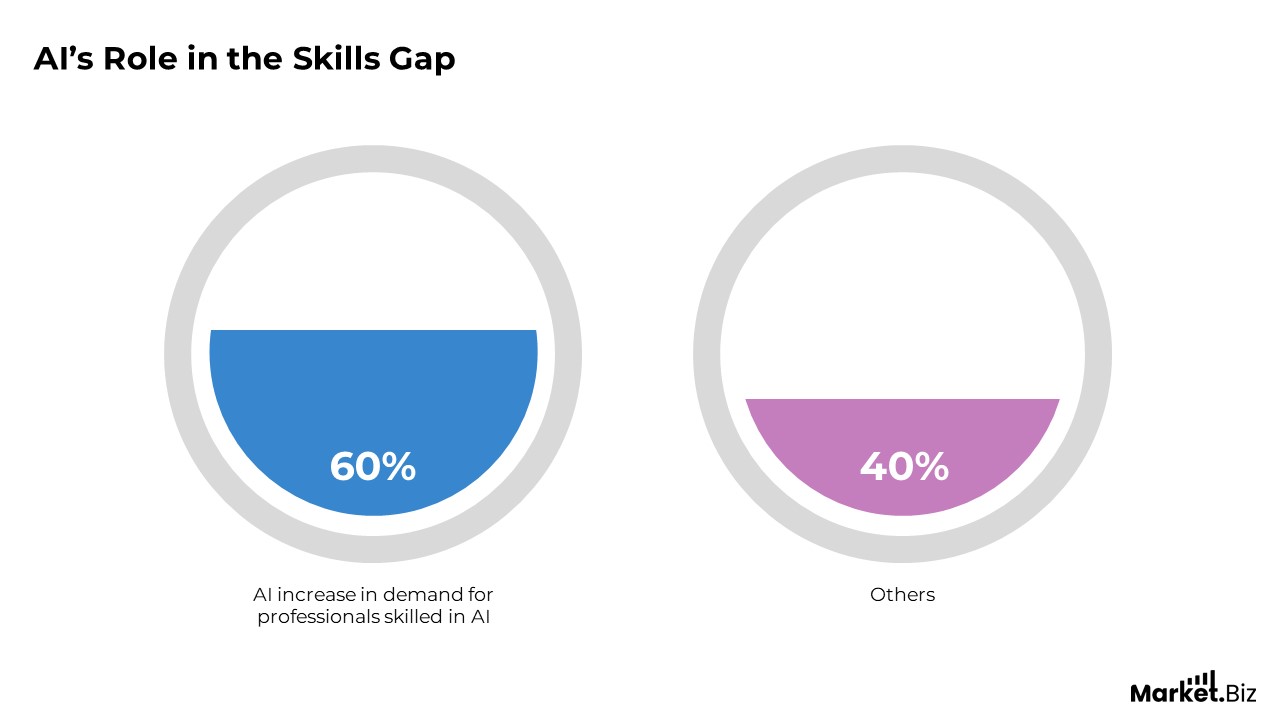
AI’s Role in the Skills Gap
- AI adoption has increased by 270% over the past four years, creating a demand for new skills in fields like machine learning and data analysis.
- 83% of businesses say AI will be pivotal in closing the skills gap by automating repetitive tasks and enabling workers to focus on higher-value activities.
- 54% of employees will need significant reskilling within the next three years due to AI-driven changes in job functions and industry needs.
- AI is expected to create 97 million new jobs in 2025, particularly in roles involving AI development, data science, and cybersecurity.
- 62% of organizations are using AI to upskill their existing workforce by identifying skills gaps and offering personalized learning opportunities.
- AI-driven platforms allow workers to access real-time skill assessments, helping to bridge the gap between the current skill set and required job competencies.
- AI-enabled virtual training programs are helping employees learn faster, with 77% of companies reporting increased training efficiency and reduced learning time.
Moreover
- The demand for AI-related skills has grown 450% over the past five years, far outpacing the availability of qualified talent.
- AI is reshaping the talent acquisition process, with 35% of HR professionals using AI tools to match candidates’ skills to job openings more efficiently.
- 50% of global employees fear that their jobs will be impacted by AI, with concerns over job displacement, particularly in low-skill, repetitive roles.
- 58% of businesses say AI can help close the skills gap by automating administrative tasks, allowing human workers to focus on critical decision-making.
- AI technologies such as chatbots and digital assistants are supporting employees by providing on-demand access to knowledge and skills training.
- The rise of AI has led to a 60% increase in demand for professionals skilled in AI ethics and explainable AI, ensuring transparent decision-making.
- AI-based learning management systems are driving more personalized and adaptive training programs, improving employee performance and closing knowledge gaps.
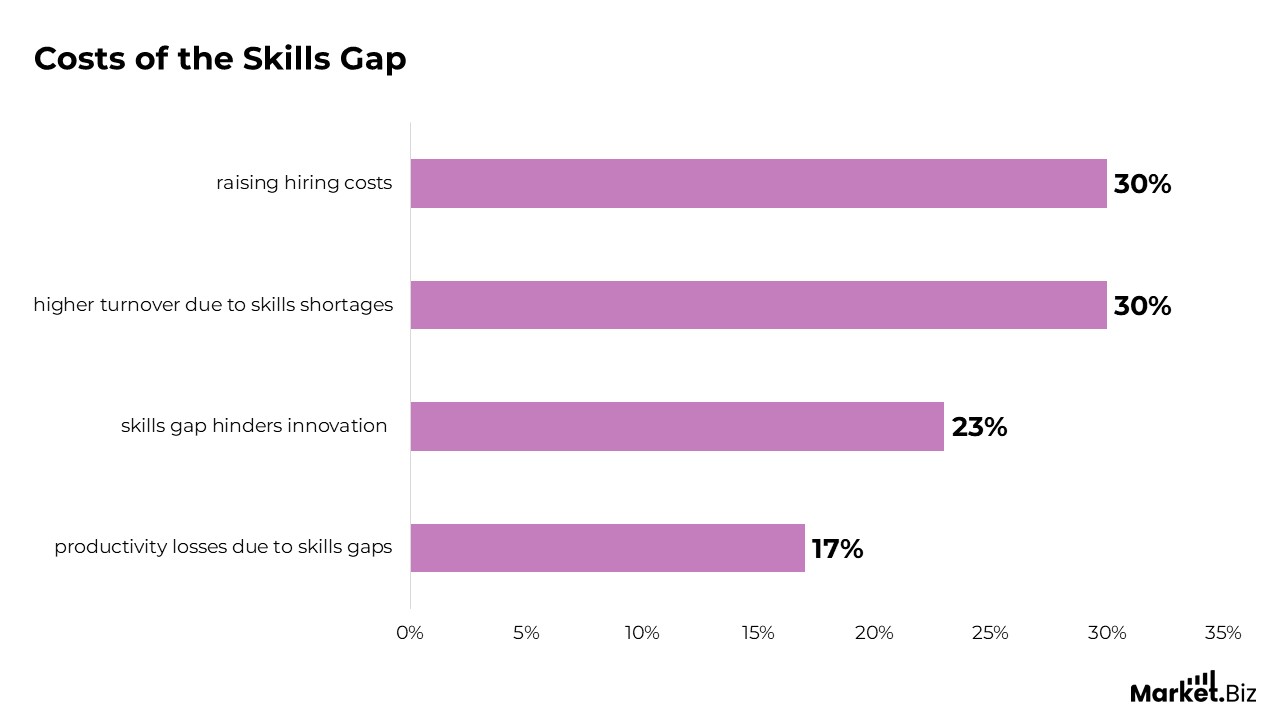
Costs of the Skills Gap
- The global skills gap could cost businesses $8.5 trillion annually by 2030 in lost economic growth.
- 17% of companies report productivity losses due to skills gaps, resulting in delayed projects and reduced efficiency.
- Unfilled positions due to skills shortages cost businesses $1.2 trillion globally.
- Companies spend an average of $1,500 per employee on training, yet only 20% of workers feel it addresses their needs.
- 23% of CEOs say the skills gap hinders innovation and global competitiveness.
- Companies in high-skill industries face up to 30% higher turnover due to skills shortages.
- The lack of skilled workers in tech and healthcare drives salary increases of up to 30%, raising hiring costs.
- 56% of businesses delay projects because of the skills gap, losing an average of $2.2 million annually.
- 39% of companies report spending more than planned on recruitment due to the skills gap.
Conclusion
The growing skills gap poses a major challenge, particularly in technology, healthcare, and manufacturing, costing businesses trillions in lost productivity. Despite a rising need for upskilling, few businesses invest in training, leaving workers underprepared.
As automation and AI reshape industries, addressing this gap is crucial for innovation and global competitiveness. Bridging the skills gap is vital for both economic growth and workforce sustainability amid rapid technological advancements.
FAQs
The skills gap refers to the mismatch between the skills employers need and those job seekers possess, particularly in industries like technology, healthcare, and manufacturing.
The skills gap leads to lost productivity, delayed projects, and increased hiring costs, with businesses facing difficulties in filling essential roles, especially in tech and healthcare.
Technology, healthcare, and manufacturing are the most affected industries, with significant shortages in skilled workers, especially in IT, nursing, and advanced manufacturing.
Automation and AI are reshaping industries, creating new demands for specialized skills while also displacing low-skill, repetitive jobs, further widening the gap.
Investing in upskilling and training programs is essential, as 70% of employers plan to increase investments in employee development to bridge the skills gap and remain competitive.