









Introduction
Online Recruitment Statistics: Online recruitment statistics provide valuable insights into the changing dynamics of the hiring process. As businesses increasingly turn to digital platforms, these statistics highlight the efficiency, effectiveness, and broad reach of online recruitment strategies.
Important trends such as the growing role of social media in talent sourcing, the widespread adoption of Applicant Tracking Systems (ATS), and the shift toward remote and hybrid work arrangements are reshaping how companies connect with potential candidates.
By examining these statistics, organizations can refine their recruitment strategies, improve hiring efficiency, and enhance the candidate experience, ensuring they remain competitive in the fast-evolving digital job market. These insights are essential for understanding how technology is shaping the future of recruitment and the workforce.
Editor’s Choice
- Approximately two-thirds of professionals are not actively seeking a job, but would consider a new offer if presented.
- Half of workers have turned down a job offer due to a negative recruitment experience.
- Almost all Fortune 500 companies, 99%, utilize Applicant Tracking Software (ATS) in their hiring processes.
- Over 70% of employers using ATS report that it simplifies the process of finding suitable candidates.
- On average, hiring managers spend just 7 seconds reviewing a candidate’s resume.
- 41% of candidates rely on job search websites to explore new career opportunities.
- Companies incur an average cost of just under $100 per day for each job vacancy.
- When approached by a recruiter, 70% of job seekers want to hear about the expected salary range first.
- For 67% of job seekers, salary remains the key deciding factor; if recruiters fail to disclose salary expectations, they risk losing out on potential hires.
- Nearly 90% of job seekers would accept a job offer more quickly if contacted by a recruiter.
- 55% of candidates believe that a job offer should be made within two weeks after the first interview.
(Source: CareerArc, Thrive My Way, Recruitee, TalentLyft, HRDrive, JSG, Zippia, Novorésumé ApS)
General Recruitment Statistics
- In 2023, the primary recruiting challenge faced by recruiters was the scarcity of qualified candidates.
- 90% of hiring managers struggle to find skilled candidates.
- 52% of recruiters face the challenge of securing top candidates before their competitors do.
- The average cost of hiring a new employee is around $4,700.
- It costs approximately 3 to 4 times the salary of a position to hire a new employee.
- According to the Society for Human Resource Management (SHRM), the average cost per hire in the US stands at $4,700.
- More than 67% of recruiters now leverage social media platforms such as LinkedIn, and Facebook to find candidates.
- According to LinkedIn Talent Solutions, 75% of potential candidates investigate a company’s values on social media before submitting an application.
- Job seekers, particularly Gen Z, and Millennials are increasingly turning to professional networking platforms to discover job opportunities.
(Source: Society for Human Resource Management, Statista, DemandSage, LinkedIn Talent Solutions, Vouch)
Recruitment Trends
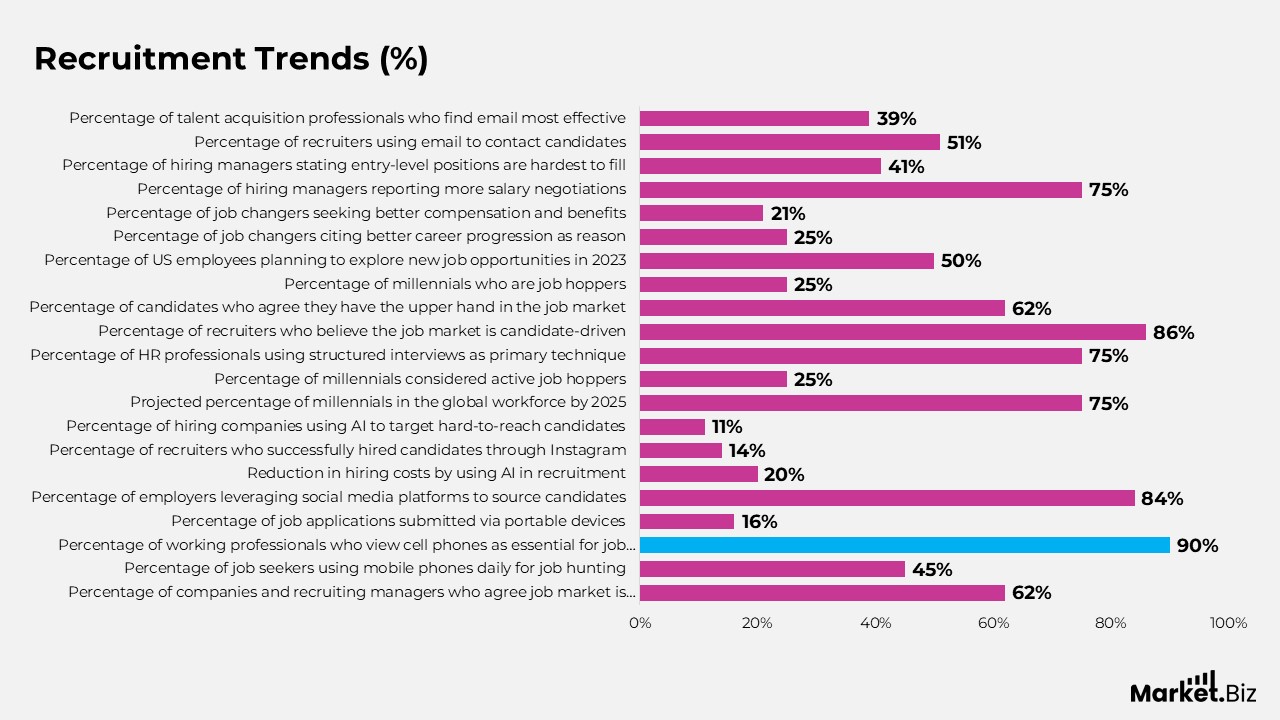
- 62% of companies and 86% of recruiting managers agree that the current job market is candidate-driven.
- 45% of job seekers use their mobile phones daily for job hunting.
- Nearly 90% of working professionals view cell phones as an essential tool for their job search.
- 16% of job applications are submitted via portable devices such as laptops, smartphones, and tablets.
- 84% of employers leverage social media platforms like LinkedIn and Instagram to source candidates.
- Companies report a 20% reduction in hiring costs by incorporating artificial intelligence (AI) into their recruitment processes.
- Around 14% of recruiters have successfully hired candidates through Instagram.
- 60% of job applications come from online job boards, followed by 56% from social networks and 50% through word-of-mouth referrals.
- Only 11% of hiring companies utilize artificial intelligence (AI) to target hard-to-reach candidate pools.
- By 2025, millennials are projected to make up 75% of the global workforce.
- 25% of millennials are energetic job hoppers.
- 75% of HR professionals rely on structured interviews as their primary interview technique.
- A significant portion of the workforce, approximately Passive Talent, is not actively seeking jobs, but remains open to new opportunities.
- 86% of recruiters believe the job market is currently candidate-driven.
- 62% of candidates agree that they now have the upper hand in the job market.
- 25% of millennials are considered job hoppers, frequently changing jobs.
- Nearly 50% of US employees are planning to explore new job opportunities in 2023.
- Of those considering a job change, 25% cite better career progression as their primary reason.
- 21% of employees are seeking new opportunities for improved compensation and benefits.
- 75% of hiring managers report that salary negotiations are more common than ever.
- Recruiters spend an average of 13 hours per week sourcing applicants for a single role.
- 41% of hiring managers state that entry-level positions are the most challenging to fill.
- 51% of recruiters still primarily use email to contact candidates, more than any other method.
- Additionally, 39% of talent acquisition professionals believe email is the most effective communication channel.
(Source: G2.com, Inc., Statista, SHRM, IBM, Achievers)
Why Diversity Matters in Hiring?
- Companies with a diverse executive team are 33% more likely to achieve above-average profits compared to those without such diversity.
- The gender pay gap in the US averages around 17%.
- Organizations with racial diversity are 35% more likely to outperform their racially homogenous competitors.
- Brands with higher levels of diversity have a 70% greater chance of gaining a larger market share.
- Approximately 57% of employees believe their company should make greater efforts to increase diversity.
- 75% of US job seekers consider a diverse workforce to be a key factor when evaluating job offers.
- Organizations with diverse leadership teams see 33% higher chances of achieving better-than-average profits compared to those with less diversity.
- The gender pay disparity in the US stands at an average of 17%.
- Racially diverse companies tend to perform 35% better than their competitors that lack diversity.
- Companies embracing broader diversity are 70% more likely to capture a larger market share.
- Around 57% of workers feel their employer should focus more on improving diversity efforts.
- 75% of US applicants view a diverse workforce as an essential consideration when deciding on a job offer.
(Source: G2.com, Inc., Statista)
Recruitment Process Outsourcing (RPO) Market Size
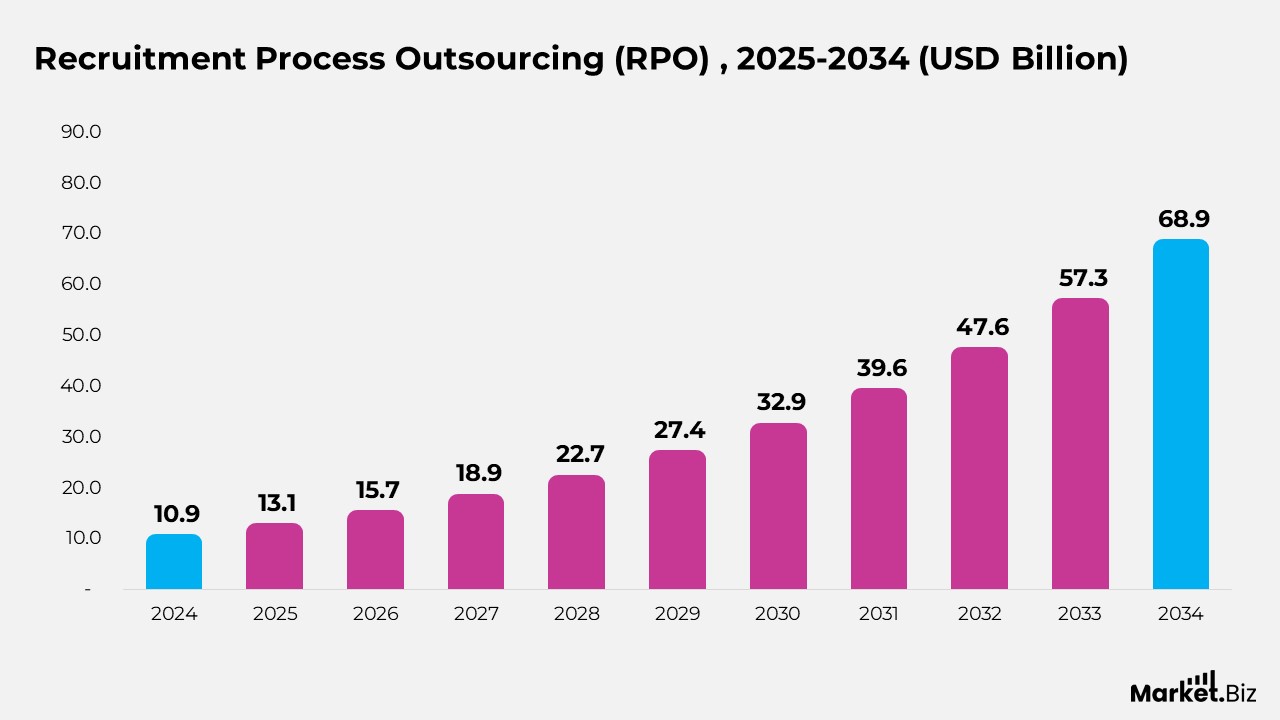
- According to Market.us, the Recruitment Process Outsourcing (RPO) market is expected to rise from $13.1 billion in 2025 to $68.9 billion by 2034, representing a compound annual growth rate (CAGR) of 20.3% from 2025 to 2034.
- The RPO market is growing due to the need for improved efficiency and scalability in hiring processes, allowing companies to focus on core functions.
- In 2024, the Enterprise-based RPO segment captured over 56% of the global market share, driven by the demand for comprehensive recruitment solutions in large organizations.
- The off-site/virtual RPO segment dominated the market in 2024, holding over 62% of the global share, fueled by the increasing demand for flexible, scalable recruitment solutions.
- Large enterprises held over 71% of the global RPO market share in 2024, driven by complex hiring needs across multiple regions.
- The IT and telecommunications sector accounted for more than 22% of the global RPO market share in 2024, due to the high demand for skilled professionals in tech fields.
- North America led the RPO market in 2024, holding more than 40% market share with a revenue of USD 4.3 billion, driven by the adoption of advanced HR technologies.
- The US RPO market is valued at approximately USD 4.1 billion in 2024 and is projected to grow to USD 21.1 billion by 2034, at a CAGR of 17.8%.
- 70% of firms now conduct hybrid recruitment and onboarding processes, reflecting a shift in talent engagement post-pandemic.
- Only 1 in 10 companies has adopted a fully virtual hiring model, yet remote workflows are becoming more common.
- 79% of US workers now seek more than just salary, prioritizing company culture, flexibility, and purpose.
- Organizations adopting RPO see 40% faster time-to-hire and 60% improved hire quality, with offshore recruitment saving up to 70% in labor costs.
- 75% of US businesses now utilize offshore talent, highlighting a trend towards globalized workforce strategies.
(Source: Market.us)
Medical Recruitment Market Size
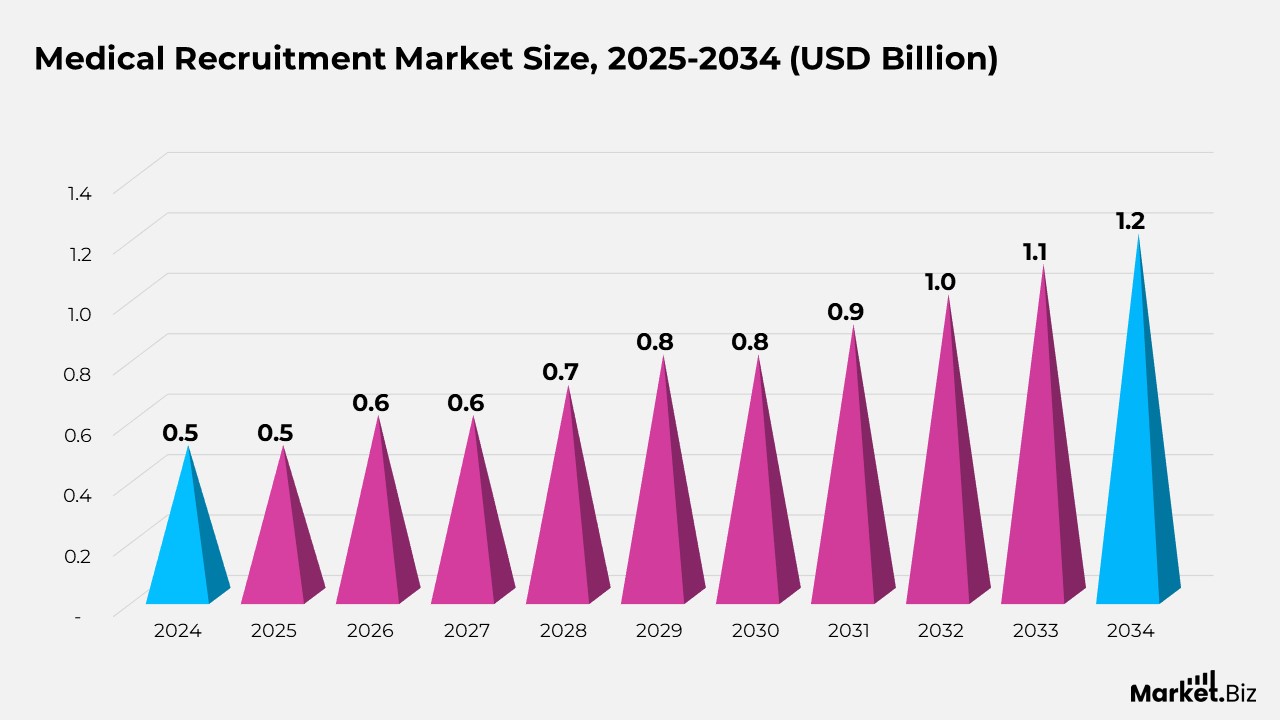
- According to Market.us, the medical recruitment market is expected to rise from $0.5 billion in 2025 to $1.2 billion by 2034, representing a compound annual growth rate (CAGR) of 9.0% from 2025 to 2034.
- The increasing demand for skilled healthcare professionals across hospitals, clinics, pharmaceutical companies, and research institutions drives the growth of the medical recruitment market.
- The home care services segment captured 42.7% of the market share, driven by the rising demand for in-home healthcare due to an aging population and chronic disease prevalence.
- The pharmaceuticals & biotechnology segment held 47.5% of the market share, fueled by continuous innovation in drug development, biotechnological research, and the need for professionals to navigate regulatory complexities.
- North America led the market with the highest revenue share of 37.2%, attributed to a persistent shortage of healthcare professionals, particularly registered nurses (RNs), projected to continue through 2037.
- The Asia Pacific region is expected to grow at the fastest CAGR, driven by a growing and aging population, expanding healthcare infrastructure, and increasing demand for medical professionals.
(Source: Market.us)
Hybrid and Remote Recruitment Statistics
- Virtual recruitment has become a crucial component of the hiring process in recent years.
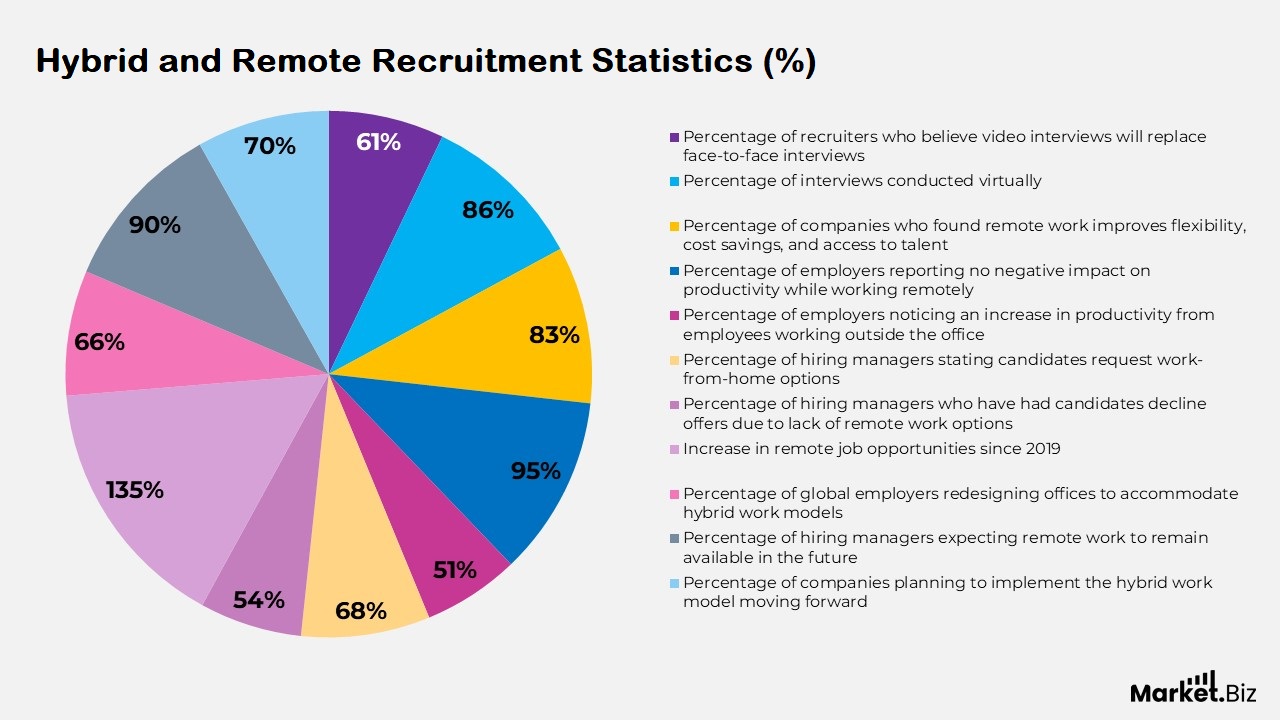
- 61% of recruiters believe video interviews will eventually replace face-to-face interviews entirely.
- Currently, approximately 86% of interviews are conducted virtually.
- More than 86% of employees prefer remote or hybrid work options.
- 83% of companies have found that remote work improves flexibility, cost savings, and access to talent.
- A significant 95% of employers report no negative impact on productivity while working remotely.
- 51% of employers have noticed an increase in productivity from employees working outside of the office.
- 68% of hiring managers state that candidates frequently request work-from-home options.
- 54% of hiring managers have had candidates decline interviews or job offers due to a lack of remote work options or flexibility.
- Two-thirds of remote workers say they would return to on-site work if their employers covered the cost of commuting.
- Since 2019, remote job opportunities have increased by over 135%.
- Remote workers scored 75 out of 100 on the Workforce Happiness Index, while in-office workers scored 71.
- Around 66% of global employers are redesigning their offices to accommodate hybrid work models.
- 90% of hiring managers suppose remote work to remain available in the future.
- More than 70% of companies plan to implement the hybrid work model moving forward.
(Source: Yello, Onrec, Zippia, Glassdoor, PwC, Flex Jobs, Gartner, Microsoft, Mercer, Novorésumé ApS)
Social Media and Online Recruiting Statistics
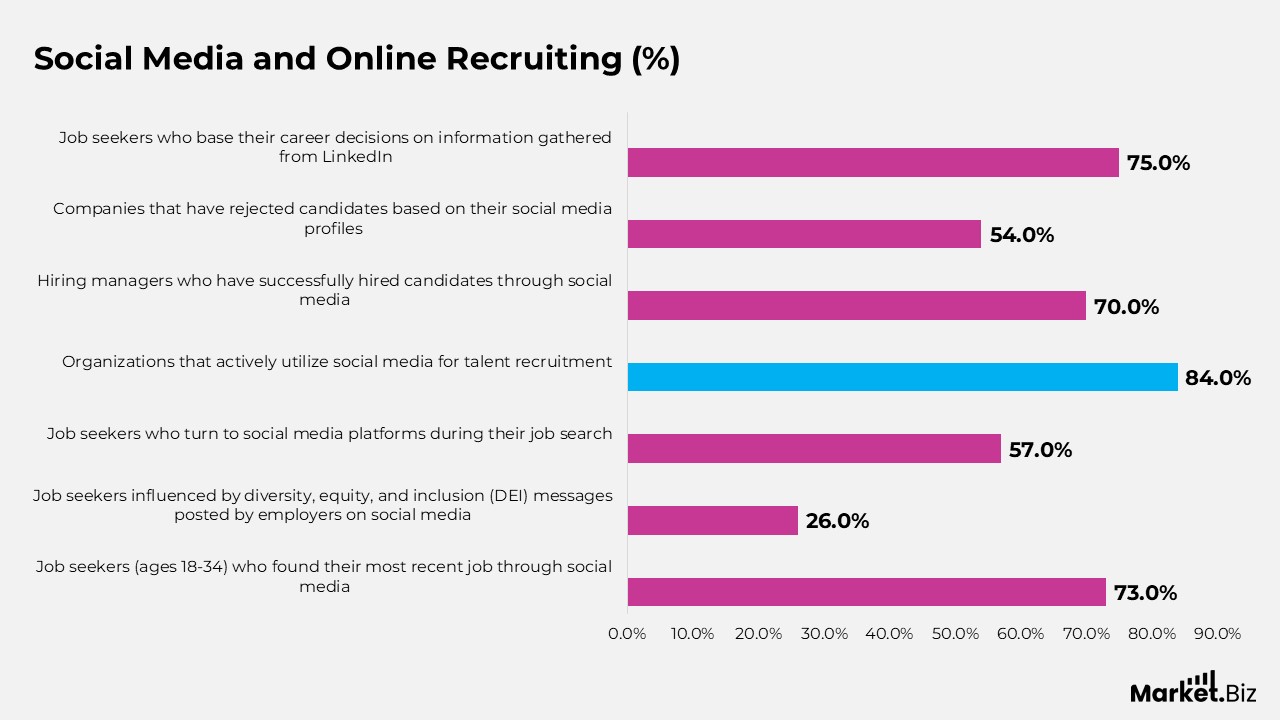
- 73% of job seekers between the ages of 18-34 report finding their most recent job through social media.
- 26% of job seekers are influenced by diversity, equity, and inclusion (DEI) messages posted by employers on social media.
- 57% of job seekers turn to social media platforms during their job search.
- 84% of organizations actively utilize social media for talent recruitment.
- 70% of hiring managers have positively hired candidates through social media channels.
- 54% of companies have decided to reject candidates based on their social media profiles.
- 75% of job seekers base their career decisions on information gathered from LinkedIn.
(Source: Zippia, Careerarc, Statista, DemandSage)
Applicant Tracking System (ATS) Statistics
- 97.4% of Fortune 500 companies, or 487 out of 500, utilize an Applicant Tracking System (ATS).
- The global ATS market is expected to reach USD 3.2 billion by 2026.
- From 2023 to 2035, the global ATS market is projected to grow at a CAGR of 9.70%.
- Approximately 67% of large companies use an ATS in their recruitment processes, compared to only 35% of small businesses.
- 78% of companies report that the implementation of an ATS has significantly simplified their hiring process.
- Organizations using an ATS see 2-3 times better results in terms of quality of hire, time to hire, and employee retention.
- Innovations in ATS, like conversational systems, enable high-volume hiring by automating up to 90% of the recruitment process through chat and text-driven automation.
- Only 3% of companies are fully utilizing all the features and functionalities available in their ATS.
- 50% of companies wish their ATS had more features to improve the recruitment process.
- 20% of companies are actively seeking to replace their current ATS.
(Source: Aptitude Research, Recruiterflow Inc.)
AI in Recruiting Statistics
- 14% more recruiters added AI-related skills to their LinkedIn profiles in 2023.
- 27% of talent professionals are exploring the use of generative AI (GenAI) in their daily recruitment activities.
- Job seekers utilizing AI-enhanced resumes have an 8% higher chance of landing a job.
- In North America, chatbots and intelligent messaging systems are the most commonly used AI tools in recruitment.
- 85% of recruiters consider AI to be a valuable tool in the hiring process.
- 79% of recruiters believe AI will soon be capable of making hiring and firing decisions.
- 44% of recruiters feel that AI will help save them significant time in their recruitment efforts.
- 35% of recruiters are concerned that AI might overlook unique or unconventional talent.
- 68% of recruiters expect AI to help eliminate unconscious bias from the hiring process.
- The primary reason 44% of recruiters began using AI was to save time in their hiring processes.
- 96% of recruiters believe AI will enhance their jobs and make tasks easier, although 60% are concerned it could eventually replace them.
(Source: Zippia, Inc., Recruiterflow Inc)
Staffing Agency Statistics
- In February 2024, US staffing agencies experienced a median 5% year-over-year revenue decline, matching the 5% decrease seen in December 2023.
- The total revenue for the staffing industry in 2023 reached approximately 593 billion US dollars.
- US staffing companies hire over 14.5 million temporary and contract workers annually.
- Experts project the US temporary staffing market will reach $185.6 billion by 2025.
- Major staffing sectors saw a 20% drop in net income in Q4 2023.
- Staffing firms experienced an increase of nearly 13% in their market capitalization during Q4 2023.
- 20% of staffing employees prefer temporary or contract roles, with schedule flexibility being a key factor in their decision.
- The revenue of leading staffing firms has been declining at an accelerating rate, from a -0.11% quarter-over-quarter decrease in Q4 2022 to -3.36% in Q3 2023. However, in Q4 2023, despite a revenue decline compared to Q3, the rate of decline slowed by 7%.
(Source: Zippia, Inc., Recruiterflow Inc)
Conclusion
Online recruitment statistics reveal both the advantages and challenges shaping today’s hiring environment. On the positive side, the increasing use of digital platforms like social media and Applicant Tracking Systems (ATS) has greatly improved the efficiency of the recruitment process, allowing companies to access a larger, more diverse talent pool.
The rise of remote and hybrid work models has provided new opportunities for businesses to attract talent from various regions, offering greater flexibility and improving work-life balance for employees. These innovations enable organizations to refine their recruitment strategies, shorten hiring timelines, and provide a better overall experience for candidates. However, there are also drawbacks to online recruitment.
While automation through AI and ATS has streamlined the hiring process, it can sometimes miss out on unique or non-traditional candidates, potentially reducing diversity. Additionally, the rapid pace of technological change can leave some companies struggling to keep up with the latest platforms and tools. Remote work, while offering flexibility, can also result in a less personal recruitment experience, making it more difficult for candidates to forge meaningful connections with potential employers.
By understanding the benefits and the challenges of online recruitment, businesses can make more informed decisions, optimizing their hiring practices while addressing the obstacles brought about by the digital transformation of the recruitment process.
FAQ’s
Recruitment statistics are data-driven insights that provide an overview of hiring trends, practices, and performance. These statistics often cover key metrics like time-to-hire, cost-per-hire, sourcing channels, and diversity, helping organizations assess the efficiency and effectiveness of their recruitment strategies.
By utilizing recruitment statistics, organizations can streamline their hiring processes, reduce costs, and improve efficiency. Analyzing these metrics enables businesses to make informed decisions, enhance candidate sourcing, and refine overall recruitment strategies, leading to more successful talent acquisition.
Common recruitment metrics include:Time-to-hire: The duration it takes to fill a position.
Cost-per-hire: The total cost associated with hiring a new employee, including advertising and agency fees.
Source of hire: Identifying where candidates come from (e.g., job boards, social media, or referrals).
Candidate quality: Evaluating the performance and cultural fit of new hires.
Diversity metrics: Monitoring the diversity of applicants and hires to ensure an equitable recruitment process.
Recruitment statistics help organizations pinpoint inefficiencies in their hiring process. For instance, if the time-to-hire is too long, it provides an opportunity to find ways to speed it up. Similarly, if the cost-per-hire is high, companies can review their recruitment channels and explore more cost-effective solutions.
Recruitment statistics can track diversity-related metrics, such as gender, ethnicity, and background, within the hiring process. By regularly assessing these figures, organizations can pinpoint areas for improvement and develop strategies to foster a more diverse and inclusive workforce.

