









Introduction
Project Management Statistics: In recent times, project management has become a key driver of organizational success across various industries. As projects become more intricate and interconnected, companies increasingly rely on structured management approaches to achieve strategic objectives, optimise workflows, and enhance overall efficiency.
Technological advancements have introduced sophisticated tools, artificial intelligence, and data-centric insights into project management, empowering teams to respond more effectively to evolving challenges and uncertainties. Sectors such as information technology, healthcare, construction, and finance are placing a greater emphasis on skilled professionals who can expertly manage complex projects.
This heightened focus on project management underscores its crucial role in driving innovation, sustaining competitiveness, and ensuring long-term success in an increasingly complex global landscape.
Editor’s Choice
- Only 39% of organizations currently provide formal training in project management.
- The average annual salary for project managers stands at approximately $92,274.
- Around 69% of project professionals report that their senior leadership places a strong emphasis on project management, while nearly 46% of organizations actively work towards fostering a culture that supports it.
- When project management is undervalued, nearly half of all projects fail, reflecting a 50% failure rate.
- Over the past year, 70% of organizations have experienced at least one project that failed to meet its objectives.
- Only 40% of projects consistently achieve the full benefits they were designed to deliver.
- About 4 in 10 project professionals believe that the projects they have handled have been entirely successful.
- A significant 56% of project managers lack access to real-time key performance indicators, with 43% spending at least a full day manually preparing project reports.
- PRINCE2 ranks as the least commonly adopted project management methodology among organizations.
- The use of project management software leads to a 52% improvement in team communication and collaboration.
Project Management Statistics
- A significant 91% of project managers acknowledge facing project management challenges within their organizations.
- Half of the project teams adopting agile approaches also integrate supplementary tools to enhance project execution.
- 82% of individuals recognize the crucial role project managers play in ensuring the success of projects.
- Ineffective project management can lead organizations to lose up to 12% of their valuable resources.
- The global market size for the IT project and portfolio management (IT PPM) sector covers the period from 2014 to 2019, along with projections for 2024. In 2019, the global IT PPM market was valued at $ 3.88 billion.
(Source: ProofHub, Statista)
AI in Project Management Market Size
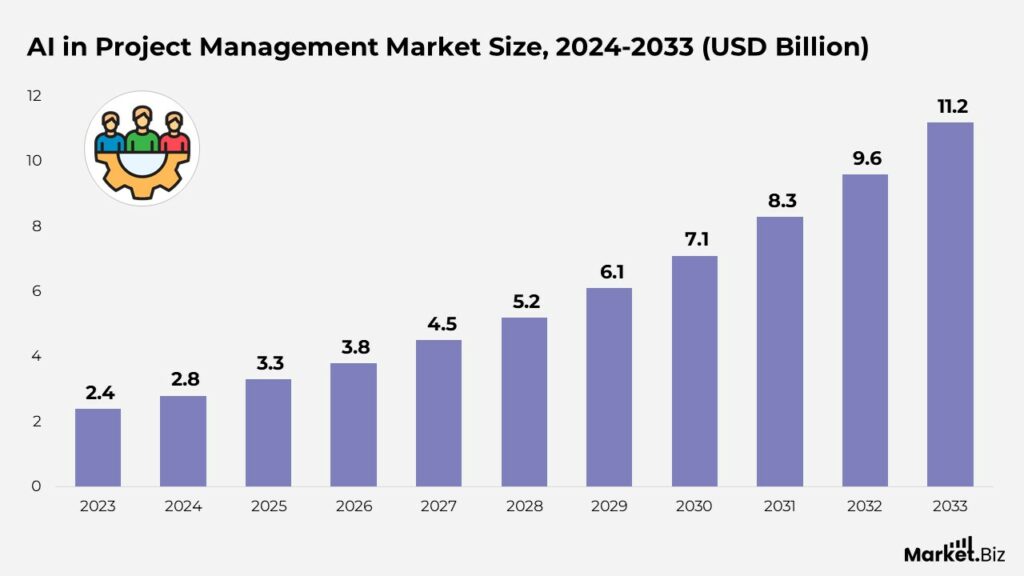
- According to Market.us, the AI in project management market is projected to reach $2.8 billion in 2024, increasing to $11.2 billion by 2033, with a compound annual growth rate (CAGR) of 16.7% between 2024 and 2033.
- The market’s growth is primarily driven by companies increasingly exploring artificial intelligence to boost operational efficiency and reduce expenses.
- Cloud deployment mode holds a dominant 65% share, owing to its scalability and flexibility that effectively support the surging demand for managing projects remotely.
- Large Enterprises command the organization size segment with a 67.3% share as these businesses progressively adopt AI to streamline and optimise complex project operations.
- Communication and collaboration lead the application segment with a 25% share, driven by the growing need for seamless coordination within geographically dispersed project teams.
- IT and Telecom dominate the industry vertical, with an 18% share, as the industry continues to prioritize technology-led project management capabilities.
- North America leads the way with a 36.7% share, reflecting the region’s strong adoption rate of AI-enabled project management solutions.
(Source: Market.us)
Online Project Management Software Market Size
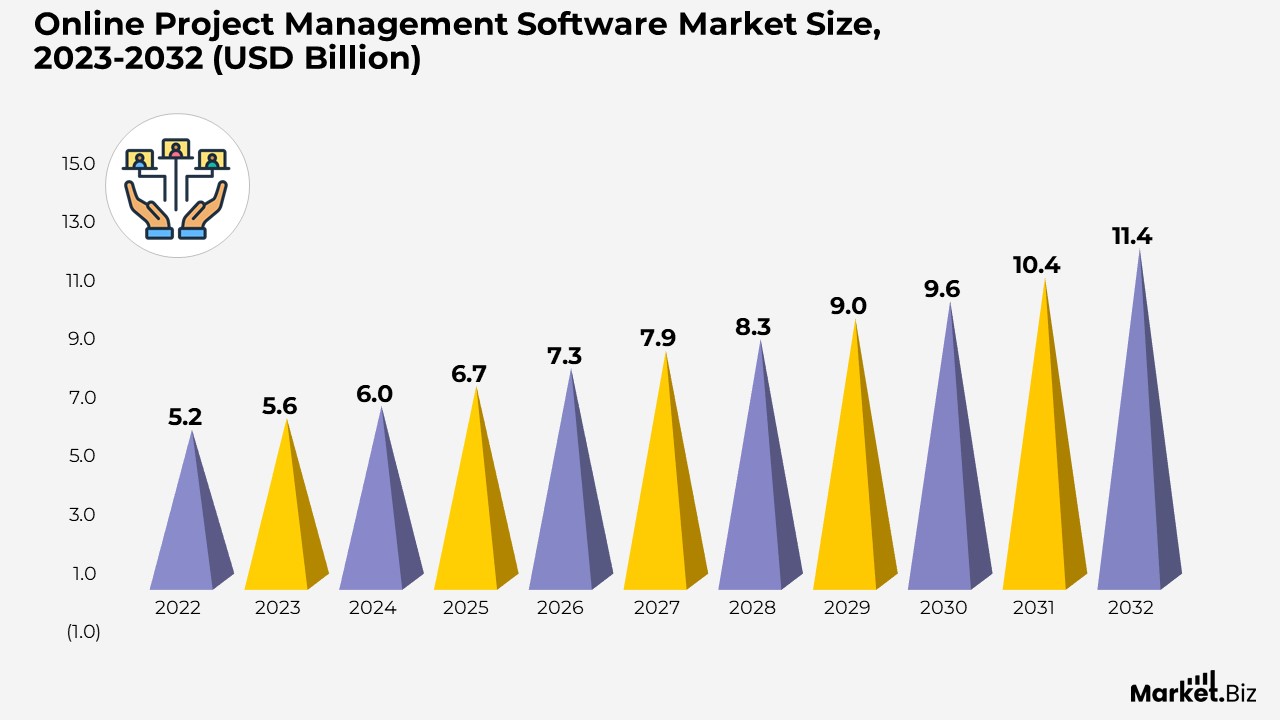
- The online project management software market is projected to grow from $5.6 billion in 2023 to $11.4 billion by 2032, representing a compound annual growth rate (CAGR) of 8.4% from 2023 to 2032.
- The expansion of this market is fueled by enterprises across diverse sectors increasingly prioritizing project collaboration, which continues to drive market growth.
- Cloud-based deployment accounts for a substantial revenue share of 64.2%, reflecting strong user preference for flexible, easily accessible deployment solutions.
- Large enterprises lead the organizational segment, holding a dominant share of 54.3%, which highlights the widespread implementation of project management software within major organisations.
- The IT and telecom sector holds a significant revenue share of 22.4%, emphasizing the robust demand for efficient project management tools in this technology-driven industry.
- The incorporation of cutting-edge technologies such as AI and ML is anticipated to unlock substantial opportunities in the coming years, representing approximately 35% of the market’s projected potential.
- North America secures a leading position with a revenue share of 38.9%, while Asia Pacific is poised to emerge as the fastest-growing region, contributing to 20% of the expected future growth.
- Key market influencers include Microsoft Corporation, Zoho, Wrike, BaseCamp, and Workfront, who together command nearly 40% of the total market share.
(Source: Market.us)
Adoption Trends in Project Management Software
- Only 23% of organizations have integrated project management software into their operational workflows.
- Jira leads the current market with a 36.57% share, followed by Microsoft Project at 19.78% and Smartsheet at 5.17%.
- The project management software sector is projected to grow at a 10.67% compound annual growth rate (CAGR) between 2020 and 2025.
- Approximately 35% of project managers still rely on MS Excel for developing resource plans.
- A significant 44% of managers remain skeptical about the effectiveness of software tools in managing projects.
- 73% of companies cite reliability, user-friendliness, and seamless integration as their top priorities when choosing digital project management solutions, though many feel that existing options fall short of these expectations.
- Poor project performance results in an average loss of 11.4% of invested resources.
- Among organizations that fail to recognize project management as a critical factor in driving change, 67% of their projects fail.
- Around 66% of project professionals reported that their organizations supported the decision to invest in project management software.
- 67% of businesses leverage project management tools to facilitate smoother and more effective communication with their clients.
- Around 40% of managers select project management software primarily based on its available features and capabilities.
- A significant 85% of organizations anticipate that artificial intelligence and project management software will drastically transform their business operations within the next five years.
- 42% of organizations have reported achieving most or all of the anticipated benefits from their software investments.
- Only 16% of companies are currently utilizing software solutions that are fully aligned with their project management needs.
Most Commonly Used Features in Project Management Software
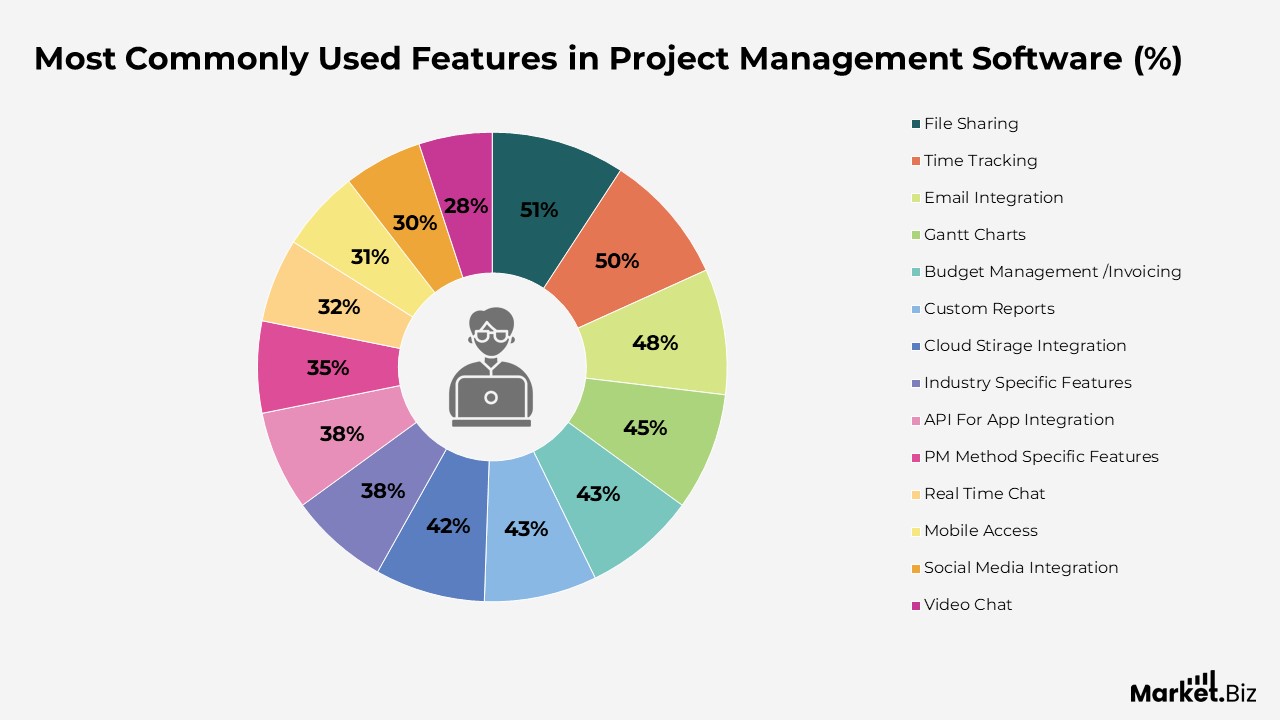
(Source: Fine Media (Pty) Ltd, PWC, Statista, Wellington, Capterra, PMI, Proprofs)
Project Management Performance
- In the United States, for every $1 billion spent on projects, approximately $122 million is lost due to underperformance.
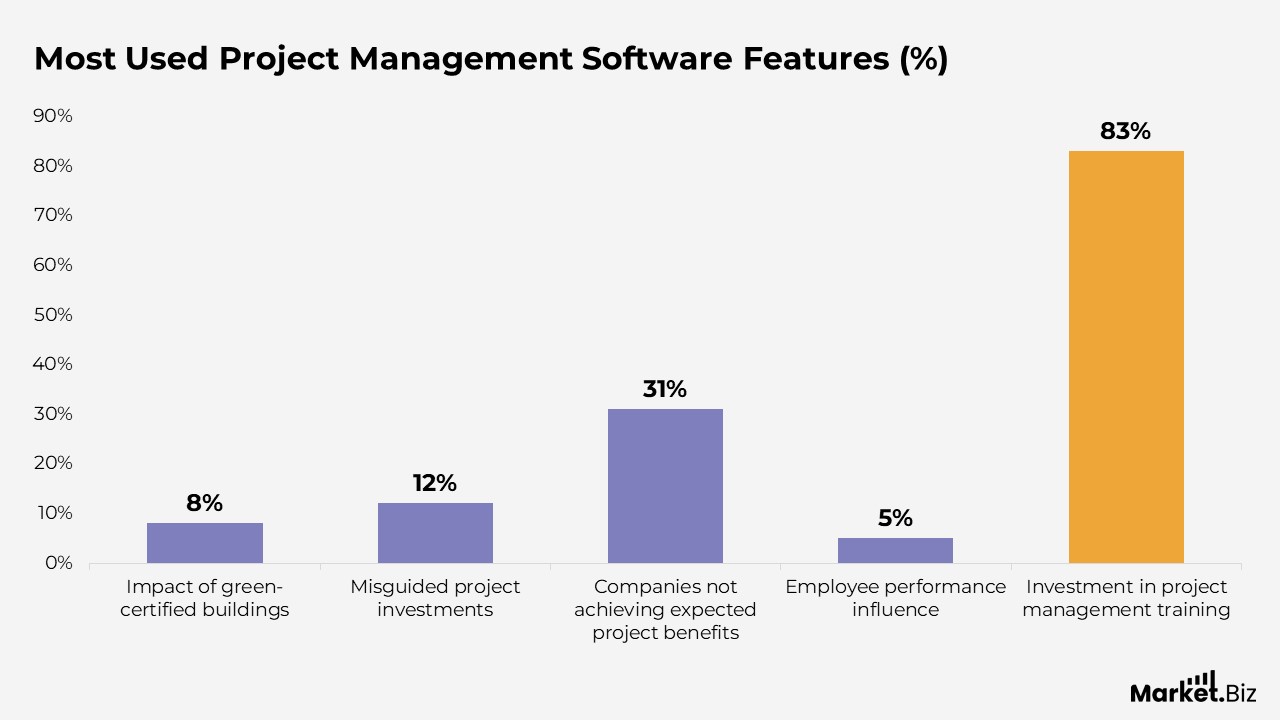
- Transitioning into green-certified buildings can enhance decision-making abilities among managers and employees by about 8%.
- 12% of organizations admit that their project investments were misguided, as these projects ultimately failed due to poor execution.
- 31% of companies report that they never fully achieve the expected benefits from their projects.
- Approximately 5% of an employee’s performance is directly influenced by shifts in technology, politics, or the economy within their organization.
- Successful projects are measured across six critical performance metrics: meeting deadlines, staying within budget, controlling budget overruns, avoiding scope creep, adhering to allocated timelines, and minimizing other causes of failure.
- An impressive 83% of top-performing organizations consistently invest in project management training to strengthen overall project outcomes.
(Source: EHP, HealthKnowledge, Wellingtone)
Project management Career & salaries Trends
- Globally, there are currently 40 million professionals working in project management, but an additional 30 million will be needed by 2035 to meet the rising global demand.
- In the United States, over 426,229 individuals are presently employed as project managers.
- The current salary range for project managers ranges from $104,000 to $183,000 per year.
- The median annual total earnings for project managers are approximately $136,000.
- China faces the widest talent gap, with an estimated shortfall of up to 13.6 million project management professionals anticipated by 2035.
- The technology sector offers the most lucrative compensation packages for project management professionals.
- Professionals holding a PMP certification report earn 33% higher median salaries compared to those without certification.
- Over the next ten years, around 77,000 new job openings are expected each year, primarily to replace retiring workers or those transitioning to different careers.
- Employment opportunities for project managers are projected to grow by 7% from 2023 to 2033, outpacing the average growth across all professions.
- A project manager’s total pay includes base salaries ranging from $69,000 to $118,000, complemented by additional compensation between $35,000 and $65,000 annually.
(Source: Project Management Institute (PMI), Zippia, BLS)
Project Management Tools Adoption
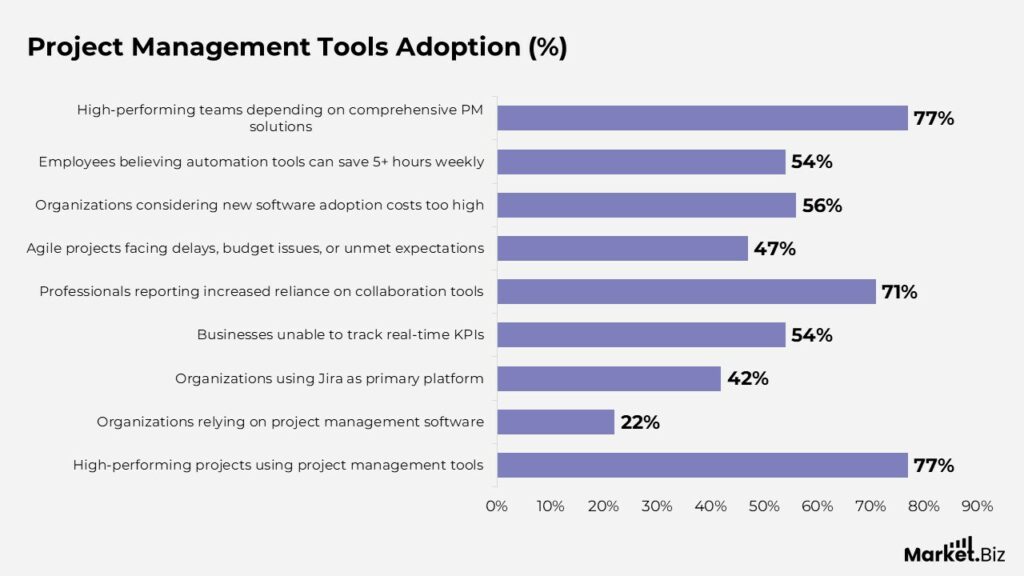
- 77% of projects classified as high-performing utilize project management tools to achieve their objectives.
- Only 22% of organizations currently rely on project management software to handle their operations.
- .
- Approximately 41.96% of organizations use Jira as their primary project management platform.
- Over 54% of businesses are unable to monitor real-time key performance indicators for their projects. Around 71% of project management professionals have noted an increase in their reliance on collaboration tools over the past year.
- Nearly 47% of Agile projects experience delays, exceed budget, or fail to meet customer expectations.
- 56% of organizations consider the cost of adopting new project management software to be excessively high.
- More than 54% of employees believe automation tools could help them reclaim over five hours of work time each week.
- 77% of high-performing teams depend on project management solutions that offer comprehensive feature sets to support their success.
(Source: TeamStage, Iseo Blue Limited, ProofHub, Visual Planning, FounderJar)
Project Management Jobs
- In the United States, seasoned project managers typically earn approximately $100,000 per year.
- There are approximately 843,910 individuals employed as project management specialists across the U.S.
- Holding a Project Management Professional (PMP) certification can increase salaries by up to 22% compared to those without the credential.
- Around 74% of project professionals believe that remote work will continue to be a prominent part of the workforce.
- Employment opportunities for project management specialists are projected to grow by 6% between 2022 and 2032, outpacing many other occupations.
- By 2030, the global economy is expected to require an additional 25 million project management professionals to meet rising demands.
- Approximately 14% of individuals believe artificial intelligence may negatively impact job availability.
- Over 61% of organizations offer project management training to their employees.
- Entry-level project managers in the U.S. have an average starting salary of approximately $53,923 per year.
- The need for skilled project managers is growing rapidly, with an estimated 88 million roles in project management-related fields projected by 2027.
(Source: The Digital Project Manager, wellingtone, U.S. Bureau of Labor Statistics, Project Management.com)
Project Management Practices
- Risk management practices are widely adopted, with 27% of organizations consistently applying them and 35% using them occasionally. Only 3% of respondents report never incorporating risk management into their processes.
- Senior leadership tends to recognize the value of project management more than other staff members, with 87% of executives stating they fully understand its importance.
- Just 32% of companies feel satisfied with their current level of project management maturity. While 67% rate their departmental project management (PM) maturity at level 3 or higher (on a 5-level scale), only 47% rate their organization-wide PM maturity that high, revealing a clear gap between departmental and organizational maturity.
- A staggering 97% of businesses acknowledge project management as essential for business success, yet 44% of project managers operate without any specialized software, although such tools are known to enhance project performance and satisfaction.
- Executive sponsorship plays a crucial role in project success. According to PMI, 62% of successful projects benefited from active sponsors, while 78% of respondents in a Geneca study expressed a desire for greater engagement from business stakeholders. Another study indicated that 33% of project failures stem from insufficient involvement by senior management.
- Companies report that the biggest benefit of project management is improved team communication (52%), followed by better customer satisfaction (38%) and higher product quality (44%). Additionally, 66% of organisations use project management software to maintain client communication.
(Source: PMI, Wellingtone, University of Ottawa, PWC, Capterra)
Project Budget Statistics
- In the United States, 91% of CEOs recognize that employee skills have a direct impact on financial outcomes.
- Roughly 43% of organizations report that they frequently or consistently complete projects within the allocated budget.
- About 27% of projects end up exceeding their original budget estimates.
- Failed IT projects result in financial losses ranging from $50 billion to $150 billion annually in the United States, due to diminished revenue and productivity.
- IT projects with budgets surpassing US$1 million are 50% more likely to fail compared to those with budgets below US$350,000.
- Around 24% of project professionals cite unrealistic budget expectations as a major barrier to project success.
- Approximately 20% of project professionals believe implementing agile methodologies can contribute to cost reductions in project management.
- Nearly 47% of project managers feel pressure to generate higher value despite having reduced budgets and compressed schedules.
- Organizations with advanced value delivery maturity manage to keep 67% of their projects within budget, while those with lower maturity levels achieve this in only 46% of cases.
(Source: Fine Media (Pty) Ltd, Statista)
Remote and Hybrid Project Management Trends
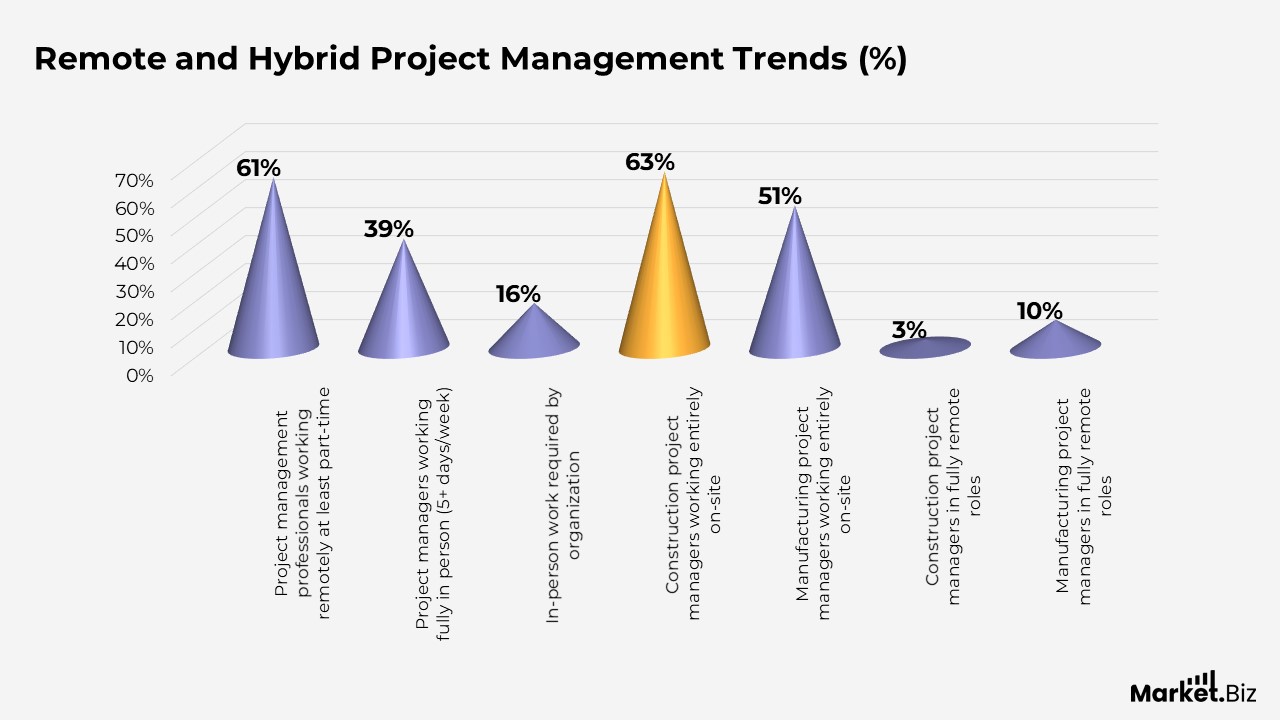
- 61% of project management professionals spend at least part of their time working remotely.
- 39% continue to work fully in person for five or more days each week.
- 16% report that in-person work is required by their organization rather than chosen voluntarily.
- 63% of construction project managers and 51% of manufacturing project managers primarily work entirely on-site.
- Fully remote roles remain rare, with only 3% of construction managers and 10% of manufacturing managers working exclusively off-site.
(Source: PMI, Monday Blog )
Reasons for Project Success
- 87% of high-performing managers state that strong delivery capabilities help reduce risks, manage costs, and boost value.
- 45% of PMOs have well-defined roles and responsibilities.
- 89% of top-performing companies consistently complete projects successfully.
- 76% of leading organizations rely on strategic initiatives to align with business intent and project goals.
- Only 37% of projects are almost always completed on time.
- 58% of organizations identify structured processes and practices as essential to achieving project success.
- 45% of high performers focus on recognizing and developing employee skills when needed.
- Just 35% of projects consistently deliver their full expected benefits.
- On average, 56% of projects succeed when proper talent and change management are in place.
- 94% of companies acknowledge project management as critical for driving business growth.
(Source: PMI, Wellington, Wellingtone, Capterra, Proprofs Project)
Industry-Based Project Management
- In the US, project-oriented jobs in the health sector grew by 17%.
- About 80% of federal IT projects in 2017 followed an ‘iterative’ or ‘Agile’ approach.
- Nearly 25% of managers believe their business teams are almost always misaligned.
- Around 93% of communication service providers apply agile project management methods.
- Just 55% of IT managers report having a clear understanding of their project’s business objectives.
- Only 5% of businesses identify project cost as the primary challenge in manufacturing projects.
- IT project failure rates range between 5% and 15%.
- Roughly 75% of business leaders implementing software projects expect them to fail.
- One major success formula emphasizes three goals: monitoring schedule, quality, and budget.
- About 17% of IT projects fail so severely that they endanger the company’s survival.
- Nearly 75% of IT executives believe their projects are destined to fail before they even begin.
- Only 4% of physicians report having fully functional Electronic Health Records (EHR) systems.
- IT projects with budgets of around $1 million are 50% more likely to fail compared to those with budgets of $350,000 or less.
- Reducing complexity in IT projects is often more important than increasing governance.
(Source: PMI, Deloitte, Geneca, Gartner, Foreign Policy, Gallup, IBM, Calleam)
Project Management Failure Statistics
- Organizations lose approximately 12% of their valuable resources due to ineffective project management practices.
- Around 57% of companies surpass their set budgets, and projects exceeding $1 million are 50% more prone to failure compared to those with budgets under $350,000.
- In IT projects, failure rates are strongly linked to the project size, with larger initiatives facing greater risks.
- 38% of organizations identify unclear roles and responsibilities as the primary barrier to project success.
- While multiple factors contribute to project failure, the absence of well-defined goals and vision remains the top reason, cited by 37% of organizations.
- An estimated 44% of managers believe that project management software holds little importance in driving project success.
- Nearly 54% of businesses lack access to real-time project KPIs, and 25% admit they don’t have the right technology in place for effective information-sharing and collaboration.
- The most frequent causes of failure, as noted by 37% of respondents, include poor planning, insufficient communication, and vague objectives.
- When project management is undervalued, approximately 67% of projects fail to meet their objectives.
- Ineffective communication alone accounts for 19% of project failures, often leading to misalignment and conflicting efforts.
(Source: The State of Project Management Report, quickly, ProofHub )
Conclusion
Project management statistics highlight its vital role in driving organizational efficiency, controlling costs, and delivering successful project results. As business environments grow more complex and market demands evolve, the integration of advanced technologies, proven methodologies, and experienced professionals becomes increasingly important.
While many organizations utilize project management to enhance collaboration, performance, and customer experience, challenges still exist in areas like technology implementation, organizational maturity, and leadership engagement.
Looking ahead, companies that focus on refining their project management approaches, invest in skill development, and adopt innovative technologies will be better positioned to overcome obstacles and achieve long-term, sustainable success.
FAQ’s
Project management statistics offer critical insights into how effectively projects are executed, how resources are utilized, and how well organizations perform overall. These insights enable businesses to identify areas of strength and weakness, facilitating more informed decision-making and process optimization.
Recent data shows that 27% of organizations consistently apply risk management practices, while 35% incorporate them intermittently. On the other hand, 3% of organizations admit to not employing any formal risk management approach, highlighting the potential for broader implementation.
Organizations with higher levels of project management maturity tend to experience stronger communication, better use of resources, higher productivity, and improved customer satisfaction. Elevated maturity levels often result in fewer failed projects and a more reliable achievement of business goals.
Modern project management increasingly relies on technologies such as project management platforms, artificial intelligence (AI), and advanced analytics. These tools improve planning precision, enable real-time tracking, foster better collaboration, and support informed decision-making. Nevertheless, full-scale technology adoption remains a challenge for some.
Despite growing awareness of its importance, project management still faces hurdles, including limited executive involvement, insufficient training, partial technology integration, and misalignment between project activities and the overarching business strategy.
To enhance project management effectiveness, companies should prioritize ongoing staff development, implement standardized frameworks, leverage technological advancements, secure leadership support, and foster a culture centred on accountability and continuous improvement.