









Introduction
Neurodiversity in the Workplace Statistics: Recognizing neurodiversity in the workplace is being seen in a more broadly understood way which is fundamental to building inclusive and innovative spaces.
According to the 2023 Neurodiversity in Business Research Report, while 92% of employers reported a Diversity, Equity and Inclusion policy, only 22% of respondents had a policy specifically concerning neurodiversity; while this is a sizeable acknowledgement, it also highlights relative neglect of a critical dimension of organisational inclusivity.
This is especially problematic when we consider that almost 1 in 7 people in the UK are neurodivergent, which includes conditions such as autism, ADHD, dyslexia and dyspraxia. Unfortunately, 65% worry about stigma and discrimination from management and 55% from colleagues, as such they are unwilling to disclose that they are neurodiversity. It is clear from these statistics that organisations need to acknowledge neurodiversity, but more importantly take action to help realize the unique attributes of neurodivergent people.
Editor’s Choice
- Employees who disclose their neurodivergence are 30% more likely to be engaged at work.
- 41% of employers have changed their recruitment processes to accommodate neurodivergent candidates.
- Bank of America has hired more than 250 neurodiverse employees in its support services group.
- 53% of Gen Z identifies as neurodivergent which signals a shift in acceptance.
- Using all types of cognitive diversity supports more varied collaboration or discussion and decisions.
- McKinsey found companies with varied working styles improved complex problem-solving by 35%.
- Neurodivergent employment contributes toward personal independence, and reduces the economic gap.
- Education, 10.2% organisations are starting to formally explore neurodiversity as schools and universities.
- 34% of neurodivergent workers report fewer distractions when they work from home.
- Job functions filled via neurodiversity programs report sustained output increases of 90-140%.
- In tech positions, neurodivergent candidates with workplace training make 140% error-free output.
- Neurodivergent employees report only low to moderate wellbeing at work, averaging 2.02 out of 5.
- Though 92% of companies have DEI plans, only 22% mention neurodiversity, revealing a serious gap in true inclusion.
General Neurodiversity in the Workplace Statistics
- 15-20% of the global population is neurodivergent due to brain differences characterized by neurodevelopmental conditions such as autism, attention hyperactivity disorder (ADHD), and dyslexia.
- Only 22% of employers have a neurodiversity policy, though 92% have a general diversity, equity, and inclusion policy.
- 65% of neurodivergent employees have concerns about stigma from management, while 55% have concerns about discrimination from colleagues.
- 76% of neurodivergent employees do not choose to disclose their condition completely in the workplace.
- Only 17% of organisations have an actual process to disclose neurodivergence which makes it more difficult for individuals to seek help.
- Employees who disclose their neurodivergence are 30% more likely to be engaged at work.
- 35% of organisations have a senior leader disclose their neurodivergence, which may help foster openness and inclusion.
- Neurodivergent employees report poor well-being and rate themselves airily on a workplace well-being scale at an average of 2.02 out of 5.
- Individuals who are autistic adults are in full time, paid employment while most of them have valuable skills to offer.
Moreover
- 41% of employers have changed their recruitment processes to accommodate neurodivergent candidates.
- Companies that embrace neurodiversity see improvements in productivity of up to 30%, and all benefit from diverse thinking.
- If we doubled the number of autistic people in employment then the economy in the UK could increase by as much as £1.5 billion to show the economic benefits of inclusion.
- 70% of adults in the US agree there is a stigma associated with asking for workplace accommodation; this percentage has increased from 60% in 2024.
- 77% of adults in the US also agree that neurodivergent employees face stigma in the workplace, again this indicates awareness in the general population.
- Neurodivergent can also bring amazing skills such as pattern identification, creativity, and attention to details, and offer unique organisational strengths.
- Companies such as SAP, Microsoft and Dell have recognised the needs to implement neurodiversity recruitment policies and realize the positive impact of different cognitive abilities.
- Simply providing quieter office environments allows neurodivergent employees to thrive and perform, which can enhance an organization’s performance.
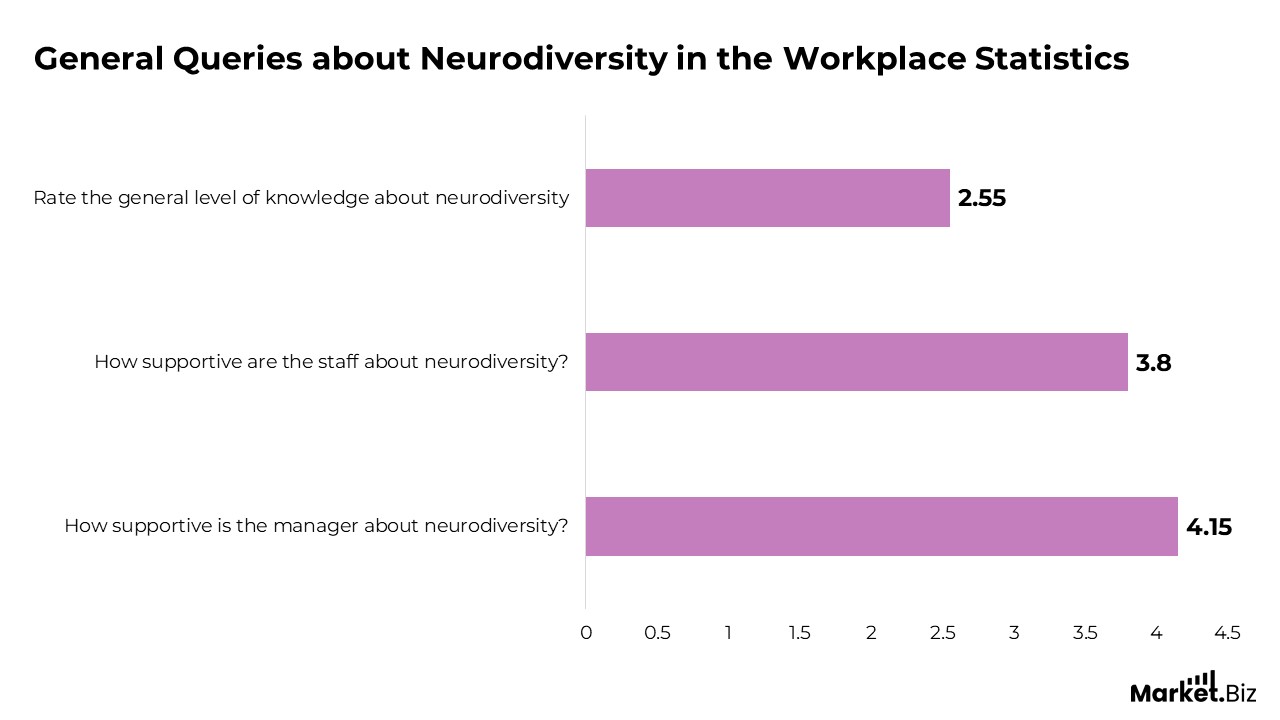
(Source: Neurodiversityinbusiness, wp-content)
Global Adoption Rate
- Of the global population, roughly 20% are neurodivergent including autism, dyslexia, ADHD, and others.
- In the U.S., 85% of autistic people are unemployed, which gives you an idea of the disparity in the workforce.
- SAP has achieved a starling 90% retention success rate for their neurodiverse employees (across 17 countries) through their Autism at work initiative.
- JP Morgan Chase executed a study demonstrating teams with neurodiverse participants were 48% faster and 92% more productive than teams without.
- Goldman Sachs developed their neurodiversity hiring initiative and their first virtual class had a 100% offer and acceptance rate.
- Microsoft has shown how their neurodiversity hiring program improved productivity and fostered innovation in the organisation.
- EY have developed neurodiversity centres of excellence aimed at supporting neurodiversity in hiring and working together to meet their client needs.
- Deloitte shared that companies employing neurodivergent professionals had workplaces that were up to 30% more productive.
- Bank of America has hired more than 250 neurodiverse employees in its support services group.
- Enabled intelligence, a start-up, reported they have 97% accuracy of data labelling having recruited neurodivergent professionals.
- 53% of Gen Z identifies as neurodivergent which signals a shift in acceptance.
- Only 22% of employers have established policies that address neurodiversity, while 92% have DEI policies.
- 36% of neurodivergent employees stated that they did not receive any type of guidance or corrections in adjusting their workplace adjustment.
- Near to 3 quarters of HR teams state that they do not know how to approach practices in neurodiversity.
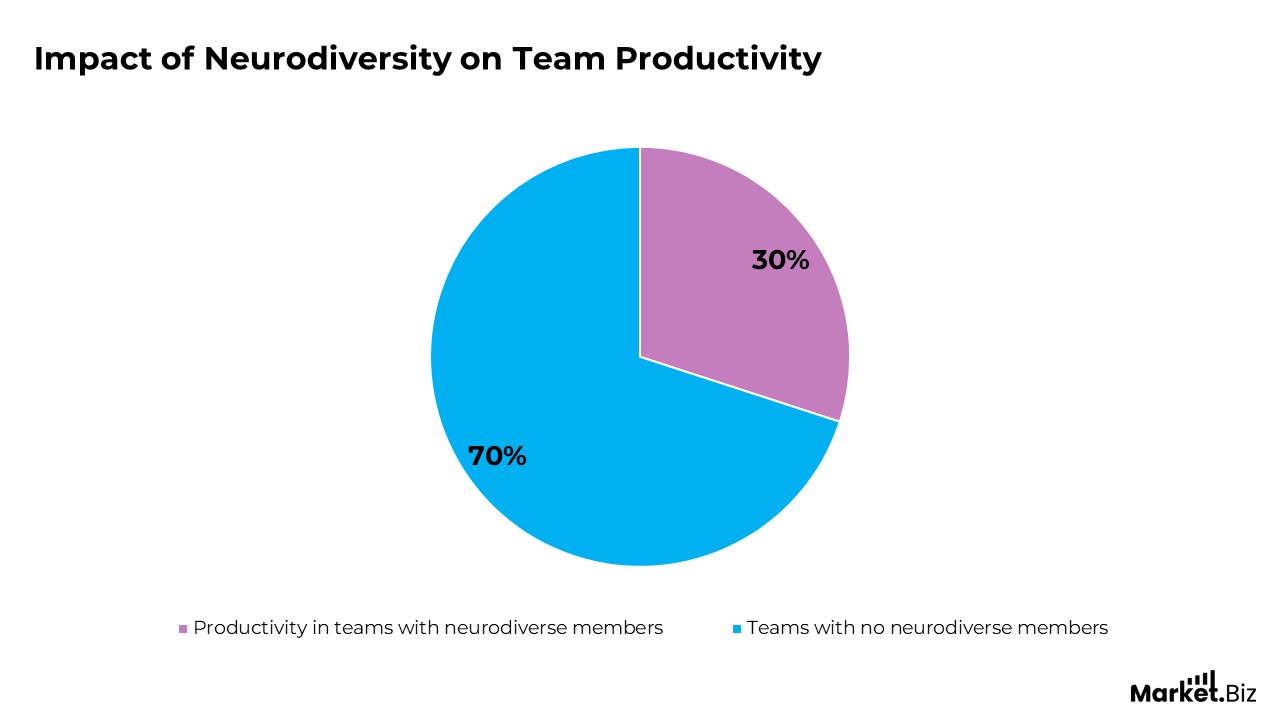
Impact of Neurodiversity on Team Productivity
- Deloitte said that teams with neurodiverse members can be up to 30% more productive than teams productive than teams with no neurodiverse members.
- JPMorgan Chase’s Autism at work program showed that employees, who are neurodivergent, were able to be 90% to 140% more productive than neurotypical colleagues.
- Neurodivergent employees in JPMorgan’s program also made fewer mistakes than their neurotypical employees.
- Deloitte has shown that organizations with cognitive diversity have a 20% increase in potential innovation revenue.
- McKinsey found companies with varied working styles improved complex problem-solving by 35%.
- SAP’s Autism at work program has a 94% retention rate of neurodiverse employees.
- An additional £1.5 billion could be contributed to the UK economy by doubling the employment rates of those with autism.
- Often neurodivergent individual are exceptional pattern movers or analytic thinkers. Potentially increasing the team’s performance due to increased attention, accuracy or logic.
- Boston consulting group showed organizations who had above-average diversity of thinking styles provide 19% more innovation revenue.
- Using all types of cognitive diversity supports more varied collaboration or discussion and decisions.
- Supported neurodivergent staff will improve business productivity with a 50% reduction in sickness absence.
- Employers in the UK are waking up to the advantages of employing neurodivergent workers, job adverts that reference neurodiversity have increased six fold since 2019.
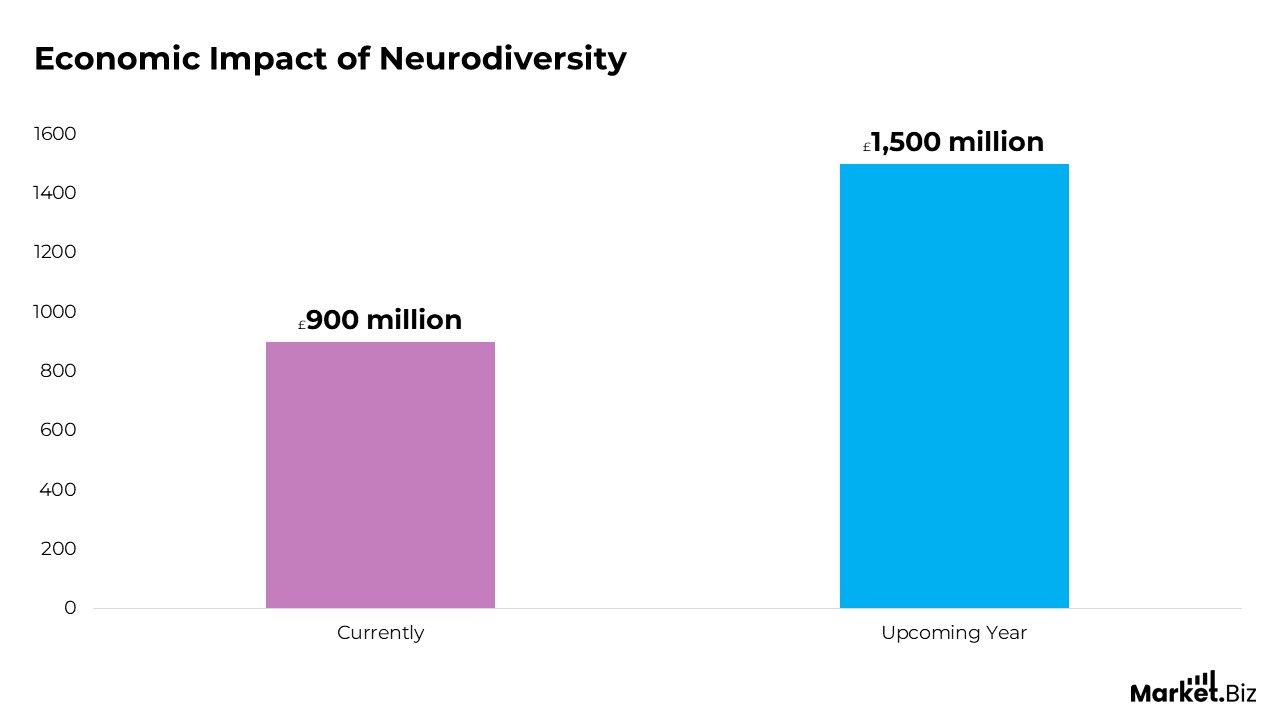
Economic Impact of Neurodiversity
- Closing the employment gap between people with disabilities and people without disabilities could contribute as much as $25 billion to the US GDP.
- If the employment rate for autistic people in the UK doubled, the economy could benefit by £900 million to £1.5 billion per year.
- Business including those with neurodivergent brains have seen as much as a 30% increase in productivity over non- neurodivergent businesses.
- Neurodivergent people leaving the safety net of government dependence impacts taxpayers by decreasing the need for supports in community service and adult care.
- Neurodiversity teams that leverage differences in innovation and problem solving ultimately results in better business performance.
- In the world, unemployment rates for neurodivergent adults can be 30-40%, as opposed to the general population.
- Neurodivergent employment contributes toward personal independence, and reduces the economic gap.
- Maximising the different skills that neurodivergent people can bring into the workforce can fill capability gaps, especially regarding industries that are struggling to fill any roles.
- The higher unemployment and underemployment rates in the neurodivergent population mean there has been a loss of potential human capital with lost productivity that costs economies billions of dollars each year.
- Inclusive workplaces at different stages of recognising and supporting neurodiversity often will lead to improved employee retention and reduced turnover costs.
- Diverse teams are better able to understand and serve a diverse client base, possibly increasing market share.
- Companies that change to support neurodivergent employees, confront tasks in a different way, and could achieve reduced error rates improved quality of outputs and subsequently savings.
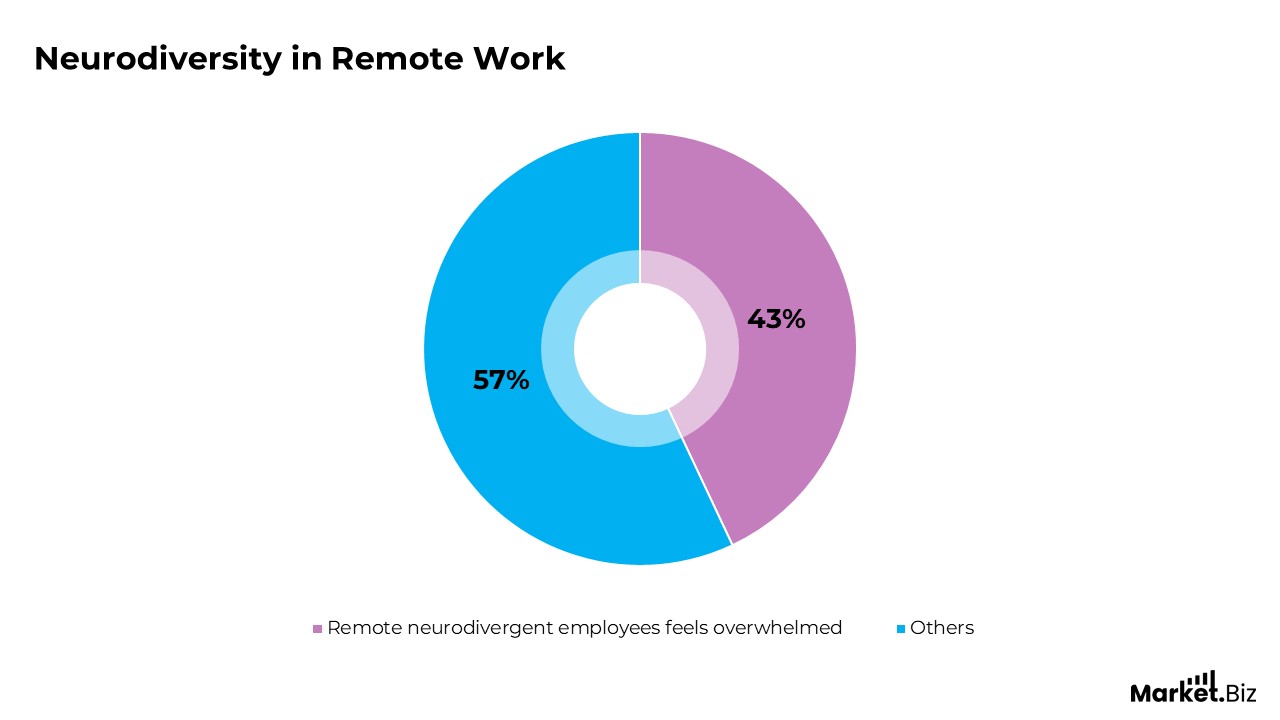
Neurodiversity in Remote Work
- 34% of neurodivergent workers report fewer distractions when they work from home, therefore changing their ability to focus and become productive.
- In traditional workplace environments, neurodivergent people spend up to 70% of their neurodivergent identity.
- 45% of neurodivergent employees have a harder time maintaining focus in virtual meetings between two screens, this highlights that the need for businesses to invest in inclusive communication practices is vital.
- 44% of neuroservices employees reported exhaustion from long video calls, so they may prefer differing methods of communicating.
- 43% of neurodivergent employees at home feel overwhelmed constantly using instant messaging programs.
- Allowing neurodivergent employees to work during their most productive hours can remarkably contribute to optimizing output and happiness in their jobs.
- Implementing asynchronous models of work will enable neurodivergent employees to relax and allow their natural work rhythms to flourish.
- Creating predictable routines and clear work environments at home will help neurodivergent employees maintain focus and productivity.
- More inclusion can happen by normalizing individual communication methods, for example, a preference for written versus verbal communication.
- 75% of neurodivergent workers choose not to disclose their neurodivergent lived experience because of the stigma that surrounds neurodiversity, and the culture of remote work environments must change to support individuals.
- When organisations welcome individuals with neurodiverse conditions, they see an increase of up to 30% productivity in the workplace because neurodivergent employees have strengths.
- If autism employment rates could double in the UK, it is estimated that the UK economy would gain billions, showing the possibility of economic benefit of a more neurodiverse way of working remotely.
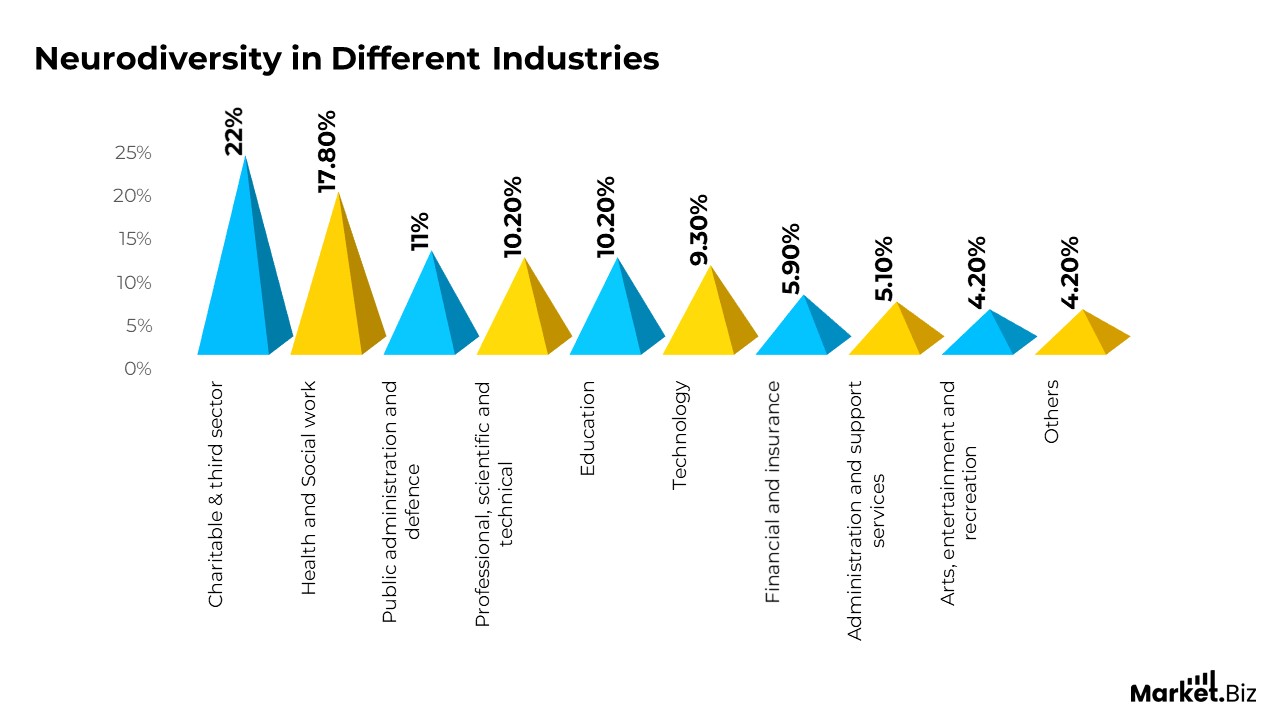
Neurodiversity in Different Industries
- Charitable & third sector, 22% of surveyed organisations operate here, the highest sector representation.
- Health and Social work, 17.8% of participating organisations, demonstrating a strong interest in neuroinclusion.
- Public administration and defence, 11% of organisations, demonstrating a growing interest in government sector engagement.
- Professional, scientific, and technical, 10.2% representation, demonstrating science and consulting firms.
- Education, 10.2% organisations are starting to formally explore neurodiversity in schools and universities.
- Technology, 9.3% participation, with tech firms leading in inclusive hiring practices.
- Financial and insurance, 5.9% of organisations, while large firms in the future study have found it difficult to track data around neurodiversity.
- Administration and support services, 5.1% representation, across a range of occupations from facilities to HR.
- Arts, entertainment, and recreation, 4.2% of organisations, using the creative strengths of neurodivergent talent.
- Construction and manufacturing, 402 organisations, is an area with the most room for growth.
- Large finance firms, only 21% collect any metrics to show the term formal engagement with neurodiversity.
- Small finance firms, just 4% collect any metrics to show the term formal engagement with neurodiversity.
Benefits of Neurodiversity Training
- Organizations that provide neurodiversity training say their teams are about 30% more productive.
- Job functions filled via neurodiversity programs report sustained output increases of 90-140%.
- In 2023, 72% of organisations provided disability awareness training to their employees; the training was stated as “neurodiversity training” in the survey.
- Only 28% of managers had training specifically on neurodiversity in 2023 and reported that successful team collaboration had improved.
- Half of all managers reported being uncomfortable hiring a neurodivergent candidate before training; this showed a big reason for needing the training.
- Almost 1 in 10 HR professionals (9%) reported being “not at all confident”, they could identify different neurodivergent conditions in candidates before training.
- After completing neurodiversity specific workshop training, 28% of trained managers rated themselves “very confident” that they could support a neurodivergent employee.
- Studies show firms that include neurodiversity training as part of their program have staff turnover reduced by about 20%, as their support systems have improved.
- Teams that trained in neurodiversity noticed a 30% increase in new ideas and other creative solutions.
- Companies with a neurodiversity training program reported they fill open role vacancies 1.5 times faster, because the recruiters had learned to spot diverse talents.
- Organisations with neurodiversity programs retained neurodivergent candidate new hires 15% longer than the comparator organization without a neurodiversity program nor training.
- Trained teams report overall job satisfaction is 25% higher when their organizations has implemented inclusive culture.
- In tech positions, neurodivergent candidates with workplace training make 140% error-free output.
- After rolling out neurodiversity workshop training, completed projects resulted in 20% more candidates representing other neurodiverse types and engaged in the application process.
Recent Development in Neurodiversity
- Though 92% of companies have DEI plans, only 22% mention neurodiversity, revealing a serious gap in true inclusion.
- Over 70% of neurodivergent people have noticed the importance of their hyper-focus, creativity and attention to detail, and ability to think outside the box, as strengths within organisations.
- Around 65% of neurodivergent individuals report being reluctant to disclose their condition at work because they are fearful of stigma and discrimination.
- Neurodivergent workers consistently report favourably on a flexible schedule, remote work, and private workspace to reduce “noise” and increase their productivity and comfort.
- Neurodivergent employees report only low to moderate wellbeing at work, averaging 2.02 out of 5.
- Close to 43% of neurodivergent employees are likely to leave their positions, primarily due to lack of support, or misunderstanding by management.
- Roughly 65% of neurodivergent employees feel that managers lack understanding of neurodiversity and would benefit from some form of training.
- Employees who disclose their neurodivergent status at work are more likely to have access to changes required for effective work with reasonable adjustments, and less likely to ask for it because of bias.
- Companies that understand and value neurodiversity can experience an increase in productivity by 30% and a 28% increase in revenue in other ways, furthering their business case for inclusion.
- SAP’s Autism at work program reports a 90% retention rate for neurodivergent employees, showing the impact of targeted supports.
Conclusion
Neurodiversity in the Workplace Statistics: Neurodiversity in the workplace is beginning to gain attention as organisations see the opportunity to utilise different thought processes for various fain. However, the statistics clearly indicate the obstacles that remain to be addressed: only 22% of organizations consider neurodiversity in their policies on diversity, and many neurodivergent workers feel they do not supported at work.
Importantly, employee satisfaction and productivity can increase and innovation can expand through developing inclusive workspaces. With almost 1 in 7 people being neurodivergent, the development of better support systems is not only the ethical thing to do, but also a good business practice. When organisations are welcoming to neurodiversity, they will attract better candidates and retain existing talent.
If organisations can provide better training and flexible work options, this gap can be addressed and organizational successes can be achieved.
FAQs
Only 22% of organisations have neurodiversity in their diversity and inclusion policies, highlighting a need to better support neurodivergent employees in the workplace.
Neurodivergent workers have talents and skills, like thinking, creativity and hyper-focusing, which can increase productivity and spur innovation.
Most of them do not, 65% indicate that they are concerned about bias from managers, and over 40% gave thought about leaving their job because of a lack of understanding and support.