








Introduction
Workplace Harassment Statistics: Workplace harassment remains a significant concern across industries, with research indicating that nearly 25% of employees have experienced some form of harassment during their careers. The U.S. Equal Employment Opportunity Commission (EEOC) reports that over 70,000 harassment charges are filed annually, with sexual harassment being one of the most prevalent forms.
Despite increased awareness and legislative measures, many incidents go unreported, with up to 75% of victims choosing not to disclose their experiences. Harassment not only impacts the mental health and well-being of individuals but also poses serious financial consequences for organizations, with harassment-related lawsuits costing businesses billions each year. Understanding workplace harassment statistics is crucial for fostering a safer, more inclusive work environment.
Editor’s Choice
- 25% of employees experience workplace harassment during their careers, with 70,000 harassment charges filed annually in the U.S.
- Women make up 60-70% of sexual harassment victims, with 40% of women in STEM facing gender-based harassment.
- 75% of victims do not report harassment due to fear of retaliation, highlighting a major reporting gap.
- LGBTQ+ employees face double the harassment rates compared to their non-LGBTQ+ counterparts in the workplace.
- Harassment in retail is particularly high, with 38% of retail employees reporting mistreatment.
- Workplace bullying impacts 19% of employees, with the majority being women, leading to a hostile work environment.
- Racial harassment affects 1 in 10 workers, with African American employees facing 40% more harassment than white workers.
- Healthcare workers experience harassment at rates of 25-30%, often from patients or co-workers.
- Harassment-related legal costs amount to an estimated $1.6 billion annually for U.S. businesses.
- Remote workers report harassment at rates of 23%, with significant increases in online harassment incidents.
- Unionized workplaces report 35% fewer harassment complaints due to proactive policy enforcement and grievance procedures.
- The future of harassment prevention includes AI-powered monitoring tools, with 20% of companies expected to implement these by 2026.
General Workplace Harassment Statistics
- 25% of employees report experiencing workplace harassment at some point during their careers.
- Women make up 60-70% of sexual harassment victims in the workplace.
- Nearly 75% of employees who experience harassment do not report it due to fear of retaliation.
- 1 in 3 young workers (ages 18-24) report having experienced harassment at work.
- 40% of harassment victims report a decline in job performance and satisfaction.
- One in 10 workers in the United States reports racial harassment in the workplace.
- LGBTQ+ workers are twice as likely to experience harassment compared to non-LGBTQ+ employees.
- 40% of women in STEM fields have experienced gender-based harassment in the workplace.
- Sexual harassment claims make up approximately 55% of all workplace harassment cases filed with the EEOC.
- 35% of employees report witnessing harassment in their workplace but choosing not to intervene.
- Harassment in retail is particularly high, with 38% of employees reporting harassment.
- Workplace bullying affects 19% of workers, with the majority being women.
- Over 70,000 harassment charges are filed with the EEOC annually, with a significant portion being sexual harassment cases.
- Over 50% of harassment victims say that the company’s response to their complaints was inadequate.
- Employees in customer service positions face higher harassment risks, with 30% of them reporting harassment.
- Harassment costs U.S. businesses an estimated $1.6 billion annually in settlements, lost productivity, and legal fees.
- 40% of employees who experience harassment report increased absenteeism or presenteeism due to stress.
- Harassment-related turnover in the workplace is linked to higher employee departure rates, with costs reaching billions annually.
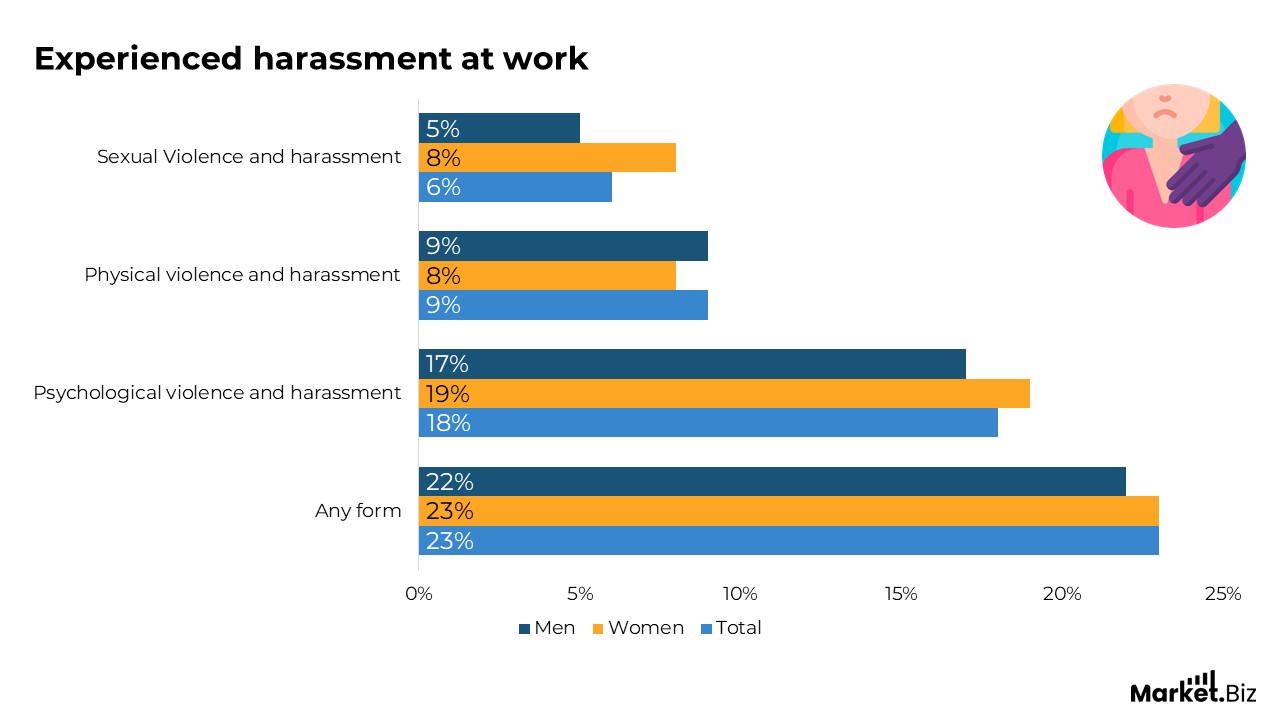
(Source: Gallup)
Types of Workplace Harassment
- Sexual harassment is one of the most common forms, with 55% of all harassment claims filed in the U.S. being sexual.
- Racial harassment affects 1 in 10 employees, with employees reporting higher levels of mistreatment in predominantly white workplaces.
- Verbal harassment, including offensive comments or jokes, is reported by 50% of victims in many industries.
- Physical harassment, such as unwanted touching or aggression, constitutes 15% of workplace harassment claims.
- Bullying is a form of psychological harassment that affects 19% of employees, with many reporting a hostile work environment due to it.
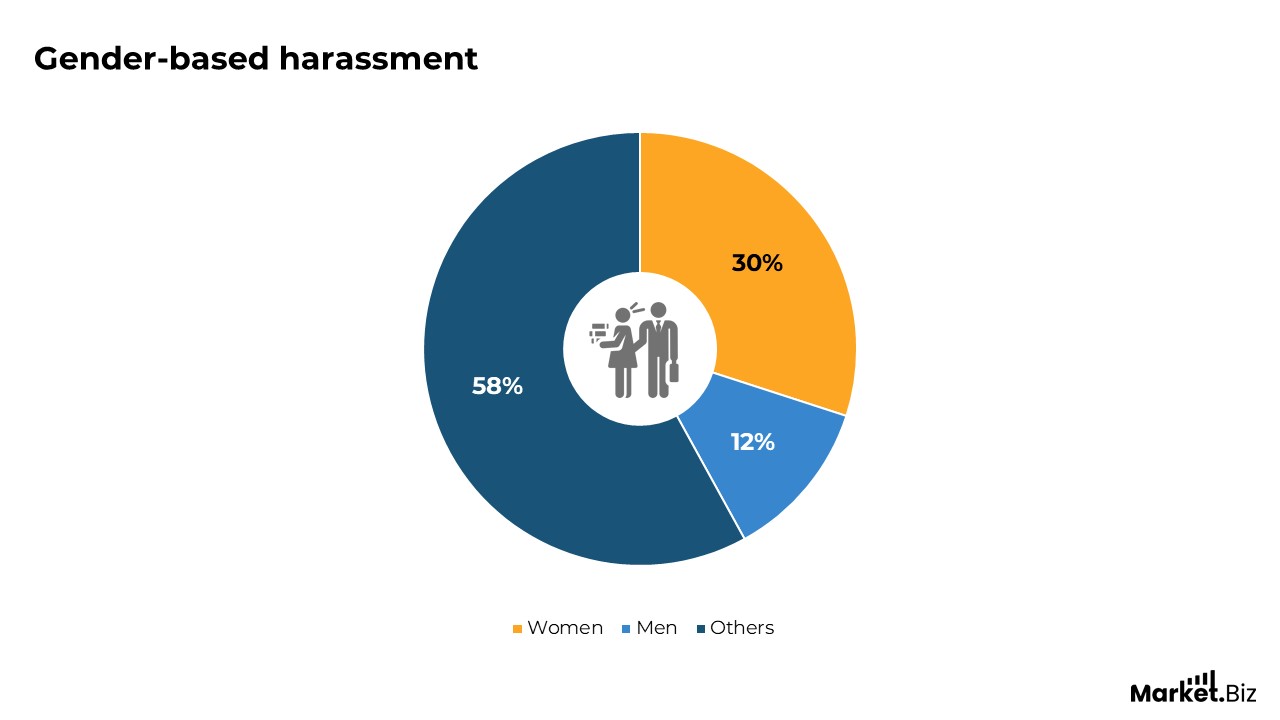
- Gender-based harassment affects both individuals, with 30% of women and 12% of men reporting gender-specific harassment.
- Disability harassment is reported by 15% of employees with disabilities, who face verbal abuse or discrimination due to their condition.
- Age-based harassment is particularly common among older workers, with 15% of employees over 50 experiencing mistreatment based on their age.
- Religious harassment is reported by 12% of employees who experience discrimination due to their religious beliefs or practices.
- Sexual orientation harassment affects 21% of LGBTQ+ employees, with many facing hostile comments and exclusion in the workplace.
- National origin harassment is reported by 1 in 5 immigrant workers, particularly in industries with a high percentage of non-native employees.
- Online harassment is rising, with 25% of employees in remote or hybrid settings reporting inappropriate emails, messages, or online behaviour from colleagues.
- Sexual favouritism occurs when employees are given preferential treatment based on their sexual relationships with a superior, affecting 12% of workers.
- Retaliation harassment happens when an employee faces discrimination after reporting harassment, making up 40% of all workplace discrimination claims.
- Power-based harassment involves abuse of authority by supervisors or managers, reported by 18% of employees as contributing to a toxic work environment.
Demographics of Harassment Victims
Gender and Sexual Harassment
- Women make up 60-70% of sexual harassment victims, particularly in male-dominated industries, with many facing unwanted comments and exclusion.
- 20% of women in male-dominated sectors like construction and tech report gender-based harassment, such as inappropriate jokes and mistreatment.
- LGBTQ+ employees are twice as likely to experience harassment compared to heterosexual employees, facing issues based on sexual orientation and gender identity.
- 40% of women in STEM fields report harassment, with many citing gender-based exclusion or mistreatment.
- 16% of men report experiencing harassment, particularly in industries with gender imbalances, such as education or healthcare.
- Sexual harassment accounts for 55% of all harassment claims filed with the EEOC, making it the most common form.
- Male leaders in industries traditionally dominated by women are 30% more likely to experience harassment compared to female leaders.
- 47% of transgender workers report harassment, often facing discrimination due to their gender identity.
- Women face 25% more harassment than white women, experiencing both racial and gender-based mistreatment.
- Non-binary individuals face 50% more harassment than their male or female counterparts, reflecting gaps in inclusivity.
Racial, Ethnic, and Age Demographics
- 1 in 10 workers report experiencing racial harassment, especially Black, Hispanic, and Asian employees.
- African American employees face 40% more racial harassment than white workers, particularly in predominantly white workplaces.
- Hispanic workers are 20% more likely to face racial harassment due to stereotypes or language barriers.
- 15% of older workers (50+) report age-based harassment, particularly in fast-paced or youth-oriented industries.
- Young workers (18-24) face harassment at a rate of 30%, often due to their lack of experience.
- 1 in 5 immigrant workers report national origin harassment, including mistreatment based on accent or ethnicity.
- Asian American employees face 25% more racial harassment in industries like tech and healthcare, driven by cultural stereotypes.
- 15% of employees report harassment based on their accent or cultural background.
- 15% of employees with disabilities experience harassment due to physical or mental conditions.
- 1 in 4 minority employees experience microaggressions, subtle but harmful acts that reinforce racial stereotypes.
Harassment in Different Industries
Industries with High Harassment Rates
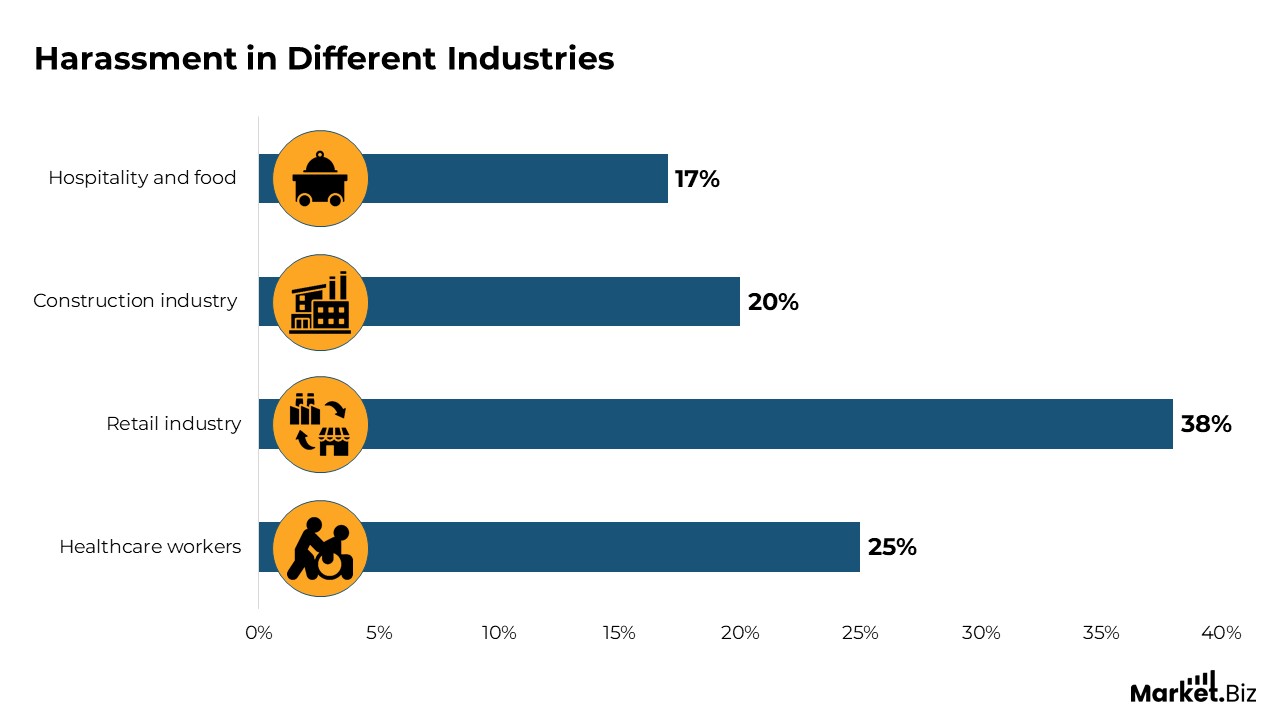
- Healthcare workers, particularly nurses, report 25% experiencing harassment, often from patients or co-workers.
- In the retail industry, 38% of employees face harassment, especially from customers or co-workers in high-stress environments.
- Construction industry employees report harassment at 20% higher rates, particularly related to gender and racial discrimination.
- Hospitality and food service workers, including wait staff and bartenders, experience harassment in 17% of cases, often from customers.
- Tech industry workers report higher levels of gender-based harassment, with 40% of women in tech facing discrimination.
- Finance and banking employees, especially women, report a high incidence of sexual harassment, with 30% of women experiencing some form.
- Education sector workers, including teachers and administrators, face harassment from both students and colleagues, with 20% reporting harassment.
- Transportation and logistics employees face harassment at 27%, with incidents commonly stemming from customers or co-workers.
- Manufacturing and industrial workers report 25% higher levels of harassment, with much of it tied to racial and gender discrimination.
- Entertainment industry workers, particularly actresses and crew members, report harassment in 30% of cases, highlighting issues of power dynamics and sexual misconduct.
- Agriculture workers, especially migrant workers, report harassment related to race and immigration status, with 35% affected.
- Government workers face harassment in 22% of cases, with political pressures and power imbalances contributing to the issue.
- Call centre employees report harassment at 28%, often related to customer mistreatment or co-worker dynamics.
- Retail management faces higher harassment rates than lower-level staff, with 30% of managers reporting verbal or physical harassment from subordinates.
- Legal professionals in law firms report harassment in 15% of cases, often linked to gender biases and competitive environments.
Harassment by Sector Characteristics and Risk Factors
- In high-stress environments, such as healthcare and retail, harassment rates rise to as much as 40%, driven by customer interactions.
- Male-dominated industries, such as construction, tech, and finance, experience 40% more harassment incidents, particularly targeting women and peoples.
- Remote work settings have seen an increase in harassment, with 23% of remote workers reporting mistreatment, especially in tech and consulting industries.
- Blue-collar industries, such as manufacturing, have higher rates of racial harassment, with 28% of workers reporting incidents.
- Non-profit sector workers often face harassment from clients and superiors, with 26% of employees reporting discrimination or harassment.
- Law enforcement agencies report higher harassment rates among female officers, with 30% experiencing mistreatment due to gender biases.
- Media and journalism workers report higher rates of harassment, with 28% of female journalists reporting sexual harassment in the field.
- Real estate professionals, especially female agents, report harassment from clients, with 35% reporting sexual harassment or discrimination.
- Sports industry employees, including athletes and staff, experience harassment at 25% higher rates, especially women in male-dominated sports.
- Scientific research institutions see harassment primarily based on gender and race, with 22% of female scientists reporting discrimination.
- Military personnel report high levels of sexual harassment, with 25% of women and 10% of men reporting incidents during their careers.
- In hospitality, particularly in hotels and restaurants, 35% of workers face harassment, often due to power imbalances and customer behaviour.
- Real estate faces increasing harassment claims, with 40% of women agents encountering mistreatment from clients or co-workers.
- Aviation workers, including pilots and flight attendants, report harassment in 30% of cases, particularly related to gender and power dynamics.
- Sales industry employees experience harassment at 25%, with aggressive sales targets often leading to unhealthy competitive environments.
Legal Costs and Harassment Lawsuits
- In 2020, the U.S. Equal Employment Opportunity Commission (EEOC) secured over $106 million in harassment-related settlements, highlighting the financial burden of legal claims.
- Workplace harassment lawsuits cost businesses an estimated $1.6 billion annually, factoring in legal fees, settlements, and lost productivity.
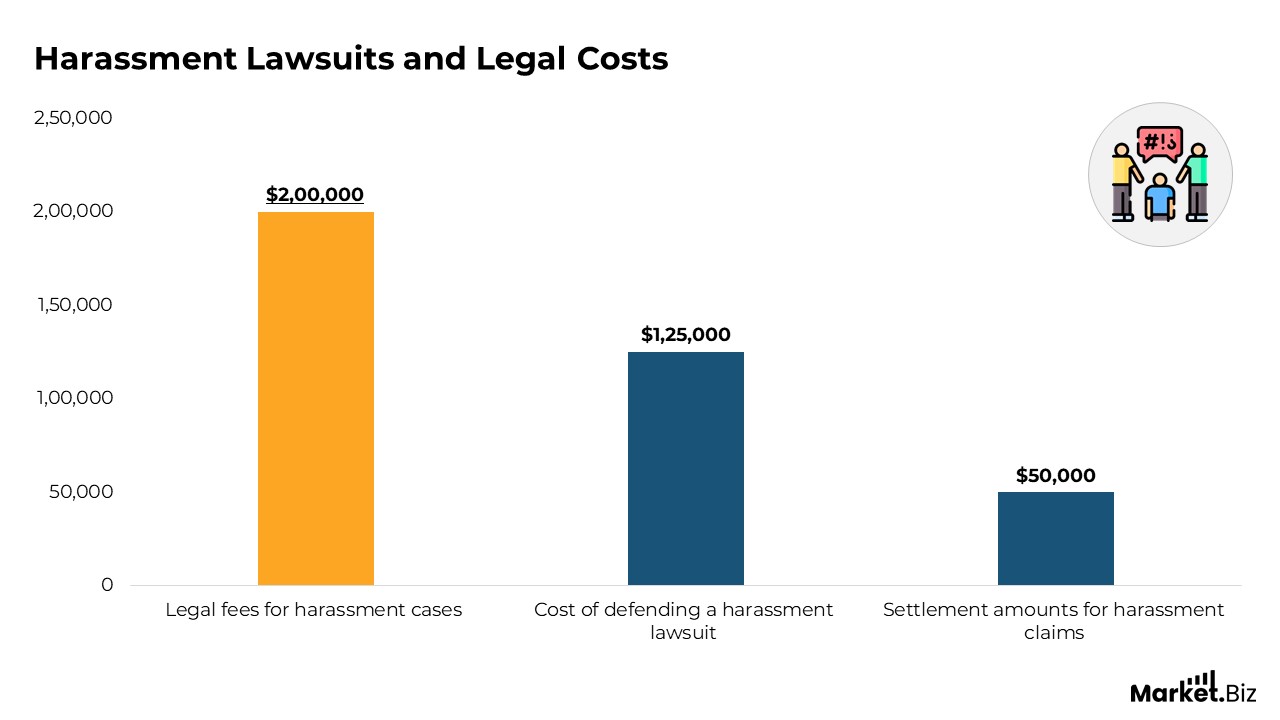
- The average cost of defending a harassment lawsuit for a company is approximately $125,000, even before any settlement is reached.
- Sexual harassment cases alone account for about 55% of all harassment-related lawsuits, often resulting in high legal and reputational costs for employers.
- Settlement amounts for harassment claims can range from $50,000, depending on the severity of the claim and the organization’s size.
- Retaliation lawsuits linked to harassment claims represent 40% of all workplace discrimination lawsuits and can add high legal costs to a case.
- Legal fees for harassment cases can be up to $200,000 for each case, with costs increasing for complex or prolonged litigation.
- In high-profile harassment cases, companies have faced public backlash. Resulting in $100 million in legal settlements, media expenses, and brand damage.
- Small and mid-sized businesses often face disproportionate costs when dealing with harassment lawsuits. With settlements affecting their bottom line by up to 5% of annual revenue.
- Pay-outs for sexual harassment claims average about $100,000 to $200,000, but severe cases can reach settlements in the millions.
- Legal costs associated with employee training and compliance to prevent harassment can range from $500 to $2,000 per employee, depending on the size of the company.
- Insurance premiums for harassment-related claims are rising, with companies paying up to 30% more for liability insurance due to increased lawsuits.
Harassment in Remote Work
- 23% of remote workers report experiencing workplace harassment, a significant increase as virtual communication lacks face-to-face accountability.
- Cyberbullying and online harassment have risen by 30% since the transition to remote work, with employees citing email, video meetings, and chat platforms as common channels for mistreatment.
- 25% of remote employees claim to have experienced harassment or inappropriate behaviour from colleagues during virtual meetings, often related to power dynamics or personal comments.
- Women in remote positions are 40% more likely to report harassment, with incidents ranging from unsolicited comments to inappropriate messages during virtual interactions.
- LGBTQ+ remote workers face higher rates of harassment, with 35% reporting mistreatment due to their sexual orientation or gender identity during online communications.
- Managers and supervisors are often cited as perpetrators of harassment, with 20% of remote employees reporting that they experienced harassment from higher-ups in virtual settings.
- Employees working in customer-facing remote roles are more likely to experience harassment from clients or customers, with 22% reporting harassment via phone or online communication.
- Inappropriate comments or sexual advances are reported by 15% of remote workers, with harassment often occurring during informal online chats or video calls.
- Harassment in remote work settings can lead to increased burnout, with 28% of employees saying harassment makes it harder to maintain a work-life balance while working from home.
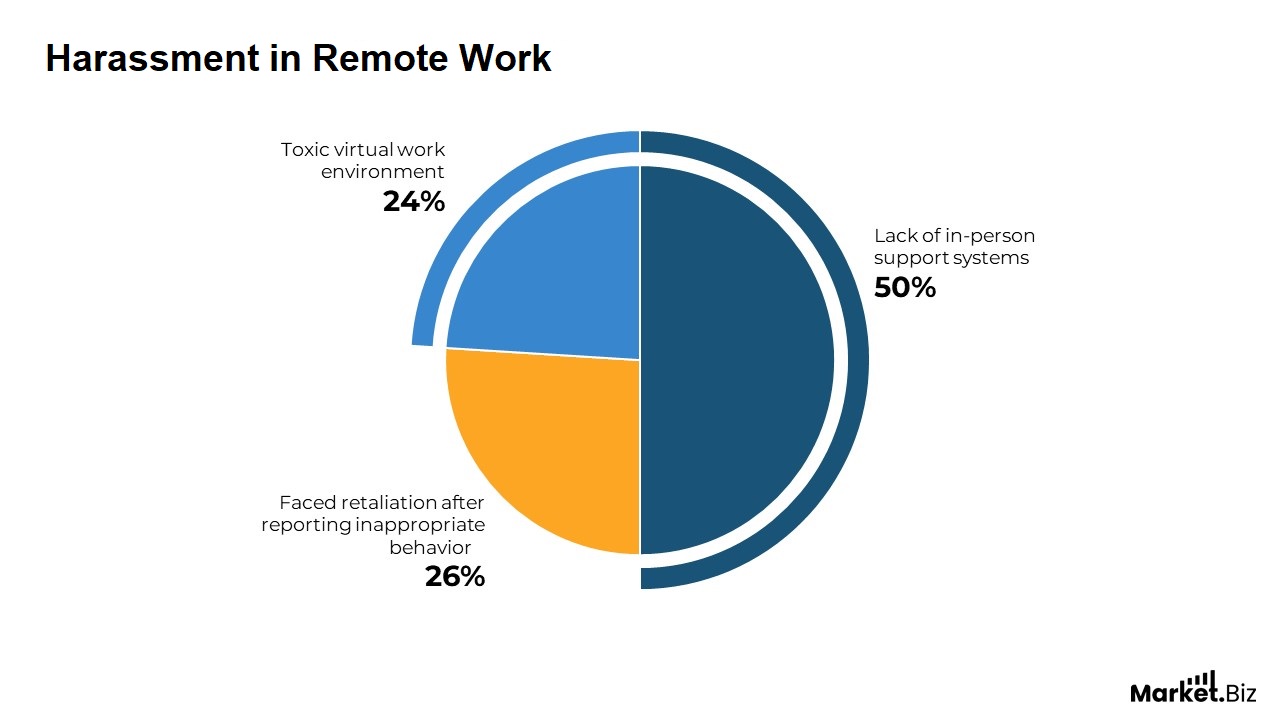
- Retaliation for reporting harassment is common in remote environments, with 26% of remote workers claiming they faced retaliation after reporting inappropriate behaviour.
- Lack of in-person support systems in remote work contributes to higher rates of unreported harassment, with 50% of workers admitting they don’t report online harassment due to fear of retaliation.
- Harassment-related turnover is rising in remote work settings, with 24% of remote employees considering leaving their job due to harassment or a toxic virtual work environment.
Role of Unions in Harassment Prevention
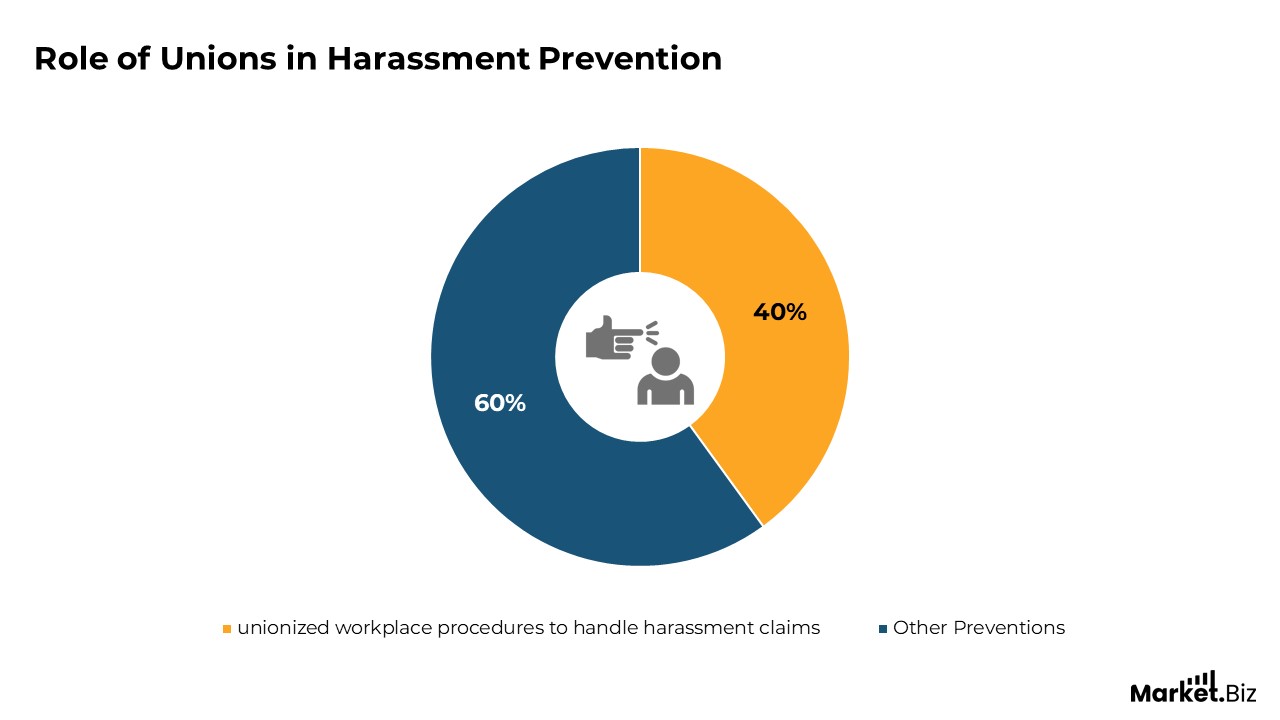
- Unions play a critical role in addressing workplace harassment, with 40% of unionized workplaces having formal grievance procedures in place to handle harassment claims.
- Unionized employees are 50% more likely to report harassment than non-unionized workers, as unions provide a safer, more supportive environment for voicing complaints.
- Unions help ensure workers have access to legal representation, with 30% of workers citing union lawyers as instrumental in harassment cases.
- Collective bargaining agreements (CBAs) often include specific anti-harassment clauses, with 28% of CBAs addressing harassment prevention and reporting procedures.
- Union leadership is often directly involved in creating training programs for workers, with 32% of unions offering mandatory harassment training to their members.
- Unions empower workers by advocating for clear harassment policies, resulting in 35% fewer harassment complaints in unionized workplaces due to proactive policy enforcement.
- Unions provide a platform for employees to collectively push for workplace culture change, with 45% of workers reporting improved harassment prevention in unionized environments.
- Unions are often the first line of defence against retaliation for reporting harassment, protecting employees from discriminatory actions in 25% of cases.
- Grievance and arbitration processes facilitated by unions lead to 80% higher success rates in resolving harassment complaints compared to non-unionized workplaces.
- Unions help establish confidential reporting systems, ensuring that 25% of employees feel more comfortable reporting harassment without fear of exposure or retaliation.
- Union advocacy has led to stronger anti-harassment legislation in several industries, with over 15% of labour unions pushing for legislative reform on harassment policies.
- Unionized workplaces have 30% lower rates of sexual harassment, as unions continuously pressure employers to enforce strict policies and ensure prompt action is taken against offenders.
Future Trends in Workplace Harassment
- AI-powered monitoring tools will be increasingly used, with 20% of companies expected to implement AI to detect and prevent harassment by 2026.
- Remote work harassment will continue to rise, with 30% more harassment incidents predicted in virtual environments due to a lack of face-to-face accountability.
- Employee training programs will evolve, with 70% of organizations planning to adopt immersive technologies like VR to simulate harassment scenarios by 2026.
- Diversity and inclusion initiatives will gain momentum, with 65% of companies focusing on inclusivity training as a key strategy to reduce harassment.
- Increased legal compliance will drive more companies to adopt comprehensive harassment prevention policies, with 40% more companies implementing new protocols within the next two years.
- Anonymous reporting systems will become standard, with 60% of firms planning to adopt these systems to encourage more employees to report harassment incidents.
- Intersectionality in harassment cases will be more recognized, with 50% of companies focusing on policies that address overlapping issues of race, gender, and sexual orientation.
- Stronger whistle-blower protections will be a priority, with 45% of companies enhancing anti-retaliation policies to safeguard employees reporting harassment.
- Generation Z’s influence will drive changes in workplace culture. With 80% of Gen Z employees demand more transparency and accountability from employers on harassment issues.
- Global harassment standards will become more standardized, with 25% of multinational companies creating unified harassment policies to comply with international labour laws by 2027.
Conclusion
Workplace harassment remains a significant issue impacting a large portion of the workforce, with many employees reporting experiences of mistreatment during their careers. Despite growing awareness, a significant number of victims still choose not to report harassment due to fear of retaliation, which worsens the problem.
Sexual harassment continues to be the most prevalent form of harassment, accounting for a large portion of workplace claims. The financial burden of harassment lawsuits on businesses is considerable, costing companies billions annually. Unions play a vital role in supporting victims and advocating for stronger preventive measures. Moving forward, there will be an increased reliance on AI-powered tools and enhanced diversity training to help create safer, more inclusive work environments.
FAQs
Around 25% of employees report experiencing workplace harassment at some point during their careers, with sexual harassment being the most common form.
The U.S. Equal Employment Opportunity Commission (EEOC) receives over 70,000 harassment charges each year, highlighting the scale of the issue.
Approximately 75% of victims choose not to report harassment due to fear of retaliation or a lack of faith in the company’s response.
Harassment-related lawsuits cost U.S. businesses an estimated $1.6 billion annually, factoring in legal fees, settlements, and lost productivity.
Unionized workplaces see 35% fewer harassment complaints due to stronger policies, grievance procedures, and a more supportive environment for reporting incidents.