









Introduction
Blockchain Adoption in HR Statistics: Blockchain technology is fast changing the human resource to improve data security, enhance processes, HR operations and support transparency. Companies like IBM and Accenture are incorporating block chain into HR department processes such as payroll or payment processing, credential verification, and employee data protection.
The global block chain industry is projected to grow to $55.54 billion by the end of 2025. Blockchain will allow HR departments to automate processes, reduce administrative tasks and enable employees to trust HR processes through secure records created with block chain.
As business pursue more block chain applications for human resources department functions, at some point block chain will become a foundational technology in the continual evolution in HR function.
Editor’s Choice
- 74% of organisations were interested in implementing block chain.
- Blockchain is projected to grow at a CAGR of 90.1% from 2025 to 2030.
- According to Gartner projection block chain market will hit $3.1 trillion by 2030.
- Blockchain is projected to grow at a CAGR of 90.1% from 2025 to 2030.
- To stay ahead in this competitive market HR teams are now using block chains, which growing at a Compounded Annual Growth Rate of 66.2%.
- Digital technologies, like RPA, AI and Chatbots, are estimated to grow at a Compounded Annual Growth Rate of 39.81% during the same time period.
- According to a survey by CNBC and Acorn, only 16% of men and 7% of women invest in block chain technology.
- Block chain stores employee data in a decentralised ledger or computer, so the possibility of tempering with data becomes 0%.
- More than 50% of block chain networks lacks teamwork.
- By the end of 2025, the remote work market size is projected to reach at $455 billion, a rise from over $300 billion in 2023.
What is HR Blockchain Technology?
Blockchain is the process that stores data around a network of decentralized computers. It improves employee productivity, automate business processes, and increase employee security. Block chains record employee data, maintain hiring processes, and maintain salary processes run smoothly in HR tech.
- Blockchain Technologies within HR:
- Recruitment and Verification
- Contract Management
- Benefits Administration
- Payroll and Payments
- Employee Data and Performance Management
- Types of Blockchain Technology in HR:
- Private Blockchain
- Private Blockchain
- Hybrid Blockchain
- Consortium Blockchain
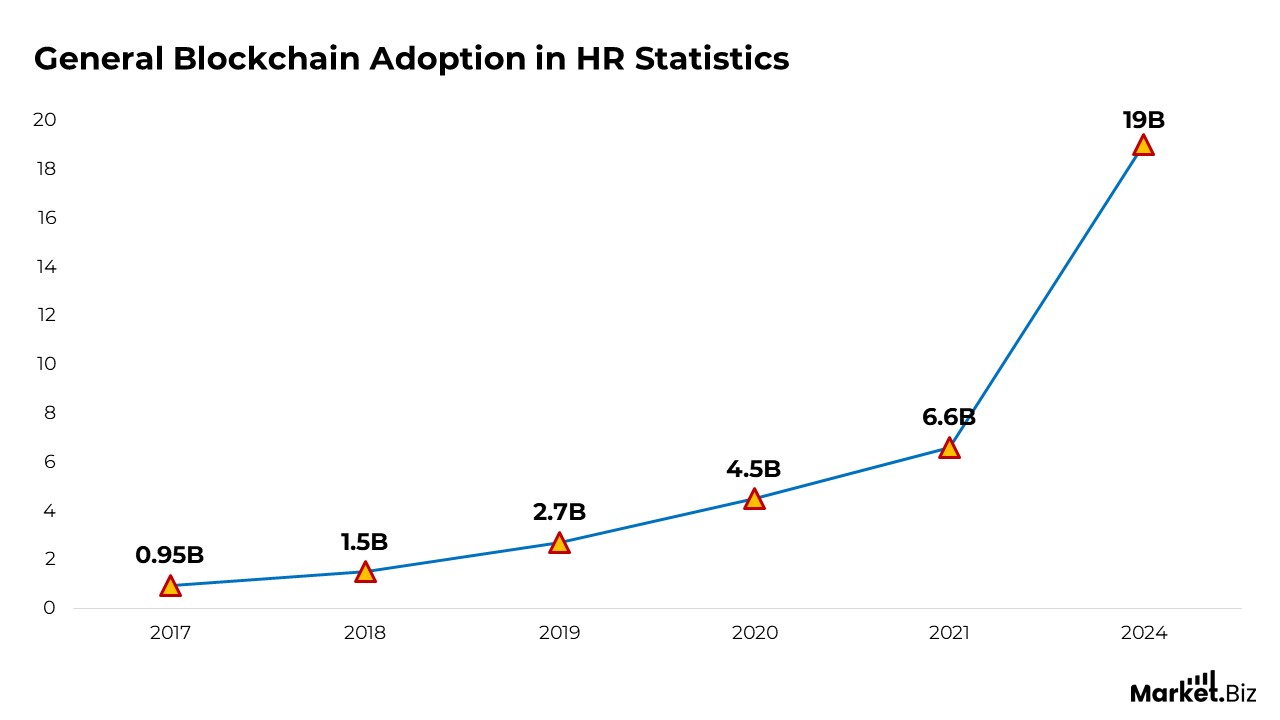
General Blockchain Adoption in HR Statistics
- Around 82% of companies were familiar with blockchain trends, and 11.7% were familiar with blockchain integrations in human resources, reported by the benchmarking association APQC in 2019.
- According to the same report, 74% of organisations were interested in implementing block chain.
- Block chain adoption rates in HR are increased by 5% in 2019 to 20% in 2022, according to the report by SCIRP Open Access.
- According to the recent market data the global block chain technology market was estimated to grow at USD 31.28 billion in 2024.
- Blockchain is projected to grow at a CAGR of 90.1% from 2025 to 2030.
- 68% of employees believe that they will lose their job if they didn’t adapt with the block chain technology.
- According to a Deloitte report, 39% of organisations were reported that block chain was over hyped and gaining more than it warranted.
Moreover
- Same report stated that according to 86% of HR professionals reported that block chain has the guts to overcome all challenges and transform HR data management.
- 77% of HR executives are confident about the potential of block chain and it can safeguarding employee data, and also maintain its accuracy, according to the stats by PwC.
- Employing block chain in HR processes can reduce overall time and data breaches and also build a personal development and trust between employers and employees, according to IBM data.
- 62% of business sated that personal and professional data security is their top priority.
- According to a recent survey by Deloitte, 33% of HR recruiters stated that in the next 3 years block chain will have a major impact on their companies.
- According to Gartner’s projection block chain market will hit $3.1 trillion by 2030.
- According to the Deloitte report, 56% of HR recruiters stated that block chain can improve the data security issues.
(Source: Ctfassets)
Global Blockchain Adoption Rates in HR
- The global block chain technology market was estimated to grow at USD 31.28 billion in 2024.
- Blockchain is projected to grow at a CAGR of 90.1% from 2025 to 2030.
- To make things easier and streamline cross-border financial transactions 37% of businesses are already using block chain.
- 13% of organisations are ready to optimize block chain into their working systems.
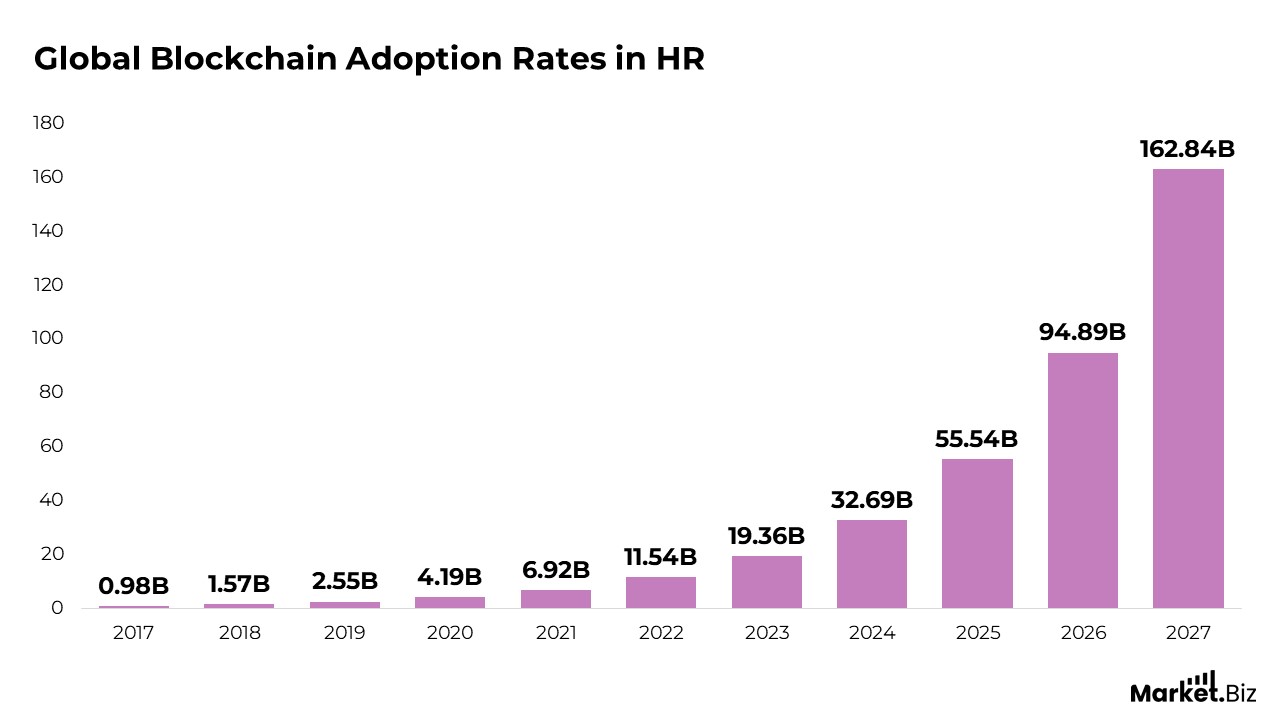
- The current global block chain market is valued at $32 billion and by the end of 2027, the global block chain market is estimated to grow at $162.84 billion.
- The global block chain market is estimated to grow by $143.48 billion in next 4 years.
- The global block chain technology market is projected to grow by $32.69 billion.
(Source: Demandsage)
- In 2017, the market value was estimated at around $0.98 billion dollars worldwide.
- In 2018, it was reached at a value of $1.57 billion globally.
- In 2019, the value reached at $2.55 billion globally.
- In 2020, the value was recorded at $4.19 billion dollars globally.
- In 2021, the market value was grew by $6.92 billion dollars globally.
- In 2022, the market saw a growth rate of $11.54 billion, a straight up growth of 10 billion within 5 years.
- In 2023, the number was at $19.36 billion worldwide.
- In 2024, it was recorded at $32.69 billion.
- As of 2025, the market size is estimated at $55.54 billion worldwide.
- In 2026, the market is projected to reach at $94.89 billion.
- And by the year of 2027, the global block chain market size is projected to reach at $162.84 billion.
Regional Variations in Adoption
- According to the recent data over 560 million people use block chain in 2025.
- According to the stats by Demand sage, around 3.9% of global population will use block chain.
(Source: Demandsage)
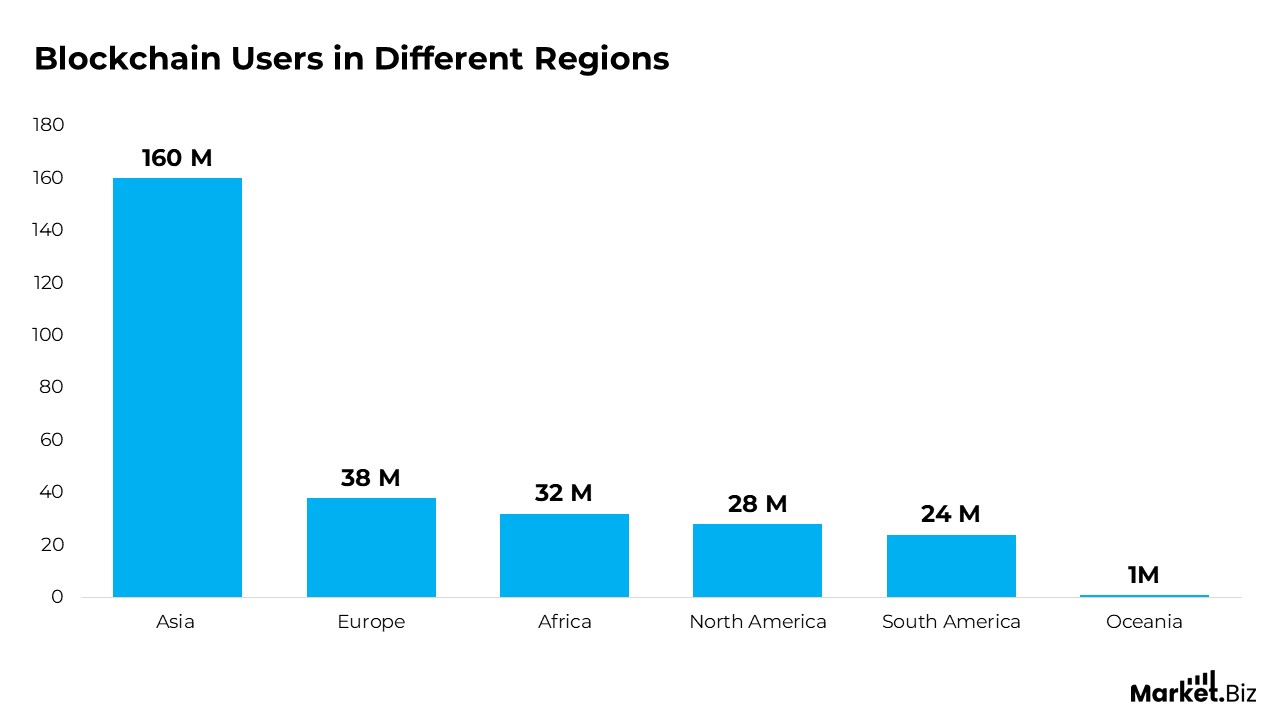
- Findings says approximately 160 million users use block chain in Asian region only.
- Europe has the second place at almost 38 million worldwide block chain users.
- Africa has 32 million genuine worldwide block chain users.
- North America ranked at 4th with 28 million worldwide block chain users.
- South America has 24 million worldwide block chain users.
- Oceania has the lowest of them all, with only 1 million worldwide block chain users.
Worldwide Use Blockchain Wallet
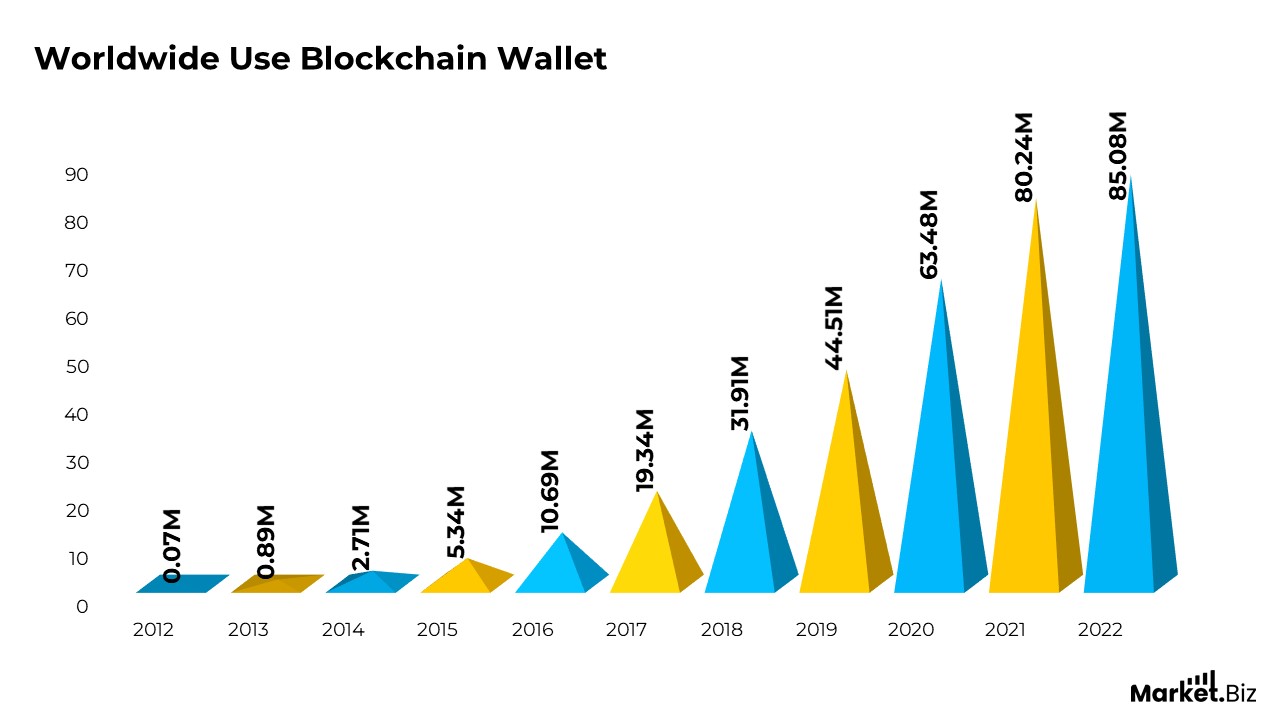
- In 2016 the worldwide block chain wallet users were 10 million.
- Back in 2021, it was reached at 80 million at a global speed. A straight up growth of 70 million in just 5 years.
(Source: Demandsage)
- In 2012, it was reported at 0.07 million worldwide blockchain wallet users.
- In 2013, it was reported at 0.89 million worldwide blockchain wallet users.
- In 2014, it was reported at 2.71 million worldwide blockchain wallet users.
- In 2015, it was reported at 5.34 million worldwide blockchain wallet users.
- In 2016, it was reported at 10.69 million worldwide blockchain wallet users.
- In 2017, it was reported at 19.34 million worldwide blockchain wallet users.
- In 2018, it was reported at 31.91 million worldwide blockchain wallet users.
- In 2019, it was reported at 44.51 million worldwide blockchain wallet users.
- In 2020, it was reported at 63.48 million worldwide blockchain wallet users.
- In 2021, it was reported at 80.24 million worldwide blockchain wallet users.
- In 2022, it was reported at 85.08 million worldwide blockchain wallet users.
Blockchain in Recruitment Processes
- According to the findings of CareerBuilder, 75% of HR recruiters found misinformation about candidates on their resumes during recruitment.
- In 2022, around 40% of businesses use blockchains in some HR solutions powered by distributed AI technology.
- Global HR market value was will see a growth rate of estimated $30 billion by the end of 2025 due to growing need to manage a workforce and speed up digitization and automation of HR operations.
- Resumes that are too good to be true is also becoming an issue for the recruiters. Around 85% of HR recruiters caught candidates with fake credentials on their resumes, in 2017.
- Blockchain reduces recruitment time, organisations without block chains take 3-10 minutes, whereas organisations with blockchains take less than half of it.
- More than 500,000 fake degrees are sold annually, and blockchain reduces security breaches and blocks fake degrees with solid digital credentials.
- Due to lack of third-party service, almost 20% recruitment costs can be saved.
- To stay ahead in this competitive market HR teams are now using blockchains, which are growing at a Compounded Annual Growth Rate of 66.2%.
- Using blockchain organisations cans save up to 30% of recruitment costs.
Blockchain Adoption in HR by Industry
- During the 2018-2023 period, the blockchain adoption in HR by industry rate is growing annually at a Compounded Annual Growth Rate (CAGR) of 80.9%.
- According to the findings of Wipro, digital technologies, like RPA, AI and Chatbots, are estimated to grow at a Compounded Annual Growth Rate of 39.81% during the same time period.
Industries that Adopted Blockchains
- Retail: 6%
- HR Technology: 9.35%
- Small Business: 30%
- Agriculture: 31%
- Automotive: 40%
- Government: 40%
- Manufacturing: 43%
- Energy: 50%
- Education: 61%
- Healthcare: 72%
- Real Estate: $700 million
- Legal Services: $4.8 billion
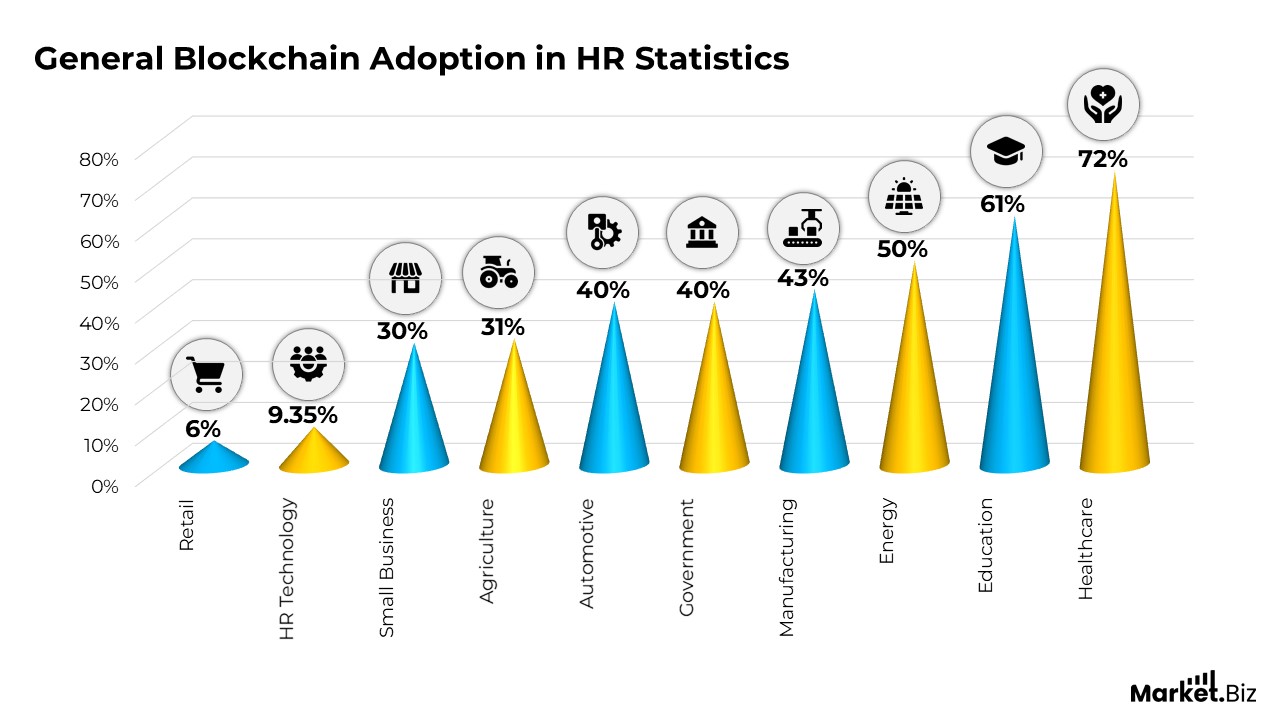
- 70% of healthcare organisations are now using block chain in HR to manage and secure employee personal and professional data.
- Almost 61% of educational organisations are using block chain for verifying academic qualifications and simplify hiring processes.
- Approximately 50% of energy sector are optimizing block chain to manage employee records.
- Approximately 43% of manufacturing sectors are using block chain to prevent security data breaches.
- Around 40% of government organisations are now considering block chain in HR to improve transparency and employee productivity.
- 40% of automotive organisations are exploring block chains in HR to streamline recruitment and manage workplace data.
- 31% of agriculture organisations are currently interested in using block chain for HR functions, such as tracking labour agreements and to make sure that payments are made fairly.
- Approximately 30% of small businesses are adopting block chain in HR to manage hiring and employee data more smoothly.
- After the adoption of block chain in HR technology sector for payroll and employee data management, the market is experiencing a Compounded Annual Growth Rate of 9.35%.
- Around 6% of retail sector organisations are using or somewhat adopting block chain to minimize security risks, and to streamline customer experience.
Blockchain User Demographics
By Gender:
- Crypto industry always seem to attract men’s interest more than women’s, and the same goes for block chain sector.
- According to data, more than 50% of males have used cryptocurrencies.
- 22% of males stated that they had used cryptocurrency.
- On the other hand only 10% of females stated that they used cryptocurrencies.
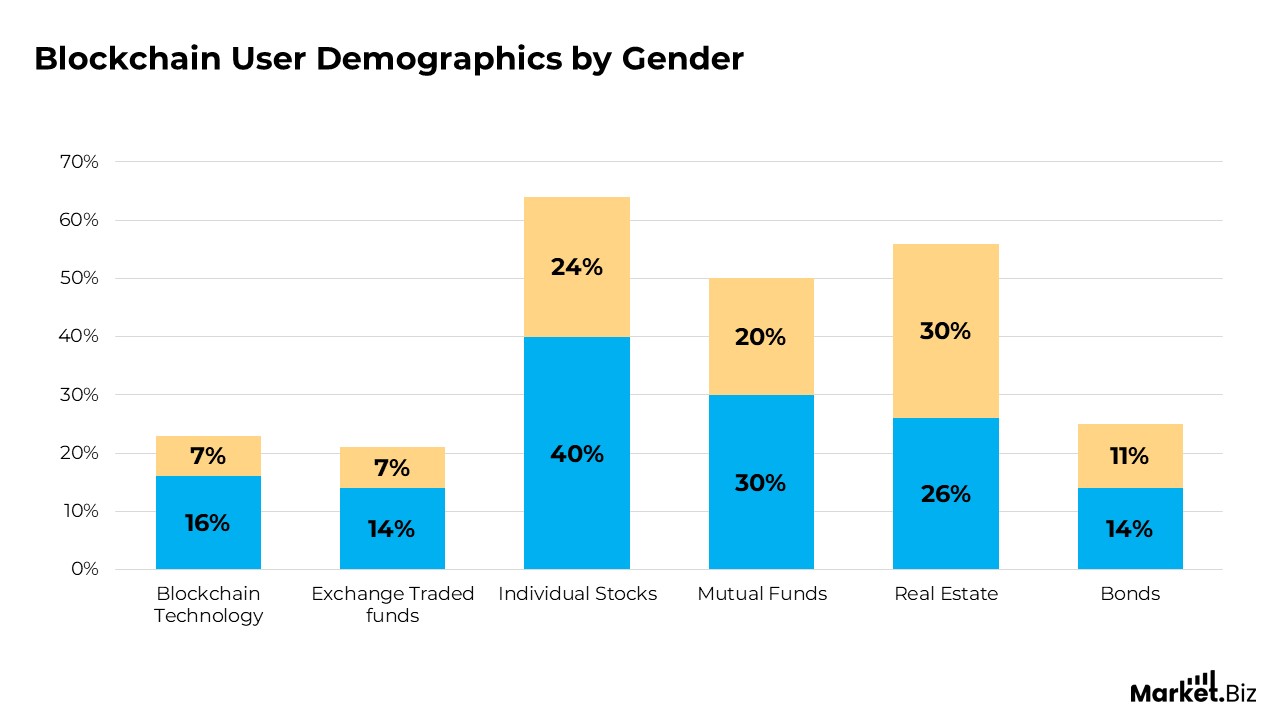
- According to a survey by CNBC and Acorn, only 16% of men and 7% of women invest in block chain technology.
| Investment Type | Share of Males Investing | Share of Females Investing |
|---|---|---|
| Blockchain Technology | 16% | 7% |
| Exchange-Traded Funds | 14% | 7% |
| Individual Stocks | 40% | 24% |
| Mutual Funds | 30% | 20% |
| Real Estate | 36% | 30% |
| Bonds | 14% | 11% |
(Source: Demandsage)
By Race:
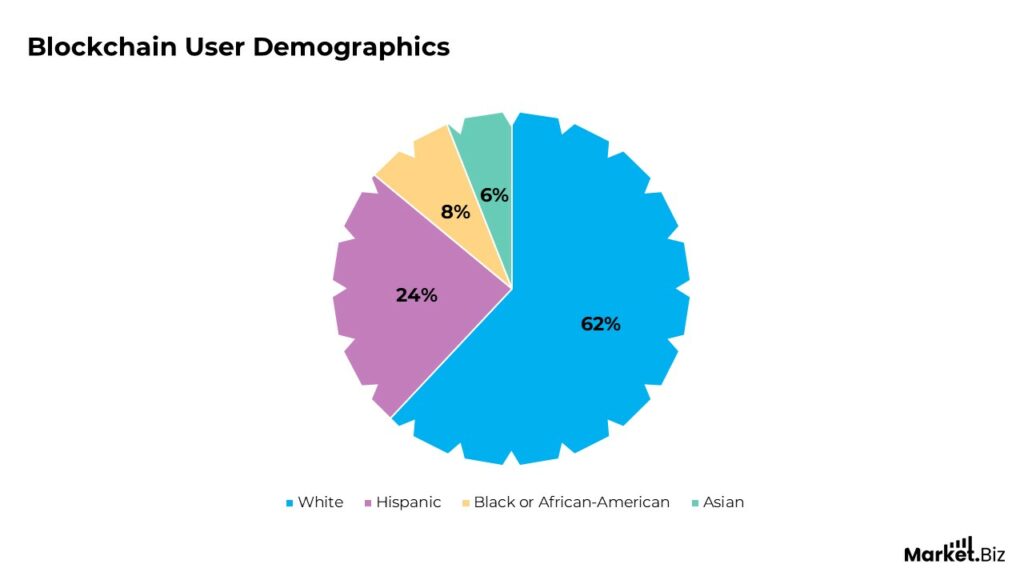
- Among all crypto owners 62% of them are white.
- 24% of block chain users are Hispanic.
- 8% of them are black or African American.
- And only a 6% of the users are Asian.
- Due to the fact that 69% of the population in the United States is white, there are no question that the highest percentage of Crypto owners are white in the US.
| Ethnicity / Race | Percent of Crypto Ownership |
|---|---|
| White | 62% |
| Hispanic | 24% |
| Black or African American | 8% |
| Asian | 6% |
(Source: Demandsage)
By Generations:
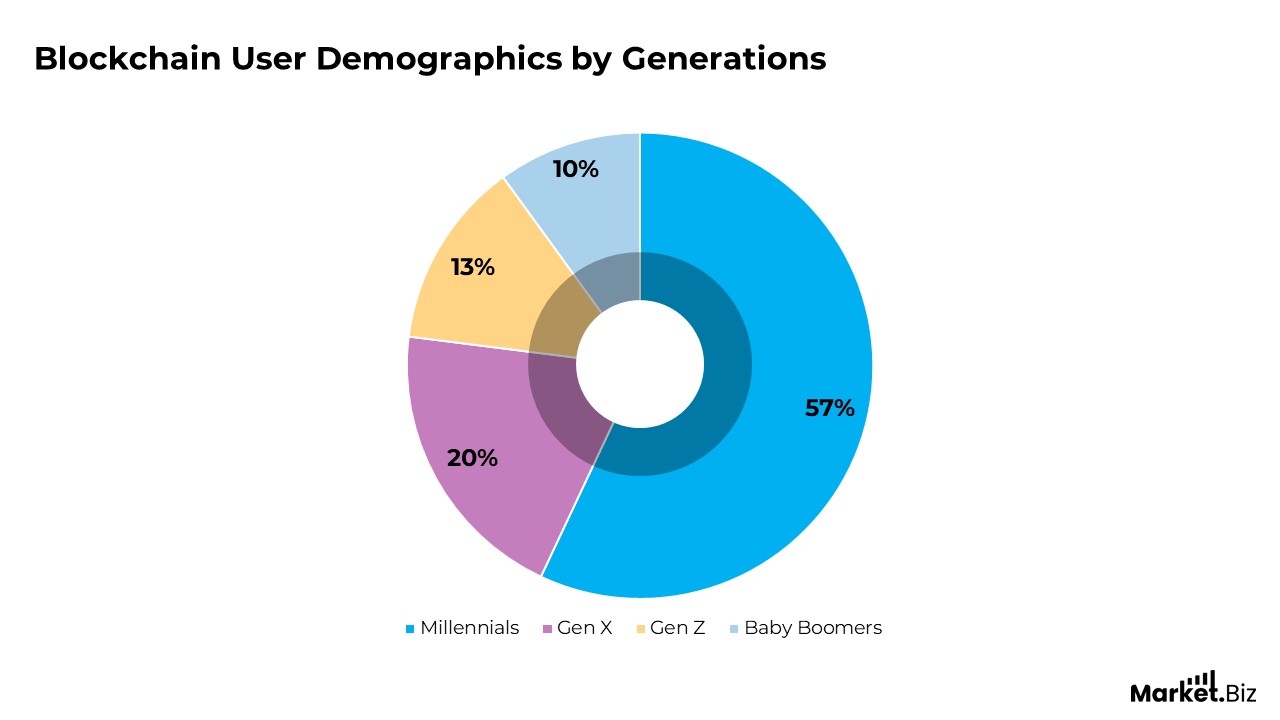
- In the United States, almost 57% of crypto owners are Millennials.
- Among all users, 20% of them are Gen X.
- 13% are Gen Z.
- 10% users are Baby Boomers.
(Source: Demandsage)
Benefits of Blockchain in HR
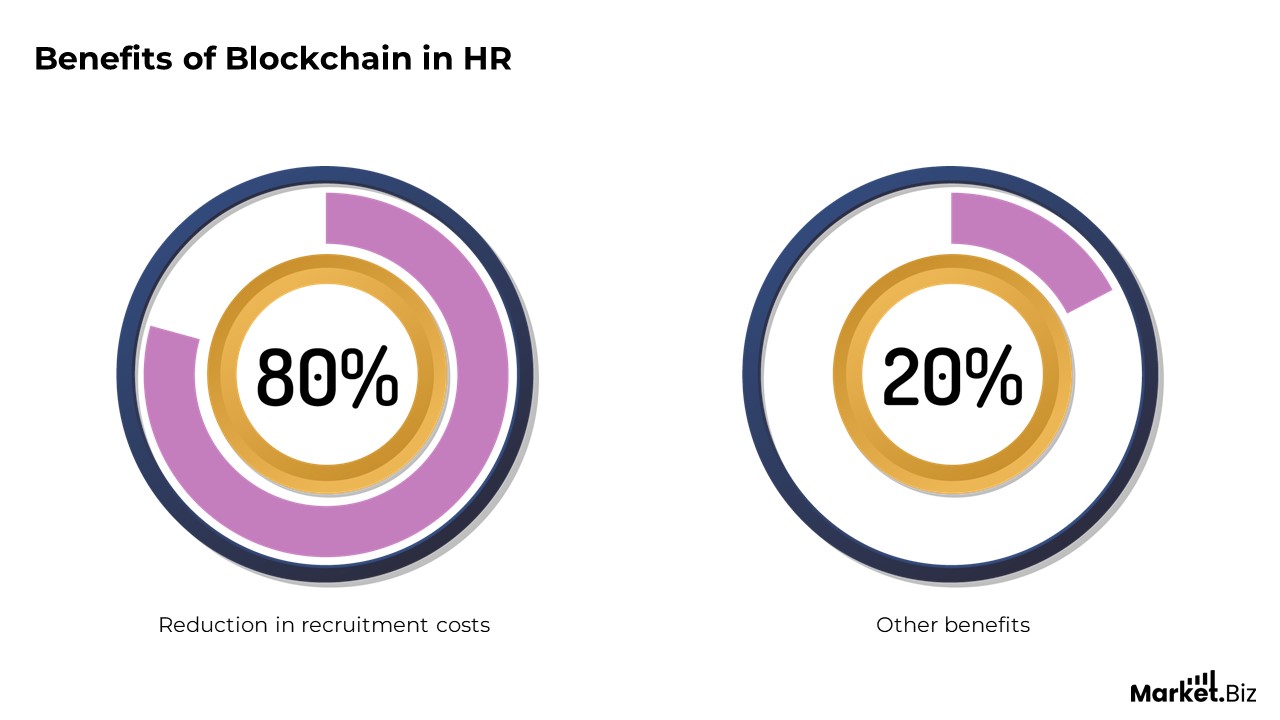
- Organisations that are using block chains can see an 80% reduction in recruitment costs.
- Block chain based payroll processes can reduce payment processes time up to 50%.
- Block chain stores employee data in a decentralised ledger or computer, so the possibility of tempering with data becomes 0%.
- Blockchain creates a transparent record of all HR transactions. This fosters trust between employers and employees and reduces disputes.
- HR teams reported 60% faster on boarding processes after implementing block chains in HR, it also helps in reducing lengthy processes.
- Global payroll teams reported a reduction in cross border transaction fees by up to 40% after implementing block chains.
- With smart contracts, 70% of routine HR tasks can be automated.
- Employees trust improves by 35%, when their personal data is stored on a tampered proof block chain.
- Auditors find 30% less agreement issues when they use block chain audit trials.
- By the end of 2025, 65% of HR leaders are planning to invest in block chains for talent management.
- Block chain in HR reduces fraud risk by 20%, as false document verification will become impossible due to crypto graphic proof.
- With the use of block chain 90% of HR data remains accessible 24/7 in global offices.
- By 2026, 75% of large organisations expect to use block chain in HR.
Challenges in Blockchain Adoption in HR
- According to the findings of PWC’s Global Blockchain Survey in 2018, among investors almost 45% of them believe that insufficient customer trust will become a major barrier to block chain adoption.
- More than 50% of block chain networks lacks teamwork.
- More than 6,500 projects are utilizing a number of mostly independent block chain platforms and solutions, each one has its own set of protocols, code language, and privacy protections.
- According to APQC, around 29% of organisations are experimenting with block chain or have fully adopted it.
- Demand for block chain engineers has increased by more than 500% in 2019 compared to the last year, according to the Blockchain Council.
- A large number of HR professional are still don’t know that how block chain works, it brings light into the adoption issues. According to a study, more than 61% of HR teams lacked basic block chain knowledge.
- There’s no consistent legal agenda for block chain in HR. Over 43% of HR professionals reported that this is a primary reason for delayed adoption.
- Block chain’s transparency can conflict with employee privacy rules. HR leaders report that 48% of problems arise from possible GDPR or HIPAA violations.
- HR software’s usually doesn’t mixed up easily with block chain. About 55% of organisations reported that their current systems are not compatible without major upgrade.
- Many block chain platforms struggle to handle the volume of global HR data. 60% of CIO’s reported that flexibility is a top challenge.
- Although block chain is secure, some ending points like user apps or cloud storage remains at risk. 1 in 3 organisations has faced breaches in some cases.
Blockchain in Freelance and Gig Economy
- More than 70.4 million US citizens are freelancing in 2025, creating almost $1.3 trillion in revenue.
- Block chain technology is being adopted by 77% of executives who believe that not using it puts their company at a competitive disadvantage.
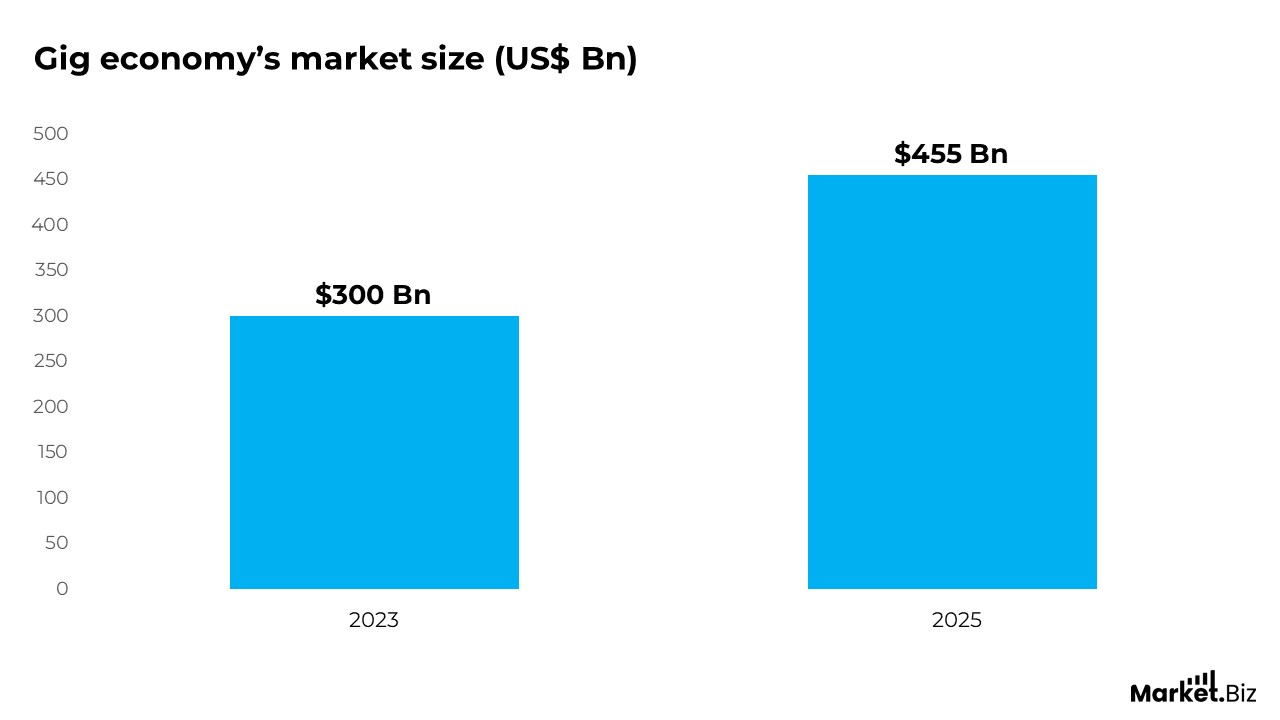
- By the end of 2025, the gig economy’s market size is projected to reach at $455 billion, a rise from over $300 billion in 2023.
- Block chain enables secure and transparent transactions, addressing common problems in freelance work such as payment delays.
- Smart contracts on block chain platforms automate payment processes, ensuring freelancers are getting paid smoothly.
- With over 560 million people using block chain globally, its adoption was into the gig economy is becoming increasingly possible.
Future of Blockchain in HR
- Block chain allows instant verification of employee documents, reducing hiring time and minimizing the risk of false qualifications.
- Implementing block chain in payroll systems can automate salary disbursement, ensuring timely and accurate payments while reducing administrative costs.
- With block chain’s spread out nature, sensitive employee data is securely stored, justifying risks associated with centralised data breaches.
- Blockchain look after transparency in HR operations, allowing employees to access and verify their records, leading to increase trust.
- Block chain simplifies cross border HR processes, helping seamless management of international employees and agreement with local regulations.
- Using smart contracts, employment terms can be automatically enforced, ensuring clarity and reducing arguments.
Conclusion
With fast growing interest from organisations interested in HR solutions that provide safer, quicker, and more transparent ways of managing their employee’s data, the application of block chain in HR is rapidly gaining power. From secure payroll systems to instantaneous backgrounds checks, block chain is improving the efficiency and trust lost years ago due to poor HR technology approaches.
With most companies making the transition to digital processes, the need for technology that can protect your sensitive information is important. With block chain projected to have global growth of a compound annual growth rate of more than 67% by the end of 2025, its role within human resources will even further expand over time.
Companies that venture in the direction of block chain sooner than later with the findings made in this report will provide themselves with a competitive advantages. Clearly, the future of human resources id digital, secure and block chain.
FAQs
In HR, some use cases for a block chain sector includes: record employee data and creating employment agreements. Supporting recruitment processes. Providing digital reward wallets for employee incentives.
Accenture block chain for agreements takes remaining paper agreements and puts them on a shared block chain database that every selected party can use to securely view agreements, review and accept changes, all captured on the block chain ledger.
Block chain does not store any of its information in one location. Every time a new block is added to the block chain, every computer on the network updates its block chain automatically. As an alternative, the block chain is copied and spread across a network of computers.