









Introduction
Job Interview Statistics: Job interview statistics provide valuable insights into the hiring process and help both employers and job seekers understand trends and expectations. According to recent studies, approximately 60% of job candidates don’t make it past the first interview stage, with only 2% of applicants landing a job offer.
Moreover, a survey by Glassdoor revealed that 33% of job seekers expect to attend at least two interviews before receiving an offer. In addition, the average length of a job interview is around 40 minutes, and 58% of hiring managers say they make their decision in the first 5-10 minutes of the interview. These statistics highlight the importance of preparation and strategic interviewing for success.
Editor’s Choice
- 47% of applicants fail interviews due to a lack of company research, emphasizing the need for thorough preparation.
- 92% of employers review candidates’ social media profiles before an interview, highlighting its influence on hiring decisions.
- 75% of American workers have experienced ageism during job searches, with older candidates facing a threefold lower chance of being interviewed than younger applicants.
- 86% of companies now use video interviews, with 74% of recruiters noting their role in streamlining the hiring process.
- The average hiring process in the U.S. lasts 23.8 days, slightly longer than the previous year’s 22.9 days.
- Top applicants generally secure a job offer within 10 days, while 20 to 40 days is typical for the overall process.
- 61% of senior executives believe interviews are most effective between 9:00 and 11:00 a.m.
- Candidates who apply to 21-80 jobs have a 30% chance of receiving an offer, while 60% of applications are abandoned due to long hiring processes.
- 35% of recruiters reject candidates with unprofessional email addresses, and 77% say that poor grammar or typos are immediate deal breakers.
- Around 60% of job candidates don’t progress past the first interview, and only 2% secure a job offer
General Job Interview Statistics
- Before making an offer, employers consider a number of important factors. Multitasking abilities are valued by 36%, initiative is prioritized by 31%, creative thinking is sought by 21%, and other qualities are sought by 12% of candidates.
- Top applicants usually land a job within ten days.
- 35% of recruiters reject candidates with unprofessional email addresses, and 77% of them say that typos or poor grammar are instant deal breakers.
- According to 74% of recruiters, video interviews facilitate the hiring process.
- For in-person interviews, candidates in the UK typically spend £52 on travel and lodging. Additionally, they spend roughly £58 on brand-new, interview-appropriate attire.
- 75% of American workers admitted to having encountered ageism while looking for a job. Additionally, 53% report that they currently deal with it at work.
- Compared to applicants with typical black names, those with white-sounding names had a 50% higher chance of being contacted for interviews.
- Before an interview, nearly 92% of employers look through a candidate’s social media accounts.
- In the United States, the hiring process typically takes 23.8 days, which is a little longer than the average of 22.9 days in 2014.
Moreover
- Interviewers would not hire a candidate who is unfamiliar with the company’s operations, according to nearly half (47%) of them.
- Candidates receive feedback at different times; 44% do so in a few weeks, 37% in a week, and less than 4% in a day.
- Schedule changes and a lack of pay information are stressful for almost half of job seekers.
- Nearly 83% of applicants claim that a negative interview experience alters their opinion of the position.
- Long email exchanges are preferred by 62% of job seekers over automated information.
- The average length of a phone interview is fifteen minutes.
- Typically, there are 20 to 40 days between an interview and a job offer.
- According to 61% of senior executives, the ideal time for interviews is between 9 and 11 a.m.
- Changes to the interview schedule irritate nearly half of the candidates.
- Within 24 hours of receiving a text invitation, 84% of applicants set up interviews.
- Today, nearly 86% of businesses conduct interviews using virtual tools.
- Candidates who don’t smile are not taken into consideration by 40% of interviewers.
(Source: Flair)
Job Interview Process Statistics
- Usually, one interview offer is given to candidates for every six applications.
- If an email address is not professional, 76% of resumes are rejected.
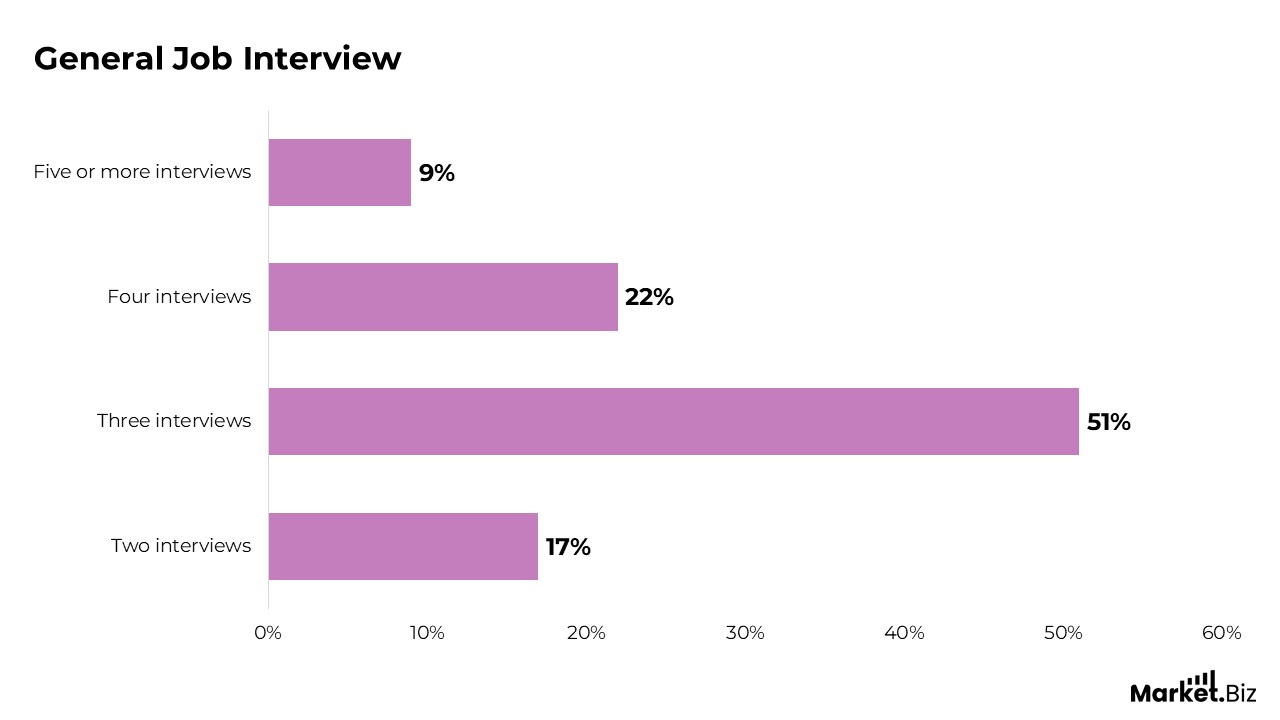
- Three interviews are necessary for 51% of recruiters to identify the best applicant.
- According to a survey of 2000 hiring managers, 33% of them decide who gets hired in less than 90 seconds.
- An employee who is 50 years old has a threefold lower chance of being interviewed than one who is 28.
- Candidates with between 21 and 80 applications have a 30% chance of receiving an offer.
- Long processes result in the abandonment of 60% of applications.
- Utilizing specialized recruiting platforms can result in a 250% reduction in cost per applicant.
- It takes an average of 58 days for companies with more than 5,000 employees to extend an offer, even for non-technical positions.
- In the hiring process, responsiveness is most valued in the US (56%) and the UK (52%), as opposed to the US (47%) and UK (43%), respectively, in 2021 and 2022.
- Five steps make up the typical interview process, which is what most businesses do.
| Job Title | Average Time of Entire Interview Process (Days) |
|---|---|
| Waiter | 8 days |
| Retail rep | 8.5 days |
| Delivery driver | 8.5 days |
| Brand Ambassador | 8.6 days |
| Hair stylist | 9 days |
(Source: Flair)
Preparation and Research Statistics
- With 70% of employers screening candidates on social media, modern hiring procedures go beyond the interview room.
- Given that 47 % of applicants fail interviews because they don’t know enough about the company they are applying to, meticulous company research is essential.
- Experience is still a major consideration when hiring, as 90.6 % say they prefer applicants with relevant work experience.
- When assessing job candidates, 71 % believe that proper dress codes are crucial, so professional presentation is important.
- An interview’s outcome can be determined by one’s personal presentation; 39 percent of job seekers say that their lack of confidence, voice quality, or smile makes a bad impression.
- Employers must devote a substantial amount of time to the screening process; according to 60% of hiring managers, this is the most time-consuming aspect of the hiring process.
- About 47% of applicants fail job interviews due to inadequate knowledge of the company, demonstrating the importance of company research for success.
- With 92% of businesses using social media platforms to research candidates prior to an interview, modern screening procedures are thorough.
- With 62 percent of job seekers choosing automated information over drawn-out email exchanges, automated communication is showing encouraging results.
- Since referrals raise the likelihood of a successful job match from 2.6 % to 6.6 %, reference checks are still very important.
Virtual Interview Statistics
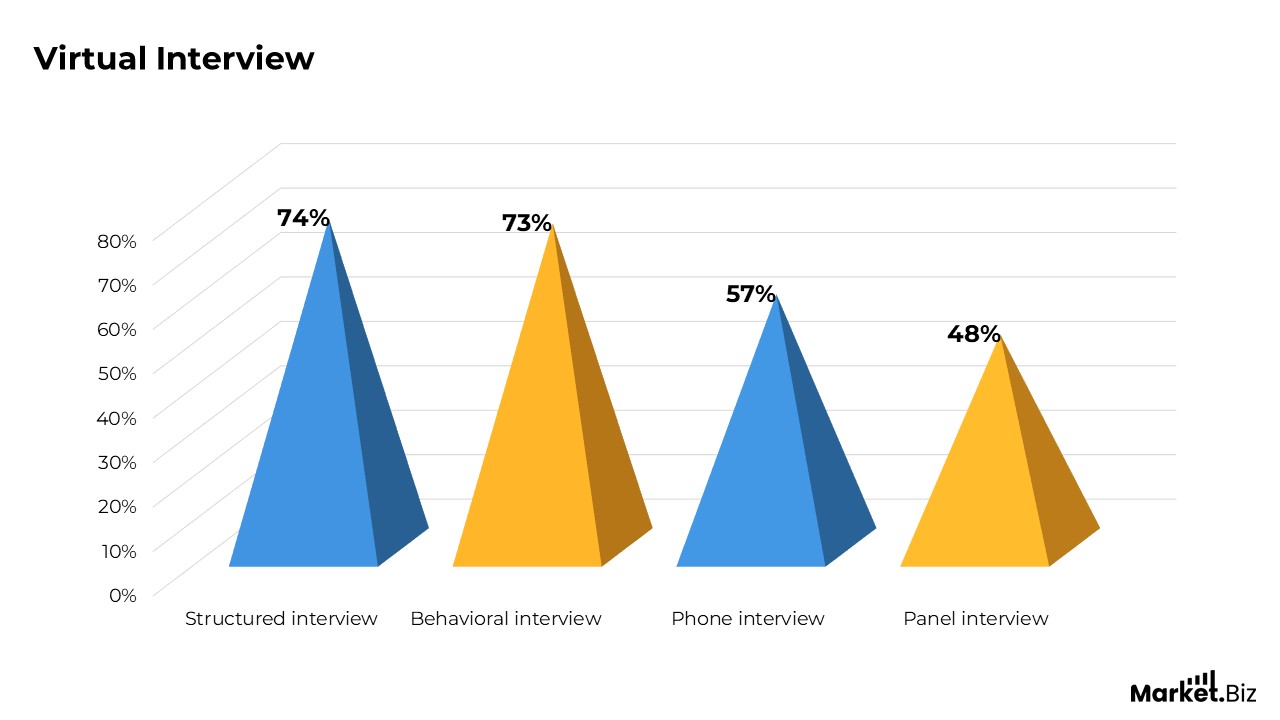
- According to 74% of recruiters, video interviews make their jobs easier, and the digital transformation of hiring is only getting faster.
- 86% now use new virtual technology for interviews, making virtual interviews a standard practice.
- There are additional factors to take into account because 88% of recruiters say that their biggest annoyance during virtual interviews is internet lag.
- In virtual environments, lighting selections are important; during video interviews, 95% of recruiters prefer cool light over warm light.
- When candidates use virtual backgrounds, 97% of interviewers prefer an office-themed backdrop because virtual backgrounds need careful thought.
(Source: Flair)
Job Hiring Statistics
- 79% of employers have rejected a candidate after reviewing their social media profiles, with 90% of employers doing so.
- Employers investigate candidates’ backgrounds 98% of the time, with 43% turning to Google. Additionally, 80% of companies believe that a candidate’s personal website is significant when assessing them.
- Inconsistencies in employee value propositions cause nearly 90% of applicants to drop out of the hiring process.
- The average cost per hire increased by 14% to $4,700 from $4,129 in 2019.
- Personal contact is important to 54% of French candidates, compared to 53% in Germany, 29% in the UK, and only 18% in the US.
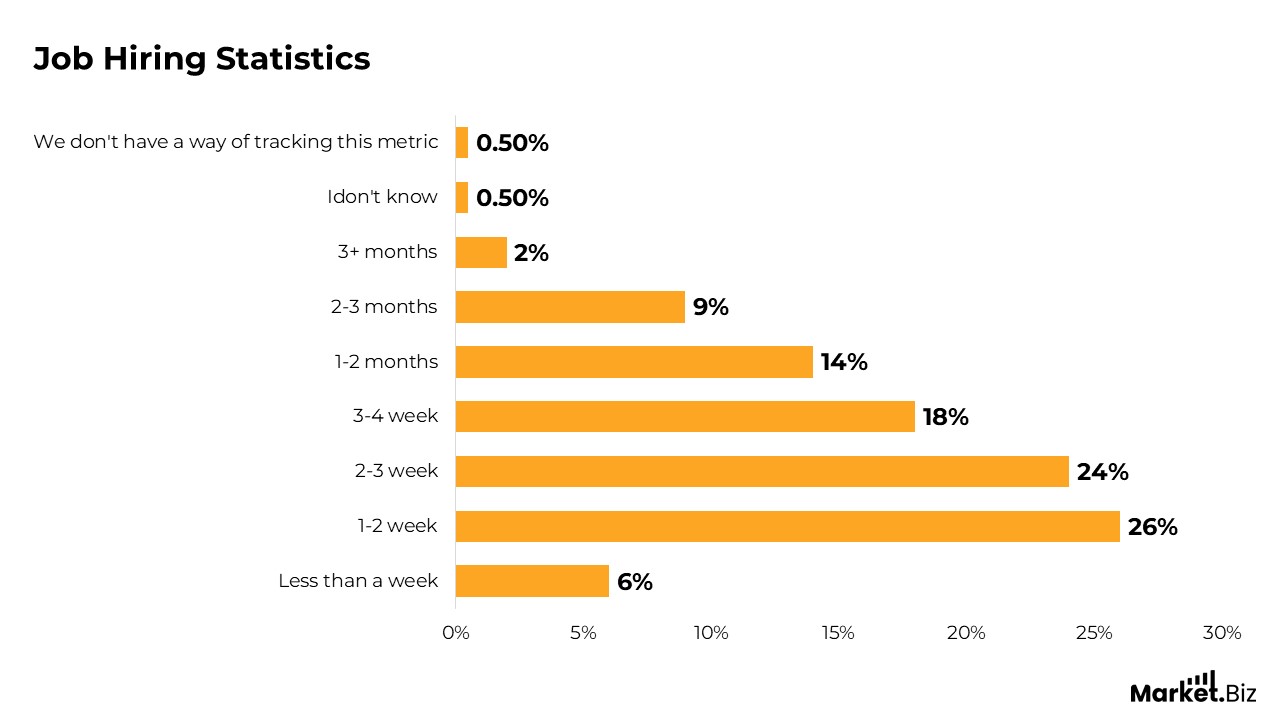
- In all industries, the average time to hire is three to four weeks, and only 25% of respondents were able to fill positions in less than two weeks.
- 48% of companies rely on employee recommendations to find their best hires.
- Finding enough qualified applicants to fill available positions is the largest challenge, according to 63% of recruiters.
- In 2025, millennials and Gen Z will make up 75% of the workforce worldwide.
- On average, 250 applications are received for corporate-level positions, and the best applicants frequently interview with several companies at once.
- According to 61% of interviewers and employers, the best times to interview for maximum alertness and responsiveness are between 9:00 and 11:00 a.m.
- Women are 26% more likely to apply to jobs where employers highlight diversity.
- Businesses with boards that reflect a variety of ethnic backgrounds are 13% more likely to perform better than those with less diversity.
(Source: Coolest-Gadgets, WP-Content)
Job Interviews by Country
- In the real world of hiring, job interviews differ from one nation to another due to cultural differences, industry norms, or hiring procedures.
- Telephone and in-person interviews are two of the most commonly used formats in the US. According to a Glassdoor survey on job interview statistics, 83% of American respondents have participated in an in-person interview, and 62% have had a phone interview.
- Over the past few years, video interviews have become more and more common in England. Video interviews are already a part of the hiring process for 76% of British companies.
- Group interviews are widely used in the commercial and hospitality industries, two of Australia’s largest sectors. According to 47% of them, they have participated in at least one group interview while working in Australia.
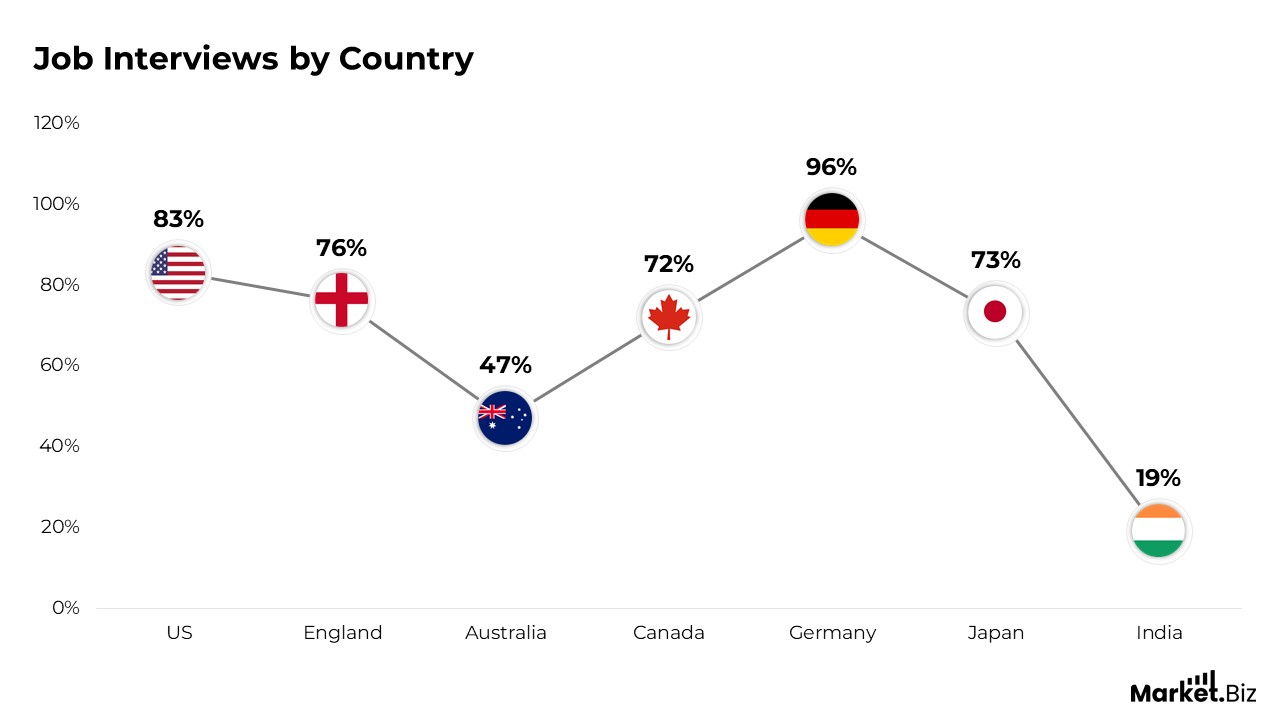
- Behavioural interview questions are becoming more and more popular in Canada. These kinds of questions are frequently used by 72% of hiring managers to evaluate job applicants.
- In Germany, a thorough resume and cover letter are essentially required. According to a Hays poll, up to 96% of employers believe that cover letters are essential during the hiring process.
- In Japan, hiring procedures are very structured. 73% of the companies use structured interview questions, whereas 55% use panel interviews.
- In India, interviewers frequently inquire about job candidates’ personal lives. During one or more interviews, 19% of applicants were asked if they were married, and 9% were asked if they planned to expand their family.
Statistics of Job Interviews by Age
- Compared to younger, less experienced candidates for the same position, 55-year-old job applicants have a threefold lower chance of being invited for an interview.
- There have been reports of age discrimination during job interviews in 84% of advertising positions, 81% of digital marketing positions, and 85% of finance positions.
- During a job interview, 75% of older Americans say they have experienced age discrimination.
Job Interviews Demographic
- According to a recent survey on job interview statistics, 33% of workers 55 and older have experienced age discrimination at work.
- Compared to their younger counterparts, older workers have experienced longer periods of unemployment.
- In 2022, the average duration of unemployment for workers aged 55 and older was 34.5 weeks. While the duration for workers aged 25-34 was only 22.1 weeks.
- Issues with technology or connectivity may also present challenges for older job seekers during virtual interviews.
- Among workers over 50, 41% reported having some difficulty utilizing technology for virtual interviews.
- 57% of HR executives concur that age diversity boosts business performance.
- However, according to 95% of older adults, they attempt to appear younger during interviews to increase their chances of landing a job. Another major issue in the workplace has been identified as gender discrimination.
- Approximately 42% of American women reported having encountered gender-based discrimination at work.
Moreover
- When it comes to job interviews, women still make less money than men—in the United States. Women are paid only 81 cents for every dollar earned by men.
- More than 75% of female job seekers who participated in job interviews said they were asked directly about their family plans.
- According to Catalyst’s survey, only 29% of top executive positions worldwide were held by women. However, businesses are starting to see the benefits of gender diversity.
- Businesses that rank in the top quartile for gender diversity are at least 25% more profitable than their peers.
- In spite of this, 33% more men than women brag about how well they performed in a job interview. Minority job seekers, however, faced significant obstacles.
- Whites had a 5.3% unemployment rate, while Blacks had a 9.7% rate. Numerous organizations have taken action to promote diversity and inclusion, according to recent studies.
- To identify and lessen unconscious bias, 44% of businesses provide hiring managers with training.
- Furthermore, according to 77% of hiring managers, diversity is important to their hiring procedures.
Success and Timing Statistics
- Given that the average time between an interview and a job offer is between 20 and 40 days, the hiring process calls for patience.
- Excellent candidates usually find new jobs within ten days, and top candidates progress through the process more quickly.
- 72% of candidates claim that the effectiveness of the interview process influences their choice to accept employment offers.
- Candidates who participate in three interviews have a 51% chance of receiving a job offer. Demonstrating the significant increase in success rates that multiple interviews can bring.
- Given that 61% of hiring managers believe that 9 to 11 AM is the best time to conduct interviews, morning interviews might offer an advantage.
- The average hiring process in the United States takes about 23.8 days from beginning to end, though this varies greatly by position in the modern era.
- The hiring process takes an average of eight days longer when additional screening steps are added, such as phone interviews.
- Candidates who have been unemployed for more than 27 weeks have a much lower chance of receiving a job offer—just over 18%—than those who have been unemployed for less than 27 weeks.
- With in-person and video interviews usually lasting 45 minutes to an hour and a half, interview duration varies depending on the format.
- It takes a lot of time for recruiters to hire people; the interview process takes up about two-thirds of their total hiring time.
Job Interview Failure Statistics
- Job seekers are discouraged and frustrated when they fail an interview; in fact, it causes them great suffering.
- Not every interview results in a job offer, but there are a few common explanations given by applicants that can increase their chances.
- 49% of employers stated that inadequate preparation was the primary cause of candidates’ interview failures, according to data on job interviews.
- Inappropriate attire and minimal research on their role or company were part of the preparation process.
- Similarly, communication is crucial; according to a Robert Half survey, 31% of hiring managers acknowledge that poor communication skills are a major factor in interview failures.
- With its delicate balance, confidence can have the opposite effect of excessive self-reliance or arrogance.
- Similar to Monster’s survey, 22% of employers cited excessive self-confidence as a reason why interviews don’t go well.
- Enthusiasm and passion for the job and the company are also very important.
- 11% of employers think that a lack of enthusiasm or passion for candidates is the reason why interviews don’t go well. When it comes to interviews, conduct is undoubtedly crucial.
- According to an Adecco survey, 71% of employers decided not to hire applicants because they acted inappropriately, like arriving late or being unkind.
- Additionally, 40% of recruiters do not want to work with applicants who lack confidence, and 50% of hiring managers say that unprofessional behaviour or poor appearance can disqualify a candidate.
Conclusion
Job Interview Statistics: With 60% of candidates not advancing beyond the first interview and just 2% receiving job offers, preparation is key to success. Employers increasingly rely on social media. With 92% checking candidates’ profiles before making decisions. Video interviews have become a standard practice, with 86% of companies using them.
Despite these advancements, challenges such as age discrimination, unprofessional communication, and long hiring processes remain. Which see 60% of applications are abandoned, it still exists. To improve their chances, candidates must align with these evolving hiring practices.
FAQ’s
Depending on their background and the nature of the role, candidates typically go through 10 to 20 interviews per job. These figures would be lower for highly qualified candidates working in specialized fields, and vice versa.
One qualitative research technique for gathering primary data is the interview. It entails asking one or more people what they think about a business, a product, or a subject. By using this approach, researchers can gather comprehensive data that may not be accessible using other research techniques.
Avoiding jeans during an interview is the safest course of action. Try to appear a tad more put together than the typical worker. An excellent business casual outfit is a sports jacket or sweater worn with a polo, blouse, or button-down shirt. Avoid wearing sneakers or athletic shoes and instead wear closed-toe shoes.
After following all the procedures, job seekers have a roughly 26% chance of receiving a job offer. Usually, the interview lasts about forty minutes. The average time to go through the interview process and get hired is 24 weeks, or about 6 months.
On average, job interviews last between 30 to 60 minutes. However, the duration can vary depending on the position, industry, and interview format, with technical roles often requiring longer sessions for assessments or tests.
Research shows that candidates often fail interviews due to a lack of preparation (40%), poor communication skills (30%), and inadequate research on the company (20%). Interviewers also place significant weight on cultural fit and confidence, which can influence decisions.