








Introduction
Cell Phone/Smartphone Addiction Statistics: Smartphone addiction has emerged as a significant issue in today’s digital era, as more people rely on their devices for both personal and work-related tasks. This growing dependency has led to a range of psychological and behavioral problems, including anxiety, sleep disturbances, and reduced attention spans.
The younger generations, in particular, are at greater risk, spending excessive amounts of time on their phones, which contributes to social isolation and increased stress. As the problem continues to escalate, various institutions around the world are taking action to promote better digital well-being. In light of this, it is essential to understand the extent and effects of smartphone addiction to foster healthier connections with technology and reduce its negative impact on mental health and productivity.
Editor’s Choice
- 56.9% of Americans acknowledge they are addicted to their smartphones.
- On average, Americans checked their smartphones 144 times each day.
- 71% of individuals apply more time on their phones than with their romantic partners.
- Nearly two-thirds of children spend 4+ hours per day using smartphones.
- 44% of U.S. adults experience anxiety when they don’t have their phones with them.
- Smartphones are responsible for over 20% of car accidents.
- 57% of Americans admit they have become dependent to their phones.
- 44% of American adults feel anxious without their phones.
- 67% of teenagers report losing sleep due to late-night smartphone or internet use.
- The typical American checks their smartphone 144 times a day.
- 88.6% of Americans check their phones within 10 minutes of waking up.
- On a global scale, an average person checks their phone 58 times daily.
- 53% of Americans have never gone more than 24 hours without their phone.
- 47% of Americans identify as being dependent to their phones.
- The regular person checks their phone about every 12 minutes, totaling roughly 80 times per day.
- 44% of U.S. adults report feeling anxious when they don’t have their phones.
- Smartphones contribute to more than 1 in 5 car accidents.
- Almost two-thirds of children spend over four hours a day on their smartphones.
- 77% of Americans own a smartphone.
- Teenagers spend an average of 9 hours per day on their smartphones.
- 66% of teens feel anxious when they don’t have their smartphones.
- 34% of teenagers consider their smartphone use to be “excessive.”
- 47% of teenagers admit to “constantly” checking their phones.
General Cell Phone/Smartphone Addiction Statistics
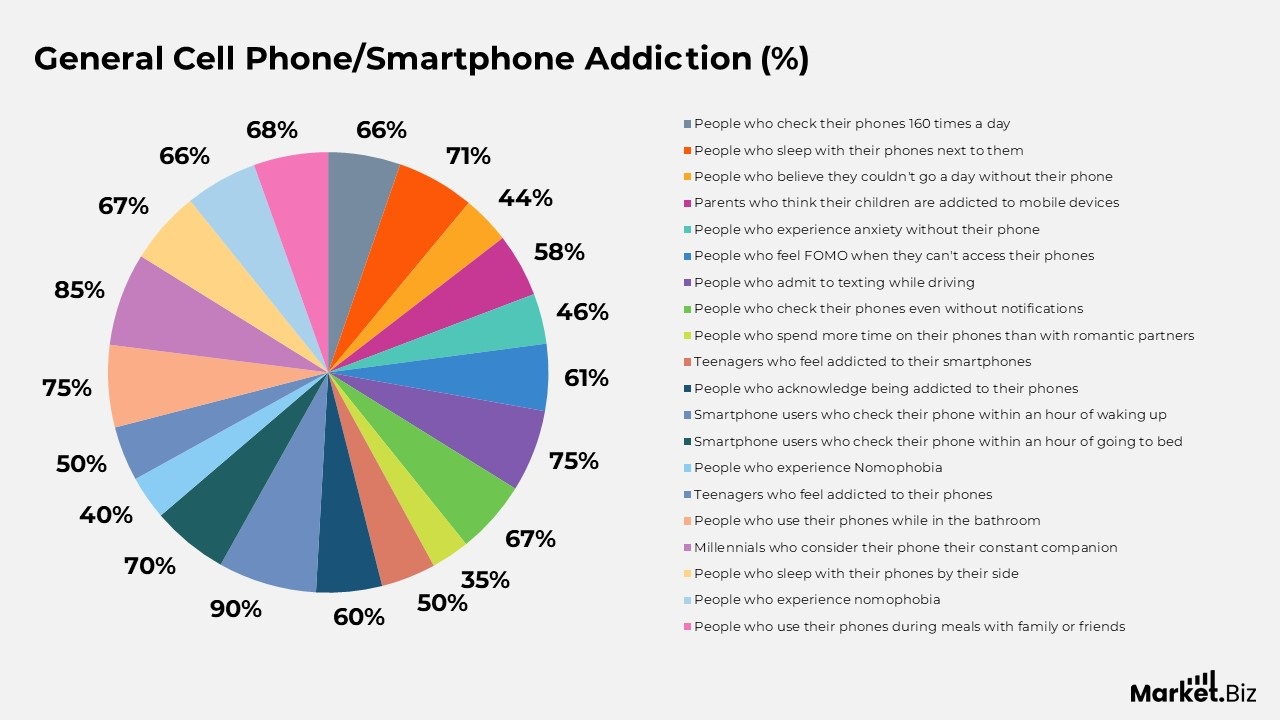
- 66% of individuals check their phones 160 times a day.
- 71% of people sleep with their phones right next to them.
- 44% of individuals believe they couldn’t go a day without their phone.
- 58% of parents think their children are addicted to their mobile devices.
- 46% of people experience anxiety when they don’t have their phones with them.
- 61% of individuals feel a sense of FOMO (fear of missing out) when they can’t access their phones.
- 75% of people admit to texting while driving.
- 67% of individuals check their phones even when they haven’t received any notifications.
- 35% of people spend more time on their phones than with their romantic partners.
- 50% of teenagers feel dependent on their smartphones.
- The average person spends more than 4 hours a day on their smartphone.
- 60% of Americans acknowledge using their phones.
- 90% of smartphone operators form their phone within an hour of waking up.
Moreover
- 70% of smartphone users check their phone within an hour of going to bed.
- 40% of the population experiences Nomophobia, the fear of not having their phone.
- 1 in 5 drivers confess to using their mobile while driving.
- 50% of teenagers feel they are addicted to their phones.
- On average, people check their phones 58 times a day.
- 75% of people use their phones while in the bathroom.
- 85% of millennials consider their phone to be their constant companion.
- There are 2.5 billion smartphone owners globally.
- On average, people check their phones 80 times a day, roughly every 12 minutes.
- 67% of individuals sleep with their phones by their side.
- The average person looks at their phone 150 times throughout the day.
- 66% of people experience Nomophobia, the fear of being without their phone.
- 68% of people admit to using their phones during meals with friends or family.
- 47% of people confess to using their phones while driving.
(Source: Recovery Center Niagara, Cross River Therapy, DemandSage, Semrush Inc., SlickText)
Factors that Fuel Smartphone Dependency
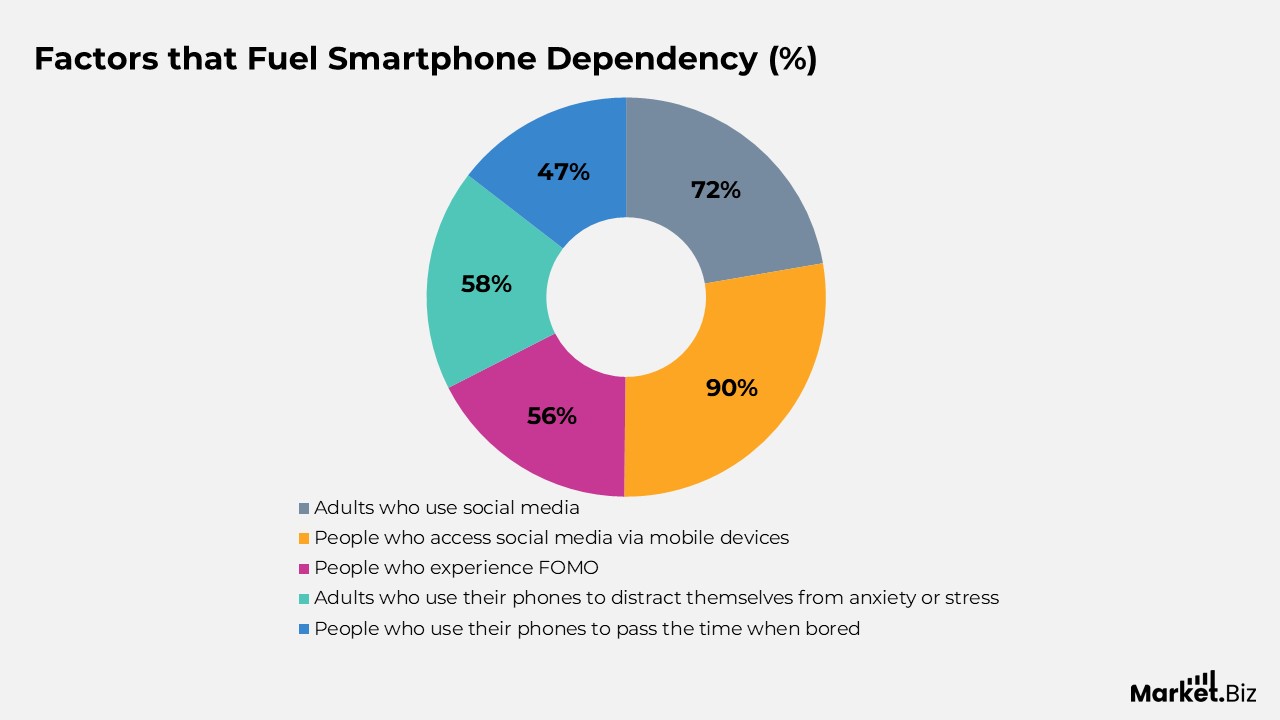
- 72% of adults use social media, and 90% of those access it via mobile devices, leading to prolonged phone usage.
- Checking smartphones triggers dopamine release, providing instant gratification and pleasure.
- 56% of people experience FOMO, primarily driven by social media.
- 58% of adults use their phones to distract themselves when feeling anxious or stressed.
- 47% of people use their phones to pass the time when they are bored.
(Source: Statista, Ambitions, DemandSage)
Smartphone Usage Statistics
- Americans check their phones 160 times a day, which averages to once every 9 minutes.
- On average, individuals spend 4 hours and 10 minutes on mobile devices each day.
- This represents a 20% increase in usage from 2020 to 2021.
- A typical user performs 2,617 clicks, taps, and swipes on their phone daily.
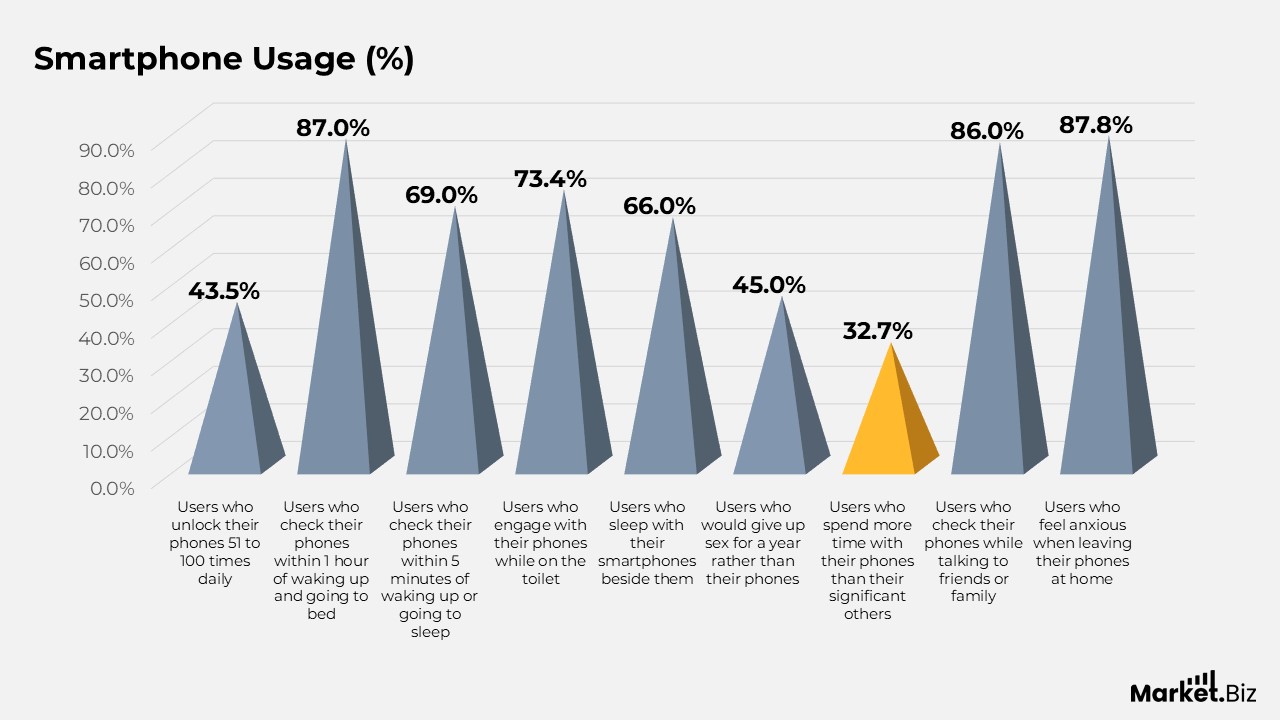
- 43.5% of users unlock their phones between 51 and 100 times each day.
- 87% of users check their smartphones within 1 hour of waking up and going to bed.
- 69% of users check their phones within 5 minutes of waking up or going to sleep.
- 73.4% of users engage with their phones while on the toilet.
- 66% of users sleep with their smartphones beside them.
- 45% of users would rather give up sex for a year than part with their phones.
- 32.7% of users spend more time with their phones than with their significant others.
- 86% of users check their phones even while talking to friends or family.
- 87.8% of users feel anxious when they leave their phones at home.
(Source: TechRepublic, DataReportal, BankMyCell, Android Authority, Reviews.org, Finances Online)
Smartphone Usage in School
- 49% of students report being distracted by phones and other devices during class.
- On average, students check their phones more than 11 times a day.
- Students spend approximately 20% of their class time texting and browsing social media.
- As a result, 80% of schools have implemented policies to limit mobile phone usage in the classroom.
- Students who refrain from using smartphones take 62% more notes in class.
- 45% of teens admit they are constantly online, including while attending class.
- 76.19% of teachers believe that smartphones are a major source of distraction for students in class.
- 46.4% of parents want educators to explore ways to incorporate smartphones into lessons more effectively.
(Source: Inside Higher Ed, Oxford Learning, EdWeek, CNBC, SlickText, Finances Online)
Cell Phone Charger Market Size
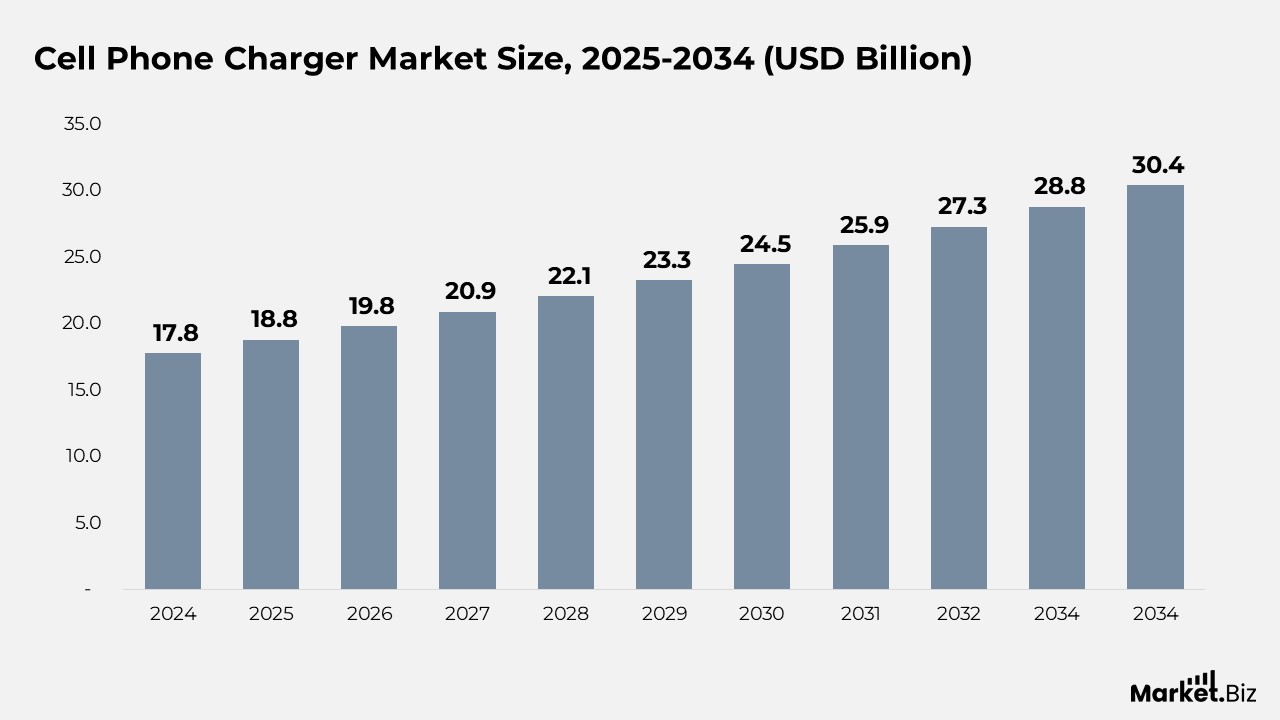
- According to Market.us, the cell phone charger market is anticipated to rise from $18.8 billion in 2025 to $30.4 billion by 2034, representing a compound annual growth rate (CAGR) of 5.5% from 2024 to 2034.
- The growth of the cell phone charger market is driven by the increasing global penetration of smartphones, with innovations like fast charging and wireless charging technologies fueling market expansion.
- In 2024, the wired segment led the Cell Phone Charger market, taking over 51.0% of the market share due to consumer preferences for reliability and established technology.
- The offline distribution station dominated the market in 2024, holding more than 80.0% of the market share, driven by consumers’ preference for in-store purchases.
- In 2024, the general charger segment led by application, holding over 52.0% of the market share, as it caters to universal mobile charging needs.
- The Asia-Pacific region led the Cell Phone Charger market in 2024, commanding 41.4% of the market share, driven by high population density and the increasing adoption of mobile devices in countries like China, Japan, and India.
- Battery health practices, such as preserving lithium-ion batteries between 20% and 80% charge, are influencing the Cell Phone Charger Market, according to Ugreen.
(Source: Market.us)
Smartphone Market Size
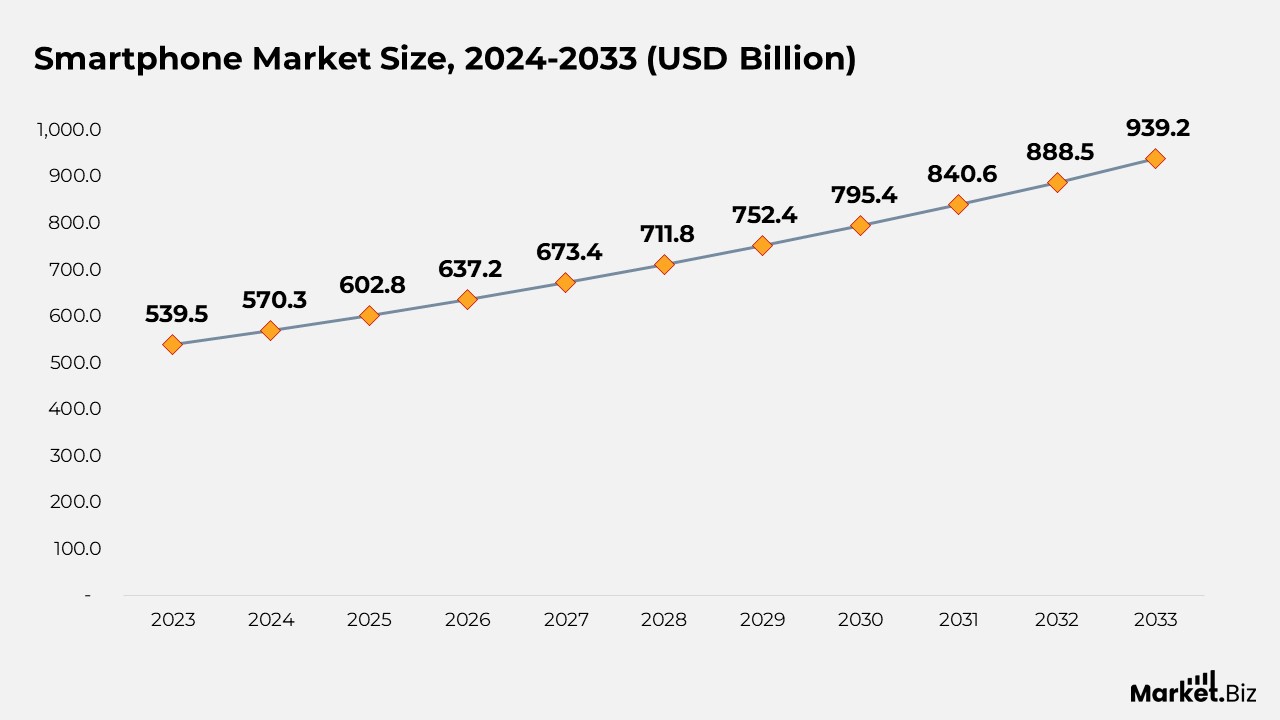
- According to Market.us, the smartphone market is expected to rise from $570.3 billion in 2024 to $939.2 billion by 2033, representing a CAGR of 5.7% from 2024 to 2033.
- The smartphone market’s growth is driven by the production, distribution, and sales of smartphones, with players including manufacturers, suppliers, and technology providers. Innovation and consumer demand for better technology, features, and designs make it highly competitive.
- As of 2024, there are about 4.88 billion smartphone users, accounting for 60.42% of the global population, with an annual growth rate of 14.9% compared to 2023.
- The smartphone market is dominated by the operating system (OS) segment, with Android leading at 63.4% market share, thanks to its open-source nature and flexibility for manufacturers and developers.
- The OEMs’ store segment, including brand shops and official online stores, holds the largest market share in smartphone distribution, with 47.6%.
- North America leads the smartphone market with a 42.6% share, valued at USD 229.83 billion, driven by high consumer spending on premium smartphones, robust 5G infrastructure, and strong brand loyalty.
(Source: Market.us)
Smartphone Usage at Work
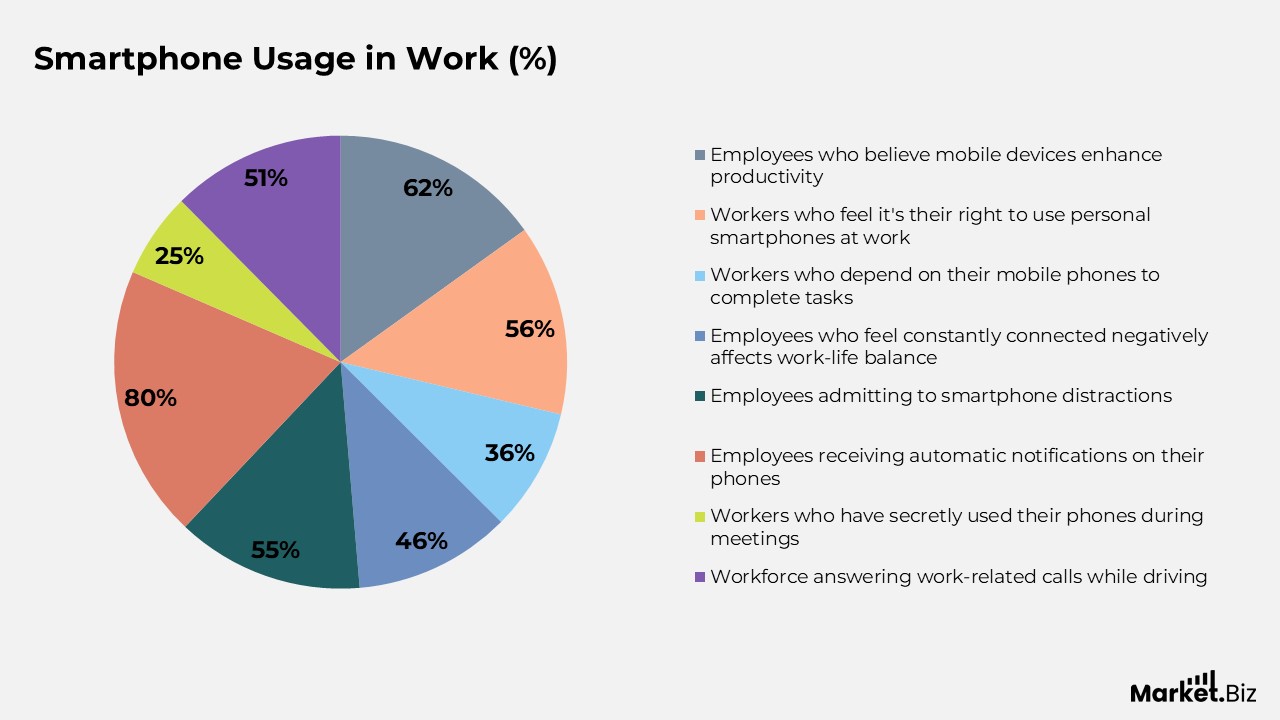
- 62% of employees believe mobile devices have enhanced their productivity.
- 56% of workers feel it’s their right to use personal smartphones at work.
- 36% of workers depend on their mobile phones to complete tasks.
- However, 46% of employees feel that being constantly connected through phones negatively affects their work-life balance.
- Workers spend an average of 56 minutes a day on non-work-related phone activities, amounting to nearly five hours of lost productivity every week.
- 55% of employees admit to frequent distractions caused by their smartphones.
- 80% of employees receive automatic notifications on their phones, which can interrupt their work.
- 25% of workers have secretly used their phones during meetings.
- 51% of the workforce has answered work-related calls while driving.
(Source: TRUCE Software, Business News Daily, Finances Online)
Teenage Smartphone Addiction
- 5% of U.S. teens have access to a smartphone, and 45% are almost always online.
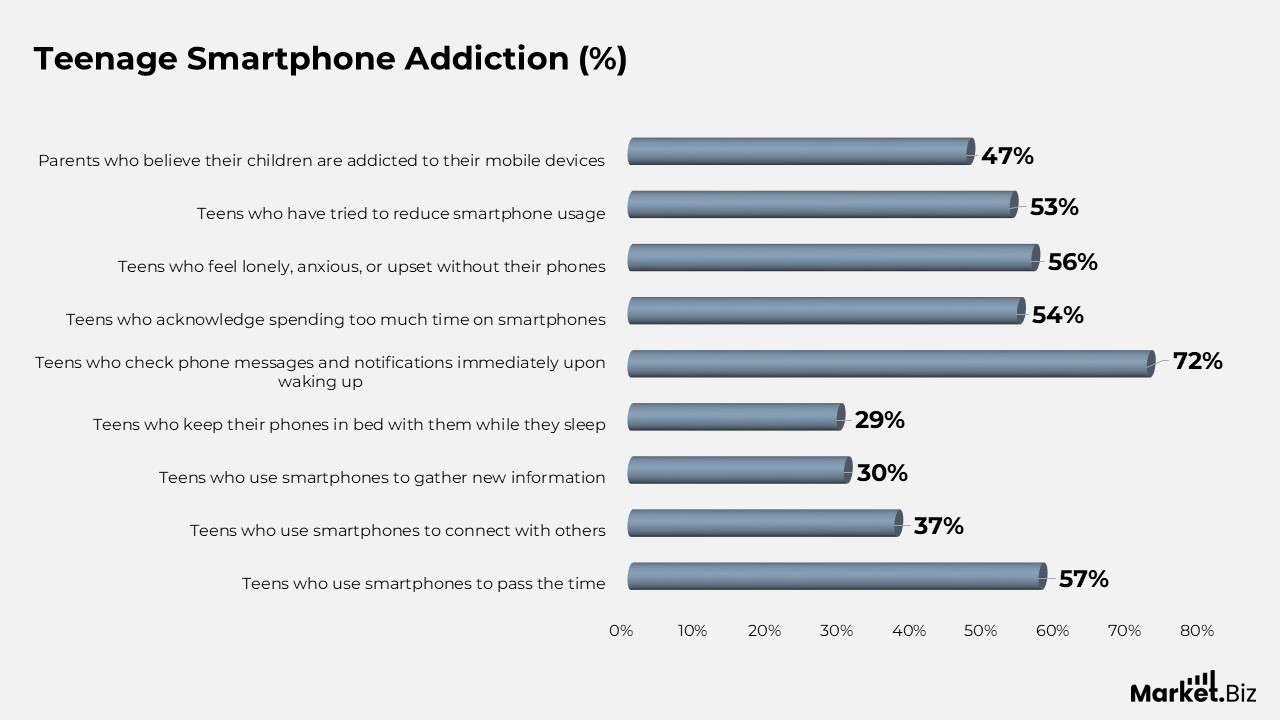
- 57% of teens use smartphones to pass the time, 37% use them to connect with others, and 30% use them to gather new information.
- 29% of teens keep their mobile devices in bed with them while they sleep.
- 72% of teens check phone messages and notifications as soon as they wake up.
- 54% of teens acknowledge they spend too much time on their smartphones.
- 56% of teens feel anxious, lonely, or upset when they don’t have their phones with them.
- 53% of teens have tried to reduce the time they spend on their phones.
- Teens who use their phones for 5 hours daily are 51% more likely to experience inadequate sleep.
- Teens who spend excessive time on social media have a 27% increased risk of depression.
- 47% of parents believe their children are addicted to their mobile devices.
(Source: Pew Research Center, EdSource, BankMyCell, Finances Online)
The Impact of Smartphone Habits on Daily Life
- On average, smartphone users unlock their devices 150 times a day.
- More than 50% of smartphone holders not ever turn off their phones.
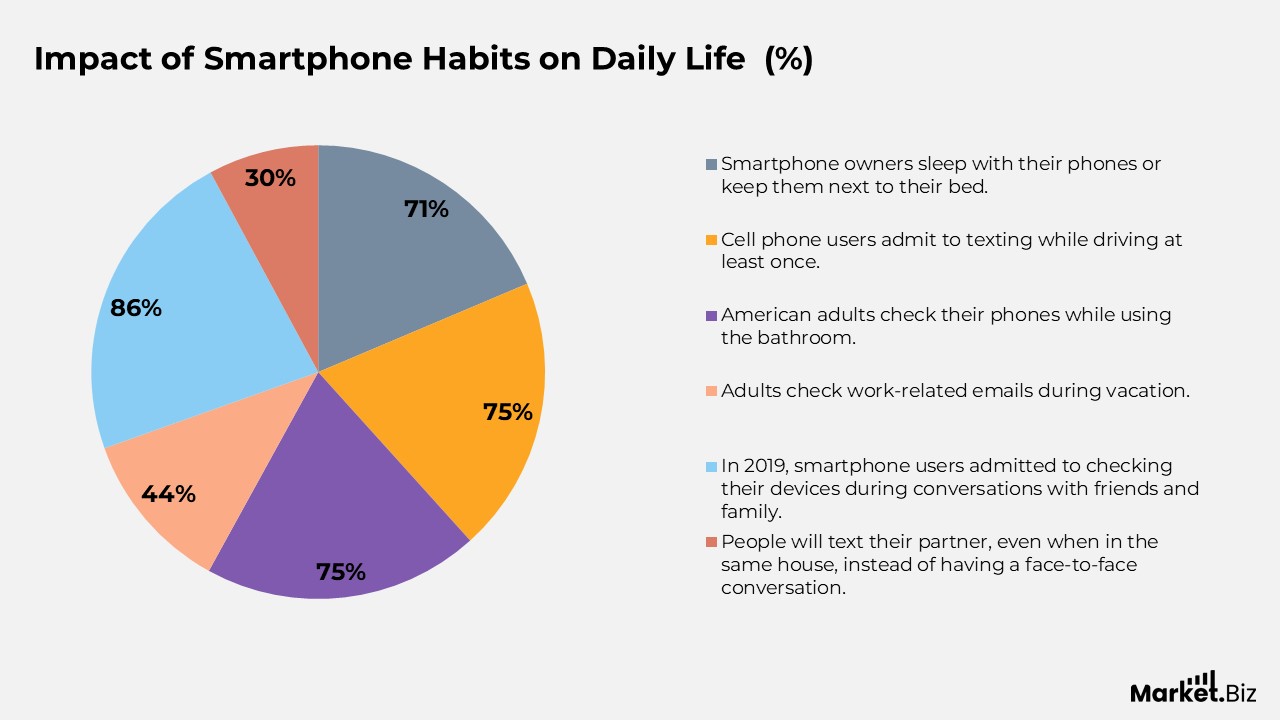
- 71% of smartphone owners sleep with their phones or keep them next to their bed.
- 75% of cell phone users admit to texting while driving at least once.
- 75% of American adults check their phones while using the bathroom.
- 12% of American grown-ups and 7% of British citizens usage their smartphones in the shower.
- 44% of adults check work-related emails during vacation.
- The average smartphone user checks their phone 63 times a day.
- In 2019, 86% of smartphone users admitted to checking their devices during conversations with friends and family.
- The typical American smartphone user reaches for their phone 352 times daily.
- 30% of people will text their partner, even when in the same house, instead of having a face-to-face conversation.
(Source: Pew Research Center, SlickText)
Cell Phone Usage Statistics by Age
- The 18 to 29 age group has the highest percentage of smartphone ownership at 96%, followed by the 30 to 49 age group at 92%, the 50 to 64 age group at 79%, and the 65 and older age group at 53%.
- However, when considering mobile device ownership, all these age groups exceed 90%.
- Millennials lead in smartphone ownership with 94%, followed by Gen X at 88.8%, Gen Z at 72.8%, and Baby Boomers at 68.1%.
- On average, Gen Z receives their first mobile phone at the age of 10.3 years.
- 53% of children in the U.S. own a smartphone by the age of 11.
- 84% of U.S. teens own a smartphone.
- Approximately 1 in 5 children has a smartphone by the age of 8.
- College graduates have the highest smartphone ownership rate at 91%, followed by individuals with some college education at 85%, high school graduates at 72%, and those without a high school diploma at 66%.
- Children in the UK spend an average of 3 hours and 20 minutes a day on their smartphones.
- 74% of parents keep their smartphones within reach while sleeping, with 12% even keeping them in bed.
(Source: Pew Research Center, MarketingWeek, Common Sense Media, NPR, EdSource, The Guardian)
What Are the Key Impacts of Smartphone Addiction?
- Excessive smartphone use can lead to poor sleep quality, with 63% of people checking their phones before going to bed.
- Prolonged smartphone usage contributes to physical health issues like neck pain, eye strain, and carpal tunnel syndrome, with 34% of people experiencing neck or back pain due to overuse.
- 21% of teens feel more comfortable texting than engaging in face-to-face conversations, leading to a decline in social interaction skills.
- Heavy smartphone users are twice as likely to report symptoms of anxiety compared to light users, linking smartphone addiction to mental health issues.
- 37% of employees spend an average of one hour daily on personal activities via their phones during work hours, reducing productivity.
- 75% of women feel their partner spends too much time on their phone during leisure moments together, leading to relationship strain.
- The average American spends $1,000 annually on their mobile device, demonstrating the financial costs associated with smartphone addiction.
(Source: Pew Research Center, Finances Online, Statista)
How do People Use their Smartphones?
- 74.7% of smartphone users participate in chatting or messaging.
- 70.95% use their phones for emailing.
- 62.9% of users use their smartphones for online banking.
- 61.7% listen to music on their mobile devices.
- 61.1% watch videos on their smartphones.
- 56.7% of smartphone users search for products online.
- 56.6% make purchases through their phones.
- 54.55% upload photos or videos from their smartphones.
- 52.3% read news on their mobile devices.
- 47.45% use their phones to make internet calls.
- 46.7% rely on their phones for map or navigation services.
- 44.85% watch movies or series on their smartphones.
(Source: DemandSage, Statista)
Global Trends in Smartphone Usage
- In the Philippines, the average daily smartphone usage is 5 hours and 47 minutes.
- In Thailand, people spend 5 hours and 28 minutes on their smartphones each day.
- Brazil sees an average of 5 hours and 25 minutes of daily smartphone use.
- In Colombia, the average daily smartphone usage is 5 hours and 9 minutes.
- South Africa also has an average of 5 hours and 9 minutes of smartphone use per day.
- Nigeria and Argentina each report an average of 5 hours and 4 minutes of daily smartphone usage.
- In Indonesia, people spend 4 hours and 56 minutes on their smartphones daily.
- Malaysia reports an average daily smartphone usage of 4 hours and 49 minutes.
- In Mexico, the average daily smartphone use is 4 hours and 37 minutes.
(Source: DemandSage, Data Portal, Statista)
Risks of Smartphone Addiction
- Nearly half of American adults admit that they experience anxiety when they don’t have their phones.
- 42% of American adults believe they waste too much time on their smartphones.
- 30% of Americans feel they would be more productive if they didn’t use smartphones.
- Poor sleep quality is a widespread issue, but smartphone addictions are particularly vulnerable. A study in the UK revealed that 69% of smartphone addictions suffer from poor sleep quality, compared to 57% of non-addicted individuals.
- A 2021 study from Ariel University, which analyzed 84 research papers, found that smartphone addiction can lead to cognitive issues such as difficulty with emotional regulation, impulsivity, shyness, and low self-esteem.
- Smartphones are responsible for causing over 20% of car accidents.
(Source: National Safety Council, Ariel University, Frontiers, YouGov, Semrush Inc.)
Conclusion
Smartphone addiction is becoming an increasingly serious issue, particularly affecting the mental health and well-being of younger generations. As smartphones become more integral to both personal and professional lives, they contribute to problems like anxiety, sleep disruptions, and social isolation.
The growing use of mobile devices makes it essential to address this addiction to encourage healthier digital habits. With ongoing research revealing the negative impacts of excessive screen time, individuals and organizations need to take proactive steps toward improving digital well-being.
By promoting balanced usage and raising awareness, we can reduce the harmful effects of smartphone addiction while still enjoying the advantages technology offers.
FAQ’s
Smartphone addiction refers to an unhealthy reliance on smartphones, resulting in negative impacts on mental health, sleep quality, and productivity. It is marked by a compulsive urge to frequently check or use a smartphone, even when it’s unnecessary or inappropriate.
Smartphone addiction is an escalating issue globally, especially among younger generations. In 2024, more people are showing signs of dependence on their smartphones, with excessive use leading to conditions like anxiety, depression, and sleep problems.
Key signs include frequently checking your phone, experiencing anxiety or discomfort when separated from it, spending more time on the phone than planned, and neglecting face-to-face interactions or responsibilities in favor of phone use.
Young adults and teenagers are most at risk due to their extensive use of social media, gaming, and constant online connectivity. However, smartphone addiction is also increasingly affecting adults.
Smartphone addiction can lead to mental health challenges such as anxiety, stress, and depression. Constant interaction with social media and notifications can trigger feelings of loneliness, inadequacy, and difficulty concentrating or relaxing.