








Introduction
Meal Kit Delivery Services Statistics: The meal kit delivery services market has emerged as a data-driven segment within the global food and beverage ecosystem, supported by changing consumer lifestyles, urbanization, and the rapid expansion of digital commerce. A growing number of households worldwide now subscribe to meal kit platforms, reflecting rising demand for convenient, home-cooked meals that reduce time spent on planning and grocery shopping.
Adoption is strongest among working professionals, young families, and health-conscious consumers who value portion control, fresh ingredients, and guided cooking experiences. At the same time, subscription-based models generate significant recurring revenue.
North America continues to account for the largest user base and spending levels due to higher disposable incomes and mature cold chain infrastructure, Europe shows stable expansion backed by sustainability-focused offerings and local sourcing, and Asia Pacific is emerging as a high-growth region driven by urbanization, dual-income households, and increasing acceptance of app-based food solutions.
Overall, meal kit delivery service statistics indicate a structurally expanding market, underpinned by convenience-oriented consumption patterns, scalable digital platforms, and evolving preferences for fresh, curated, and at-home meal preparation.
Editor’s Choice
- Around 17% of consumers in the US have tried a meal kit subscription at least once, indicating broad awareness but trial-led adoption.
- Millennials make up the core user group, accounting for roughly 35% of the total meal kit customer base.
- Households earning more than USD 100,000 annually show nearly 3 times higher likelihood of using meal kit services.
- HelloFresh holds a commanding position in the US market with an estimated 72% share as of 2022, reflecting strong scale and brand dominance.
- Blue Apron reported a year-over-year customer decline of more than 12% in Q1 2023, highlighting ongoing retention challenges.
- HelloFresh Group expanded its global footprint to 6.64 million active customers by Q3 2024.
- Meal kits generate approximately 33% lower greenhouse gas emissions than grocery-sourced meals, largely due to reduced food waste.
- Industry efforts led to a 20% reduction in average plastic packaging waste per meal kit between 2019 and 2022.
- Nearly 58% of consumers indicate a willingness to pay a premium for meal kits with eco-friendly packaging.
- Germany represents the largest meal kit market in Europe, driven primarily by HelloFresh’s strong domestic market presence.
Competitive Shake-Up and Consolidation Trends in the Global Meal Kit Industry
- HelloFresh leads the US meal kit landscape with an estimated 72% market share as of 2022, reflecting strong scale and brand penetration.
- Blue Apron experienced a customer base contraction of more than 12% year over year in Q1 2023, signalling sustained churn pressures.
- HelloFresh Group reported a global active customer base of 6.64 million in Q3 2024, reinforcing its international leadership position.
- Marley Spoon generated revenues of €436 million in 2022, supported by expansion across multiple developed markets.
- Gousto achieved unicorn status in 2020 after securing funding at a valuation exceeding USD 1 billion.
- HelloFresh expanded into ready-to-eat offerings through the acquisition of Factor75 for USD 277 million.
- Kroger entered the meal kit space by acquiring Home Chef for an initial USD 200 million and integrating kits into its physical retail channels.
- Nestlé took a majority stake in Mindful Chef in 2020, strengthening its presence in health-focused meal solutions.
- Sunbasket pivoted toward a broader, full-service food delivery model to counter subscription fatigue and churn.
- Blue Apron was acquired by Wonder Group for USD 103 million in 2023, marking industry consolidation.
- Goodfood holds roughly a 40% share of the Canadian meal kit market, positioning it as the domestic leader.
- HelloFresh operates in 18 countries as of 2023, underscoring its global footprint.
- Purple Carrot leads the US market for 100% plant-based meal kits, catering to vegan and flexitarian consumers.
- The top 3 meal kit providers collectively control more than 85% of the US market, indicating a highly concentrated competitive structure.
- Amazon suspended its Amazon Fresh Meal Kits trial due to logistical and fulfillment complexities.
- Albertsons acquired Plated for nearly USD 300 million, later discontinuing the standalone subscription model.
- HelloFresh allocated approximately 15% of its revenue to marketing activities in 2022 to sustain customer acquisition.
- Chefd ceased operations in 2018 before selling select assets to Campbell Soup Company.
- Green Chef became the first USDA-certified organic meal kit provider and was later acquired by HelloFresh.
- Hungryroot leverages AI-driven grocery and recipe personalization, achieving 47% year-over-year growth in 2022.
(Source: Gitnux, Statista)
Who Buys Meal Kits and Why
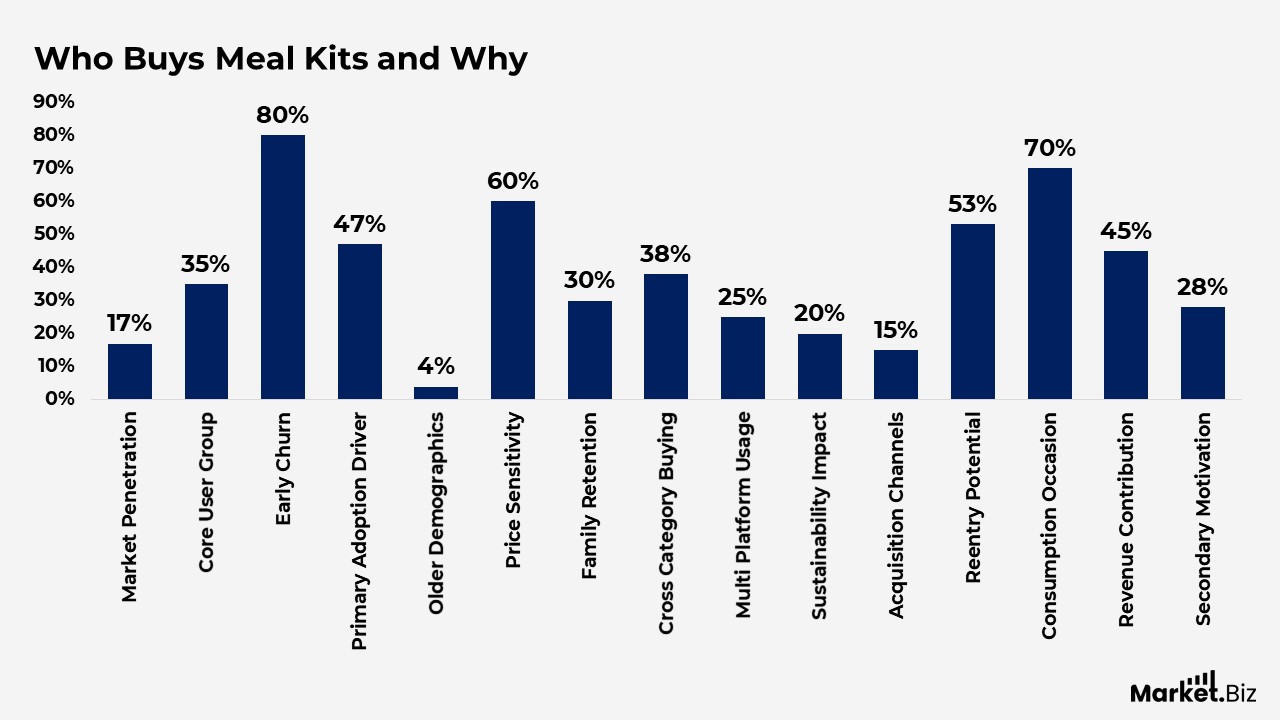
- About 17% of US consumers have tested a meal kit subscription at least once, reflecting high awareness but trial-driven usage.
- Millennials make up the largest share of users, accounting for roughly 35% of the total customer base.
- Households with annual incomes above USD 100,000 have nearly three times the adoption rate as lower-income households.
- Subscriber churn is significant, with close to 80% of customers cancelling within the first 6 months.
- High-income, urban male consumers have the highest meal kit usage frequency across demographic segments.
- Time efficiency is the leading value proposition, as 47% of users subscribe primarily to reduce meal planning effort.
- Baby Boomers remain largely disengaged, with only 4% having actively used a meal kit service.
- Pricing acts as a major barrier, with around 60% of former users citing high cost as the main reason for cancellation.
- Family households demonstrate stronger loyalty, being about 30% more likely to retain subscriptions for more than 3 months than single users.
Moreover
- Cross-purchasing behaviour is common: 38% of meal kit users also buy ready-to-eat meals from grocery stores weekly.
- Platform switching is prevalent, with nearly 25% of subscribers using more than one meal kit service simultaneously.
- Sustainability messaging resonates strongly with younger audiences, with Gen Z consumers being 20% more likely to choose meal kits based on environmental claims.
- Referral-based marketing contributes to approximately 15% of new customer acquisitions in the sector.
- Price sensitivity remains high, with 53% of former subscribers indicating a willingness to return if pricing becomes more affordable.
- Dinner dominates consumption occasions, preferred by nearly 70% of meal kit users over breakfast or lunch options.
- Consumers aged 25–44 account for nearly 45% of total industry revenue, making them the most commercially valuable cohort.
- Culinary exploration also drives adoption, with 28% of users ranking the opportunity to try new recipes as a key motivation.
- Long-term loyalty is limited, with retention rates falling below 15% after 12 months for most leading providers.
- Gender based preferences vary slightly, with men leaning toward meat-focused kits while women choose vegetarian options about 10% more often.
- Sustainability expectations are high, as nearly 90% of users expect meal kit packaging to be fully recyclable.
(Source: Gitnux, Statista)
Global Footprint of Meal Kits
- North America accounts for close to 45.6% of global meal kit revenue, reflecting high household penetration and a mature delivery infrastructure.
- Germany is Europe’s largest meal kit market, supported by strong domestic operations from leading providers.
- The UK meal kit industry surpassed £1 billion in annual value as of 2022, indicating mainstream consumer adoption.
- Japan shows a distinct consumption pattern, with older people-friendly soft meal kits accounting for about 14% of the senior population.
- Australia ranks among the highest globally, with around 15% of households having tried a meal kit in 2021.
- Canada recorded rapid acceleration during the pandemic, with the meal kit sector expanding by nearly 80% in the first year of COVID-19.
- China’s adjacent semi-cooked and pre-made dish market reached 345.9 billion yuan in 2021, highlighting the scale potential for meal kits.
- South Korea’s meal kit market reached approximately 200 billion won in valuation in 2020, driven by urban convenience demand.
Further
- Latin America remains an emerging market, with revenues projected to reach around USD 500 million by 2025.
- Nordic countries, including Sweden, Norway, and Denmark, show strong localisation trends, with about 60% of respondents preferring locally sourced fish in kits.
- France experienced strong post-pandemic momentum, as the “Paniers à cuisiner” segment grew by roughly 25% in 2021.
- In South Africa, organized retail participation has increased, with major retailers launching meal kits to serve the rising middle class.
- The US West Coast records the highest concentration of plant-based meal kit subscribers nationwide.
- California alone contributes nearly 15% of the total US meal kit user base.
- New Zealand’s leading meal kit provider went public in 2021 with a valuation of about NZD 449 million, signalling market maturity.
- Italy shows slower adoption, with only around 3% of the population subscribing, due to a strong traditional food culture.
- The Middle East and Africa together account for less than 4% of global meal kit revenues, indicating early-stage development.
- Belgium exhibits high market concentration, with a single leading provider controlling nearly 80% of the meal kit market.
(Source: Gitnux, Statista)
Sustainability Shifts, Cost Pressures, and Innovation Trends Shaping Meal Kits
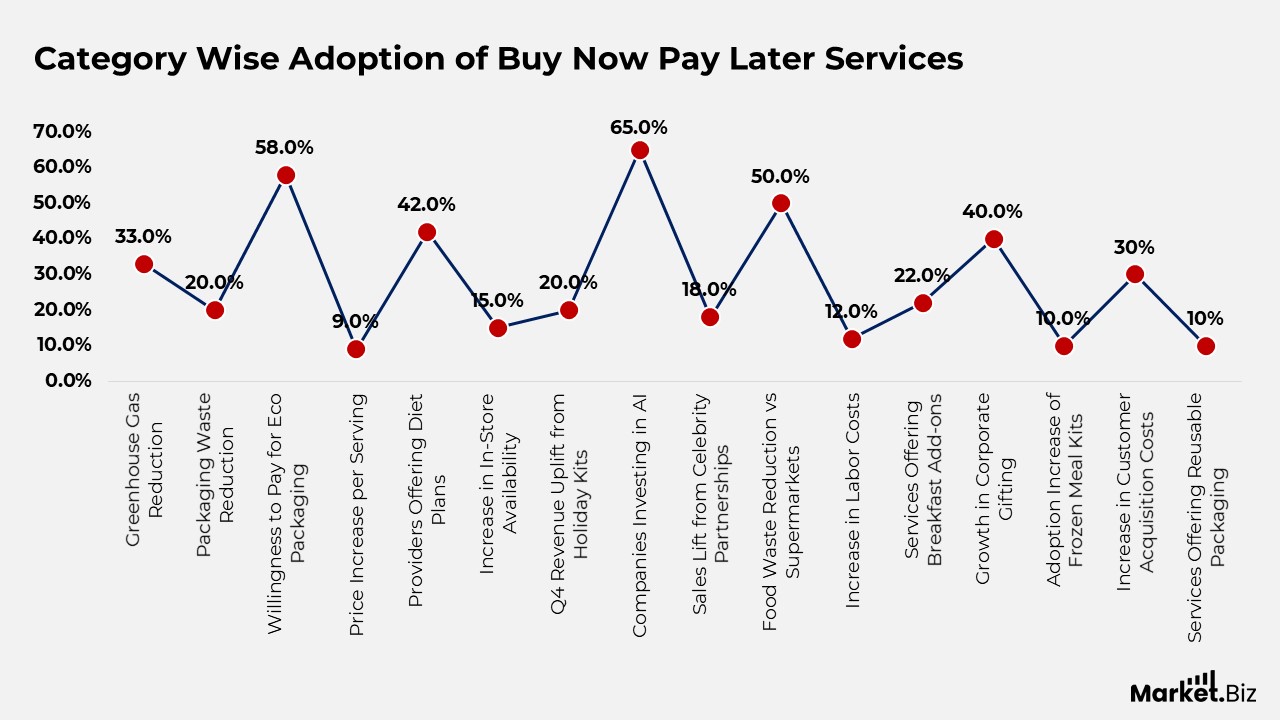
- Meal kits generate around 33% lower greenhouse gas emissions than grocery-purchased meals, largely due to tighter portion control and reduced food waste.
- Industry-wide efforts lowered average plastic packaging waste per meal kit by nearly 20% between 2019 and 2022.
- Consumer willingness to support sustainable practices is rising, with about 58% of buyers prepared to pay a premium for eco-friendly packaging.
- Inflationary pressures pushed the average meal kit price per serving up by approximately 9% in 2022, affecting affordability.
- Prepared “heat and eat” meal kits are expanding at nearly 2× the growth rate of traditional cook-it-yourself formats.
- Menu specialisation is increasing, with roughly 42% of meal kit providers now offering structured diet plans such as Keto or Paleo.
- Omnichannel strategies are gaining momentum, with in-store meal kit availability increasing by about 15%.
- Seasonal demand remains strong, as holiday-themed meal kits can lift Q4 revenues by up to 20% for leading players.
- Supply chain disruptions resulted in an estimated USD 300 million loss in operational efficiency during 2021.
Moreover
- Data-driven retention strategies are expanding, with nearly 65% of companies investing in AI to forecast subscriber food preferences.
- Brand collaborations show measurable impact, as celebrity chef partnerships raise the likelihood of meal kit purchases by around 18%.
- Personalized nutrition kits designed for specific health needs rank among the top 3 emerging trends in the sector.
- Compared to conventional supermarkets, meal kit logistics generate roughly 50% less food waste.
- Cost structures tightened further, as labour expenses at fulfilment centres increased by approximately 12% in 2022.
- Basket expansion strategies are evolving, with about 22% of meal kit services now offering breakfast add-on options.
- Corporate gifting demand surged during the remote work period, with meal kit gifting volumes rising by nearly 40% between 2020 and 2022.
- Frozen meal kits are gaining traction to improve shelf life, with adoption increasing by about 10% in 2023.
- Customer acquisition costs rose by close to 30% following changes to mobile privacy, pressuring marketing efficiency.
- Reusable packaging remains limited, with only about 10% of services offering container-return programs due to high reverse logistics costs.
- Ethical sourcing credentials are increasingly visible, appearing on roughly 35% of meal kit packages in 2023.
(Source: Gitnux, Statista)
How Consumers Order Food Today: Platform Power, Pricing Sensitivity, and Changing Habits
- A Toast survey shows that 47% of guests are comfortable paying delivery fees of USD 3–6.
- Data from Statista indicates that DoorDash dominates the US market, controlling nearly two-thirds of the online meal delivery share as of January 2024.
- According to Grubhub, burritos, including bowls and wraps, rank as the most frequently ordered takeout item.
- The most commonly ordered breakfast item is a sausage, egg, and cheese sandwich.
- Late-night demand peaks around chicken quesadillas, which are the top choice for orders placed after 10 pm.
- On a global scale, Uber Eats leads in international usage with approximately 88 million users, according to Business of Apps.
- Younger consumers show strong platform loyalty: 59% of users aged 18–24 and 53% aged 25–35 prefer DoorDash.
- Pricing remains critical, as about 35% of consumers rank low delivery fees as the most important feature when choosing a service.
- The global online food delivery market is projected to grow at a CAGR of 7.88% between 2025 and 2029, reaching a total value of USD 1.91 trillion by 2029.
Moreover
- Industry revenue momentum remains strong, with online food delivery expected to generate around USD 1.41 trillion this year.
- Ordering frequency continues to rise, as more than 40% of adults order delivery or takeout 3–5 times per month.
- Online grocery delivery is accelerating rapidly and is expected to reach approximately USD 945 billion in revenue by the end of this year.
- Meal kits are contributing to delivery growth, with global revenues in the meal kit delivery segment forecast to rise by USD 4.9 billion between 2024 and 2028, an increase of 33.58%.
- Speed and convenience influence willingness to pay, as the average delivery time is about 35 minutes, yet 27% of consumers would pay extra for faster service.
Further
- Restaurant operations increasingly rely on digital tools, with 95% of restaurant owners stating that technology improves efficiency in handling delivery orders.
- Alcohol delivery is gaining traction, with around 39% of US consumers ordering alcohol for parties and celebrations.
- Discovery behavior is platform-driven, as 51% of US consumers browse third-party apps like DoorDash when deciding where to order food.
- Evening remains peak demand, with 6 pm identified as the most common ordering time, while US breakfast delivery orders from 5–11 am grew by 29% in 2024.
- Despite economic uncertainty, demand remains stable, as 37% of consumers report their delivery frequency has not declined over the past year.
- Work-related fatigue is a key motivator: 38% of consumers say job demands most often drive them to order takeout or delivery.
(Source: Gitnux, Statista)
Conclusion
Meal Kit Delivery Services Statistics: In summary, the statistics surrounding meal kit delivery services reveal a market that has moved beyond early adoption into a more mature, structurally embedded segment of the food delivery landscape.
Usage patterns point to strong engagement from millennials, affluent households, and urban consumers, while regional data reinforces North America’s leading role and highlights Asia Pacific as the primary growth engine.
Sustainability indicators demonstrate clear benefits in reducing waste and emissions, aligning with consumer expectations for environmentally responsible offerings. At the same time, elevated churn, cost sensitivity, and increasing operational expenses signal that future expansion will rely less on rapid customer acquisition and more on retention, personalization, and efficient delivery models. Collectively, these insights suggest a market with durable demand potential, where long-term success will depend on balancing convenience, affordability, and operational discipline.
FAQ’s
Meal kit statistics show that adoption is largely trial-driven rather than habitual. A sizable portion of consumers have experimented with meal kits, but long-term usage remains limited, indicating that the category is still balancing novelty with sustained value perception.
Millennials tend to prioritise convenience, time efficiency, and digital ordering experiences, all of which closely align with the meal kit value proposition. Their comfort with subscriptions and willingness to experiment with new food formats also explain their outsized presence in usage data.
Meal kit services are more prevalent among higher-income households because these consumers are better positioned to absorb premium pricing in exchange for time savings. Statistical patterns suggest that affordability remains a barrier for middle- and lower-income segments.
Elevated churn reflects a mismatch between initial expectations and long-term value. While consumers are attracted to promotions and novelty, recurring costs and the effort involved in cooking can erode perceived benefits over time.
Meal kits reduce cognitive and logistical burdens such as meal planning and grocery shopping. Statistical data consistently show that time savings outweigh other motivations, highlighting convenience as the service’s core utility.