








Introduction
Employee Surveillance Statistics: Under the increasing pressure caused by remote and hybrid work modes, employee surveillance has become a major area of focus in modern workplace management. This market is expected to realize an impressive CAGR of 12.3%, increasing from $648.8 million in 2025 to $1,465.2 million by 2032, fuelled by the increased necessity in monitoring productivity and data safety in decentralized work environments.
In fact, 80% of companies are reported to monitor remote/hybrid workers using special software that tracks them online, monitor the location, and even their patterns of behaviour. While these tools offer operational ability, they are also helping concerns of privacy and trust among the workforce, and thus need to be implemented fairly and in a clear manner.
Editor’s Choice
- 71% of the workforce is digitally trackable, a 30% rise from the last year.
- 76% of employers monitor the browsing activity and software use of employees.
- The European employee monitoring solutions market will grow to from USD 1.75 billion in 2025.
- In 2025, 61.4% of employers will monitor their worker’s time and attendance.
- While 40% of workers who are not monitored are affected with an increased level of stress.
- Some 37% of remote employers use video surveillance to monitor their workers.
- Hyderabad, India, is one of the world’s most heavily surveilled cities, with 83.32 cameras per 1,000 people.
- 46 percent of workers say tracking software was added or increased by their employer in the last year.
- In 2025, 73 percent of employers are projected to use online monitoring tools and more than half will track physical spaces.
- More than 80% of the workforce say they are being monitored by their bosses to a moderate or large extent.
What is Employee Surveillance?
Employee monitoring is the use of technology to monitor the behaviour of employees within an organization. This can be everything from tracking computer use and video surveillance to email logging and location tracking and its main objective is to increase productivity and safeguard company assets.
Due to a surge in remote work, companies are using digital surveillance tools to track their employees at home. Employee surveillance has already made a name for itself in recent years, included in heated discussions about privacy in the workplace and ethical mistakes.
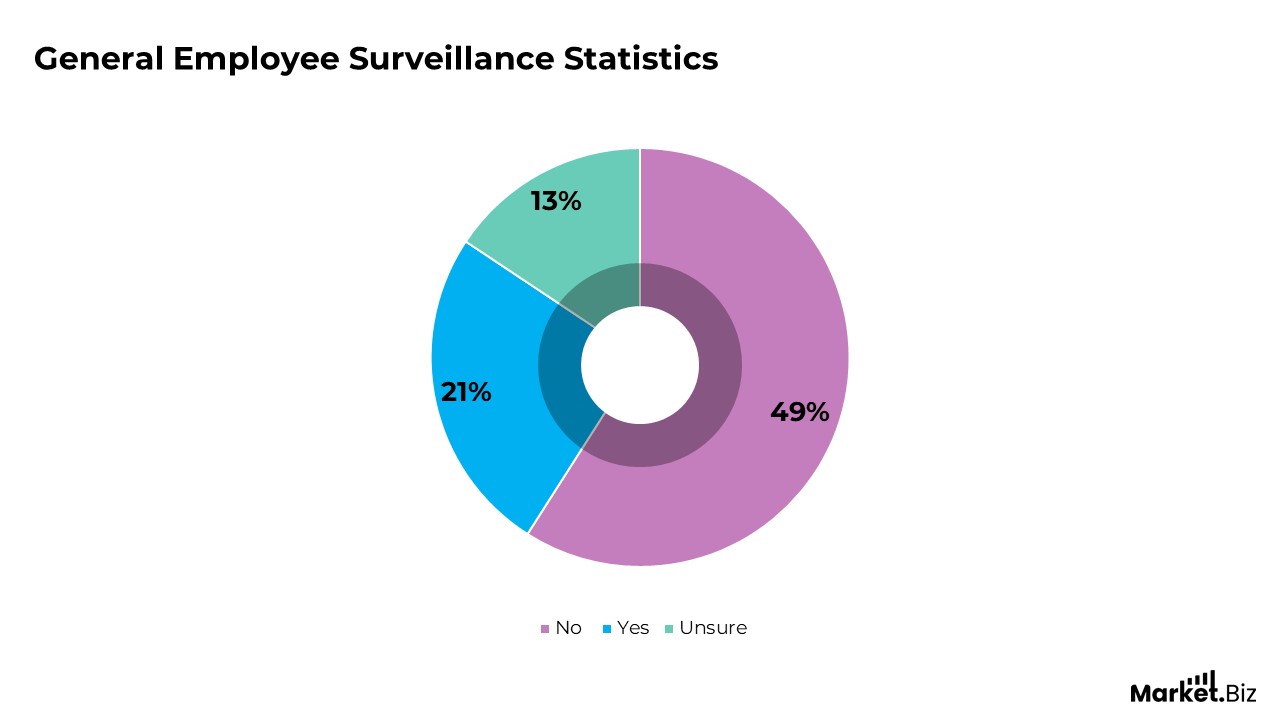
General Employee Surveillance Statistics
- 71% of the workforce is digitally trackable, a 30% rise from the last year.
- 70% of big employers are tracking workers, a share the report predicts will only rise.
- 96% of businesses use time-tracking software, with the majority explaining that the goal is to end micromanaging while giving employees flexibility on when they work.
- 73 percent of organizations have online monitoring tools, and more than half are monitoring physical spaces.
- 43 percent of workers say their online behaviour is tracked, though the degree of surveillance varies.
- 76% of employers monitor the browsing activity and software use of employees.
- Employers utilizing time and attendance for oversight 61.4% of employer use time and attendance to monitor employee punctuality and productivity.
- More than 56 percent say they feel nervous about being watched, and 43 percent think it is an invasion of privacy.
- 46 percent of workers say tracking software was added or increased by their employer in the last year.
- Trust in the workplace is highly one sided, just 52 percent of employees have trust in their employer, while 63 percent of employers trust their workforce, and it is divided along gender lines.
Moreover
- Employee surveillance is now a multi-billion dollar market, underscoring its swift expansion.
- AI powered productivity tools monitor data including hours logged on and emails sent, doling out scores on employee workloads.
- Some companies track desk and room occupancy using motion sensors and heat sensors.
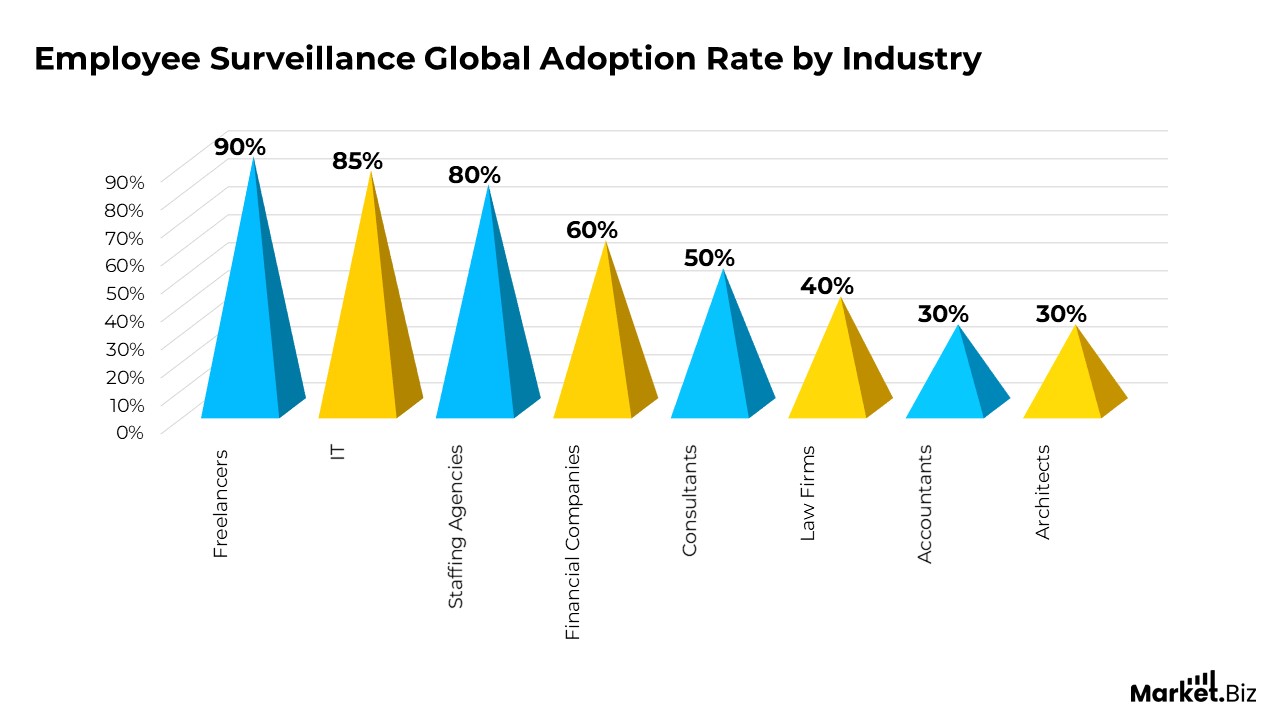
- Technology companies use employee monitoring software extensively to gauge performance and to prevent any illegal acts during their working hours.
- Insider threat detection and prevention are one of the top causes of data breaches.
- Surveillance gadgets, including RFID sensors, GPS, and biometric their every move and level of productivity.
- Employee monitoring capabilities have become far more advanced in 2021, especially in terms of location tracking and real time activity monitoring.
- Most staff members do not even know that they are on the edge of a mental health crisis because there is no proactive support.
(Source: zippia, wp-content)
Global Adoption Rate
- The global employee monitoring solutions market is predicted to have the value of $1,392.5 million by the year 2026, with the immense support of North America, Europe and Asia-Pacific region.
- The global employee monitoring software market size is projected to reach $7.61 billion by 2029, and register a CAGR of 18.1% over the forecast period.
- The global market for employee monitoring software is projected to be valued at $4.5 billion in 2026, with CAGR expected to grow at 12.1% from 2021 to 2026.
- According to the report, the world employee monitoring software market was estimated at $3.3 billion in 2024 and is expected to hit $3.91 billion in 2025 at a CAGR of 18.3%.
- 70 percent of large employers are projected to track their employees in 2025, up from 60 percent in 2021.
- The world employee surveillance and monitoring software market is estimated to reach $1,465.2 million in 2032 from $648.8 million in 2025 with a CAGE of 12.3%.
- The market is expected to value at $5.97 billion gross by the end of the forecast period 2025 due to rise in demand for productivity and accountability in companies across the globe.
More Stats
- The U.S. market for employee monitoring solutions market is expected to reach $2.85 bn in 2025 and represents a significant portion of the global market.
- The European employee monitoring solutions market will grow to from USD 1.75 billion in 2025.
- The employee monitoring solutions market in Asia Pacific is estimated to reach US$ 0.9 Billion in 2025 and is expected to grow at a CAGR of 10.6% from 2025 to 2033.
- The Latin American employee monitoring solutions market reached USD 0.3 billion in 2025, growing at a CAGR of 8.4% from 2025 to 2033.
- The employee monitoring solutions market in the Middle East & Africa is estimated to be valued at USD 0.17 Bn in 2025, expanding at a CAGR og 8.5% from 2025 to 2033.
- In 2025, 73 percent of employers are projected to use online monitoring tools and more than half will track physical spaces.
- In 2025, 61.4% of employers will monitor their worker’s time and attendance.
- In 2025, 76 percent of employers said that they monitor employee’s habits through the use of web browsing and other software.
(Source: zippia, wp-content)
Surveillance in Different Regions
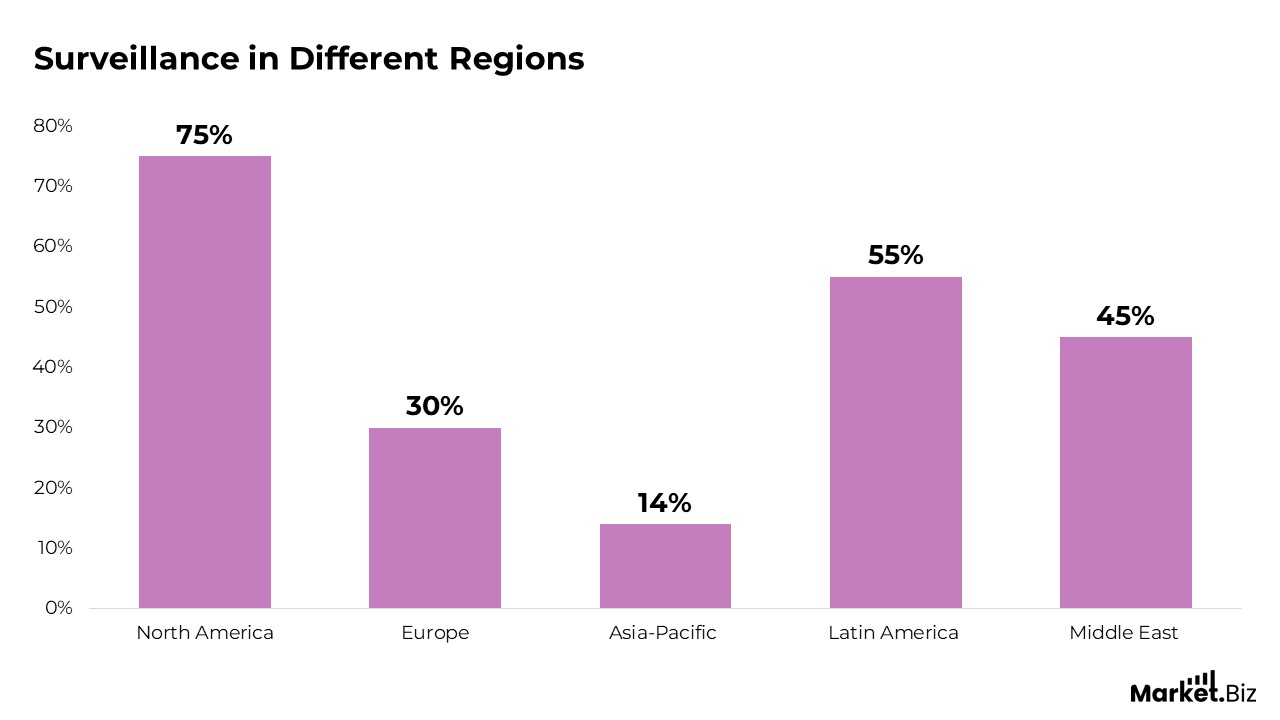
- Adoption of employee surveillance is highest in North America, where more than 75% of large firms digitally track employees.
- The figure is alarming if you think about it; 71% of U.S. workers are being digitally watched, if you will, as remote technology surges there.
- Europe has around 30% of the worldwide employee monitoring market, with regulations and strict privacy laws somewhat suppressing adoption rates.
- In Germany adoption of employee surveillance appears to be lower; as they have relatively strong data privacy laws.
- Asia-Pacific employee monitoring software market is expanding rapidly with an estimated CAGR of 14% in the region by 2030.
- The adoption rate in China is increasing, with 65 percent of companies having deployed employee surveillance tools, particularly in tech companies.
- Employee monitoring in India has also shot up by 50% with increased number of people working from home and digital infrastructure expansion.
- Adoption in Latin America is somewhat moderate, with approximately 55% of organizations using some type of employee monitoring.
- Australia and New Zealand are as high as 60%;, navigating employee privacy fears and the needs of business.
- 45% adoption rate reported by Middle East businesses. As businesses in the Gulf become more focused on cybersecurity and productivity, 14% reveal that they’re deploying unified security strategies to protect against cyber criminals.
- In Canada, 68 percent of companies are employing monitoring tools, particularly in finance and IT.
- Employee surveillance is also up in Japan, though less sharply, between 35 percent and 40 percent, because of the liking in the culture for what British author Richard Lewis calls trust based management.
Technological Involvement in Surveillance
- In a recent study by MIT, 80% of companies track remote or hybrid workers with dedicated software that watches online activities, location, and behaviours like keystrokes and the tone of communication.
- According to Gartner, 71% of workers are digitally monitored, a 30% increase in only 12 months.
- The world employee surveillance and monitoring software market is estimated to be valued at US$ 648.8 Mn in 2025 and is expected to increase to US$ 1,465.2 Mn by 2032, registering a CAGR of 12.3%.
- As the trend of AI adoption grows, so does its use in employee monitoring tools for productivity analysis, anomaly detection, etc.
- Cloud based employee management software is gaining in popularity because of the scalability and remote access.
- Sophisticated tracking tools, such as RFID, GPS, biometric scanners and AI-enhanced software, are now showing up in all kinds of workplaces.
- With the advent of wearable devices, such as fitness bands and smartwatches, it is now possible to monitor physiological signals in real time to assess the weariness of an individual.
- In 2025, nearly 50% of workers have had their online activities monitored by their employers.
- Employers are leveraging monitoring solutions to collect data on employee productivity, such as time spent on activities and application usage.
- Employee monitoring software that is non-invasive is increasingly becoming requested in a variety of industries to manage tracking productivity and privacy.
- With the transition to remote or hybrid work, employers are finding it hard to trust its employees on whether they are working or not, resulting in enhanced surveillance.
Impact of Surveillance on Remote Work
- It’s projected that 70% of large companies will be doing so in 2025, compared with the current 96% of companies using time-tracking software.
- More than 56% of workers are nervous about being monitored, while 43% think it is an invasion of privacy.
- 43% of workers say that surveillance negatively influences their morale, and 36% think it diminishes their job satisfaction.
- And even while tracking is on the rise, 72 percent of employees say it has no bearing on the quality of their work, whereas 68 percent of employers believe it improves work.
- Workers are wasting more than 10 hours a week on voluntary tasks that make them look busy, like responding to emails quickly or keeping their screens lit.
- Some people at remote work simulate activity with ‘mouse shuffling,’ a response to constant surveillance.
- While 40% of workers who are not monitored are affected with an increased level of stress.
- Disengagement and high turnover surveillance can undermine trust between employers and employees, which can also lead to disengagement and increased turnover.
- The constant monitoring can wear down the lines between work and personal life, and contribute to feeling of burnout and diminished well-being.
- 43 percent of employees feel that surveillance is invasive to their privacy and raises both ethical and legal concerns.
Employee Surveillance Tools
- Some 65% of all companies are using monitoring of their workers to increase efficiency and security.
- Some 74% of U.S. employers track employees’ work, including using real-time tracking of phone and computer activity on 59%; time spent on the web on 62%.
- Some 37% of remote employers use video surveillance to monitor their workers.
- 38% of monitoring solutions are deployed in stealth, hidden from employees, but that percentage has decreased by 23.37% since 2021.
- More than a third (34%) of tools are now capturing employees’ specific GPS locations up over 44.85% from last year.
- Nearly 8 percent of monitoring tools allow the recording of audio with a device’s internal microphones.
- 61% of businesses who review employee performance with artificial intelligence, review measurements of productivity.
- Biometrics and 58%, 51% of respondents work in environments in which they are biometrically monitored by their company at the office.
- Recording of calls, emails or messages by staff were retained by managers in 73 percent of cases to monitor the way employees are performing and/or to make sure rules are being followed.
- More than 80% of the workforce say they are being monitored by their bosses to a moderate or large extent.
- Monitoring software also log keystrokes, mouse movements, and work processes of users to determine their productivity.
Physical Surveillance Technologies
- About 75% of employers surreptitiously keep tabs on their employees in the office with a video surveillance system.
- Biometric access controls, such as fingerprint and facial recognition, are used across 58% of businesses to track the movement of employees.
- 39% of firms that track their workers use video cameras to keep an eye on them.
- China has deployed some 540-626 million surveillance cameras and is, without doubt, the most monitored society on earth.
- Hyderabad, India, is one of the world’s most heavily surveilled cities, with 83.32 cameras per 1,000 people.
- AI adoption is low today (7% of end users have embedded AI in their physical security systems) which means AI hasn’t yet been trained to a level where it is assuming tasks that might otherwise absolve humans of these same chores.
- 81% of respondents use mobile applications for physical security, however only 25% use mobile credentials, indicating that there is a difference between mobile tool usage and credential usage.
- The Los Angeles police department purchased 7,000 body cameras for $57.6m in 2016, revealing in that $8,000 per unit the massive investment in wearable surveillance tech.
- More than 70% of large cities in the developed world have adopted some form of smart policing technology, highlighting the significance of surveillance in the way cities are run.
AI on Employee Surveillance
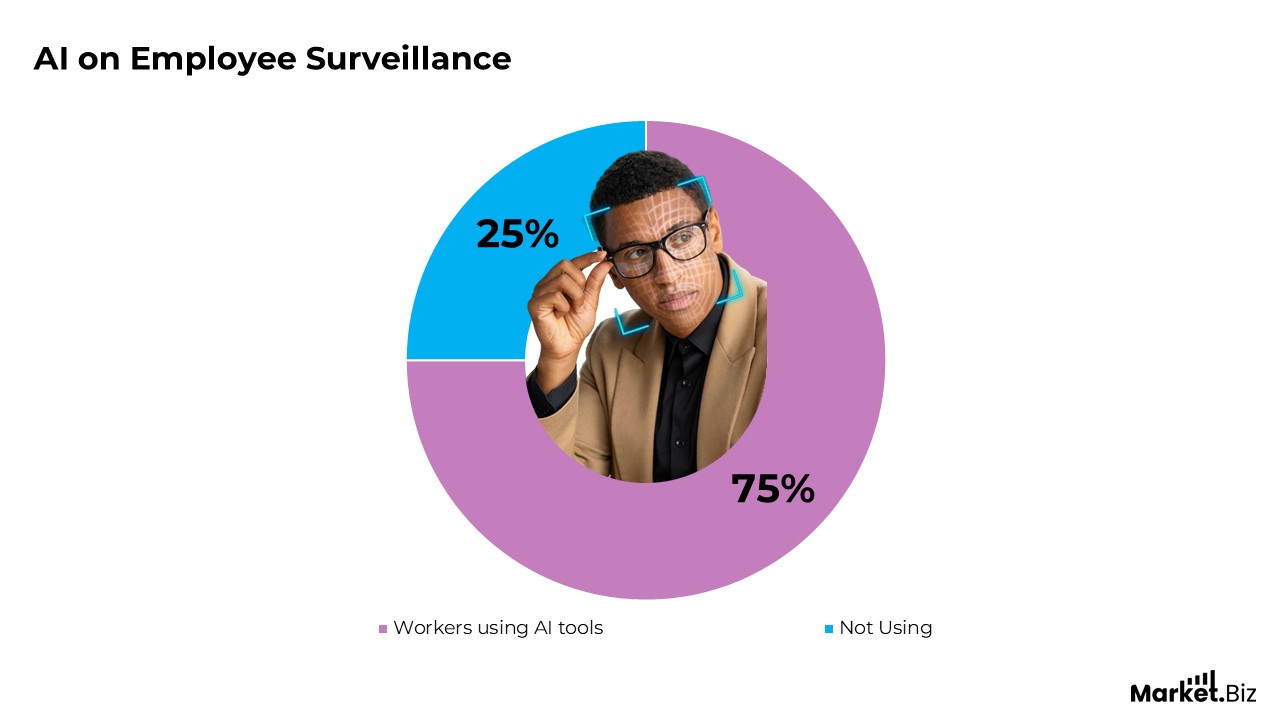
- As of 2024, three-fourth (75%) of workers were using AI tools in their jobs, nearly half (46%) of the workers adopted these in the last 6 months.
- Businesses such as Shoosmiths, have even encourages AI use in employees, with the firm offering bonuses to those who use tools such as Microsoft’s Copilot as freely as they can to encourage the adoption party.
- So called productivity software can monitor online activity, location and even desk behaviour, such as keystrokes and tone in communications, often with employees never knowing.
- A survey from 2024 showed 68% of workers are against AI driven oversight, claiming issues with privacy and freedom.
- Studies suggest that using AI to track employees can lead to a drop in productivity and higher levels of system change.
- Workers fed 485% more corporate data into AI tools from March 2023 to March 2024 in a spike of growing concerns about the privacy of data.
Recent Development in ES
- Such AI tools are being increasingly employed by employers to monitor their employees’ activities, such as email usage, number of meetings attended and patterns of keystrokes, with a view of improving productivity and performance appraisal.
- Around 74% of firms have started using online tracking, while 67% look to biometrics such as facial recognition, fingerprints, and iris scans, to monitor the presence of employees at the workplace.
- About 40 percent of U.S. workers believe they are being tracked, and more than half disapprove of being monitored at work due to concerns about job satisfaction and privacy, the poll showed.
- The Consumer Financial Protection Bureau (CFPB) recently warned companies of the legal landmines that could explode when they deploy AI and algorithmic scores for employee monitoring, with a particular focus on compliance with the Fair Credit Reporting Act.
- Studies say highly active electronic monitoring causes more employee anxiety, dangerous work speed, and more accidents.
- In Victoria, the media has reported that a parliamentary inquiry has of 18 recommendations to regulate the monitoring of employees, recommending that employees be kept in the loop and that biometric data cannot be collected.
- Research from Cornell University states that AI-powered surveillance is even more isolating and met with more resistance by employees than regular surveillance.
- Contemporary surveillance applications are now connected to cloud-based access control systems, which enable organisations to monitor where their staff are moving around the workplace faster.
- A new wave of surveillance is sweeping through the contemporary workplace, with employers now monitoring workers to a degree they never have before both on and off the job and its already changing the way we think about work and our bosses.
Conclusion
Employee surveillance was rose to the top when companies used technology to keep tabs on employees working from home to stop the spread of the COVID-19 virus and watch over those slowly dropping back into the office. The boom in working from home has made digital monitoring systems more commonplace across industries. As much as these tools can help companies more efficiently to manage teams, however, there are also concerns about trust and privacy.
It is important for employers to be straightforward with employees about when and how they are being watched. Balancing the business needs against an employee’s rights is the key to using surveillance fairly. As office technology changes, so will employee surveillance remain a hot topic. Whether you are an employee or an employer, if you are interested in keeping up with the technology, you better be prepared to adapt.
FAQs
Employee surveillance means when companies use tools or software’s to track their employees during the work hours, such as tracking emails, screen time or location.
As of 2025, most companies use surveillance system to track their employees. Mostly with remote setups.
Employer monitor employees to improve productivity, protect company asset and data and make sure that company’s rules are followed.
It’s legal, if the employer tells the employees about it.
Yes, over monitoring without consent can reduce trust and hurt confidence.